You're probably not pitching a product to a venture capitalist this quarter. You're pitching it to your VP of Product, an engineering leader protecting scarce capacity, and a go-to-market partner who's seen too many launches flop because the story was fuzzy.
That's why most advice on what is pitching a product misses the PM job. Inside a company, pitching isn't theater. It's how you secure resources, shape roadmap priorities, and get multiple teams to commit to the same decision at the same time.
Strong PMs learn this early. They stop treating the pitch as a presentation skill and start treating it as a decision-making skill. The feature that gets built isn't always the one with the most elegant spec. It's the one whose pitch makes the trade-off feel obvious.
The Most Important Meeting of Your Quarter
Tuesday, 2:00 PM. You have 30 minutes with your GM, your engineering director, and the sales lead. By 2:30, they will decide whether your team spends next quarter on your proposal, or whether the slot goes to a security project, a pricing experiment, or a CEO ask that appeared yesterday.
Inside a company, that is what pitching a product means for a PM. You are asking the organization to commit scarce capacity to one bet instead of another. The essential job is to create alignment under constraint.
The stakes are different from a founder pitch. A founder asks for capital. A PM usually asks for something harder to coordinate:
- Roadmap priority: Why this should beat other funded and unfunded work
- Cross-functional commitment: Why engineering, design, sales, marketing, and support should spend time now
- Executive confidence: Why the upside justifies the delivery risk, adoption risk, and opportunity cost
- Decision clarity: What you want approved today, and what happens if the answer is yes
That last point decides a lot of meetings.
If leaders leave saying, “Interesting idea, send a follow-up,” you did not create a decision. You created more work.
I see mid-level PMs miss here in a predictable way. They show too much product. Ten screens. Five edge cases. A backlog-shaped walkthrough of implementation details. The room learns what the feature does, but not why the company should choose it now.
Senior leaders rarely fund detail first. They fund a case. At companies like Amazon, Stripe, and Microsoft, the winning proposal usually makes four things easy to judge: what problem matters, why now, what bet you are making, and what trade-offs come with it. If your pitch leaves those fuzzy, the feature will stall even if the concept is solid.
For executive reviews, use the same discipline described in this guide on how to present to executives with clear trade-offs and recommendations. Product pitching inside a company is executive communication with resource implications.
A strong internal pitch has a simple shape:
- State the business problem fast
- Explain why the timing matters
- Describe the product move at the right altitude
- Quantify or clearly frame the expected value
- Ask for one specific decision
Then stop and discuss.
Good PMs do not treat the meeting like a TED Talk. They open with the recommendation early, then turn the room into a working session. Questions from the VP of Product, engineering pushback on scope, and sales concerns about customer readiness are not interruptions. They are the actual meeting. If you cannot handle that dialogue, you are not ready to ask for the investment.
The practical standard is simple. Open with the point quickly. Leave enough room for real debate. The best internal pitches feel less like a presentation and more like a crisp decision review where every function can see the upside, the cost, and the next move.
The Unified Pitch Framework You Can Use Anywhere
You are ten minutes into a review with your VP, engineering manager, and head of sales. The feature sounds promising. Then the questions split the room. Engineering asks what exactly needs to ship. Sales asks which deals this helps. Your VP asks why this deserves priority over the other two bets on the roadmap.
That is the test. A pitch framework is useful if it keeps one story intact under pressure.
Use P-S-V-M: Problem, Solution, Value, Momentum. I like it for internal product pitches because it works in the meetings PMs sit in. Quarterly planning. Executive reviews. Cross-functional roadmap debates. It also holds up in customer and partner conversations because the core job stays the same: make the audience believe the problem is real, the approach is sound, the upside matters, and the next step is credible.
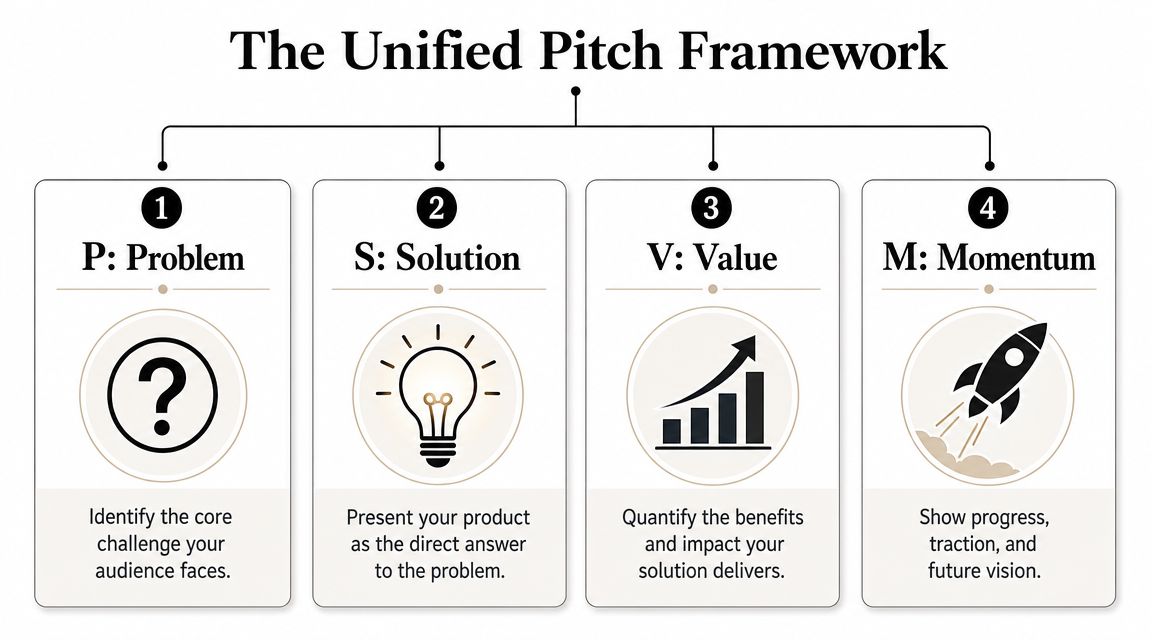
P means Problem
Start with operational pain that someone in the room already feels.
At companies like Amazon or Microsoft, weak pitches often fail here because they describe a capability before they establish the cost of the current state. “We built AI-assisted routing for support tickets” invites design feedback. “Support managers are manually triaging high-volume queues, response quality is inconsistent, and senior agents are spending time on work software should handle” invites prioritization.
Strong problem framing has three parts:
- Specificity: name one problem, owned by one team or user group
- Evidence: cite customer calls, internal funnel data, support trends, or observed workflow friction
- Urgency: explain what gets worse if the team waits one or two quarters
If the problem statement is fuzzy, every later slide becomes a debate about preference.
S means Solution
Describe the product move at decision-making altitude.
Mid-level PMs often lose executive confidence at this stage. They either stay too abstract and sound unprepared, or they go too deep and turn the pitch into a design review. The better approach is to define the mechanism clearly enough for leaders to judge risk and for engineering to judge feasibility.
Use this pattern:
- What it is: one sentence
- Who it's for: one primary user or buyer
- What changes: the before-and-after behavior
- What you are not building: the key scope boundary
That last point matters inside a company. Senior leaders fund contained bets more often than sprawling visions. If you need a sharper way to connect the feature to company goals before drafting the pitch, this product strategy framework for tying roadmap bets to business outcomes is a useful planning tool.
V means Value
Value is the business case.
Translate the product move into an outcome the audience can defend after the meeting. For an internal pitch, that usually means one of four things: revenue, retention, cost to serve, or strategic positioning. For example, Stripe product teams often frame infrastructure work in terms of merchant conversion, developer adoption, or support load, because those are metrics executives and go-to-market leaders can use in prioritization.
Keep the value case tight:
- Primary outcome: the main business result you expect
- Who benefits first: the customer, an internal team, or a revenue segment
- How you will measure it: one leading indicator and one lagging indicator
- What the upside depends on: adoption, enablement, pricing, or rollout constraints
Say “this reduces manual queue handling for support leads” only if you can connect it to faster resolution times, lower support cost, better SLA performance, or a stronger customer experience. Features do not get funded. Business outcomes do.
A pitch gets stronger when the audience can repeat your value in company language, not product language.
M means Momentum
Momentum answers the question every skeptical executive asks, even if they phrase it politely. Why should we believe this will work here?
Inside a company, momentum is rarely one big proof point. It is a stack of smaller signals. Customer demand from sales calls. Usability feedback from prototypes. Early results from a manual pilot. A clear rollout plan. A scoped engineering estimate. A credible owner in sales enablement or support ops. Tramshed Tech makes a similar point in its product pitching guide, arguing that persuasive pitches pair the promise with concrete evidence and execution readiness.
This is where senior PMs separate themselves. They do not pitch an idea in isolation. They show why the organization can absorb it and execute it now.
A practical momentum checklist:
- Proof: what evidence suggests demand or effectiveness
- Readiness: what engineering, design, data, or GTM dependencies are already lined up
- Risk control: what could fail, and how the team will contain that risk
- Next step: the smallest decision that gets the bet in motion
If your pitch covers Problem, Solution, Value, and Momentum in a disciplined way, you can use the same core structure in a staff meeting, a funding review, a customer conversation, or an external partner pitch. The wording changes. The backbone does not.
How to Tailor Your Pitch for Any Audience
Using the same pitch for every audience is one of the fastest ways to sound junior.
The structure can stay the same. The emphasis can't. A CFO, a staff engineer, a seller, and a customer are not listening for the same proof. If you don't adapt the pitch, they'll each hear a different risk and none of them will hear enough value.
One of the most useful frames here is simple: many pitches fail because the presenter uses the wrong objective function for the audience. The right question is what decision does this pitch need to facilitate? That's the core argument in this Launchnotes perspective on pitching in product management.
Pitch focus by audience
| Audience | Primary Concern (Problem) | Desired Outcome (Value) | Key Metric to Show |
|---|---|---|---|
| Internal Executives | Misalignment with company strategy or poor use of resources | Strategic fit, prioritization confidence, clear trade-offs | Business outcome metric tied to company goals |
| Investors | Unclear market opportunity or weak business case | Confidence in market size and return potential | Market or traction metric |
| Your Product Team | Unclear user pain, technical risk, delivery ambiguity | Confidence that the work is feasible and worth building | Impact metric plus implementation scope or success criteria |
| Customers | Daily pain isn't solved well enough today | Better workflow, less friction, better outcomes | Outcome metric that maps to their job to be done |
How the same feature changes by audience
Take an AI summarization feature for enterprise account teams.
For an executive team, the pitch sounds like a strategic efficiency bet. You're arguing that the feature improves account coverage, supports revenue teams, and fits the company's AI positioning.
For engineering and design, the pitch sounds different. You're not selling aspiration. You're clarifying user workflow, confidence thresholds, failure modes, and what version one should exclude.
For customers, the message gets simpler still. They don't care about model architecture. They care whether the feature helps them prep for a customer call faster and with less manual work.
If you need a cleaner way to think through who you're talking to before you build the pitch, start with a sharper target audience definition process.
What each audience wants you to prove
Don't just change your wording. Change your evidence.
- Executives want trade-off clarity: Why now, why this, why not the alternatives
- Investors want business asymmetry: Why the upside is meaningfully larger than the downside
- Teams want operational realism: What's in scope, what's risky, and what success looks like
- Customers want relevance: Does this solve a problem they feel
If your audience asks “Why are you telling me this?” halfway through, the pitch wasn't tailored tightly enough.
The Anatomy of a Winning Pitch Deck
A product pitch is a conversation first, but the deck still matters because it controls the sequence of belief. Bad decks force the audience to work too hard. Good decks make each slide answer the next obvious question.
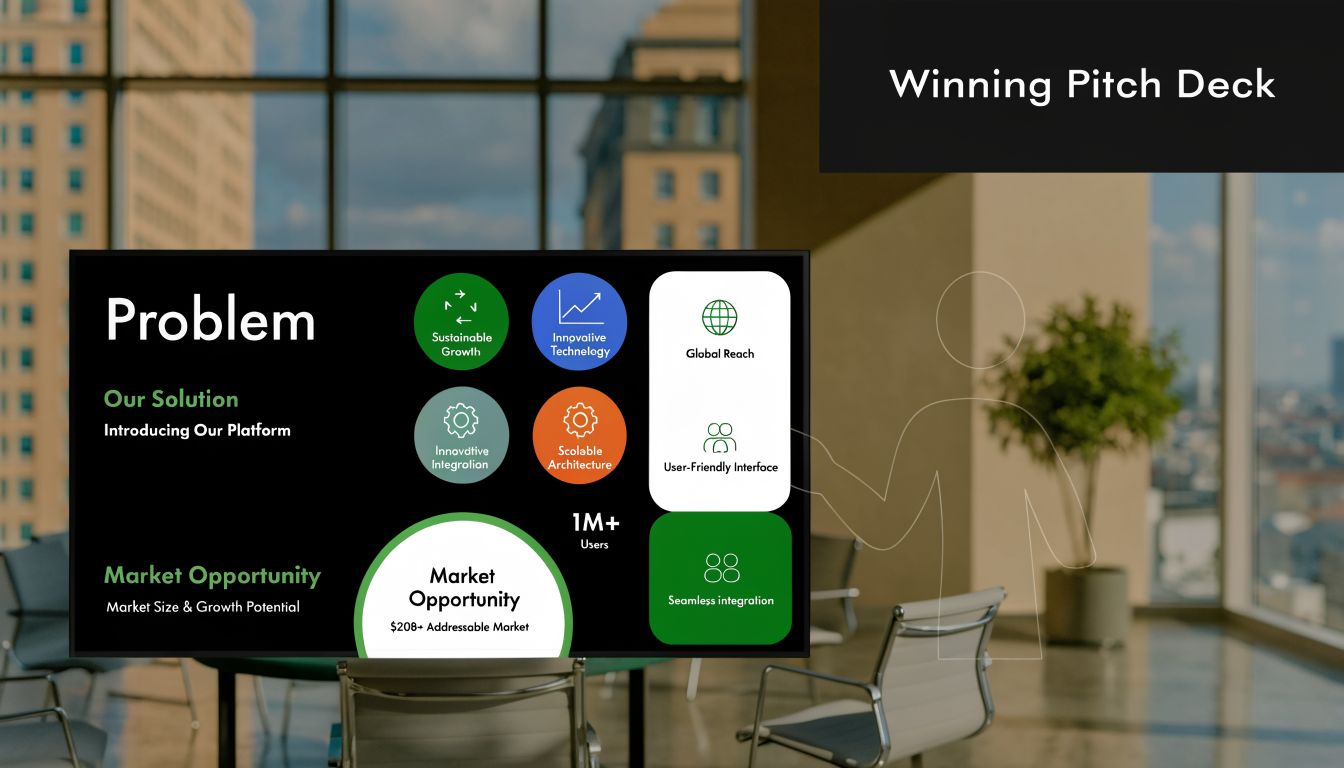
Pitch environments are brutally competitive. One source notes that more than 1,000 pitch decks are created worldwide every day, venture firms may review 500 to 1,000 decks annually, 10 to 15 slides is considered an effective length for early startup decks, decks with 11 to 20 slides were 43% more successful in raising funds, and only about 1% of pitch decks secure funding, according to this roundup of pitch deck statistics. Internal PM decks aren't fundraising decks, but the lesson transfers cleanly. Concision wins.
The slides that actually matter
Use a deck in the 10 to 12 slide range. That's enough to make the case without overwhelming the room.
One-liner
What the product move is, who it's for, and why it matters.Problem
Ground the audience in the user or business pain.Why now
Show urgency. Strategy shift, customer pressure, market opening, or internal bottleneck.Solution
Explain the product move at the right altitude.Demo or prototype Make it tangible. Skepticism often drops at this stage.
Value
State the business upside in plain language.Proof
Include traction, feedback, pilot learning, or strong evidence.Go-to-market or rollout
How this reaches users or customers.Risks and trade-offs
Senior leaders trust PMs who surface downsides without being asked.The ask
Headcount, prioritization, launch support, budget, or approval.
A strong supporting asset here is a clean executive brief. If your deck keeps getting too dense, sharpen your executive summary writing before you touch the slides.
The deck is not the pitch
The deck supports the conversation. It should never carry the full burden.
That's why I like reviewing strong pitch deck examples for scaling businesses alongside internal product narratives. The useful pattern isn't design flair. It's sequence, restraint, and clear asks.
A practical example of deck storytelling is below.
Storytelling Techniques to Make Your Pitch Unforgettable
You are in the QBR with your GM, engineering director, and sales lead. You have ten minutes. The feature is real, the customer pain is real, and the roadmap is crowded. If your story stays at the level of “here's what we built,” the room files it under interesting but deferrable.
Internal product pitches live or die on whether people can retell them after the meeting. Executives repeat the business case. Engineering repeats the problem framing. Sales repeats the customer change. If each group leaves with a different version, the pitch slips.
Put one user in the room
The fastest way to make a pitch stick is to anchor it to one specific user, in one specific moment of friction.
At Meta, Amazon, and Stripe, strong product reviews usually get concrete fast. Not abstract personas. A support lead trying to resolve a ticket across three tools. An account executive losing momentum because setup takes two days. A finance manager exporting CSVs at month end because the dashboard stops one step short.
That level of specificity does two things. It gives your audience a scene they can remember, and it prevents vague feature language from taking over the pitch.
Instead of “Our platform includes automated workflow orchestration,” say, “An operations manager is still copying status updates between systems every morning. This feature removes that handoff and cuts the failure point that creates downstream delays.”
Now the room can see the problem.
Use data at the moment skepticism shows up
Story gets attention. Evidence gets approval.
A common PM mistake is front-loading five charts before anyone cares. Another is telling a polished customer story with no proof that the problem is material. Strong pitches place evidence exactly where the audience starts asking hard questions.
In practice, that usually means one of three moments:
- Right after you describe the pain, to prove it is widespread
- Right after you show the solution, to prove it changes an outcome
- Right before the ask, to prove the investment is worth the trade-off
Keep the number tied to a decision. If the metric does not help an executive choose, fund, or sequence work, cut it.
For AI-related pitches, I often pressure-test this section with a few prompts from this guide to AI tools for product managers. It helps tighten the leap from capability to business impact, which is where internal AI pitches often fall apart.
Build tension before the reveal
A memorable pitch has controlled pacing. The room should feel the cost of the current state before you show the answer.
That does not mean theatrics. It means order.
If you demo too early, people evaluate screens before they understand stakes. If you explain architecture too early, engineering gets pulled into implementation details before leadership agrees the problem matters. The better sequence is pain, consequence, decision pressure, then resolution.
This matters even more when the feature sounds incremental. A workflow improvement, permissions update, forecasting tool, or AI assistant can sound small until you show how often the failure happens and which team pays for it.
Video can help here if the workflow is hard to picture. A short customer clip or walkthrough hosted on a LunaBloom AI video platform can make operational pain feel concrete without adding six more slides.
Three delivery moves that work in real rooms
- Name the trade-off yourself: “We can ship the lighter version in one quarter, but it will not solve the handoff problem for enterprise accounts.” Senior leaders trust PMs who surface the limit without being pushed.
- Use one comparison the audience already understands: For example, position a new approval layer as similar to code review. It gives control without blocking speed.
- Slow down on the sentence that carries the decision: The line people repeat later is usually your framing of cost, risk, or upside. Say it once, clearly, then stop.
I have seen solid pitches fail because the PM rushed past the strongest line in the deck and spent three extra minutes on mockup details nobody remembered.
A story arc that works inside companies
Internal product storytelling is different from a founder pitch. You are not selling vision alone. You are asking other teams to spend political capital, roadmap space, and operating time.
Use this sequence:
- The user moment that exposes the problem
- The business consequence if nothing changes
- Why now, not later
- The product move and what it changes
- The trade-offs, constraints, and rollout reality
- The decision required from this room
That arc works for exec reviews, engineering planning, sales enablement, and customer advisory sessions because it matches how companies make decisions. It gives people a problem they can picture, a reason to care now, and a clear ask they can act on.
Pitching in the AI Era Templates and Prompts
AI products create a special pitching problem. The capability often sounds impressive before it sounds useful.
That's dangerous. If you pitch AI as novelty, leaders will admire it and deprioritize it. If you pitch AI as a concrete improvement to a broken workflow, they can fund it.

The AI feature pitch template
Use this structure for internal AI pitches:
- Workflow problem: What people struggle with today
- AI capability: What the system can now do
- User-visible outcome: What becomes faster, easier, or more reliable
- Human control point: Where users review, edit, approve, or override
- Risk boundary: What the system won't promise
- Adoption path: How the team will introduce it safely
This keeps the conversation grounded. It also prevents the two common AI mistakes: over-explaining the model, and over-promising certainty.
A strong AI pitch says, “This capability helps account managers prepare faster by generating first-draft meeting summaries they can review before sending.” A weak one says, “We use advanced generative AI to automate customer intelligence.”
Prompts PMs can use tomorrow
Use ChatGPT, Claude, Gemini, or similar tools as drafting partners, not as strategy substitutes.
Try prompts like these:
Problem framing prompt
“Act as a VP of Product. Rewrite this feature idea as a business problem statement for an executive audience. Focus on strategic risk, wasted effort, and customer impact. Keep it under 120 words.”Audience adaptation prompt
“Take this product pitch and rewrite it for three audiences: executive leadership, engineering, and enterprise customers. Keep the core idea constant but change the proof points.”Value proposition prompt
“Generate five outcome-based value propositions for an AI scheduling assistant aimed at enterprise sales teams. Avoid technical jargon. Tie each proposition to a user workflow.”Risk slide prompt
“Draft a slide titled Risks and Mitigations for an AI-generated content feature. Include failure modes, review controls, and adoption concerns.”Narrative prompt
“Turn this PRD summary into a 10-slide pitch deck narrative using Problem, Solution, Value, and Momentum.”
If you're building a modern PM workflow around AI, this roundup of AI tools for product managers is a useful starting point. It fits well with the drafting, synthesis, and research steps that show up in pitch prep.
Artifacts matter more in hybrid teams
A live pitch is no longer enough. Internal stakeholders often review your case asynchronously before the meeting or after it.
That means your pitch should travel well in artifacts:
- One-page narrative
- Short demo clip
- Clickable prototype in Figma
- FAQ for objections
- Follow-up memo with the decision ask
For teams experimenting with richer visual explainers, resources like the LunaBloom AI video platform can help you think through how short video assets support asynchronous storytelling. The point isn't flashy media. It's reducing the amount of explanation your live meeting has to do.
In AI product pitches, confidence comes less from charisma and more from artifact quality, scoped claims, and visible controls.
Three Pitching Mistakes That Will Stall Your PM Career
The meeting starts with a VP asking one question: “Why should we fund this now?” The PM answers by opening Figma.
I've watched strong product thinkers lose momentum that way. Their idea may be solid. Their pitch signals weak judgment, weak prioritization, or weak command of the company context. Inside a company, that matters more than slide polish because the room is deciding whether to spend headcount, roadmap space, and political capital on your recommendation.
Mistake one: the feature tour
A feature tour explains what you built or want to build. A pitch explains why the company should care.
This mistake shows up all the time in internal reviews at large tech companies. A PM walks through screens, edge cases, and architecture decisions before anyone in the room has bought into the problem, the upside, or the timing. Engineering hears more scope. Sales hears more enablement work. Finance hears more cost. Leadership still does not know why this deserves priority over the other ten initiatives competing for the same quarter.
Use a simple test. If your first five minutes could fit just as easily in a sprint review, you are not pitching. You are demoing.
The fix is straightforward. Start with the decision frame:
- What changed in the business or market
- Which user problem is now expensive enough to act on
- Why this solution is the best use of resources now
- What success looks like in numbers and behavior
At companies like Amazon and Google, PMs who get funding do this well. They connect the product idea to a measurable business constraint, then show why the proposed path is the right trade-off, not just an interesting build.
Mistake two: the defensive monologue
Internal pitches fail when the PM treats questions like interruptions instead of part of the evaluation.
Executives, engineers, and sales leaders are not judging whether you can recite your deck without getting flustered. They are judging whether your reasoning holds up under pressure. If they cannot test the assumptions in the room, they will test them afterward without you. That is usually where support dies.
Good PMs leave space for challenge. Great PMs make challenge useful.
What I look for when hiring PMs
I listen for whether the PM can absorb pressure, sharpen the conversation, and keep the group aimed at a decision.
That tends to show up in behaviors like these:
- They ask before defending: “Which assumption feels weakest to you?”
- They classify the pushback: “Is the issue customer demand, implementation risk, or opportunity cost?”
- They answer at the right altitude: executive summary for leaders, operational detail for engineering, commercial impact for sales
- They change the recommendation if the facts warrant it: not to appease the room, but to improve the decision
That last one matters. PMs sometimes think confidence means holding the line. Inside a company, confidence usually means showing you can separate a good idea from your own ego.
Mistake three: the vague ask
A surprising number of PMs end a solid pitch with “Would love feedback” or “Curious what everyone thinks.”
That creates work, not momentum.
Your job is to convert discussion into a decision. If you want two engineers for a quarter, ask for two engineers for a quarter. If you want approval for a pilot with legal review and sales support, say that plainly. Name the decision-maker, the commitment, and the timing.
A clear ask usually has four parts:
- Decision: what you want approved
- Owner: who needs to approve it
- Commitment: budget, people, time, or risk tolerance required
- Timing: when the decision must be made to preserve the opportunity
This is one of the clearest differences between a PM who manages tickets and a PM who shapes direction. Leaders promote people who reduce ambiguity for the organization.
The career cost of getting this wrong is real. If your asks are consistently fuzzy, stakeholders start doing the framing for you. They narrow the scope, delay the call, or recast your idea as a low-priority experiment. You lose control of the narrative and, over time, the size of problems you are trusted to lead.
The PMs who gain influence are the ones who make the next decision easy to take.
Pitching a product is one of the clearest signals of PM maturity because it compresses several skills into one moment: judgment, prioritization, user understanding, business sense, cross-functional empathy, and executive communication. Get good at it, and you do more than win meetings. You get better scope, stronger trust, and more chances to lead work that matters.
If you want more practical PM frameworks like this, Aakash Gupta publishes resources on product strategy, growth, AI, and PM career development that are useful for both aspiring and experienced product managers.
