A sprint review is moving fast. The data scientist says the new model looks strong on the test set. Engineering wants to wire it into the feature flag system. Design asks whether edge cases are handled. Everyone seems aligned except the PM who's wondering a basic question they don't want to ask out loud: what exactly does “test set” mean, and how much should we trust it?
That moment matters more than most PMs realize. In AI products, understanding the training set and test set isn't some optional technical literacy badge. It's part of launch judgment. If you can't tell whether a model was evaluated cleanly, you can't tell whether the team has built a product or a demo.
I've seen this become a career separator. The PM who can ask, “Was this split random, time-based, or by user?” sounds very different from the PM who only asks for the headline metric. One is managing delivery. The other is de-risking product decisions.
Your AI Product Career Starts Here
A lot of PMs first encounter the training set and test set indirectly. You join an AI roadmap discussion, hear phrases like “validation loss,” “holdout,” or “generalization,” and try to reverse-engineer the conversation in real time. That can make smart product people feel behind when they aren't.
You aren't behind. You're just looking at a product decision that has been framed as a modeling detail.
The meeting where this shows up
A common pattern goes like this. The ML team says performance is good enough to launch to a limited audience. Leadership asks whether the model will hold up in production. Someone references test set performance as evidence. At that point, the PM needs to know whether that evidence is trustworthy.
If the answer is yes, you can move toward rollout with a clear experiment plan. If the answer is no, you're betting roadmap time, engineering capacity, and user trust on a weak signal.
Strong AI PMs don't need to build every model. They need to know whether the evidence for launch is real.
That's why this topic is career-relevant. It helps you do three things better:
- Challenge shaky launch readiness: Ask whether the team evaluated on data the model had never influenced.
- Translate model quality into business risk: Connect offline performance to likely production behavior.
- Lead cross-functional decisions with confidence: Engineering, data science, and leadership all trust PMs who ask the right evaluation questions.
For aspiring AI PMs, this is one of those concepts that changes how you're perceived in interviews and in role. If you're building that muscle, Aakash Gupta's writing on breaking into AI PM work is a useful companion because it focuses on how PMs build practical fluency rather than pretending they need to become researchers.
What separates strong PMs here
The strongest PMs at companies like Google, Meta, and OpenAI don't treat model evaluation as a handoff artifact. They use it to make resource and launch calls. They know a polished dashboard can still hide a flawed evaluation setup.
That is the true breakthrough. Learn the training set and test set well enough, and you stop being a spectator in AI product reviews.
Why This Isn't Just for Engineers
A familiar product review scenario goes like this: the model looks strong in the demo, the accuracy slide gets a few nods, and someone asks whether the feature is ready for rollout. The answer depends less on the headline metric than on how the team split the data before training and evaluation.
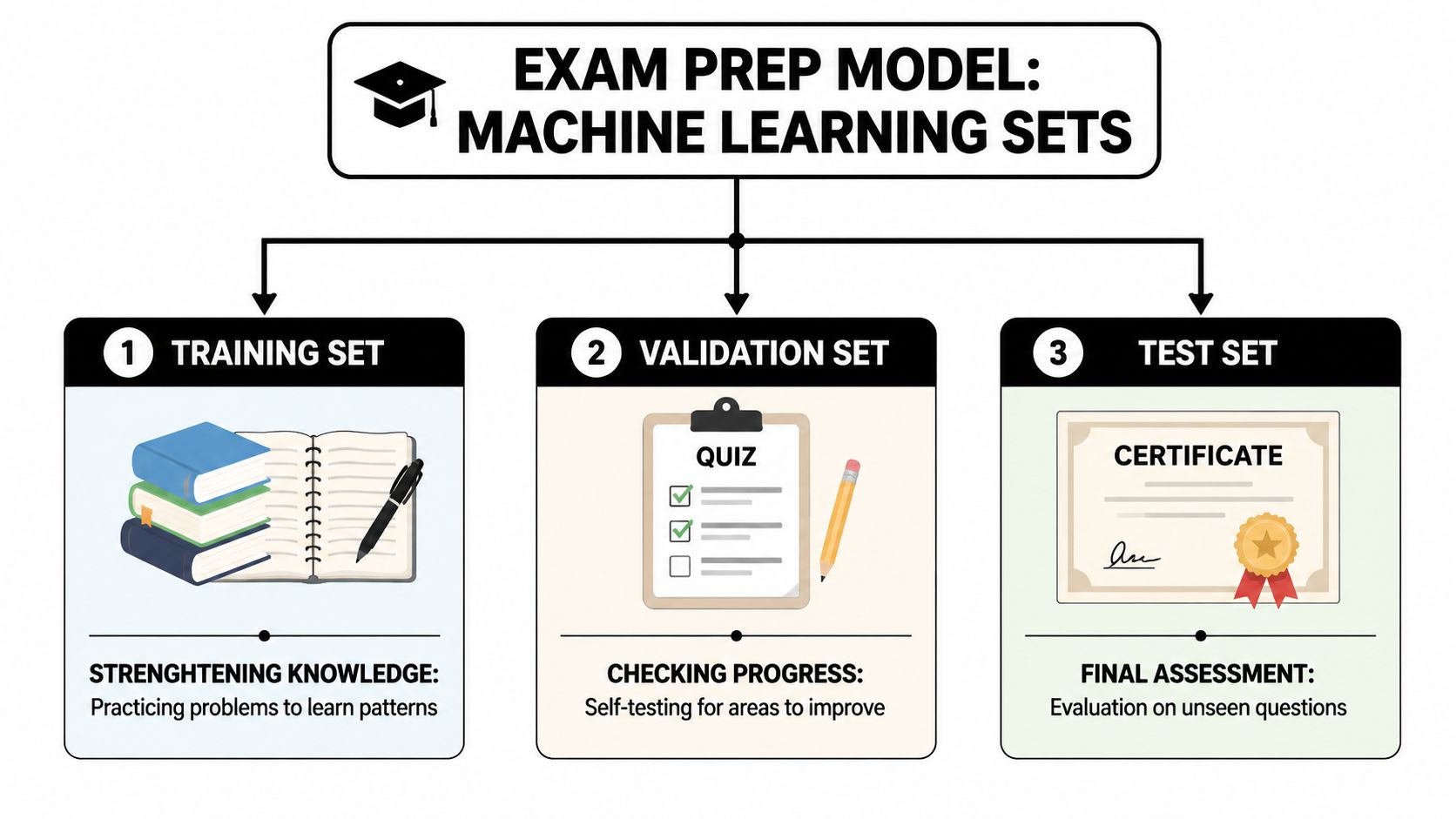
An exam analogy helps explain both the mechanics and the product risk.
The separation is simple. The consequences are not.
The training set is the material the model learns from. The validation set is what the team uses to compare model versions, tune hyperparameters, and make design choices during development. The test set is the final holdout used to check whether the selected model performs well on data it has not already influenced.
That separation matters because each dataset has a different job. If those jobs blur together, the evaluation gets less trustworthy.
A common setup uses separate training, validation, and test splits. The exact ratio changes with data volume, task complexity, and how expensive errors are in the product. Codecademy's explainer on training, validation, and test sets covers the mechanics well.
Why PMs should care
PMs do not need to tune models themselves. They do need to know whether the evidence behind a launch decision is clean.
If a team keeps checking test set performance while making model changes, they are no longer using the test set as an independent read on launch readiness. They are using it as part of development. That usually makes the model look better in review than it will look in production.
I have seen this show up in practical ways. A team reports a strong offline score, leadership gets excited, and the product ships into a narrower customer segment or noisier workflow than the dataset reflected. Then precision drops, support tickets rise, and the roadmap absorbs rework that could have been avoided with a cleaner evaluation process.
This is why data splitting is a product management topic. It helps PMs pressure-test whether a model is ready for customer exposure, limited release, or another iteration cycle.
A useful related question is who should own those evaluation and data-quality decisions across product, analytics, and ML. Aakash Gupta's article on when to hire a data product manager is a practical read if your team is still defining that boundary.
Here's a short walkthrough if you want the concept in a different format.
What works and what doesn't
What works:
- Keep the roles of each dataset separate: Train on one set, tune on another, evaluate on the final holdout.
- Agree on evaluation rules before reviewing results: That reduces post-hoc rationalization.
- Treat the test result as launch evidence: Once the team uses it to guide repeated iteration, it stops being a clean signal.
What doesn't:
- One dataset doing every job: It saves time early and creates confusion later.
- Repeated test-set peeking: Even occasional peeking can bias the result.
- PMs focusing only on the metric: The setup behind the metric determines whether it deserves trust.
A model can look accurate in a deck and still be a weak input for a product launch decision.
The PMs Framework for Data Splitting
The biggest mistake I see from otherwise capable teams is assuming the split should be random because random feels neutral. In product data, that often produces a misleading evaluation.
Research has shown that splitting strategy can materially change measured performance, and the underlying question is often not just train versus test, but what unit should define the split: time, user, account, device, or geography. That matters especially for behavioral logs, cohorts, and event streams where random splitting can leak future behavior into the past, as discussed in this paper on train-test splitting strategies.
The decision question PMs should ask
Don't ask only, “How did we split the data?”
Ask, “What real-world prediction moment are we trying to simulate?”
That reframes the discussion from data science preference to product realism. A PM working on fraud, recommendations, or churn may need three completely different split strategies because the deployment reality is different in each case.
If your product team is building stronger analytical habits across functions, this broader guide to data-driven decision making is a useful complement.
Data Splitting Strategy Decision Framework
| Strategy | When to Use It (Product Example) | Risk of Using the Wrong Strategy |
|---|---|---|
| Random split | Best when examples are close to independent, such as some document or image classification tasks | You may assume the model generalizes when the product data actually has time, user, or account dependencies |
| Stratified split | Useful when classes are imbalanced, such as moderation severity labels or fraud flags | The test set may underrepresent rare but important cases, which hides product risk |
| Time-based split | Churn prediction, demand forecasting, incident prediction, or any product that predicts future behavior | Future information can leak into training, making offline results look stronger than real deployment |
| Group split | Recommendations, account health, B2B scoring, or anything with repeated behavior from the same user or entity | The model may memorize user-specific patterns and look better than it will on new users or accounts |
How PMs should evaluate the options
A random split works when records are effectively interchangeable. If you are classifying isolated support tickets with no meaningful time dependency and no customer overlap issues, random may be fine.
A stratified split is less about sophistication and more about discipline. If one class matters more and appears less often, such as abuse reports or high-risk transactions, the team should preserve class balance across sets so evaluation isn't distorted by missing the hard cases.
Time-based splits are the default candidate whenever the product predicts forward. If the model will be used in July to predict what happens next, the evaluation should mirror that logic instead of blending June and July signals together.
Group splits become essential when repeated interactions from the same entity appear throughout the data. If the same user, merchant, or account lands in both training and test, the model can seem smarter than it is because it's recognizing a familiar actor.
Decision rule: The best split is the one that most honestly recreates the moment your product will make a prediction.
A practical script for engineering meetings
You don't need to sound like a researcher. Use questions like these:
- Prediction timing: “At the moment of prediction, would the model have access to this information?”
- Unit of split: “Should we split by event, by user, or by account?”
- Future leakage: “If we shuffled this data randomly, would we accidentally let the model learn from the future?”
- Launch geography: “Does the evaluation reflect the market we're launching into?”
That set of questions will make you more useful in an AI review than asking for one more benchmark chart.
Putting Theory into Practice in Your Product
The concept gets easier once you map it to common PM problems. Three examples come up constantly in AI roadmaps: churn prediction, recommendation systems, and deciding whether a model is ready for an online experiment.
Churn prediction
Suppose your team wants to predict which customers are likely to cancel. A random split sounds convenient, but it can create a false sense of readiness if examples from later periods influence what the model learns before evaluation.
A better product question is: can the model trained on earlier behavior predict later churn? That usually pushes the team toward a time-based split because the product itself is making a forward-looking decision.
Tiny illustrative code:
train = df[df["date"] < "2024-07-01"]
test = df[df["date"] >= "2024-07-01"]

X_train, y_train = train[features], train["churned"]
X_test, y_test = test[features], test["churned"]
For PMs, the operational takeaway is simple. If the model is meant to predict the future, the split should respect time.
Recommendation systems
Now think about a recommendation feature in a marketplace or content app. If you split by interaction only, the same user can appear in both training and test. That often flatters the model because it has already seen that user's preferences.
The PM question becomes: are we testing the model's ability to generalize, or its ability to remember familiar users? If you care about cold-start or new-user quality, a group split by user is usually more honest.
Tiny illustrative code:
from sklearn.model_selection import GroupShuffleSplit

splitter = GroupShuffleSplit(n_splits=1, test_size=0.2, random_state=42)
train_idx, test_idx = next(splitter.split(df, groups=df["user_id"]))

train = df.iloc[train_idx]
test = df.iloc[test_idx]
That's the kind of implementation detail PMs don't need to write themselves, but they should recognize when discussing launch risk.
From offline confidence to online testing
A clean test set result doesn't replace an A/B test. It gives you a credible reason to run one.
PM judgment matters here. A strong offline result can justify investment in experiment design, guardrails, and rollout sequencing. A weak or questionable offline result usually means you shouldn't spend engineering cycles pushing the model into a user-facing test yet.
Tiny illustrative code:
model.fit(X_train, y_train)
preds = model.predict(X_test)
# evaluate preds before proposing online exposure
If you're connecting model evaluation to experimentation plans, Aakash Gupta's guide to A/B testing best practices is useful for turning offline evidence into a sharper online hypothesis.
Offline evaluation answers, “Should this be considered for launch?” Online experimentation answers, “Did it improve the product in the real environment?”
That distinction helps PMs avoid two opposite mistakes. One is launching because the model demo looked impressive. The other is demanding an online experiment before the offline evidence is credible enough to justify the work.
Red Flags Every PM Should Spot
Most AI product failures don't begin with terrible models. They begin with evaluation shortcuts that nobody challenged early enough.

Red flag checklist for model reviews
Bring these questions into sprint reviews, launch reviews, and model readouts.
- Leaky split logic: Ask whether any future information could have entered training. Time leakage is common in product logs.
- Test set reuse: If someone says the team made changes after seeing test results, treat the current score as less credible.
- Mismatch with launch population: If the feature is launching globally but the test set mostly reflects one market or segment, the result may not transfer cleanly.
- No clear split rationale: “We just used the default split” is not a strong answer for behavioral or user-level data.
- Preprocessing done too broadly: If feature engineering, normalization, or cleaning used the full dataset before the split, probe further.
Representativeness matters more than most PMs think
A key statistical best practice is to ensure that training and test sets are representative of the same underlying population. One practical way to check this is by comparing feature distributions between the two sets. A model trained on one distribution may fail when deployed on data that looks different, and the test set must be kept aside until the very end of training, as summarized in Wikipedia's overview of training, validation, and test data sets.
You don't need to run the statistical test yourself to be effective. You do need to ask whether the team checked whether the train and test data resemble each other in the dimensions that matter for the launch.
What to say in the room
A PM can surface real risk with plain language:
- On geography: “Are the users in the test set representative of our launch markets?”
- On cohorts: “Did newer users end up overrepresented in one split?”
- On product changes: “Did logging, definitions, or labels change between the training period and test period?”
- On trust: “Was the test set untouched until the final evaluation?”
The fastest way to lose confidence in a model review is hearing that the team tuned decisions after looking at the final holdout.
One more practical note. Teams often over-index on a single summary metric and under-index on split integrity. As a PM, you should reverse that instinct. A modest result from a clean evaluation is more useful than a flashy result from a contaminated one.
From Model Evaluation to Product Launch
A week before launch, the dashboard says the model is performing well. Sales wants the feature in market this quarter. Engineering says the offline results are solid. The PM question is simpler and harder: is the evidence strong enough to put customer trust, support volume, and roadmap credibility behind this release?
That is where training, validation, and test sets become a product decision tool. The training set shows what patterns the model learned. The validation set supports model selection and tuning. The test set is the final independent check on whether the version you plan to ship has earned a real launch discussion.
Good PMs use that separation to reduce avoidable risk. If the team has blurred those lines, offline metrics stop being decision-grade evidence. You may still choose to run a limited experiment, but now you are doing so with open technical debt and a higher chance of wasting launch time on issues that should have been caught earlier.
What senior PMs do differently
Senior AI PMs treat test set results as an input to go or no-go decisions, not as a trophy metric. At companies that ship AI features responsibly, offline evaluation is used to decide whether the feature deserves engineering integration, policy review, experiment setup, customer-facing positioning, and rollout support.
The practical trade-off is straightforward. Waiting for perfect evidence slows learning. Launching with weak evidence creates rework, support pain, and stakeholder skepticism that can follow the team for months. Strong PMs manage that trade-off explicitly. They ask what level of offline confidence is enough for a beta, what level is enough for broad release, and what failure modes still need human review or guardrails.
A practical launch lens
Before approving the next step, ask:
- Is the final test result clean enough to support a launch decision?
- Does the evaluation match the users, workflows, and edge cases we expect at launch?
- What online metric should improve if the offline result is real?
- What is the rollout plan if performance drops in production?
Those questions change the conversation in the room. You stop acting like a project coordinator collecting updates. You start acting like the person accountable for launch quality, evidence standards, and the cost of being wrong.
For PMs building that broader release judgment, Aakash Gupta's piece on product launch strategies for PMs is a useful follow-on read because it connects technical readiness to rollout discipline.
If you want more practical PM guidance like this, explore Aakash Gupta. He publishes resources across product strategy, growth, AI PM skills, and career development for PMs who want sharper judgment and stronger execution.
