The CEO asked for a growth strategy on Monday. By Tuesday, the room was full of words like PLG, virality, flywheel, AI personalization, and expansion motion. Nobody disagreed, but nobody had made the core decision yet: where does growth come from for this product, at this stage, with this business model?
That's the question good PMs answer.
Forget the Buzzwords Let's Talk Real Growth
Most PMs hear “drive growth” and immediately jump to channels. Launch a referral loop. Improve onboarding. Add lifecycle emails. Buy traffic. Ship an AI feature. Those can all work, and all of them can fail.
The problem is that growth strategy is not a tactics list. It's a choice about which lever deserves focus now. If you're working on a mature product with weak activation, more acquisition spend just fills a leaky bucket. If you're on an enterprise platform with long sales cycles, a pure self-serve motion may look elegant in slides and break in reality. If your retention is strong but expansion is ignored, you're leaving one of the highest-quality growth paths untouched.
I've seen this play out in products that looked healthy on top-line dashboards but were structurally fragile underneath. New signups masked poor retention. Sales celebrated pipeline while product usage stayed shallow. Teams shipped growth experiments without agreeing on the bottleneck. That's how smart teams stay busy and still miss plan.
A better way to think about what are the growth strategies is to treat them like a diagnostic toolkit:
- If awareness is low, solve distribution.
- If activation is weak, solve first-value delivery.
- If retention is unstable, stop spreading effort across five channels.
- If the product is sticky, look hard at expansion and monetization.
- If the core market is saturated, then consider adjacent segments, new products, or partnerships.
Google, Meta, and other scaled product organizations don't win because they know more buzzwords. They win because teams isolate the growth constraint and match the motion to the product. That's the difference between “we need growth” and “we know which system to improve next.”
If you want a broader primer on how product teams define growth in the first place, Aakash Gupta's breakdown of what product growth means in practice is a useful companion to this decision-making lens.
Growth work gets easier when you stop asking, “What tactic should we run?” and start asking, “What constraint is holding the business back?”
That shift is career-defining for PMs. Junior PMs propose ideas. Strong mid-career PMs identify bottlenecks. Senior PMs connect the bottleneck to a business model, a roadmap, and a measurable operating plan.
The Foundational Growth Frameworks Every PM Must Know
If you can't classify the type of growth you're pursuing, you'll mix incompatible bets into one roadmap. That usually leads to diluted execution and confusing metrics.
The first framework to know is old, but it still matters because it forces clean strategic thinking.
Start with Ansoff, then translate it into product language
The Ansoff Matrix gives you four core paths: market penetration, market development, product development, and diversification. That framework still underpins most discussions of business growth, even when modern teams rename the plays as PLG, geographic expansion, ecosystem strategy, or AI-led product extension. As summarized in Terakeet's review of the framework, roughly 80% of growth comes from maximizing the value of the core business, while 20% comes from adjacencies such as new geographies and breakout businesses, citing McKinsey's view on growth allocation (Terakeet on business growth strategies).
For PMs, the translation looks like this:
| Ansoff path | PM translation | Typical product questions |
|---|---|---|
| Market penetration | Grow the core product in the current market | Can we improve activation, conversion, retention, pricing, or distribution? |
| Market development | Bring an existing product to a new segment or geography | Does the current product fit a different buyer, workflow, or region? |
| Product development | Build new capabilities for existing customers | What adjacent use case can deepen adoption or expand account value? |
| Diversification | Enter a new market with a new offer | Are we solving a different problem, with different economics and risks? |
At Google, a market penetration mindset often means improving existing surfaces, distribution, and user habits before inventing a totally new business. At Meta, it can mean increasing engagement depth inside existing products before chasing a separate adjacency. At Microsoft, product development often shows up as adding workflows that make an existing suite more valuable to the same customer base.
That's why PMs should treat growth as a portfolio of bets, not one monolithic project.
Use AARRR to find where the journey breaks
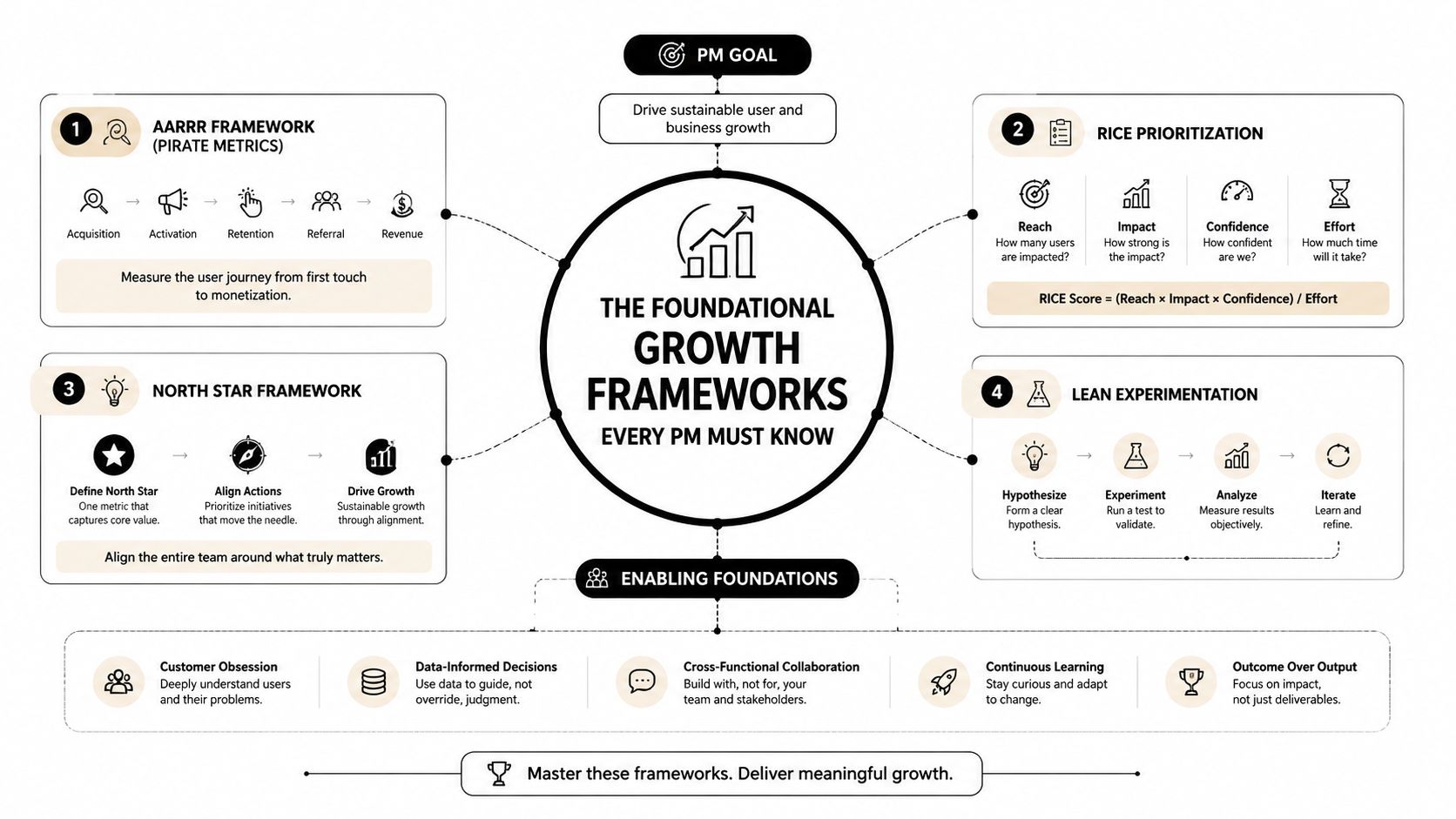
Once you know the strategic path, you need an operating model. The most practical one for PMs is still AARRR:
- Acquisition means people discover and reach the product.
- Activation means they hit first value.
- Retention means they keep coming back.
- Referral means existing users bring in more users.
- Revenue means the business captures value.
This framework is useful because it prevents a common PM mistake. Teams often report “growth” using acquisition metrics while retention is deteriorating. AARRR forces you to trace the full user journey.
Here's the practical way to use it:
- Pick one business outcome
Revenue, active usage, expansion, or retention. Don't start with ten. - Map the funnel to that outcome
Identify which AARRR stage has the biggest drop or weakest instrumentation. - Define one primary metric and two guardrails
Example: improve activation rate, while monitoring retention quality and support burden. - Align ownership
Product, design, data, engineering, marketing, and sales need named owners, not vague participation.
Practical rule: If your team can't say which AARRR stage is the current bottleneck, you're not running growth. You're running activity.
Add a portfolio lens before you commit roadmap time
The next leap from competent PM to senior PM is recognizing that not all growth bets belong in the same queue.
Use three buckets:
- Core optimization
Onboarding, checkout, pricing, lifecycle, performance, and in-product prompts. - Adjacent expansion
New personas, new geographies, partner channels, new packaging. - New value creation
Major feature lines, new jobs-to-be-done, or entirely new products.
Each bucket has a distinct risk profile and stakeholder set. A checkout improvement might need only one team and a straightforward experiment design. Conversely, expanding into a new customer segment may require sales enablement, support coverage, and pricing changes.
If you want a more detailed operating view for how PMs structure these systems, Aakash Gupta's framework for growth is a useful reference.
What junior PMs miss and senior PMs don't
Junior PMs often ask, “Which growth strategy is best?” That's the wrong question.
The right questions are:
- What stage is the product in?
- Where is the current constraint?
- Which strategic path fits our capabilities?
- What evidence says this is a core bet versus an adjacency?
- What would have to be true for this to work?
Those questions make growth less glamorous and much more effective.
Product-Led vs Sales-Led Deciding Your Go-To-Market
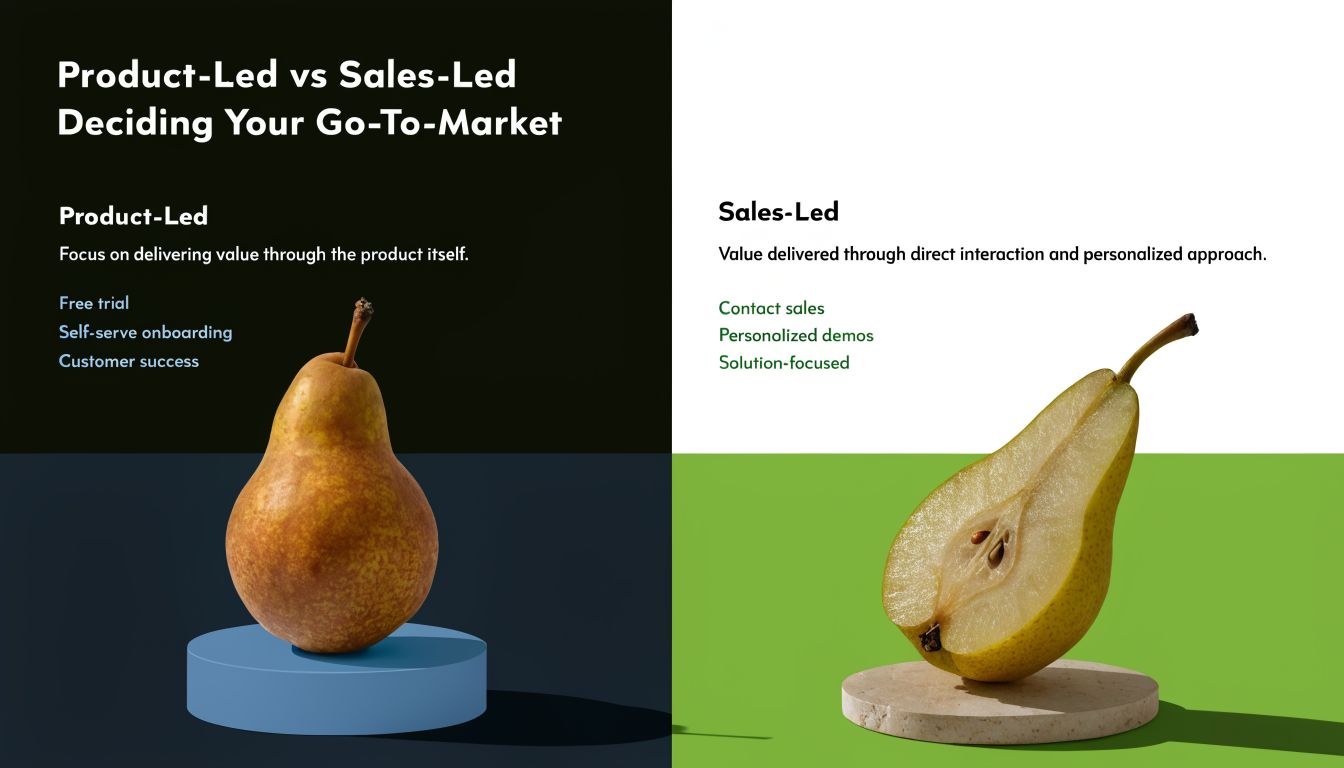
Some growth debates sound philosophical but are really operational. Product-led versus sales-led is one of them.
A self-serve motion looks attractive because PMs can measure it cleanly. A sales-led motion looks slower, but it may be the only realistic path if the product is expensive, complex, or tied to procurement and security reviews. The mistake is treating one as modern and the other as outdated.
When product-led fits
Slack, Figma, Notion, Dropbox, and Calendly made product-led growth feel obvious because the user could understand value quickly. Individual users could adopt the product without asking for executive approval first. The workflow spread across teams naturally.
PLG tends to fit when these conditions are true:
- Fast time to value
A user can experience meaningful utility within one session or a short setup flow. - Low initial complexity
The first use case doesn't require services, integrations, or training to be credible. - Bottom-up adoption
The user and the buyer are close enough that product usage can influence purchase. - Simple packaging
The pricing model is understandable without a rep walking every buyer through it. - Observable collaboration
Product usage creates natural invites, sharing, or workspace expansion.
If you're building a developer tool, collaboration suite, creator platform, or lightweight AI utility, PLG may be your natural starting motion.
When sales-led is the correct answer
Now compare that with Salesforce, Palantir, ServiceNow, or many security and infrastructure products. These products often require stakeholder alignment, budget approval, legal review, implementation planning, and cross-functional adoption. In those cases, a pure self-serve path can generate curiosity without conversion.
A sales-led motion tends to fit when:
| Signal | Product-led bias | Sales-led bias |
|---|---|---|
| User value discovery | Immediate | Requires tailored demo or solutioning |
| Buyer complexity | Single user or small team | Multiple stakeholders |
| Implementation effort | Light | Heavy |
| Contract size | Modest and standardized | Negotiated and strategic |
| Security and compliance needs | Minimal at entry | Material at entry |
| Product configuration | Mostly default | High customization |
This doesn't mean PMs on sales-led products do less growth work. It means the growth surface is different. You'll spend more time on evaluation friction, trial-to-pilot conversion, proof-of-value design, admin setup, and land-and-expand paths after the initial deal.
A bad GTM choice creates fake signal. A product may get signups but no revenue, or revenue but no durable usage.
Hybrid is common, but only if you earn it
Many companies want both. That can work, but hybrid motions only work when the boundaries are explicit.
A clean hybrid model might look like this:
- PLG for discovery and early usage
- Sales assist for larger teams
- Customer success for expansion
- Product instrumentation across all stages
That's what many modern B2B SaaS companies aim for. Users start free or low-friction. Teams adopt. Admins notice usage. Sales engages when account complexity or deal size justifies it.
The PM implication is straightforward. You need different product surfaces for different motions:
- self-serve onboarding for individual users
- workspace controls for team admins
- analytics and governance for buyers
- expansion hooks for account growth
If you're building in this space, Aakash Gupta's write-up on product-led growth is useful for understanding where product ownership ends and GTM design begins.
A simple decision test
Ask these five questions in your next roadmap review:
- Can a new user reach first value without human help?
- Does product usage naturally create more product usage?
- Is the buyer likely to trust self-serve purchase at the current price and risk level?
- Can support and onboarding scale without adding services headcount too early?
- Does expansion happen through in-product adoption or through account planning?
If most answers point left, push harder on PLG. If most point right, design for sales-led growth and stop pretending a freemium layer will fix an enterprise motion.
The Modern Growth Playbook Tactics and Channels
Once the strategic path and GTM motion are clear, PMs need tactics that match them. Teams usually get distracted at this stage. They choose tactics because another company used them, not because the product has earned them.
The better approach is to keep a short list of growth plays and know exactly when each one deserves priority.
Inbound and search-led demand
This play works when buyers actively search for the problem, compare solutions, and can self-educate before talking to anyone. HubSpot built a durable machine here. So did many developer and B2B software companies that turned product education into distribution.
A PM's one-pager for inbound looks like this:
- When to use it
Strong category intent, searchable use cases, and content that can teach before selling. - Key metrics
Qualified visits, sign-up intent, activation from content-acquired users, and conversion by topic cluster. - What usually fails
Publishing generic AI-written articles with no real product insight or customer specificity.
The PM job isn't to write every article. It's to make sure content maps to real user questions, onboarding friction, and product differentiation. The best content programs are tightly linked to activation, not vanity traffic.
Viral loops and collaborative spread
Viral growth is powerful when the product itself creates user-to-user exposure. Figma files, Dropbox sharing, Loom links, and Calendly invites all made product usage visible to the next potential user.
Use this play when:
- the product has shareable artifacts
- the receiver gets value before becoming a full customer
- invites are part of the core workflow, not bolted-on gimmicks
PMs often force referrals where no real loop exists. A discount code isn't a growth loop if users don't already have a natural reason to bring others in.
Products spread best when sharing completes the user's job, not when marketing asks for a favor.
If referrals are a likely channel for your product, this guide on whether to invest in referrals as a growth channel is a useful decision aid.
Paid acquisition
Paid channels can accelerate growth. They can also hide weak economics and weak product-market fit.
Paid tends to make sense when the funnel is already instrumented, the conversion path is reasonably stable, and the team knows which audience converts into durable value. Meta and Google both offer enormous reach, but buying reach isn't the same as buying retention.
A strong paid motion requires product partnership on:
- landing page clarity
- signup friction
- activation speed
- event tracking quality
- audience feedback loops into positioning and packaging
What doesn't work is scaling spend before the onboarding path is healthy. PMs should be skeptical of any paid plan that assumes the product will “catch up later.”
Retention-led growth and expansion revenue
This is the most overlooked lever in many software businesses, especially teams obsessed with top-of-funnel dashboards. West Monroe notes that for software and subscription companies, expansion revenue from existing customers is often one of the most evidence-based growth strategies, and that it can offset churn and even produce net negative churn. The same source cites the Rule of 40, where combined growth rate plus profit margin should be at least 40%, as a health check for scaling companies (West Monroe on data-driven growth strategies).
That should change how PMs prioritize.
If you're on a subscription product, ask:
- Are retained customers adopting deeper workflows?
- Is packaging designed for upsell and cross-sell?
- Do we know which behaviors predict expansion?
- Are reactivation paths treated as a product problem or dumped onto marketing?
The highest-quality growth often comes from existing customers getting more value, not just from acquiring more logos.
Strategic partnerships
Partnerships are underrated because they sit between product, business development, marketing, and sales. But when they work, they compress distribution and credibility at the same time.
Good partnerships usually have one of three structures:
- Embedded distribution
Your product appears inside an existing workflow or ecosystem. - Bundled value
The combined offer solves a customer problem neither product solves alone. - Credibility transfer
The partner reduces trust friction for a segment you want to enter.
Bad partnerships are press-release partnerships. They create noise and no operating model.
A practical priority order
For most PMs, the order should be:
| Stage | Most likely focus |
|---|---|
| Early product | Activation and retention |
| Early traction | One repeatable acquisition channel |
| Growing SaaS | Expansion and monetization |
| Mature core | Adjacent segments, partnerships, new product bets |
That order prevents the common trap of trying to look advanced before the basics are working.
AI-Powered Growth The New Frontier for PMs
AI is no longer just a productivity layer for marketing teams. It's becoming a growth layer inside the product itself.
That distinction matters. If you only use AI to draft ad copy or summarize interview notes, you'll get efficiency. If you use AI to improve targeting, personalization, conversion, retention, or product utility, you can create new growth loops.

AI should change the product, not just the campaign
Netflix made personalization a product experience, not a marketing afterthought. Meta's recommendation systems changed what users saw and how often they returned. Google has long used intent and relevance systems to improve discovery quality across products.
As a PM, that's the right mental model. The interesting question isn't “How can we use AI on the growth team?” It's “Where can AI improve the user's path to value so meaningfully that growth follows?”
Good answers usually fall into four buckets:
- Personalization
Tailor the content, workflow, next action, or recommendation based on user context. - Prediction
Identify churn risk, upgrade readiness, support risk, or lifecycle drop-off before it happens. - Generation
Help users create something valuable faster, which improves activation and retention. - Optimization
Improve pricing, messaging, routing, or lifecycle timing based on observed behavior.
Where AI PMs should look first
The most effective AI growth opportunities are often hiding in boring parts of the product.
Onboarding and first value
If users struggle to configure the product, AI can shorten setup, recommend templates, summarize inputs, or generate the first useful output. This is especially powerful in horizontal products where blank-page syndrome kills activation.
Think about how Notion AI changed the first-session experience for many users. It didn't just add a feature. It reduced the effort required to produce something useful.
Retention and churn prevention
Most churn doesn't happen as a surprise. The signals are usually there in behavior, support interactions, or declining usage depth.
An AI-informed PM team can flag at-risk accounts, trigger customized interventions, and route the right save action. That could be an in-product prompt, a success touch, a setup recommendation, or a packaging nudge. The point is not fancy modeling for its own sake. The point is intervening while the customer still has a path back to value.
The best AI growth work starts with a customer problem that already exists. AI just makes the response faster, more relevant, or more scalable.
Expansion and monetization
AI can also create entirely new reasons to pay. Copilot-style features at Microsoft and generative workflows across design, coding, analytics, and support products show how AI can become a monetized product layer.
For PMs, the monetization questions are direct:
- Does the AI feature save meaningful time?
- Does it improve output quality enough to justify packaging?
- Does it deepen workflow lock-in?
- Can users understand and trust the output?
If yes, AI may be both a retention driver and an expansion path.
The trap to avoid
The trap is adding AI because the market expects it. That creates demos, not growth.
Weak AI growth bets usually have one or more of these problems:
| Weak bet | Why it fails |
|---|---|
| Generic chatbot bolted into the app | No clear user job, low repeat use |
| AI copy generator with no workflow fit | Novelty without durable retention |
| Personalization with poor data quality | Irrelevant recommendations erode trust |
| Predictive model with no intervention path | Insight exists, but the product can't act on it |
Strong AI PMs focus on instrumentation, feedback loops, and trust. They define the user decision being improved, the data needed, the product surface where intervention happens, and the business metric that should move.
For teams building AI fluency into product workflows, Aakash Gupta's AI tools guide for product managers is one practical resource among several for understanding the current tooling market.
What this means for your career
Growth PMs who understand AI as a business lever will stand out. Not because “AI PM” is a flashy title, but because companies need people who can connect model capability to product value and commercial outcomes.
That's a senior skill set. It combines product judgment, analytics, experimentation, and enough technical literacy to avoid shipping theater.
Measuring What Matters Growth Metrics and Sizing
A growth strategy that isn't tied to numbers is just storytelling. McKinsey reports that only 25% of companies grow sustainably over time, which is exactly why disciplined KPI selection matters so much in growth work (McKinsey on growth outperformance).
PMs need two things here: a good North Star Metric and a credible way to size opportunities before they consume roadmap capacity.
Pick an NSM that reflects delivered value
A North Star Metric should capture the core value the user receives, not just the business result you want. Revenue matters, but it's often a lagging signal. Signups matter, but they're easy to inflate. The strongest NSMs connect user success to business health.
Here's a simple reference table:
| Business Model | Example Company | Example North Star Metric (NSM) |
|---|---|---|
| Music streaming | Spotify | Time spent listening |
| Marketplace | Airbnb | Nights booked |
| Team collaboration | Slack | Teams with sustained collaborative usage |
| Design software | Figma | Active collaboration in files |
| SaaS subscription | HubSpot | Accounts reaching repeated workflow value |
Notice the pattern. Good NSMs measure ongoing value creation, not one-time events.
Pair the NSM with counter-metrics
An NSM without guardrails can create bad behavior. If you optimize time spent, you may hurt experience quality. If you optimize signups, you may flood the product with low-intent users. If you optimize trial conversion, you may pressure users before they're ready.
Use two or three counter-metrics such as:
- Retention quality
- Customer acquisition cost
- Support burden
- Conversion quality
- Churn or downgrade rate
This is one of the easiest ways to sound more senior in a growth review. Don't just say what metric should move. Say what you refuse to break while moving it.
Operating principle: Every growth metric needs a quality check. Otherwise teams can hit target and still damage the business.
A back-of-the-envelope sizing model
You don't need a finance team to size a growth idea well enough for prioritization. Use this four-part model:
- Define the affected population
Which users, accounts, or sessions does this initiative touch? - Estimate behavior change
What step should improve? Activation, conversion, retention, expansion? - Connect it to business output
How does that step influence revenue, usage, or account growth? - Apply confidence and effort
High-impact, low-confidence ideas should not automatically outrank medium-impact, high-confidence wins.
A practical example:
- If onboarding friction affects new workspace creation
- and you believe setup clarity will improve activation among that group
- and activation historically correlates with stronger retention or monetization
- then you can frame the project as a measurable business bet, not just a UX improvement
What strong PMs do differently
Weak sizing says, “This could be huge.”
Strong sizing says:
- which user segment is affected
- which metric should move
- what assumptions are carrying the estimate
- what would invalidate the thesis quickly
That's the difference between a wishlist and a growth plan.
Your First 90 Days on a Growth Team
A new growth PM shouldn't start by promising a breakthrough. Start by learning where the business leaks value, where the team lacks instrumentation, and which growth story is unsupported by evidence.
Days 1 through 14
First, get fluent in the current funnel and revenue model. Read the dashboards, but don't stop there. Sit with data, design, engineering, lifecycle marketing, sales, and customer success. Each group sees a different failure mode.
Then talk to users. Not abstract personas. Real users who activated, churned, upgraded, stalled, or never got started.
Your checklist:
- Map the funnel from acquisition to retention and expansion
- Audit event tracking so you know which metrics are trustworthy
- Review onboarding as a new user on desktop and mobile
- Read support tickets and win-loss notes for repeated friction themes
Days 15 through 45
Identify likely bottlenecks and build a focused opportunity list here. Don't bring ten ideas to the team. Bring three, each with rationale, user evidence, and expected business effect.
One of those ideas should test for overlooked segments. Invoke Media defines an underserved market segment as a group whose needs aren't fully met by existing products, and aligning product, messaging, and metrics to that niche can achieve growth that broad-market playbooks miss (Invoke Media on underserved market segments).
That often matters more than one more generic acquisition campaign.
Days 46 through 90
Ship something small enough to learn from and important enough to matter. Good early bets usually live in onboarding, retention surfaces, account expansion prompts, or a narrowly scoped audience segment.
Use a simple operating cadence:
- Week 7
Lock the hypothesis, owner, metric, and guardrails. - Week 8 to 10
Launch, monitor, and review qualitative feedback with the numbers. - Week 11 to 12
Present what changed, what didn't, and what the team should do next.
Your first win on a growth team is credibility. Show that you can diagnose, prioritize, and learn quickly.
If you do that, you'll earn the right to lead bigger bets. That's how PMs grow into growth leaders.
If you want more practical PM systems on growth, AI, career progression, and product leadership, explore Aakash Gupta. He publishes resources for product managers across levels, including growth frameworks, newsletters, podcasts, and coaching-oriented content.
