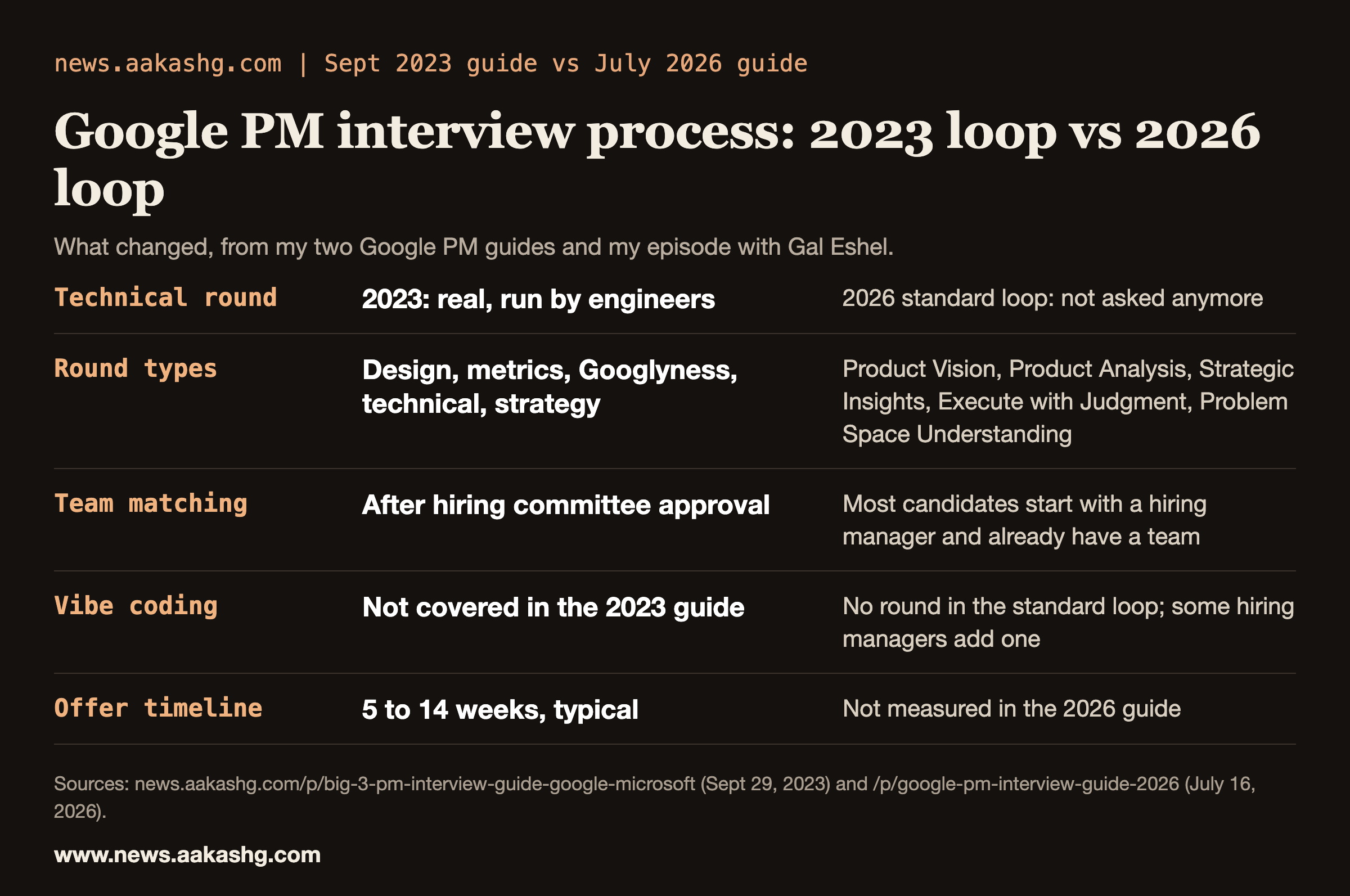
The Google PM interview process looks different in 2026 than it did when I last documented it in 2023. This page puts the two loops side by side. The 2023 version comes from my Big 3 PM interview guide, and the 2026 version comes from my Google PM guide for 2026, which draws on six people who had been through or run the process, Gal Eshel among them.
The short answer
Gal Eshel, a former Google PM, lists five round types in the 2026 loop based on his coaching data: Product Vision, Product Analysis, Strategic Insights, Execute with Judgment and Problem Space Understanding. The dedicated technical round that I faced in 2017 is gone, and many candidates now start with a hiring manager interview, so the team decision happens earlier than it used to.
The 2023 loop
For the Big 3 guide in September 2023 I talked to 4 people who recently got offers and 2 current hiring managers. The picture then was seven rounds of interviews across 3 to 5 stages:
- A recruiter screen, where Google always probes why you want to work there.
- A screen with a PM interviewer who walks you through a product execution, sense or design case.
- For APMs only, a 2 hour written homework assignment.
- Sometimes a second screen.
- An on-site of 4 to 5 interviews of 45 minutes each.
The on-site then included product design, metrics, Googlyness and leadership, a technical interview run by engineers, and most often a product strategy round. After that the hiring committee reviewed the packet, and approved candidates were matched to specific roles and projects. I wrote that the interview side took 4 to 6 weeks, and a typical person spent 5 to 14 weeks end to end. The 0.2% application-to-offer rate in that guide was an estimate from industry chatter and Glassdoor, so treat it as a rough number.
What changed by 2026
For my July 2026 guide I talked to 6 people: one candidate who had just finished the process, one still in it, 2 current hiring managers and 2 former ones. One of the six was Gal Eshel, who spent six years as a PM at Google and sat on hiring committees. Google’s own prep materials may list the rounds differently from Gal’s list, so confirm against what your recruiter sends.
Three things stood out.
The technical round is gone from the standard loop
In 2017 my own loop included a technical round: “How would you improve page load of Google Search?” That is not asked anymore. I also asked Google AI’s director of product, Satyajeet Salgar, about vibe coding rounds. His answer was that there are now two ways into Google PM. One is the standardized process, which has no vibe coding round and is followed by team matching. The other is a specialized process where the hiring manager controls the rounds, and some hiring managers in his org have used them for vibe coding.
So the claim “Google asks vibe coding questions” and the claim “Google does not” are both true, depending on which door you came through.
Hiring managers now come first
Gal told me that until two or three years ago you interviewed as a generalist and only then went through team matching. Now the vast majority of candidates start with a hiring manager interview. That means you are already assigned to a team, and you will not necessarily have the team matching process. The catch is that you are expected to know the area. If the team is an AI team, you are expected to have AI knowledge.
The round types have new names
Gal listed five types in the loop, based on his coaching data: Product Vision (what used to be called product sense), Product Analysis, Strategic Insights, Execute with Judgment, and Problem Space Understanding, which Gal has the least data about. Gal gave a standard estimation example, how many messages per second Gmail receives, as a Product Analysis question. He also said there is no dedicated technical interview anymore, although technical knowledge is still expected, especially in Execute with Judgment. Labels also do not guarantee content, because Googlers are not tied to a question bank.
For Strategic Insights, you are meant to think like a CEO or an SVP, and the most common pitfall he named is starting at that altitude and then drifting into tactical L5 details after a few minutes. See the Google PM guide for 2026 for the full rundown.
How to prepare for the five round types
Preparation for the Product Vision round is the same product sense skill I teach in the product sense interview guide and on my product sense interview questions page. For the behavioral side, Googlyness decides a lot of offers, and I cover it on my Googleyness interview questions page. Gal’s advice on that round was to prepare 8 to 12 real stories and never invent one.
Two habits from my coaching apply to all five rounds. First, ask where the role sits before you prepare, since a hiring manager round expects domain knowledge on day one. Second, rehearse your introduction, because every loop opens with it. I run this prep with people through Land a PM Job.
If you are earlier in your career, my page on the Google APM program covers that route, and the Google product manager page covers the role itself.
Frequently asked questions
How many rounds is the Google PM interview process?
In my September 2023 guide it was seven interviews across 3 to 5 stages. Gal lists five round types for the 2026 loop, and the exact number of interviews depends on the role and on whether you came through a hiring manager first.
Is there still a technical round in the Google PM interview?
Not in the standard loop. In my July 2026 guide, a Google AI director of product said the standardized process has no vibe coding round, while hiring managers who control a specialized process have used one.
How long does the Google PM interview process take?
I measured 5 to 14 weeks for a typical person in 2023, including 4 to 6 weeks of interviews. I did not re-measure that in 2026, so confirm it with your recruiter.
Do I still go through team matching at Google?
Often not. Gal Eshel said the vast majority of candidates now start with a hiring manager interview, which means a team is already assigned.
What are the Google PM interview round types in 2026?
Product Vision, Product Analysis, Strategic Insights, Execute with Judgment and Problem Space Understanding, per Gal Eshel’s coaching data.
Want the paid deep dives on each round? Subscribe to the newsletter.
