If you use podcasts for learning like background noise, you get inspiration. If you use them like a PM operating system, you advance your career.
That distinction matters more now because podcast listening has scaled into a mainstream learning behavior. In 2019, 20 million consumers listened to a podcast for the first time and another 14 million identified as weekly listeners, according to the FlexMR summary of The Infinite Dial report on podcast trends at FlexMR’s market research podcast overview. For product managers, that means your peers are already learning on the move. The edge no longer comes from listening. It comes from converting episodes into better decisions, sharper product sense, and stronger interview stories.
The most useful podcasts for learning do one of three jobs. They sharpen product judgment. They widen your strategic range. Or they upgrade the way you think. The mistake I see most often is that PMs subscribe broadly and process nothing. They finish episodes with a vague sense that they learned something, then carry none of it into a roadmap review, customer interview, experiment design, or hiring loop.
The fix is simple. Build a podcast flywheel.
Capture one idea. Synthesize it into a note. Apply it in a real artifact such as a PRD, strategy memo, experiment brief, or stakeholder update. Share the result with your team or network. That loop turns passive listening into visible professional growth.
That is how top PMs use podcasts for learning. Not as entertainment, but as low-friction apprenticeship.
The list below is built for that outcome. It mixes tactical PM content, strategic business thinking, and cognitive tools that matter if you want to move into senior product roles or become an AI PM. Start with the featured pick if you want immediate job-search and execution value. Add the others based on the gap you need to close next.
1. Aakash Gupta's Newsletter & Podcast

Aakash Gupta is the one I’d put at the top for PM career acceleration because the content is built around the actual constraints product managers face. Interviews, hiring advice, growth thinking, communication patterns, and role-specific tactics show up in a way you can use immediately.
Most podcasts for learning help you think better in general. This one helps you operate better as a PM.
Why it works for PMs
Aakash’s material sits in the sweet spot between operator detail and career strategy. That matters if you are trying to break into PM, move from PM to Senior PM, or reposition yourself toward AI product roles.
The useful trade-off is this. You get highly practical content tied to product work, but you need to actively extract the lesson. Don’t binge this one casually. Treat each episode like a working session.
A good way to use it is to map episodes to one of four lanes:
- Job search: Resume framing, interview stories, hiring manager expectations
- Execution: PRDs, prioritization, stakeholder management, experimentation
- Strategy: Market selection, growth loops, defensibility, product vision
- AI PM: How new workflows, copilots, and model capabilities change product bets
If you want to see the level of detail in his long-form conversations, browse this Mahesh Yadav podcast transcript.
Best use case
This is the strongest option on the list when your question is, “What should I do this week to improve as a PM?”
I’d especially recommend it for:
- Aspiring PMs: You need language for interviews and better examples for projects
- Mid-level PMs: You need sharper judgment on growth, influence, and execution
- Senior PMs: You need external calibration from operators who have seen scale
The practical downside is that operator-heavy podcasts can create false confidence. Listening to a strong episode on pricing, activation, or AI strategy is not the same as practicing it. Pair every episode with one output.
After each listen, write one sentence that starts with: “In my product, this changes…” If you cannot finish that sentence, you consumed content but did not learn it.
What works and what does not
What works:
- Tight connection to PM work
- Useful for both career moves and day-to-day execution
- Strong fit for AI PMs who need current thinking, not theory alone
What does not:
- Passive listening during multitasking
- Treating interviews as entertainment
- Subscribing without a capture system
If you only add one show to your stack of podcasts for learning, start here.
2. Lenny's Podcast
Lenny’s Podcast is for PMs who want tactical depth from leaders who have built inside companies like Airbnb, Slack, and Netflix. The interviews often stay close to the work: roadmaps, growth, org design, hiring, and product craft.
That makes it one of the better choices when you want pattern recognition, not motivation.
Where it beats other product podcasts
The strongest episodes usually have a usable artifact inside them. A decision framework. A hiring rubric. A metrics lens. A way to structure onboarding or prioritization.
That’s the key trade-off. The content can be dense, but density is an advantage if you are willing to pause and take notes. I would not queue this up for background listening at the gym. I would use it before a planning cycle, before interviewing for a new role, or when rebuilding a weak product process on your team.
A strong companion move is to pair it with a more structured PM curriculum. If you need that, this roundup of best product management courses is a useful next step.
Best listening protocol
Use Lenny’s Podcast when you need operating examples from teams that have already solved a problem you are facing.
A simple protocol:
- Before listening: Define the problem. Example: “Our roadmap reviews are too feature-heavy.”
- During listening: Capture only frameworks and decisions, not interesting anecdotes.
- After listening: Rewrite one takeaway into your own team language.
The common failure mode is collecting frameworks you never deploy. PMs love templates. Teams only benefit when a template survives contact with your own product constraints.
If an episode gives you five ideas, pick one. Implementation beats accumulation.
Lenny’s Podcast earns its place among the best podcasts for learning because it helps PMs borrow battle-tested thinking. Just make sure you translate that thinking into your own context instead of copying prestige-company playbooks blindly.
3. Masters of Scale
Masters of Scale is what I recommend when a PM has become too feature-focused and needs to think like a business builder again.
Reid Hoffman’s format pushes toward one big growth thesis per episode. That structure is useful because it trains you to connect product decisions to company scale, not just local optimization.
Why PMs should care
At top tech firms, product managers who grow fastest usually understand more than user stories and sprint rituals. They understand market timing, distribution, incentives, network effects, and how leadership teams make expansion bets.
Masters of Scale helps with that layer.
It is less tactical than a pure PM show. That is also its advantage. When you listen well, you start asking better questions:
- What growth assumption is our roadmap really making?
- Where is our bottleneck. Product, distribution, trust, or pricing?
- Which part of our strategy breaks if adoption arrives faster than expected?
That is the kind of thinking senior PMs and product leaders get rewarded for.
Best use case
Use this podcast when you are working on:
- New market entry
- Growth loops
- Platform strategy
- Organizational scaling
- AI product bets that require business model shifts
The weak use case is immediate execution. If you need to write a better PRD tomorrow, choose a more tactical show. If you need to improve your strategic range, this one delivers.
A practical pairing is to reinforce each episode with reading from strong PM and business titles. This list of best books for product managers fits that purpose.
One caution. Founder stories can distort your judgment if you consume them uncritically. Survivorship bias is real. Treat each episode as a strategic hypothesis generator, not a universal playbook.
For PMs building in AI, that matters even more. The loudest growth narratives are often the least transferable. Masters of Scale is strongest when you use it to sharpen your questions, not to import someone else’s strategy whole.
4. The Knowledge Project
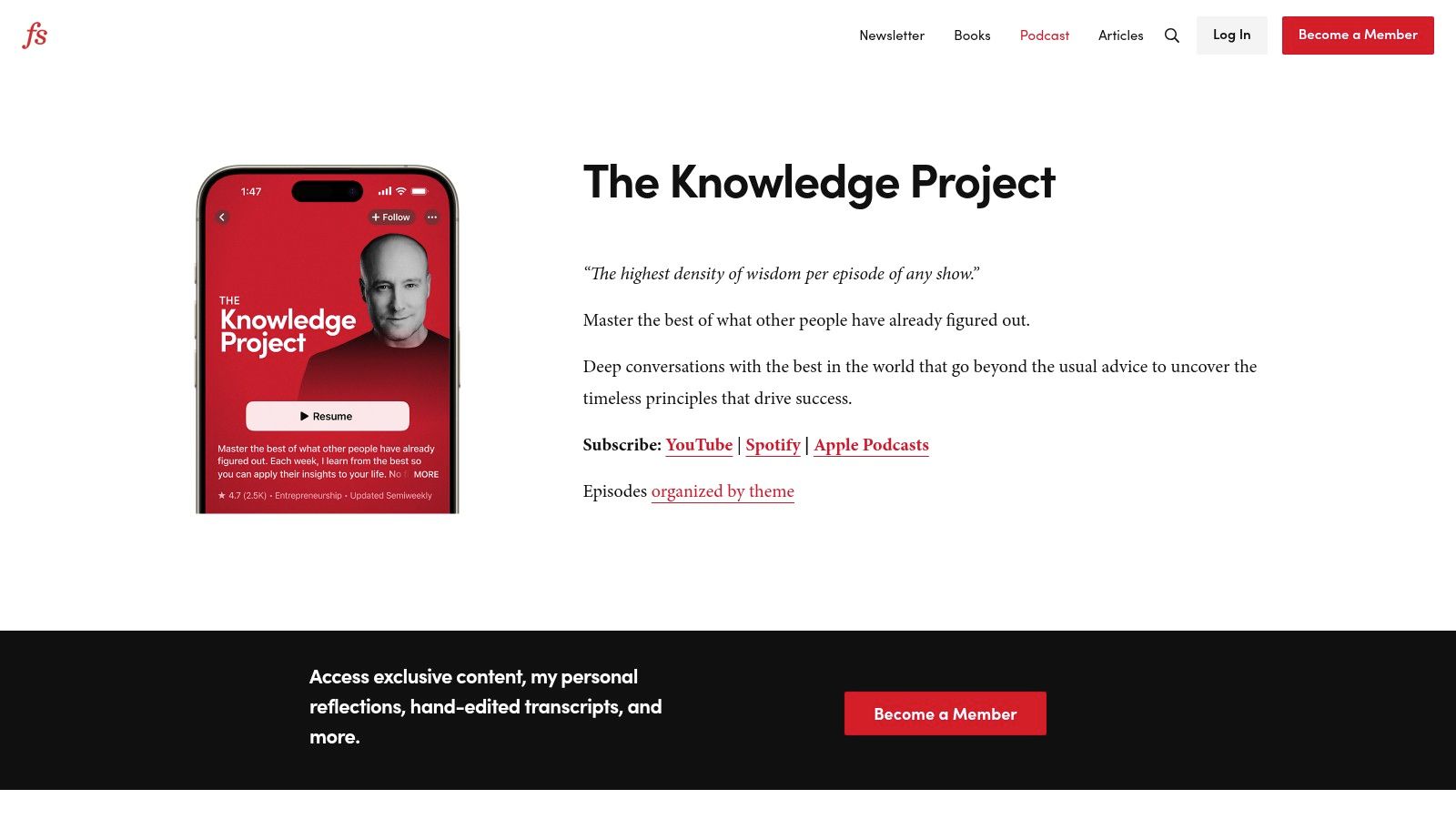
The Knowledge Project is not a product podcast. That is why it belongs on this list.
PMs spend too much time optimizing for immediate tactics and not enough time improving the quality of their judgment. Shane Parrish’s interviews focus on mental models, decision-making, incentives, and long-range thinking. Those are senior PM skills.
What it does better than tactical shows
It improves the engine, not the output.
A tactical podcast might teach you how to run a roadmap review. The Knowledge Project helps you notice whether you are framing the problem correctly, overweighting recent data, or choosing speed when reversibility is needed.
For PMs at companies like Google, Meta, or OpenAI, this distinction matters because product work increasingly involves ambiguous trade-offs. You are not just choosing features. You are choosing which uncertainty to absorb.
If you want a quick primer on where to listen across platforms, this guide on Spotify podcasts versus Apple options is a useful companion.
Best listening prompt
Don’t ask, “What did I learn?” Ask, “Which decision would I revisit after hearing this?”
That prompt makes the podcast practical.
Good fits:
- PMs moving into broader scope
- Leaders making trade-offs under uncertainty
- AI PMs dealing with model quality, trust, and product risk
Weak fits:
- People looking for immediate templates
- Early-career PMs who still need execution fundamentals first
One strong pattern is to listen to The Knowledge Project before a quarterly planning cycle. It helps reset your decision lens before the org starts arguing over features and allocations.
Among podcasts for learning, this one gives you fewer instant wins and more durable upside. That is a good trade if you are playing a long game.
5. Huberman Lab
Huberman Lab is useful for PMs for a simple reason. Product management is a cognitive endurance job.
You need focus, energy regulation, sleep discipline, and the ability to learn dense material without burning out. Huberman Lab is one of the few podcasts for learning that directly supports those capabilities.
Where it helps PM performance
The best episodes are protocol-driven. You get concrete ideas around focus, motivation, learning, and recovery. For PMs juggling meetings, strategy work, customer calls, and async communication, that can be more valuable than another product interview.
This show is especially helpful in two moments:
- when you are ramping into a harder role
- when your output quality is slipping because your operating system is broken
That said, this is not a replacement for product craft. It is a force multiplier for it.
A good pairing is a more PM-specific listening list such as these best product management podcasts, then use Huberman Lab to improve the conditions under which you apply what you learn.
The trade-off
Huberman Lab often runs long and can get technical. That is great if you want depth. It is poor if you only have fragmented listening time.
My recommendation is to use it selectively, not habitually. Choose episodes tied to an active problem:
- low focus during strategy work
- poor retention while studying AI concepts
- weak energy across heavy stakeholder weeks
The common misuse is trying to overhaul your life after one episode. Don’t do that. PMs already suffer from over-optimization.
Pick one protocol. Run it for a week. If it changes your work quality, keep it. If not, move on.
Use Huberman Lab when the bottleneck is you, not your framework.
6. Freakonomics Radio
Freakonomics Radio trains one of the most underrated PM instincts: incentive literacy.
A surprising amount of bad product thinking comes from ignoring how people behave inside systems. PMs describe ideal flows. Users respond to incentives, habits, friction, and trade-offs. Freakonomics Radio is strong because it keeps pulling you back to that reality.
Best use in product work
Listen to this show if you work on marketplaces, growth loops, pricing, trust and safety, creator tools, or any product where participant behavior shapes outcomes.
It sharpens questions like:
- What behavior are we rewarding accidentally?
- Which metric is being gamed?
- Who bears the hidden cost of this change?
- What second-order effect will show up after launch?
Those are not abstract questions. They sit at the center of strong PM judgment.
The trade-off is that Freakonomics Radio is rarely PM-specific. You need to do the translation work yourself. For some listeners, that is a feature. For others, it feels indirect.
A practical exercise
After each episode, map the lesson into one of these product lenses:
- Acquisition: What incentive attracts the wrong user?
- Retention: What habit loop are we underestimating?
- Monetization: What pricing signal changes behavior?
- Governance: What rule creates a workaround?
This is one of the better podcasts for learning if you want to get better at causal thinking without forcing yourself through a textbook. It makes systems thinking easier to remember because the stories stick.
If your PM weakness is naivety about human behavior, put this in your weekly rotation.
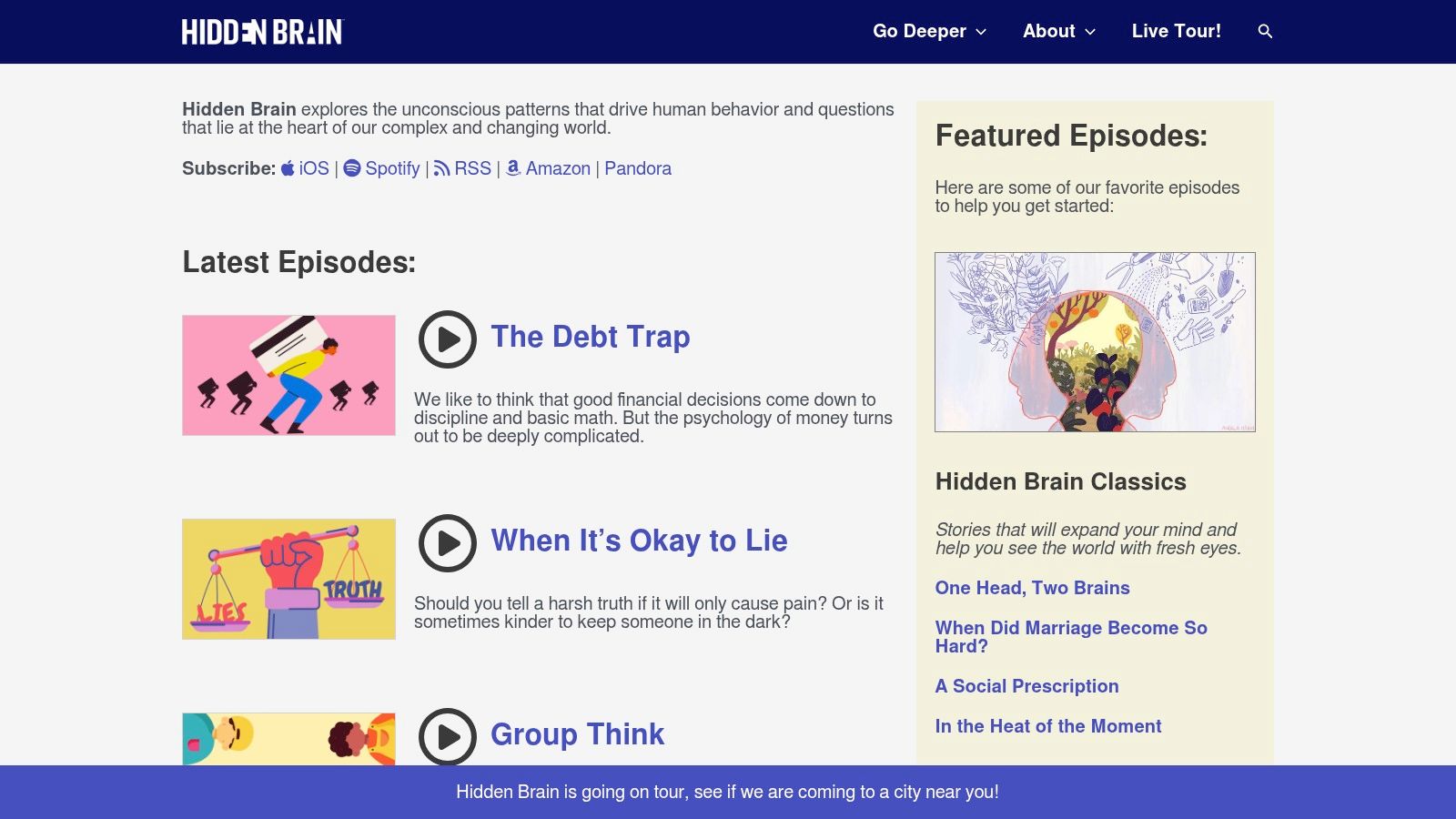
7. Hidden Brain
Hidden Brain helps PMs in a different way. It improves your sensitivity to the invisible forces behind user and stakeholder behavior.
That matters because many product problems are not feature problems. They are belief problems, motivation problems, social proof problems, or framing problems.
Why it earns a spot
Strong PMs understand that data tells you what happened. Behavioral insight helps explain why.
Hidden Brain is useful for:
- onboarding flows that need trust
- collaboration products where team norms matter
- change management inside large organizations
- interview loops where communication and perception matter as much as the answer itself
It is also one of the easiest podcasts for learning to recommend broadly because the storytelling makes it accessible even when the underlying topic is complex.
What it changes in practice
I’ve seen PMs improve dramatically once they stop assuming users are rational and start designing for attention, identity, loss aversion, social friction, and context.
That is where Hidden Brain helps. Not with a ready-made growth template, but with a better model of human behavior.
The trade-off is obvious. You will not finish an episode and suddenly know how to structure your quarterly roadmap. You will, however, become more effective at customer interviews, experiment interpretation, cross-functional persuasion, and adoption design.
This is a great complement to a metrics-heavy PM stack. If your current learning diet is mostly dashboards, A/B tests, and frameworks, Hidden Brain rounds you out.
Use it when the numbers tell you something is off but the mechanism is still fuzzy.
8. TED Talks Daily
TED Talks Daily is the fastest way on this list to widen your idea surface area.
That is its whole job. Short episodes, broad topics, low commitment.
The right way to use it
Do not expect depth. Expect sparks.
This is one of the best podcasts for learning when you are trying to avoid local maxima in your thinking. PMs can get trapped inside their product category, their company language, and their industry assumptions. TED Talks Daily helps disrupt that pattern by dropping in perspectives from science, design, leadership, public policy, psychology, and emerging technology.
For AI PMs, this matters a lot. The strongest opportunities often appear at the intersections: model capabilities plus workflow pain, or technical change plus organizational resistance.
What works and what fails
What works:
- Commute listening
- Idea sourcing before strategy sessions
- Broadening examples for interviews and presentations
What fails:
- Treating it as a primary skill-building source
- Building your whole learning stack from short-form inspiration
- Mistaking novelty for insight
I like TED Talks Daily as a top-of-funnel learning source. If a topic clicks, go deeper elsewhere. If not, move on with no guilt.
That makes it especially useful for busy PMs who need momentum. Long-form shows are powerful, but they also create friction. TED Talks Daily lowers the activation energy. Sometimes that is exactly what you need.
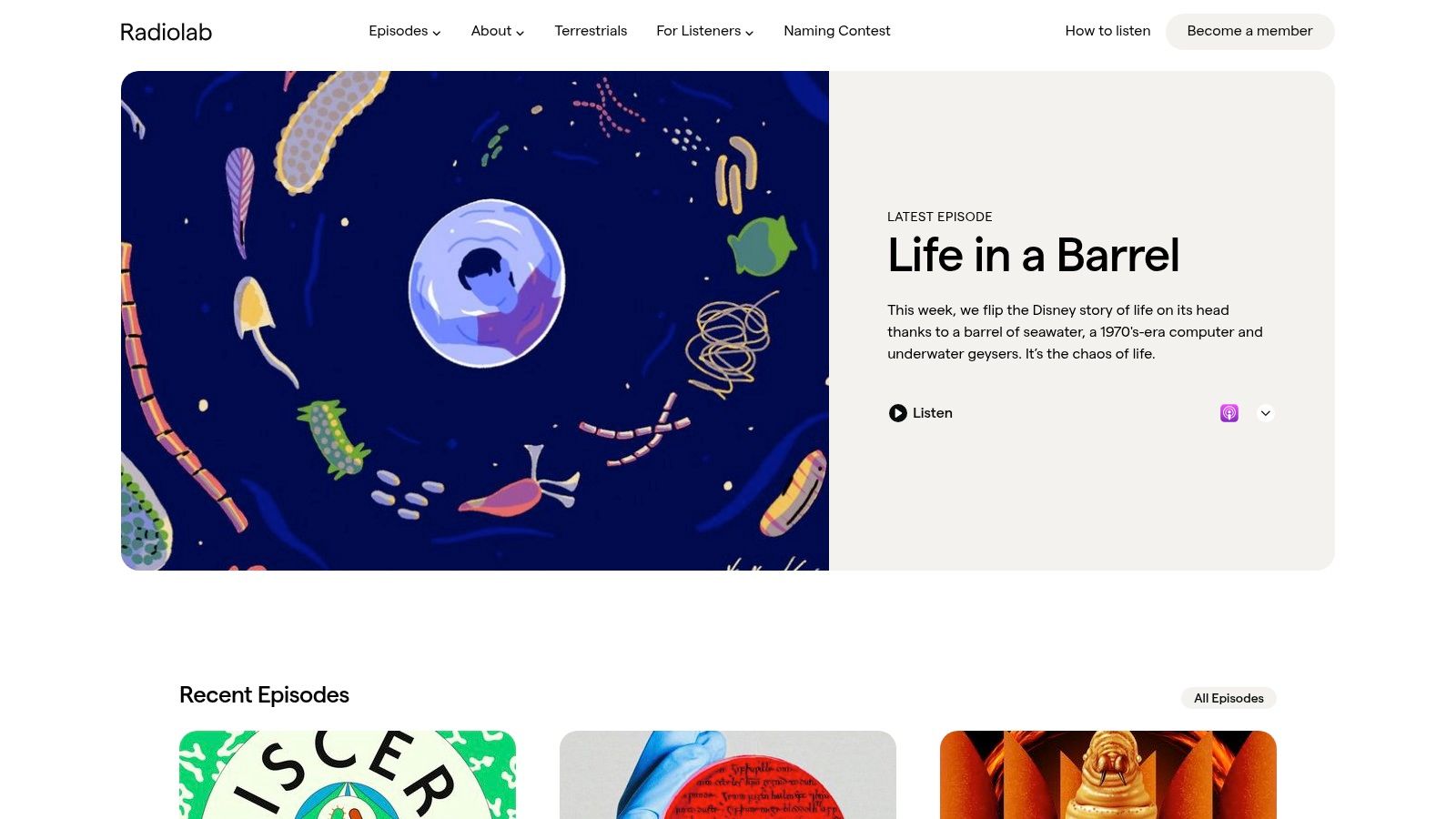
9. Radiolab
Radiolab is less about direct PM tactics and more about memorable understanding.
If you have ever noticed that some ideas stick because they were wrapped in a strong story, you already understand Radiolab’s value. Its sound design and narrative structure make complex topics easier to retain.
Why PMs underestimate it
PMs often overvalue information density and undervalue memory design.
That is a mistake. A leader who can remember, explain, and reframe complex topics clearly has a real edge. Radiolab helps build that muscle because it shows how to turn abstract ideas into compelling narratives.
This is useful in:
- executive communication
- storytelling for product strategy
- customer problem framing
- AI product education, where users often need help understanding what a system does
Best way to apply it
Don’t just listen for content. Listen for structure.
Notice:
- how the episode opens
- when the central question becomes clear
- how tension is maintained
- how complexity gets unpacked without losing momentum
Then steal those moves for your own work. Good PMs write clearly. Great PMs also sequence information well.
The trade-off is that Radiolab is indirect. If you want a list of PM frameworks, look elsewhere. If you want to become the person in the room who can make a complicated issue understandable and memorable, this is a strong choice.
Among podcasts for learning, Radiolab is one of the best for upgrading communication craft without making it feel like homework.
10. Planet Money
Planet Money is the cleanest economics podcast for PMs who hate economics podcasts.
It takes market forces, pricing dynamics, regulation, labor shifts, and business incentives, then makes them legible. That is valuable because many product decisions are downstream of economic reality whether teams admit it or not.
Where it helps most
Planet Money is especially useful for PMs working in fintech, marketplaces, B2B SaaS, creator tools, productivity software, and AI products with evolving cost structures.
It can sharpen your instincts around:
- willingness to pay
- how constraints shape adoption
- why user behavior changes under different market conditions
- what business model pressure will eventually do to the product
For AI PMs, that last point matters. A product can be technically impressive and still be hard to sustain if the economics are weak or the value capture is fuzzy.
The practical trade-off
Planet Money is compact and accessible. That makes it easy to keep up with. The downside is that you still need to connect macro ideas to your actual product.
A practical rhythm:
- Listen during the week
- Write one note on the economic implication for your category
- Bring that lens into roadmap or pricing conversations
This show is one of the strongest podcasts for learning if your weakness is business fluency. Plenty of PMs can write specs. Fewer can connect product choices to the economic system around them.
That gap becomes more visible as you move toward senior roles.
Top 10 Learning Podcasts, Comparison
| Resource | Core Focus & Features | Quality (★) | Value & Pricing (💰) | Target Audience (👥) | Standout / Unique (✨) |
|---|---|---|---|---|---|
| 🏆 Aakash Gupta, Newsletter & Podcast | AI PM, product strategy, growth, job-search; newsletter + podcast | ★★★★★ | 💰 Paid deep-dive newsletter + free podcast, high ROI | 👥 Aspiring & senior PMs, AI PMs, job-seekers | ✨ Actionable frameworks, resume/interview playbooks |
| Lenny's Podcast | In-depth leader interviews; playbooks, templates, metrics | ★★★★☆ | 💰 Free podcast; tactical playbooks | 👥 PMs focused on growth, roadmaps & metrics | ✨ Guest-sourced templates & operational tactics |
| Masters of Scale | Founder stories on scaling, org strategy, experimentation | ★★★★☆ | 💰 Free; strategic perspective for scale | 👥 Senior PMs, PMs building org-level strategy | ✨ Founder-led scale mental models & narratives |
| The Knowledge Project | Long-form mental models, decision-making frameworks | ★★★★☆ | 💰 Free; improves decision quality | 👥 PMs seeking better judgment & strategy | ✨ Timeless thinking tools from top performers |
| Huberman Lab | Science-backed protocols for focus, sleep, learning | ★★★★☆ | 💰 Free; direct productivity ROI | 👥 PMs wanting high-performance habits | ✨ Actionable neuroscience protocols |
| Freakonomics Radio | Economics, incentives, behavioral & market insights | ★★★★☆ | 💰 Free; strong for market/pricing intuition | 👥 PMs working on pricing, incentives, experiments | ✨ Economic framing for product decisions |
| Hidden Brain | Narrative + research on cognitive biases & behavior | ★★★★☆ | 💰 Free; fuels user-research hypotheses | 👥 PMs, UX researchers & designers | ✨ Story-driven insights into unconscious behavior |
| TED Talks Daily | Short talks across tech, science, design, idea sparks | ★★★☆☆ | 💰 Free; broad exposure & serendipity | 👥 PMs seeking cross-disciplinary inspiration | ✨ Quick idea bursts for creative connections |
| Radiolab | Narrative storytelling, sound design, memorable explanations | ★★★★☆ | 💰 Free; teaches persuasive storytelling | 👥 PMs who pitch, craft narratives & product stories | ✨ Masterclass in narrative structure & emotion |
| Planet Money | Accessible economics through stories and case studies | ★★★★☆ | 💰 Free; builds business & market fluency | 👥 PMs aiming to own business outcomes | ✨ Practical, entertaining economic case studies |
Your 24-Hour Action Plan
Many readers approach a list like this, subscribe to three shows, and change nothing about how they work. Don’t fall into that trap.
Treat podcasts for learning like a PM system, not a content pile. The system I recommend is C-S-A-S:
Capture. During the episode, write down one idea worth keeping. One only. If you try to capture everything, you will keep nothing.
Synthesize. Rewrite the idea in your own words by Friday. Keep it short. What was the claim, why did it matter, and where might it apply in your product work?
Apply. Put the insight into a real artifact. Update a PRD. Reframe a metric in your weekly review. Change a customer interview guide. Revise your resume bullet. Add a decision filter to your roadmap.
Share. Post the takeaway internally, bring it into your next 1:1, or publish a short note on LinkedIn. Shared learning compounds because it creates accountability and helps other people associate you with sharp thinking.
Here’s the move to make in the next day.
Subscribe
Pick one podcast from each of these buckets:- PM execution: Aakash Gupta’s Newsletter & Podcast or Lenny’s Podcast
- Strategy: Masters of Scale or Planet Money
- Thinking: The Knowledge Project, Hidden Brain, or Freakonomics Radio
If you want the fastest practical value, start with Aakash Gupta.
Schedule
Put a 30-minute block on your calendar for Friday and title it “Podcast Synthesis.” Protect it like a product review. Almost all learning systems break here: people listen but never synthesize.Capture your first insight
During your very next episode, open Apple Notes, Notion, Obsidian, or your tool of choice and write one line that explains its importance.Turn it into a PM artifact
Use the insight within 48 hours. A few examples:- From Aakash Gupta or Lenny’s Podcast, improve an interview story or roadmap note
- From Masters of Scale, challenge a weak growth assumption in your strategy doc
- From Hidden Brain, revise onboarding copy or stakeholder framing
- From Planet Money, question a pricing or monetization assumption
- From Huberman Lab, fix the working conditions that are reducing your output quality
Build an AI PM lane
If AI product management is your target, dedicate one of your weekly listens to capability translation. After each episode, ask:- What new user behavior becomes possible?
- What workflow gets compressed?
- Where could trust break?
- What should a PM validate before building?
That last step matters. AI PMs do not win by sounding informed. They win by connecting technical change to product value, risk, and adoption.
The goal is not to listen to everything. The goal is to create visible evidence that your learning changes your work. That is what turns podcasts from passive content into career acceleration.
If you want a sharper edge in product strategy, hiring, growth, and AI PM career moves, start with Aakash Gupta. His podcast and newsletter are built for product managers who want practical advice they can apply in their next sprint, interview loop, or roadmap review.
