As a PM leader who's hired and mentored hundreds of product managers at companies like Google and Meta, I've seen one skill separate the top 1% from the rest: mastering product discovery. It's not about having a brilliant idea in the shower; it's about a repeatable system to find and validate the right problems to solve for the right customers. Too many PMs, even experienced ones, are stuck in a 'feature factory,' shipping endless updates that fail to make a real impact. They lack a robust toolkit of product discovery techniques to guide their decisions.
This guide changes that. Forget abstract theory. We're diving straight into 10 battle-tested methods you can apply immediately to de-risk your roadmap, build stakeholder confidence, and advance your career. This isn't just a list; it's a practical playbook for PMs at all levels—from those breaking in, with a starting salary range of $110K-$140K, to senior leaders earning over $250K.
Inside, you'll find actionable frameworks, from structuring user interviews and applying Jobs to Be Done to leveraging AI for continuous discovery. We'll provide step-by-step implementation details, real-world examples from companies like Figma and OpenAI, and specific AI prompts to supercharge your workflow. By the end, you'll have a complete system to stop guessing and start building products that move the needle.
1. User Interviews and Research Synthesis
The foundation of any successful product discovery effort is direct conversation with your users. User interviews are one-on-one, qualitative sessions designed to uncover the "why" behind user behaviors. They go beyond surface-level feature requests to explore deep-seated pain points, motivations, and the context in which problems occur. This raw data is then processed through research synthesis, where individual anecdotes are consolidated into actionable patterns, personas, and insights that guide the entire product team.
This technique is fundamental because it connects product decisions directly to human needs, reducing the risk of building something nobody wants. For instance, the founders of Airbnb famously conducted in-person interviews with early hosts. They didn't just ask about online listings; they observed hosts' entire process, discovering that poor-quality photos were a major barrier to trust and bookings. This insight led them to hire professional photographers, a pivotal move that directly addressed a real, observed user problem.
Career Impact
- Aspiring PMs: Excelling at user interviews is a non-negotiable skill. In interviews, being able to say, "I conducted 15 user interviews for a personal project, synthesized the findings, and identified three core pain points" is far more powerful than just having a certification.
- Practicing PMs: This is how you build authority. Presenting direct quotes and video clips of users struggling is the most effective way to align stakeholders and get buy-in for your roadmap.
How to Implement It
- Recruit & Schedule: Identify 5-8 participants from your target demographic. Use tools like UserInterviews.com (plans start around $40/participant) or Respondent.io. For B2B, leverage your company's sales or customer success teams to find willing customers.
- Prepare Your Guide: Draft open-ended, non-leading questions. Focus on past behaviors ("Tell me about the last time you…") rather than future hypotheticals ("Would you use a feature that…").
- Conduct the Interview: Record the session (with permission) using tools like Zoom or Google Meet. Your goal is to listen 80% of the time. Probe for context, workarounds, and emotions.
- Synthesize with AI: After the interviews, upload transcripts to a tool like ChatGPT-4 or Dovetail.
- AI Prompt: "Analyze the following 5 user interview transcripts. Identify recurring pain points, motivations, and user goals. Group these into 3-5 distinct themes, and for each theme, provide 2-3 direct, illustrative quotes."
- Translate these themes into artifacts like personas, empathy maps, or Jobs-to-be-Done statements. For a deeper dive, read this guide on how to conduct effective user interviews.
Key Insight: Avoid the trap of treating interviews like a feature request form. Your goal isn't a list of solutions; it's a deep understanding of the problem. A user asking for an "export to PDF" button might actually be trying to share a report with their boss, a job for which a shareable link could be a better solution.
2. Jobs to Be Done (JTBD) Framework
The Jobs to Be Done (JTBD) framework shifts the focus from user demographics to user motivations. It operates on a simple but powerful premise: customers don't buy products; they "hire" them to get a specific "job" done. This approach reframes product discovery around the functional, social, and emotional outcomes users are trying to achieve. Instead of asking "What features do you want?", JTBD asks "What progress are you trying to make?".

This technique is essential because it reveals the true competitive landscape. For example, Netflix didn't just compete with Blockbuster; it competed with a glass of wine or a book. The "job" was "help me relax and be entertained after a long day." By understanding the core job, Netflix could build a solution superior to a much wider range of alternatives. This perspective makes JTBD one of the most effective strategic product discovery techniques.
Career Impact
- Mid-Career PMs: Mastering JTBD is how you graduate from feature-level thinking to product strategy. It equips you to answer the "why" behind your roadmap and defend it at the leadership level. This skill is common in Senior PM job descriptions at companies like Intercom and HubSpot.
- Senior Leaders: JTBD is the framework for identifying multi-billion dollar market opportunities. It helps you decide which markets to enter (or exit) by focusing on stable, long-term user needs rather than fleeting feature trends.
How to Implement It
- Identify the Job via "Switch" Interviews: Interview recent customers who just started using your product or stopped using a competitor's. Focus on the circumstances that led them to seek a new solution.
- Define the Job Statement: Structure your findings into the format: "When [situation/context], I want to [motivation/goal], so I can [desired outcome]." Example: "When I'm planning a new feature, I want to see all relevant user feedback in one place, so I can make an evidence-based decision quickly."
- Map the Forces of Progress: Analyze the "pushes" (problems with the old solution), "pulls" (attractions of the new one), "anxieties" (fears about the new solution), and "habits" (allegiance to the old way).
- Identify True Competitors: Document everything a customer might "hire" to do the job, including non-obvious workarounds (e.g., a spreadsheet, a daily standup meeting, or simply doing nothing).
Key Insight: A "job" is stable over time; solutions change. People always needed to share information. The solutions evolved from memos to faxes to email and now to Slack. Focusing on the job, not the current solution, future-proofs your product discovery.
3. Analytics and User Behavior Data
While qualitative interviews tell you the "why," quantitative analytics reveal the "what" at scale. This technique involves tracking user interactions within your product to uncover objective evidence of how people actually use it. This data provides a macro-level view of feature adoption, user flows, and retention, offering proof of what’s working and what isn’t.
This technique is essential for making evidence-based decisions. For example, Spotify constantly analyzes listening patterns to identify micro-trends, which directly fuels the creation of hyper-targeted playlists like "phonk" or "lofi beats." This data-driven curation engine is a core part of its product. Similarly, Duolingo uses cohort analysis on lesson completion rates to refine exercise difficulty and optimize its learning path for long-term retention.

Career Impact
- All Levels: Data fluency is a non-negotiable PM skill in 2024. A typical PM job posting from a company like Datadog or Snowflake will explicitly require experience with tools like Amplitude or Mixpanel and a proven ability to derive insights from data. Salaries for data-proficient PMs often carry a 10-15% premium.
- AI PMs: This is your bread and butter. Training models, evaluating performance, and identifying opportunities for personalization all rely on a deep understanding of user behavior data.
How to Implement It
- Define Key Metrics & Events: Work with engineering to define and implement event tracking for critical user actions (e.g.,
button_clicked,lesson_completed). Focus on metrics that signal value (activation, engagement, retention), not just activity. - Set Up Your Analytics Stack: Use a product analytics tool like Amplitude (offers a generous free tier), Mixpanel, or PostHog. Create dashboards that surface your North Star Metric and supporting KPIs.
- Analyze User Flows: Use funnel analysis to see where users drop off in key workflows (e.g., sign-up). Identify the biggest drop-off points as prime areas for investigation.
- Segment and Compare: Segment your data by user attributes (e.g., plan type, acquisition source) and behavior. Use cohort analysis to compare the retention of users who engaged with a new feature versus those who didn't. Find excellent resources on this at Amplitude's blog.
Key Insight: Raw data can be misleading. A feature with high usage isn't necessarily valuable; it might just be a necessary but frustrating step in a broken workflow. Always pair quantitative findings ("what") with qualitative investigation ("why") to understand the full story.
4. Customer Surveys and Questionnaires
While user interviews provide deep qualitative insights from a small sample, customer surveys allow you to gather structured feedback at scale. This technique uses questionnaires to collect quantitative and qualitative data from a large user population, helping you validate hypotheses, measure satisfaction, and spot trends that individual interviews might miss.
This quantitative approach is one of the most efficient product discovery techniques for quantifying a problem's prevalence. For example, Netflix regularly surveys users on content preferences to inform its multi-billion dollar acquisition strategy. Similarly, Slack often uses short, in-app surveys to collect immediate feedback on new features, helping them quickly iterate based on a large volume of responses.
Career Impact
- Entry to Mid-Level PMs: Running surveys demonstrates your ability to gather data at scale and think quantitatively. It's a quick way to validate insights from your user interviews and present a more complete picture to leadership.
- For AI PMs: Surveys are crucial for gathering labeled data and human feedback to fine-tune models (e.g., "Was this AI-generated summary helpful? Rate 1-5"). This is a core part of the Reinforcement Learning from Human Feedback (RLHF) loop.
How to Implement It
- Define Your Goal: Start with a clear question (e.g., "What percentage of users struggle with our current reporting feature?"). Your goal dictates the questions.
- Design the Survey: Keep it short (5-10 minutes). Use tools like Typeform or Tally.so (offers a great free version). Use a mix of question types (multiple-choice, rating scales, and a few open-ended questions). Explore this resource on how to create a questionnaire that unlocks real growth.
- Segment and Distribute: Send the survey to a relevant segment of your user base via email or in-app pop-ups. Offering a small incentive (like a $5 gift card) can significantly boost response rates.
- Analyze with AI: Export survey responses as a CSV and feed them into an analysis tool.
- AI Prompt: "Analyze the attached CSV of survey responses. The column 'open_feedback' contains qualitative answers. Identify the top 3 themes from this text feedback and calculate the average satisfaction score (from the 'satisfaction_score' column) for each theme."
- Identify interesting respondents for follow-up interviews.
Key Insight: A survey is not just a data collection tool; it's a conversation starter. A low satisfaction score is a signal telling you exactly who to interview next to understand the "why" behind the data.
5. Competitive Analysis and Benchmarking
While user-centric methods are crucial, understanding the market landscape is equally important. Competitive analysis is the systematic study of your rivals' products, strategies, and market position. It goes beyond a simple feature comparison to uncover their strengths, weaknesses, and the unmet user needs they leave behind.
This technique is essential for strategic positioning. For example, Figma didn't just copy Sketch. They analyzed the market and identified a major friction point: collaboration. By building a browser-based tool with real-time multiplayer capabilities, they addressed a clear gap. Similarly, Superhuman studied incumbent email clients to pinpoint sources of slowness and frustration, then built a premium product centered entirely on speed.
Career Impact
- Aspiring PMs: A thorough competitive analysis is a fantastic project for your portfolio. It shows you can think strategically about the market, not just features. This is a common take-home assignment in PM interviews.
- Senior PMs: This skill is critical for making build vs. buy decisions, justifying investment in new product lines, and briefing executives on the competitive landscape. Your ability to articulate a differentiated strategy is a key measure of your seniority.
How to Implement It
- Identify Competitors: Map out direct (e.g., Figma vs. Sketch), indirect (e.g., Slack vs. email), and potential future competitors.
- Test Their Products: Sign up for and use competitor products firsthand. Document the end-to-end user experience, from onboarding to cancellation.
- Analyze and Document: Use a tool like Coda or Notion to create a living document that compares key aspects like features, pricing, GTM strategy, and user experience. Note strengths and weaknesses.
- Synthesize Gaps with AI: Feed your notes and public information (like G2 reviews) into an AI tool.
- AI Prompt: "I'm a PM for [Your Product]. I've attached my notes on competitors [Competitor A, B, C] and 50 G2 reviews for each. Synthesize this information to identify 3 strategic opportunities for differentiation based on their weaknesses and customer complaints."
- Use a competitive analysis framework to guide your research.
Key Insight: The goal isn't to copy features. It's to understand the "why" behind your competitor's choices and the "why not" for the opportunities they missed. Talking to your competitors' customers is one of the most effective ways to uncover these hidden gaps.
6. Usability Testing and User Testing Sessions
While user interviews uncover what people say, usability testing reveals what they do. This technique involves observing users attempting to complete specific tasks with a product or prototype. The goal is to identify usability issues and validate design assumptions, tracking metrics like task success and time-on-task. It is one of the most direct and impactful product discovery techniques for validating solutions.
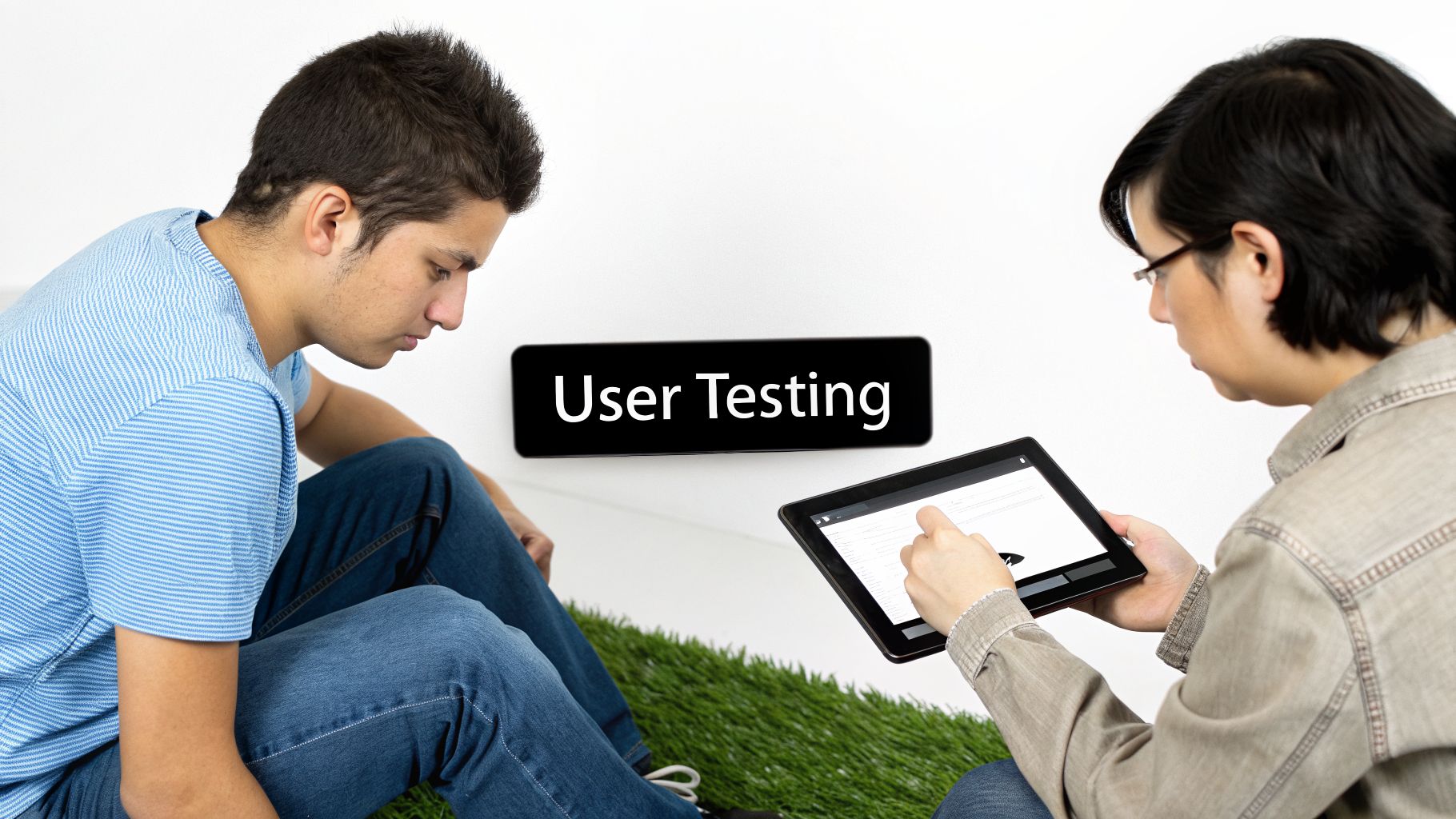
This method provides undeniable evidence of friction points. For example, Amazon continuously tests its checkout flow to reduce cart abandonment. By observing users struggle with form fields, their product teams can make data-informed changes that directly improve conversion rates. Apple famously tested countless prototype interfaces for the original iPhone, ensuring the touch-based navigation was intuitive before it reached the public.
Career Impact
- All Levels: This is a fundamental skill that builds empathy and credibility. Bringing a video clip of a user failing to complete a task to a planning meeting is more powerful than any slide deck. It shifts the conversation from opinion to evidence.
- Courses to Master This: For hands-on practice, consider courses like "User Experience (UX) Design" on Coursera (approx. $49/month) or "Become a UX Designer" on Udacity's Nanodegree program (approx. $399/month), which include practical usability testing projects.
How to Implement It
- Define Tasks & Recruit: Identify critical user paths and create realistic tasks (e.g., "Imagine you need to share your quarterly sales report. Show me how you would do that."). Recruit 5-8 users.
- Choose a Method: Use moderated testing (with a facilitator) for deep insights or unmoderated testing (using tools like Maze or UserTesting.com, starting around $50/participant) for quantitative data at scale.
- Facilitate the Session: Record the session. Instruct the user to think aloud. Resist the urge to help; let them struggle, as this is where insights emerge. Learn how to conduct usability testing.
- Analyze & Share: Document observations, focusing on where users succeeded, failed, or expressed frustration. Create a highlight reel of the most critical moments to share with your team. A great resource is available on running effective usability tests.
Key Insight: You don't need a polished product to start. Early tests with low-fidelity Figma prototypes are inexpensive and can surface major conceptual flaws before a single line of code is written. This "test early, test often" mindset saves immense time and resources.
7. Customer Support and Feedback Analysis
Your customer support team is on the frontline, interacting with users at their most critical moments. Analyzing this continuous stream of communication—support tickets, chat logs, and complaints—is one of the most underrated product discovery techniques. It offers an unfiltered view into where your product is failing to meet expectations. This systematic review turns a cost center into a powerful discovery engine.
This method is crucial because it highlights problems your most engaged (or most frustrated) users are facing right now. For example, the team at Slack regularly analyzes support conversations to spot patterns. Discovering that many new users were getting stuck during channel creation led them to redesign parts of their onboarding, directly improving activation rates by addressing a real, documented point of friction.
Career Impact
- Entry-Level PMs: This is one of the easiest and highest-impact ways to add value on day one. By befriending the support team and synthesizing their insights, you can quickly become the "voice of the customer" and identify quick wins for the roadmap.
- AI PMs: Support tickets are a goldmine for fine-tuning AI. They provide real-world examples of user problems, which can be used to train AI-powered help bots or identify gaps in your product's AI capabilities.
How to Implement It
- Establish a System: Work with support leads to tag and categorize incoming feedback in tools like Zendesk or Intercom. Use dedicated feedback tools like Canny or Productboard to link feedback directly to feature ideas.
- Set a Cadence: Schedule bi-weekly syncs between product and support. This should be a collaborative analysis of top recurring themes.
- Quantify and Qualify with AI: Automate the initial analysis.
- AI Prompt: "Connect to our Zendesk API. Every week, pull all new tickets tagged 'user_confusion' or 'feature_request'. Summarize the top 5 recurring themes, quantify their frequency, and provide an example ticket for each."
- Share Insights Widely: Create a simple, weekly summary dashboard showing "Top 5 User Frustrations This Week." This builds shared empathy and informs prioritization.
Key Insight: The most valuable feedback often isn't a direct feature request but a description of a failed goal. A user reporting they "can't download the report" might not need a different file format; they might be trying to share progress with a stakeholder who doesn't have an account. Dig into the underlying "why."
8. Product Development Sprints and Discovery Workshops
Product development sprints and discovery workshops are intense, time-boxed sessions where cross-functional teams collaborate to tackle a specific problem. By bringing together product, design, engineering, and marketing, these formats accelerate discovery from months into days. They serve to build shared understanding, generate a wide range of solutions, build testable prototypes, and gain rapid feedback.
This technique is powerful because it breaks down silos and forces decisive action. The famous Google Ventures Design Sprint is a prime example. In just five days, teams progress from mapping a problem to testing a realistic prototype with actual users. This compressed cycle allows companies to validate or invalidate high-stakes ideas before committing significant engineering resources.
Career Impact
- Mid-Career PMs: Facilitating a successful design sprint is a major career milestone. It demonstrates leadership, strategic thinking, and the ability to drive alignment across an entire team. This is a highly sought-after skill in job descriptions for Lead PM roles.
- Remote Work Context: In a remote or hybrid environment, proficiency with digital collaboration tools like Miro or FigJam is essential for running these workshops effectively.
How to Implement It
- Define the Challenge: Create a crystal-clear problem statement and a pre-read document with all relevant data and user research.
- Assemble the Team: Invite a diverse group of 5-8 people. Ensure you have a Decider (the person who makes the final call), along with representatives from engineering, design, product, marketing, and support.
- Facilitate the Sprint: Follow a structured agenda. A typical five-day sprint involves: Day 1 (Map), Day 2 (Sketch), Day 3 (Decide), Day 4 (Prototype), and Day 5 (Test). Use a facilitator to keep the group on track.
- Prototype and Test: The goal is to create a prototype that is just realistic enough to test your core hypothesis (a "facade of quality"). It should be built for learning, not for shipping.
- Synthesize and Act: After the sprint, consolidate findings from user testing. Document the outcomes, decisions, and next steps, and share them widely to maintain momentum.
Key Insight: Avoid groupthink by using structured brainstorming methods. Instead of an open discussion, have participants sketch ideas individually and silently before sharing. This prevents the loudest voices from dominating and ensures a wider variety of solutions are considered.
9. Beta Testing and Early Access Programs
Beta testing moves discovery from the lab into the real world. It involves releasing a nearly complete feature to a select group of external users before its official launch. This technique is critical for gathering real-world usage data, identifying bugs that only appear at scale, and validating that the solution performs as expected under authentic conditions.
This technique is essential because it stress-tests your solution against the chaos of real user environments. For example, OpenAI granted early access to its GPT-4 API to a select group of developers. This not only surfaced bugs but confirmed that the model could solve complex problems in actual production environments, a level of validation impossible to achieve internally.
Career Impact
- Mid to Senior PMs: Successfully managing a beta program demonstrates your ability to handle a product launch from start to finish. It involves technical coordination, community management, and marketing, showcasing your cross-functional leadership.
- Career Advancement: The relationships you build with beta testers can be incredibly valuable. These power users can become evangelists for your product and provide testimonials that strengthen your go-to-market launch.
How to Implement It
- Define Goals & Recruit: Establish clear success metrics (e.g., "Achieve a 75% task success rate for the new feature"). Recruit users who match your ideal customer profile, setting clear expectations about the product's unfinished state. Use tools like Product Hunt's Ship or build a waitlist.
- Establish Feedback Channels: Create a dedicated, easy-to-access channel for feedback, such as a private Slack group, a Discord server, or an in-app feedback tool like Sprig.
- Onboard and Engage: Provide beta users with clear instructions and support. Actively engage them with prompts, questions, and updates.
- Track & Analyze: Combine qualitative feedback with quantitative usage analytics from your analytics tool (e.g., Amplitude). Look for discrepancies between what users say and what they do.
- Iterate and Communicate: Act on the feedback. Push updates to the beta group and communicate how their input has directly shaped the product. This builds advocacy and keeps them engaged.
Key Insight: A beta program is not just a bug hunt; it’s your first marketing campaign. Treat your beta testers like VIPs. By making them feel heard and valued, you are building a loyal group of early advocates who will champion your product at launch.
10. Market and Trend Research
While many discovery techniques focus inward on users, market and trend research looks outward to the broader ecosystem. This involves studying industry-wide shifts, emerging technologies (especially AI), competitive movements, and macroeconomic factors to anticipate future customer needs. It’s about understanding the waves of change before they reach the shore.
This strategic foresight is a key differentiator for market-leading companies. Netflix didn't wait for its DVD-by-mail customers to demand streaming; it analyzed broadband adoption rates and changing media consumption habits to pioneer the shift. Similarly, Amazon identified the growing need for scalable web infrastructure, leading to Amazon Web Services (AWS), a business born from a market-level observation.
Career Impact
- Senior PMs & Product Leaders: This is a core responsibility at the Director/VP level. Your ability to synthesize market trends into a compelling product vision is what justifies your high salary (often $250K+). You are expected to answer, "What should we be building in 3-5 years?"
- AI PMs: Staying on top of the latest research papers (from sources like arXiv), model releases (from OpenAI, Google, Anthropic), and open-source developments is non-negotiable. This fast-moving field requires constant learning.
How to Implement It
- Identify Information Sources: Follow key industry analysts (Gartner, Forrester), newsletters (Stratechery, Lenny's Newsletter), and VC blogs (a16z). Set up Google Alerts for competitor announcements and funding rounds.
- Talk About the Future: In user interviews, ask, "What new technologies, like AI, are you or your company experimenting with?" or "What are the biggest changes you see coming in your industry?"
- Synthesize Internally: Create a recurring forum or a dedicated #market-intel Slack channel to consolidate observations from your sales, marketing, and support teams.
- Use AI for Synthesis: Use AI tools to stay ahead of the curve.
- AI Prompt: "Act as a market research analyst for the B2B SaaS industry. Summarize the top 5 most important AI-related developments from the last month, citing your sources. For each development, suggest one potential product opportunity for a project management software company."
Key Insight: The goal is not to blindly follow every trend. Use market signals as a lens to re-examine your core customer problems. A trend like AI's growth is just noise until you connect it to a specific job your customer is trying to do, which then becomes a concrete opportunity to explore.
10-Point Product Discovery Comparison
| Method | Implementation Complexity 🔄 | Resource Requirements ⚡ | Expected Outcomes 📊 | Ideal Use Cases 💡 | Key Advantages ⭐ |
|---|---|---|---|---|---|
| User Interviews and Research Synthesis | 🔄 Medium–High — planning, recruiting, skilled moderation | ⚡ Low–Medium — time for interviews & synthesis, analyst effort | 📊 Deep qualitative insights, personas, validated hypotheses | 💡 Discovery, empathy-building, early-stage validation | ⭐⭐⭐ Rich contextual understanding; uncovers hidden needs |
| Jobs to Be Done (JTBD) Framework | 🔄 High — extensive interviewing and synthesis to define jobs | ⚡ Medium–High — research, cross-team alignment, training | 📊 Outcome-focused job statements and competitive landscape | 💡 Long-term strategy, product positioning, differentiation | ⭐⭐⭐ Clarifies real user goals; reveals alternative solutions |
| Analytics and User Behavior Data | 🔄 Medium — instrumentation and analysis discipline | ⚡ Medium — engineering to implement; tools and dashboards | 📊 Quantitative behavior at scale: funnels, retention, anomalies | 💡 Optimizing features, measuring impact, growth experiments | ⭐⭐⭐ Objective, continuous evidence; scalable insights |
| Customer Surveys and Questionnaires | 🔄 Low–Medium — survey design and sampling considerations | ⚡ Low — survey tools and distribution; statistical analysis | 📊 Quantified preferences, satisfaction scores, segmentable data | 💡 Validating hypotheses at scale, prioritizing features, NPS | ⭐⭐ Broad representativeness; faster scalable feedback |
| Competitive Analysis and Benchmarking | 🔄 Medium — structured research and ongoing monitoring | ⚡ Low–Medium — analyst time, market intelligence tools | 📊 Market gaps, feature parity insights, positioning options | 💡 Strategic positioning, product differentiation decisions | ⭐⭐ Identifies gaps and standards; informs go-to-market choices |
| Usability Testing and User Testing Sessions | 🔄 Medium — test design, facilitation, and recording | ⚡ Low–Medium — participants, moderators, tooling | 📊 Usability issues, task success rates, time-on-task metrics | 💡 Pre-launch validation, UX refinement, prototype testing | ⭐⭐⭐ Detects concrete usability problems early; actionable fixes |
| Customer Support and Feedback Analysis | 🔄 Low — aggregation and tagging processes required | ⚡ Low — existing data; tooling for categorization & analysis | 📊 Recurring complaints, feature requests, churn drivers | 💡 Prioritizing bug fixes, reducing friction, roadmap inputs | ⭐⭐ Direct view of real customer pain; continuous signal |
| Product Development Sprints and Discovery Workshops | 🔄 High — intense coordination and facilitation | ⚡ High — cross-functional time commitment and facilitation | 📊 Rapid prototypes, aligned decisions, tested hypotheses | 💡 Rapid ideation, cross-team alignment, early concept testing | ⭐⭐ Accelerates decisions and buy-in; tests multiple ideas fast |
| Beta Testing and Early Access Programs | 🔄 Medium — selection, rollout, feedback processes | ⚡ Medium — support channels, analytics, engagement efforts | 📊 Real-world usage data, edge-case discovery, early advocacy | 💡 Pre-launch validation, product-market fit testing, risk reduction | ⭐⭐⭐ Validates in production contexts; builds advocates |
| Market and Trend Research | 🔄 Medium–High — synthesis of broad data and forecasting | ⚡ Medium–High — subscriptions, analyst time, scenario planning | 📊 Strategic signals, emerging opportunities, future scenarios | 💡 Long-term strategy, R&D prioritization, new markets | ⭐⭐⚪ Anticipatory insights; helps prioritize long-term bets |
From Technique to System: Building Your Continuous Discovery Habit
We've explored a powerful roster of ten product discovery techniques. You now have a detailed blueprint for each one: when to use it, a step-by-step process, and real-world examples. But knowing these techniques is not the endgame. The real work of a top-tier product manager begins now, by moving from a project-based mindset to one of continuous discovery.
The most effective PMs at companies like Google, Netflix, and Airbnb don't just "do discovery" at the start of a project. They live it. They build a system where insights from the market and users constantly flow into the product development process. They master switching between these methods based on the specific question they need to answer.
Key Takeaway: Individual techniques are tools. The real skill is building the workbench—a continuous system where these tools are used in concert to consistently de-risk decisions and uncover real user needs before a single line of production code is written.
Your Action Plan: From Theory to Practice
Action is what separates great PMs from the rest. Don't try to implement all ten techniques at once. Build momentum by focusing on one or two methods that address your current team's biggest blind spot.
Here’s your immediate, actionable plan for the next 48 hours:
- Identify Your Biggest Gap: Look at your current roadmap. Where did you make the biggest assumptions? Was it on the problem (a gap for User Interviews), the solution's usability (a gap for Usability Testing), or the market positioning (a gap for Competitive Analysis)? Be honest.
- Champion One Technique: Choose the single technique from this list that best closes that gap. If your team is flying blind, commit to scheduling five user interviews in the next two sprints. If you are drowning in opinions, champion setting up an Amplitude dashboard to track one key user behavior.
- Create a Mini-Playbook: In a one-page document, define the goal, the steps (use our templates as a starting point), who is involved, and what success looks like. This makes your effort official and easier for others to follow.
- Share Your Findings: Present your findings—from a survey, a usability test, or an analytics deep dive—in your team's next sprint review. Connect your insights directly to a proposed decision: "Based on 3 of 5 users struggling with our new filter, I propose we simplify the UI in this specific way."
- Build the Habit: Once you demonstrate a small win, expand your efforts. Introduce a second, complementary technique. Over time, this practice evolves from a one-off project into a sustainable, continuous discovery habit. This is how you build a reputation not just for shipping features, but for shipping products that win.
Mastering these product discovery techniques is your path to becoming an indispensable product leader. It's how you move from being a feature manager to a true value creator, building a career defined by impactful, customer-centric products.
For PMs serious about mastering the craft of product management, from discovery to launch and beyond, I highly recommend the resources from Aakash Gupta. His newsletter and content are packed with the kind of in-depth frameworks and real-world teardowns used by product leaders at top tech companies. Explore his work at Aakash Gupta to get tactical advice you can apply immediately.
