As someone who has hired and managed dozens of Product Managers at companies from early-stage startups to FAANG, I've seen one skill consistently separate the top 10% from the rest: the ability to define exactly what "done" looks like. Ambiguity is the enemy of execution. This is where the Given-When-Then format for acceptance criteria isn't just a useful tool—it's your most critical framework for ensuring your team builds the right thing, the right way, the first time.
If you’re tired of features launching with bugs or getting stuck in endless QA cycles because of misunderstood requirements, this guide will give you a step-by-step, implementable system. Mastering acceptance criteria given when then creates a shared language for product, engineering, and QA, forming the very foundation of how high-performing teams at places like Google and Meta operate. It's how you translate user needs into testable, unambiguous instructions that eliminate guesswork.
The PM's Framework for Flawless Product Delivery
The Given-When-Then structure is a simple yet powerful framework for describing a feature's behavior from a user's point of view. It forces you to think through every scenario with a level of precision that leaves no room for misinterpretation.
- Given: The initial setup. What context or state must be true before the scenario begins? This is your starting point.
- When: The specific user action. What trigger or event occurs? This is the core action.
- Then: The expected, observable outcome. What is the testable result of the action? This is your definition of success.
This structure turns a fuzzy requirement like "the user should be able to log in" into a set of concrete, testable scenarios. This simple shift in communication is what separates teams that ship quality on the first try from those stuck in a painful cycle of rework and bug-fixing. The business impact is real: I’ve seen teams adopt this and cut down bug-related rework by over 30% in a single quarter.
From Vague to Valuable: A Concrete Example
Let's look at how this transformation works in practice. A vague criterion is a recipe for confusion; a precise Given-When-Then scenario is a blueprint for success.
| Component | Vague Acceptance Criterion | Precise Given-When-Then Criterion |
|---|---|---|
| Given | N/A | Given a registered user is on the login page |
| When | The user should be able to log in. | When the user enters their correct email and password and clicks the "Log In" button |
| Then | N/A | Then the system authenticates the user and redirects them to their account dashboard |
The difference is night and day. The vague version leaves everything open to interpretation—what page are they on? What happens after they log in? The precise version provides a testable script that anyone on the team can understand and verify.
The Business Impact: From Ambiguity to Actionable Clarity
This isn't just a theoretical improvement. Industry data confirms what experienced PM leaders have known for years: clarity upfront saves an enormous amount of time, money, and sanity. Teams that adopt the Given-When-Then format report a significant reduction in time wasted in backlog refinement meetings and a decrease in post-release bugs caused by misunderstood requirements. For a junior PM, mastering this skill is one of the fastest ways to build credibility with your engineering team. For a senior PM, it's how you ensure predictable delivery across your product portfolio.
The goal is to create a single source of truth that a human can read and a machine can test. When an engineer, a QA analyst, and a PM all look at the same Given-When-Then scenario, they share the exact same mental model of the feature.
This shared understanding is the grease in the wheels of efficient development. When you focus on writing better product specs from the start, you slash the endless back-and-forth and empower your team to build with confidence. The Gherkin syntax used in Given-When-Then was designed for exactly this—to bridge the communication gap and make sure everyone is perfectly aligned on what success looks like.
How To Write Bulletproof Given-When-Then Criteria: A Step-by-Step Process
Theory is one thing, but execution is what separates the top-tier PMs from the rest. This is the exact step-by-step process I’ve coached my teams on for years to kill ambiguity and get everyone on the same page. You can apply this framework within 24 hours.
We’ll start with a classic user story for an e-commerce platform:
As a returning customer,
I want to update the quantity of an item in my shopping cart,
So that I can purchase the correct number of products.
Now, our job as PMs is to translate this user need into specific, testable behaviors that leave no room for interpretation.
This simple flow is how we turn a fuzzy requirement into a concrete test case using the GWT structure.
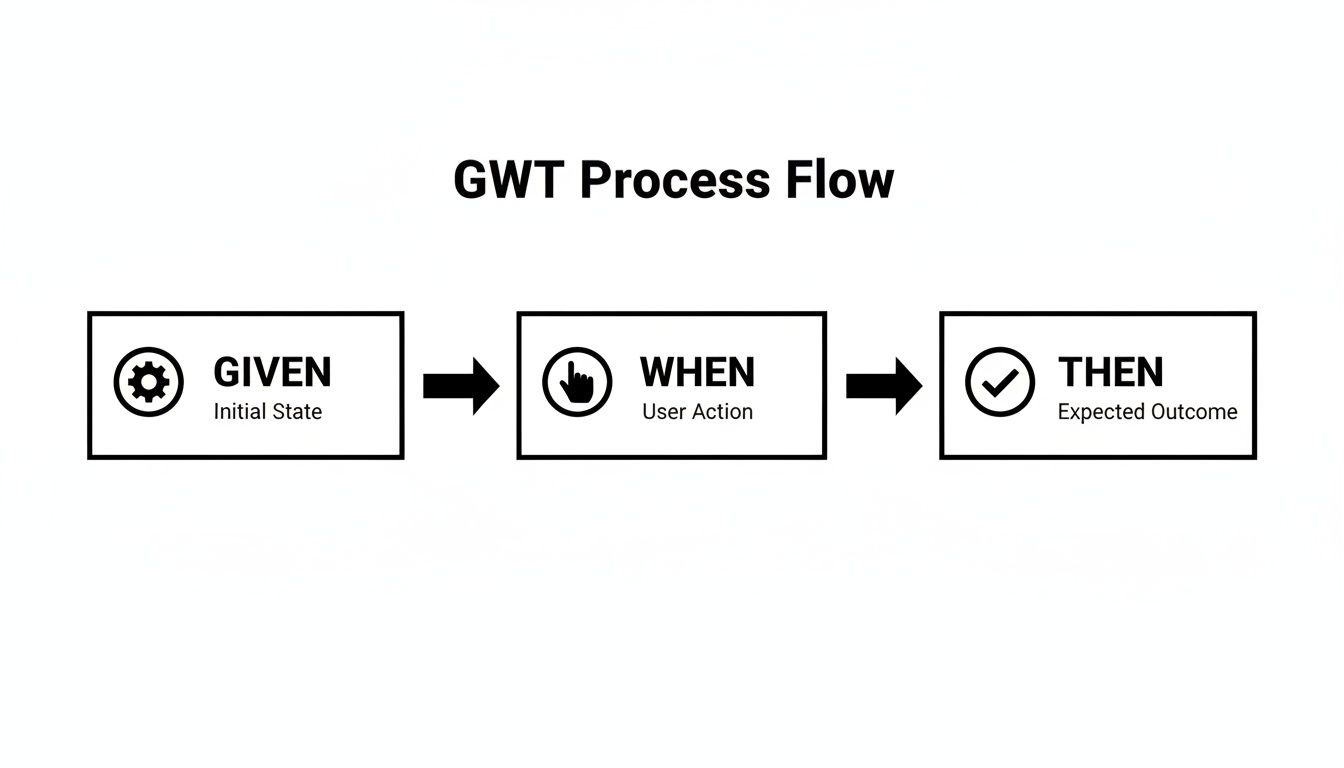
This process forces you to define the initial context (Given), the action (When), and the measurable outcome (Then). It creates a scenario that’s crystal clear and, more importantly, verifiable.
Step 1: Define the "Happy Path"
You always, always start with the "happy path"—the ideal journey where everything works perfectly. This is your foundation. For our shopping cart story, the happy path is simply increasing an item's quantity.
Scenario: User increases item quantity
- Given a registered user is logged in
- And they have an item in their shopping cart with a quantity of 1
- When they increase the quantity of that item to 2
- Then the shopping cart page updates to show the item quantity as 2
- And the cart subtotal is recalculated correctly
This single scenario is already ten times more valuable than the user story alone. It's concise and gives engineering and QA a precise target to hit. If you want more practice, you can find more comprehensive examples of user stories with acceptance criteria to see how this plays out across different features.
Step 2: Uncover Edge Cases and Negative Paths
With the foundation set, we get to the part where great PMs earn their salary. You have to start asking, "What if…?" and think like a QA analyst who is actively trying to break the feature.
Here is the checklist I run through with my teams to hunt down edge cases:
- Boundary Conditions: What happens at the limits (e.g., quantity 0, max stock, character limits)?
- Invalid Inputs: What happens with bad data (e.g., entering "abc" into a number field, negative numbers)?
- State Variations: What happens if the starting state is different (e.g., an empty cart, a logged-out user, different user permissions)?
- System Failures: What happens if a network request fails or a dependent service is down?
Let's apply this thinking to our shopping cart.
Scenario: User decreases item quantity to zero
- Given a user has an item in their cart with a quantity of 1
- When they decrease the quantity of that item to 0
- Then the item is removed from the shopping cart
- And the cart subtotal is updated
Scenario: User attempts to exceed max stock
- Given a user has an item in their cart
- And the item has a maximum available stock of 5
- When they attempt to increase the quantity to 6
- Then the quantity field remains at 5
- And a message is displayed: "Maximum quantity of 5 reached."
The goal isn't just to define what should happen, but also what should not happen. By defining both positive and negative paths, you create guardrails for the user experience and prevent unexpected behavior. This is a hallmark of a senior product thinker.
This isn’t just about making better software; it’s about predictable delivery. Clear Given-When-Then criteria are a direct lever you can pull to improve your team's sprint velocity and your credibility as a leader.
Real-World Examples: From SaaS Logins to Complex AI Features
Theory is one thing, but seeing how Given-When-Then actually works in the trenches is what really matters. As a PM, you’ll be defining features that run the gamut from simple UI tweaks to mind-bendingly complex AI models. I've found that the GWT format is flexible enough to handle it all, bringing the same level of clarity whether you're at a SaaS startup or a giant like Meta.
Let's break down a few examples from different product areas. These aren’t just generic templates; they’re structured exactly like the criteria my teams and I have used to ship real products. You’ll see just how well the framework adapts from basic user flows to the tricky behaviors of intelligent systems.
To make this even more concrete, here are GWT scenarios for different product types, showing how the format works across various technical contexts. This table is a template you can immediately use for your own features.
GWT Scenarios For Different Product Types
| Feature Type | Scenario | Given-When-Then Example |
|---|---|---|
| SaaS Login | Successful Login with MFA | Given a registered user with MFA enabled is on the login page And they have their authenticator app ready When they enter correct credentials and click "Log In" And they enter the correct 6-digit code from their app Then they are successfully authenticated and redirected to their dashboard |
| SaaS Login | Incorrect MFA Code | Given a user has entered their password and is on the MFA screen When they enter an incorrect 6-digit code Then an error message "Invalid code, please try again" is displayed And they remain on the MFA screen |
| Social Media | Liking a Post (Success) | Given a logged-in user is viewing a post they have not liked When they click the "Like" button Then the like button icon immediately changes to a "liked" state And the like count increments by one And a POST /likes API call is successfully sent |
| Social Media | Liking a Post (Network Error) | Given a user is viewing a post When they click the "Like" button And the network request to the server fails Then the like button reverts to its original "unliked" state And a toast notification appears: "Could not complete action. Please check your connection." |
| AI Feature | Recommendations Display (History) | Given a user has a purchase history of "running shoes" When they load the homepage Then a "Recommended for You" module is displayed And the module contains 5 unique product recommendations And at least 3 of the products are from the "athletic apparel" or "running accessories" categories |
| AI Feature | AI Service Fallback | Given a user loads the homepage When the recommendation AI service fails to respond within 500ms Then the "Recommended for You" module is hidden And a default "Top Selling Products" module is displayed in its place |
As you can see, the structure remains consistent, but the specifics within each Given, When, and Then clause adapt to the feature's unique logic and potential failure points. This provides a clear, shared understanding for everyone on the team.
The key here is defining the system's graceful failure. You specify the exact user feedback for a failed state, ensuring the user is never left wondering what happened. This level of detail separates a polished product from a frustrating one. For career growth, showing you can think through failure states demonstrates seniority.
For further insights into how Given-When-Then criteria are applied in cutting-edge technology, resources like Parakeet AI's blog can be valuable for understanding real-world examples.
AI PM Specialization: Writing ACs for Non-Deterministic Systems
How do you write acceptance criteria when the outcome isn't predictable? This is the core challenge for AI Product Managers. With AI features, you can't test for a specific output like, "Then the user is shown Product X." It just doesn't work that way.
Instead, you have to shift your thinking to test the behavior and properties of the system. Your criteria must define the guardrails the AI model operates within.
Here's an AI prompt you can use with tools like ChatGPT or Claude to help brainstorm these properties:"I am a Product Manager writing acceptance criteria for an AI-powered product recommendation engine. The user story is: 'As a shopper, I want to see personalized product recommendations so that I can discover relevant items.' Based on this, generate a list of testable properties and behaviors for the recommendation module, including diversity, relevance, freshness, and fallback logic. Frame these as Gherkin-style scenarios."
Let's look at the AI recommendation example again.
User Story: As a shopper, I want to see personalized product recommendations on the homepage, so that I can discover items relevant to my interests.
Here’s how we’d write out the scenarios in full:
Scenario: Recommendations Display for a User with Purchase History
- Given a logged-in user has a purchase history of "running shoes"
- When they load the homepage
- Then a "Recommended for You" module is displayed
- And the module contains 5 unique product recommendations
- And at least 3 of the recommended products are from the "athletic apparel" or "running accessories" categories
- And none of the recommended products are items the user has previously purchased
Fallback Scenario: AI Service is Unresponsive
- Given a user loads the homepage
- When the recommendation AI service fails to respond within 500ms
- Then the "Recommended for You" module is hidden
- And a default "Top Selling Products" module is displayed in its place
By focusing on the properties of the output (number of items, category relevance, uniqueness) and defining the system's fallback logic, you create testable and valuable criteria. If you're looking for more guidance on this, exploring sample user stories and acceptance criteria for complex features can provide additional context. This skill is critical for the growing field of AI PM, a specialization with salaries often ranging from $180,000 to $250,000+ at leading tech companies.
Common Mistakes PMs Make (And How to Fix Them)
Writing solid acceptance criteria is a craft. I’ve seen even senior PMs stumble into a few common traps. These aren't just minor slip-ups; they create confusion, trigger expensive rework, and can seriously damage your credibility with the engineering team. Let's walk through the anti-patterns I see most often so you can build the muscle memory to avoid them.
Mistake 1: Prescribing the "How" Instead of the "What"
This is the cardinal sin of writing acceptance criteria. Your job as a PM is to own the what and the why—the user problem and the successful outcome. You are not there to architect the solution. When your ACs start dictating database tables, API endpoints, or specific JavaScript libraries, you’ve gone too far.
Bad Example (Anti-Pattern):
- Given the user is on the product details page
- When the user clicks the "Add to Cart" button
- Then a POST request is made to the
/cartAPI endpoint - And the
cart_itemstable in the database is updated with the product ID
This handcuffs your engineers. What happens when they refactor the backend and a different endpoint makes more sense? Your criteria instantly become a source of friction.
Good Example (Best Practice):
- Given a user is viewing a product page
- When they click the "Add to Cart" button
- Then the cart icon in the header updates to show a count of 1
- And a confirmation message "Item added to your cart" is displayed
See the difference? We're focused entirely on the observable user experience. Now the engineering team has the autonomy to figure out the best implementation.
Mistake 2: Writing Vague, Catch-All Scenarios
Another classic pitfall is writing criteria that are too broad. These "catch-all" scenarios feel like you're covering your bases, but in reality, they're just ambiguous and impossible to test properly.
Bad Example (Anti-Pattern):
- Given a user is on the login form
- When they enter their credentials
- Then they should be able to log in successfully
What are "credentials"? What does "successfully" mean? This forces your engineers and QA to guess.
Good Example (Best Practice):
- Scenario: Successful login
- Given a registered user is on the login page
- When they enter their correct email and password and click "Log In"
- Then they are redirected to their account dashboard
By being painfully specific, you eliminate guesswork. A great acceptance criterion reads like a test script because that's exactly what it is—a script to verify behavior.
Mistake 3: Forgetting the "Unhappy Paths"
It's easy to get tunnel vision on the perfect user journey. But what happens when things go wrong? Forgetting to define error states and negative paths is a recipe for a brittle, frustrating user experience and one of the most common deadly sins PMs commit.
Think about a simple password reset. The happy path is easy. The real work is in the exceptions:
- What happens if the user enters an email that isn't in our system?
- What if the password reset token has expired?
- What if their new password fails to meet security requirements?
When you don't write acceptance criteria given when then for these scenarios, you force engineers to make assumptions. Those assumptions rarely match the product experience you had in your head.
The Career Cost of Vague Criteria
This isn't just a "nice-to-have" skill. In job interviews for PM roles at companies like Atlassian and Shopify, I've seen candidates get grilled on how they define requirements. Being able to articulate the GWT framework and provide concrete examples of how you've used it to prevent bugs is a massive differentiator. Product leaders report that teams who nail Given-When-Then demonstrate 44% higher collaboration effectiveness and 37% better alignment across product, engineering, and QA. You can discover more insights from the Agile Alliance glossary on why this structure is so powerful.
Scaling GWT: From User Stories to System Architecture (Senior PM Skill)
For mid-career and senior PMs, the true power of acceptance criteria given when then comes from applying it beyond simple user stories. It's a framework that scales beautifully to define the critical, often invisible, requirements that make a product feel fast, secure, and reliable. This is how you level up from defining features to engineering a high-quality product system.
This is a leadership-level skill. You're using a simple communication tool to drive process, slash friction, and speed up delivery for your whole product organization.
Defining Testable Non-Functional Requirements (NFRs)
NFRs like performance, security, and accessibility often feel abstract. How do you actually pin them down? The GWT format forces you to make these goals concrete and, most importantly, measurable.
Performance (Page Load Time):
- Given a user is on a standard 4G mobile network connection
- When they navigate to the product listing page
- Then the Largest Contentful Paint (LCP) must complete within 2.5 seconds
Security (Access Control):
- Given a user with "viewer" permissions is logged into their account
- When they try to access the
/admin/settingsURL directly - Then they are redirected to the main dashboard
- And a 403 Forbidden status is logged in the system for audit
Accessibility (Screen Reader):
- Given a user with a screen reader enabled is on the login page
- When they tab to the email input field
- Then the screen reader announces "Email address, required, edit text"
Suddenly, vague goals like "make it fast" or "be secure" become unambiguous, pass/fail tests. Your engineers know exactly what to build, and your QA team knows exactly what to validate.
Creating Ironclad API Contracts
If you're a PM working on platforms, data products, or microservices—a common path to Staff/Principal levels—GWT is your best friend for defining API behavior. Your "user" is another developer or system, but the core principles are identical. Your acceptance criteria literally become the API contract.
Scenario: Successful API Request
- Given the requesting service provides a valid API key in the
X-API-Keyheader - When a
GETrequest is made to/v1/users/123 - Then the API must return a 200 OK status code
- And the response body must contain a JSON object with
id,name, andemailfields
Scenario: API Request with Invalid Authentication
- Given the requesting service provides an invalid or expired API key
- When a
GETrequest is made to/v1/users/123 - Then the API must return a 401 Unauthorized status code
- And the response body must contain an error code
AUTH_FAILURE
As a PM, your ability to define clear API contracts is a massive career differentiator. It shows you can think systematically and serve internal or external developer customers, a critical skill for senior and platform PM roles.
Driving Team Alignment with a "Definition of Ready"
Finally, you can apply the GWT mindset to your team's entire workflow. The most powerful way I've seen this done is by creating a "Definition of Ready" (DoR) that the whole team commits to. A DoR is a checklist that confirms a user story is fully understood and ready for a developer to pick up. It's your shield against ambiguity and mid-sprint churn. You can read more about how this small change impacts the dynamics of delivery vs. feature product teams in our detailed guide.
A solid DoR might look something like this:
- Clear User Story: The "As a, I want, so that" format is complete.
- Acceptance Criteria Written: At least one happy path and all relevant negative/edge cases are defined in GWT format.
- Design Complete: All necessary UI/UX mocks (e.g., from Figma) are attached and reviewed.
- Dependencies Identified: Any dependencies on other teams or APIs are noted.
By getting your team to align on a DoR, you're scaling the principles of clarity from the acceptance criteria given when then framework to your entire development process. It's a simple leadership move that pays off with massive dividends in team velocity and morale.
Getting Your Team's GWT Questions Answered
When teams first start using the Given-When-Then format, the questions start flying. That's a great sign—it means they're actually thinking through the process. As a product leader, I've heard every possible question. Here are my straight-up, actionable answers to the ones that come up most often.
How Many Acceptance Criteria Are Enough For One User Story?
There's no magic number. The goal is coverage, not a certain count. A simple story, like changing a button's color, might only need one or two criteria. A complex feature, like a new checkout flow, could easily have 10 or more.
My rule of thumb: if an engineer or QA analyst can still ask, "But what should happen if…?", you have a gap. It is always better to be overly explicit than to leave room for expensive assumptions.
Start with the "happy path," then build out by tackling:
- Negative Paths: What happens when a user enters invalid data?
- Edge Cases: How does the system act at its limits (e.g., zero items in a cart, max character length)?
- Alternative Flows: Are there other valid ways a user could complete the action?
Use the And keyword to bundle related conditions into a single scenario. This keeps your list from getting out of control while ensuring all critical details are captured.
Who Is Responsible For Writing The Given-When-Then Criteria?
The Product Manager owns the "what" and the "why," period. Ultimately, the PM is responsible for ensuring the criteria exist and accurately describe the desired outcome. That ownership is core to the PM role.
But writing them should never be a solo mission. The best acceptance criteria are forged in collaboration. I coach my PMs to follow this specific workflow:
The PM drafts the first pass. Then, in backlog refinement, they sit down with a lead engineer and a QA analyst to pressure-test it.
This isn't a casual review; it's a collaborative teardown. The engineer checks for technical feasibility, calling out Given states that are difficult to set up or Then outcomes that are complex. The QA analyst puts on their detective hat, hunting for unhappy paths and edge cases the PM missed. This turns the criteria from a document into a pact.
Can Given-When-Then Be Used For Tasks Without A User Interface?
Absolutely. This is a huge misconception. The GWT format is a killer tool for backend stories, API development, and data processing tasks. The "user" in these cases is just another system or a developer.
Think about defining a new API endpoint:
- Given: The state of the database before the call and any required headers (like a valid auth token).
- When: The API call itself (e.g.,
WHEN a POST request is made to /users with a valid payload). - Then: The expected result—the HTTP status code, the exact JSON response body, and any data changes in the database.
It’s a versatile format for defining any system behavior, not just what's on a screen. Using acceptance criteria given when then for your APIs creates an ironclad contract that other services can build against with confidence.
How Does This Fit Into A 3 Amigos Meeting?
Given-When-Then criteria are the perfect centerpiece for a "3 Amigos" (PM, Dev, QA) meeting. They turn abstract chats into hyper-focused, productive work sessions. Instead of the PM starting with a vague user story, they come to the table with a draft of the GWT scenarios. The criteria become the meeting's agenda.
The conversation immediately becomes a targeted effort to poke holes in the logic:
- The Developer might point out that a certain
Givenstate is hard to reproduce in a test environment. - The QA Analyst will suggest new scenarios for different user permissions or flaky network conditions.
- The PM facilitates, capturing all feedback and refining the criteria on the spot.
Using a GWT draft as the foundation makes the 3 Amigos session incredibly efficient. You walk out with the story truly "Ready" for development because everyone has a locked-in, shared understanding of what success looks like.
At Aakash Gupta, we are dedicated to providing product managers with the tools and frameworks needed for career advancement. For more deep dives into PM skills and leadership strategies, explore my newsletter and other resources at https://www.aakashg.com.
