You're probably looking at two job descriptions that both sound strategic, cross-functional, and high impact. One says Product Manager. The other says Brand Manager. Both mention customers, growth, positioning, launches, and leadership. On paper, they look adjacent.
In practice, they build very different careers.
I've seen candidates make this decision too casually. They optimize for the company name, the compensation band, or whichever hiring manager sounded sharper in the interview. That's backward. The better question is simpler: Do you want to own what gets built, or do you want to shape what people believe about it?
That choice affects your meetings, your metrics, your partners, and the kind of executive seat you can credibly grow into. It also affects how transferable your skills are across software, AI, consumer, retail, and startup environments.
Both paths matter. Strong companies need both. But they create different forms of advantage.
The Crossroads Between Product and Perception
At Google, Meta, OpenAI, or a startup with twenty people, the confusion usually starts the same way. Both roles sit near important decisions. Both influence growth. Both touch customers. That makes them sound interchangeable when they aren't.
Product management vs brand management comes down to where you create value inside the company. Product managers are closest to the product itself. They decide what problem gets solved next, what feature gets prioritized, how trade-offs are made, and whether the shipped experience works for users. Brand managers shape the narrative around the company or product. They define how the market perceives it, how consistently it shows up, and what emotional associations customers carry forward.
That difference sounds clean in theory. It feels messier in real jobs because the functions overlap during launches, pricing changes, repositioning, and category creation. If you've worked in product marketing, that overlap can make both paths feel within reach. This breakdown of product marketing and product management is useful if you're sitting near that boundary already.
The practical mistake is choosing based on surface prestige rather than long-term optionality.
Use this quick lens early:
| Dimension | Product Manager | Brand Manager |
|---|---|---|
| Primary ownership | Product decisions | Market perception |
| Core partners | Engineering, design, data | Creative, media, marketing |
| Main question | What should we build next? | What should customers believe and remember? |
| Success pattern | Adoption, usage, retention, feature outcomes | Awareness, loyalty, consistency, reputation |
| Likely leadership arc | Head of Product, GM, founder path | Head of Brand, VP Marketing, CMO path |
If you want to drive operating decisions, product is usually the stronger path. If you want to shape demand, narrative, and category memory, brand is usually the better fit.
Core Mission and Daily Responsibilities
The job titles sound similar because both roles are strategic. Their calendars reveal the truth.
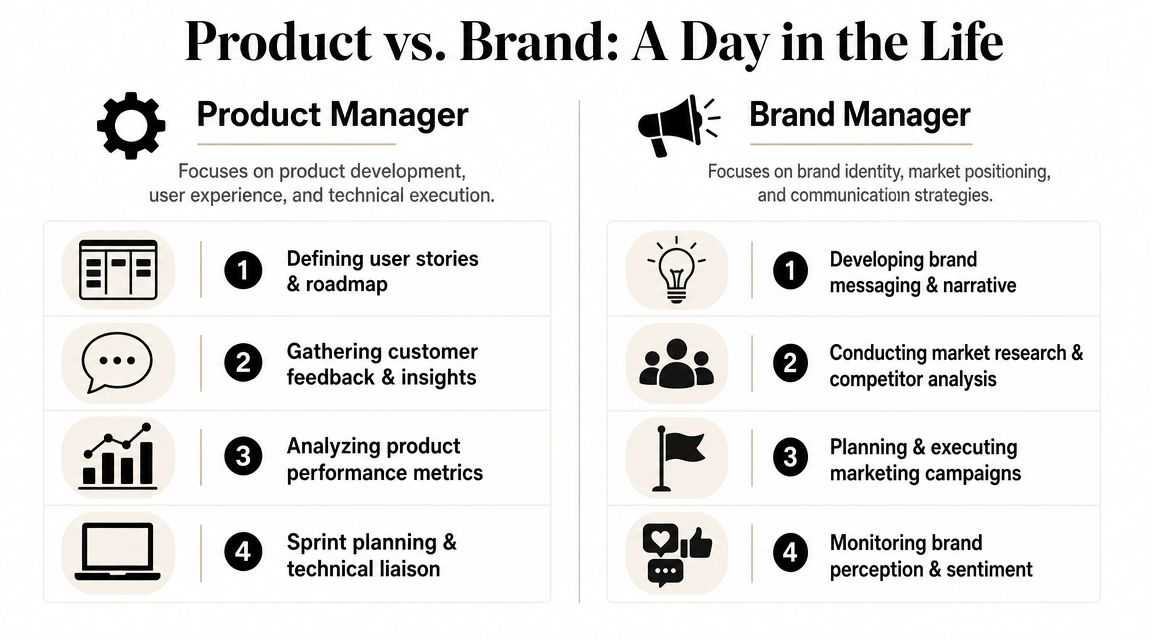
What each role is actually trying to do
A product manager owns the path from idea to market success. That means converting an opportunity into something real, guiding it through development, launch, and measurement. UXCam cites research indicating that a fully optimized product manager could increase company profits by 34.2%, and also notes that over 60% of PMs work without formal product-management processes in its review of product management statistics. That captures why the role keeps expanding. It sits directly on top of execution and business performance.
A brand manager has a different mission. They protect and strengthen perception. They make sure the market hears a coherent story, sees consistent identity, and builds trust over time. They are not deciding acceptance criteria for a feature or resolving a sprint trade-off with engineering. They are deciding whether the message, voice, visual cues, and campaign expression match the market you want to own.
If you want a clean breakdown of PM scope, this summary of product manager roles and responsibilities is a useful complement.
Practical rule: If the job spends more time deciding what gets built and whether users adopt it, you're in product. If it spends more time deciding what gets said and whether customers believe it, you're in brand.
A typical week in product management
A strong PM week usually includes a mix of discovery, prioritization, and delivery work. The tools tell the story. Think Jira or Linear for sprint execution, Figma for design review, Notion or Confluence for specs, and Amplitude or Mixpanel for product behavior.
Common PM artifacts include:
- PRDs and user stories: Clear definitions of the problem, the user, the scope, and the release expectations.
- Roadmap decisions: What makes the next quarter, what slips, and why.
- Experiment plans: Hypotheses, test design, and success criteria.
- Launch readiness notes: Dependencies across engineering, support, legal, analytics, and go-to-market.
Meetings are equally revealing. PMs spend time in standups, backlog reviews, sprint planning, design critiques, KPI reviews, and stakeholder alignment sessions. The throughline is always the same. They're trying to reduce ambiguity so a team can ship the right thing.
A typical week in brand management
Brand managers live in a different operating system. Their tools often include campaign planning platforms, social and sentiment dashboards, CMS environments, survey tools, market research inputs, and creative review workflows.
Their week tends to revolve around:
- Message development: Clarifying brand voice, narrative, tone, and promises.
- Creative direction: Reviewing campaign concepts, packaging, copy, or launch assets.
- Market and competitor reading: Tracking shifts in positioning and audience response.
- Cross-channel consistency checks: Making sure paid, earned, owned, and in-product messaging don't drift apart.
The meeting load changes too. Brand managers spend more time with creative, content, PR, social, growth marketing, agency partners, and leadership teams discussing audience interpretation rather than implementation detail.
The simplest summary is this: PMs manage decisions that change the product. Brand managers manage decisions that change the story around it.
Measuring Success with KPIs and Decision Frameworks
The easiest way to understand product management vs brand management is to ask one question at the end of the quarter: What evidence would prove you did a good job?
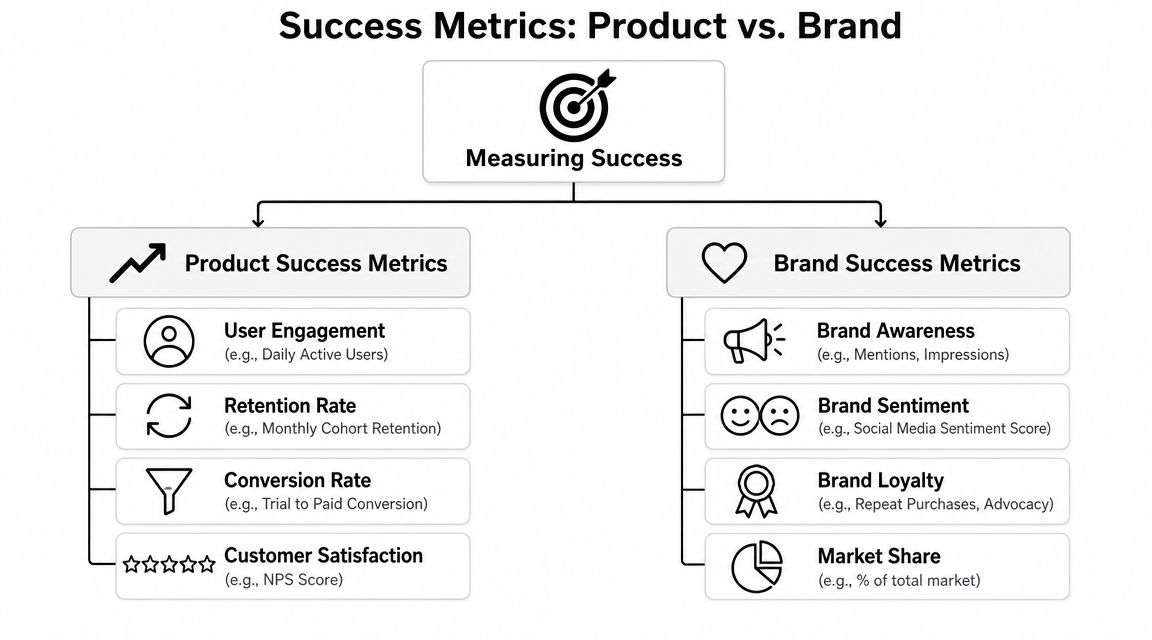
Product management is tied to feature-definition and delivery metrics. PMs own the roadmap and evaluate outcomes through product KPIs such as feature adoption rates, user engagement, funnel conversion, churn by cohort, and A/B test results on product features, while brand management centers on market perception and messaging instead of those delivery metrics, as described in this overview of PM and brand KPI differences.
The KPI split
| Decision area | Product management | Brand management |
|---|---|---|
| Product usage | Feature adoption, engagement, retention | Supports messaging around usage, but doesn't own the metric |
| Delivery quality | Acceptance criteria, usability, experiment outcomes | Reviews whether the launch expression is on-brand |
| Customer journey | Funnel drop-off, activation, churn by cohort | Awareness, loyalty, consistency of brand experience |
| Testing style | A/B tests on product behavior | Message, creative, and perception testing |
| Core orientation | Functional performance | Reputation and attachment |
That difference creates a different decision language inside the company.
How PMs make calls
A PM usually asks, “What behavior changed?” If a team shipped onboarding improvements, the PM wants to know whether more users completed setup, returned, or adopted the target feature. If the metric didn't move, the launch wasn't successful just because it shipped on time.
That's why PM work often feels harder to fake. The feedback loop can be blunt. Users either engage with the thing or they don't.
If your team struggles with metric selection, this guide on OKR vs KPI is useful because it forces separation between strategic intent and the operating measures that show whether the work is landing.
Product teams get judged by whether the product changed user behavior. Brand teams get judged by whether the market changed its perception.
How brand managers make calls
Brand managers usually ask, “What meaning did the market attach to us?” They care whether the company is being understood in the intended way, whether the experience feels consistent, and whether customers are building trust and attachment over time.
That makes brand work more cumulative. A campaign can be well executed but still hurt the brand if it attracts the wrong audience, confuses the positioning, or creates a short-term spike at the expense of long-term memory.
The trade-off is important for your career. Product managers get closer to operational truth. Brand managers get closer to market narrative. Both matter, but they train different instincts.
Career Paths Salary Expectations and Leadership Tracks
If you care about optionality, this is the section that matters most.
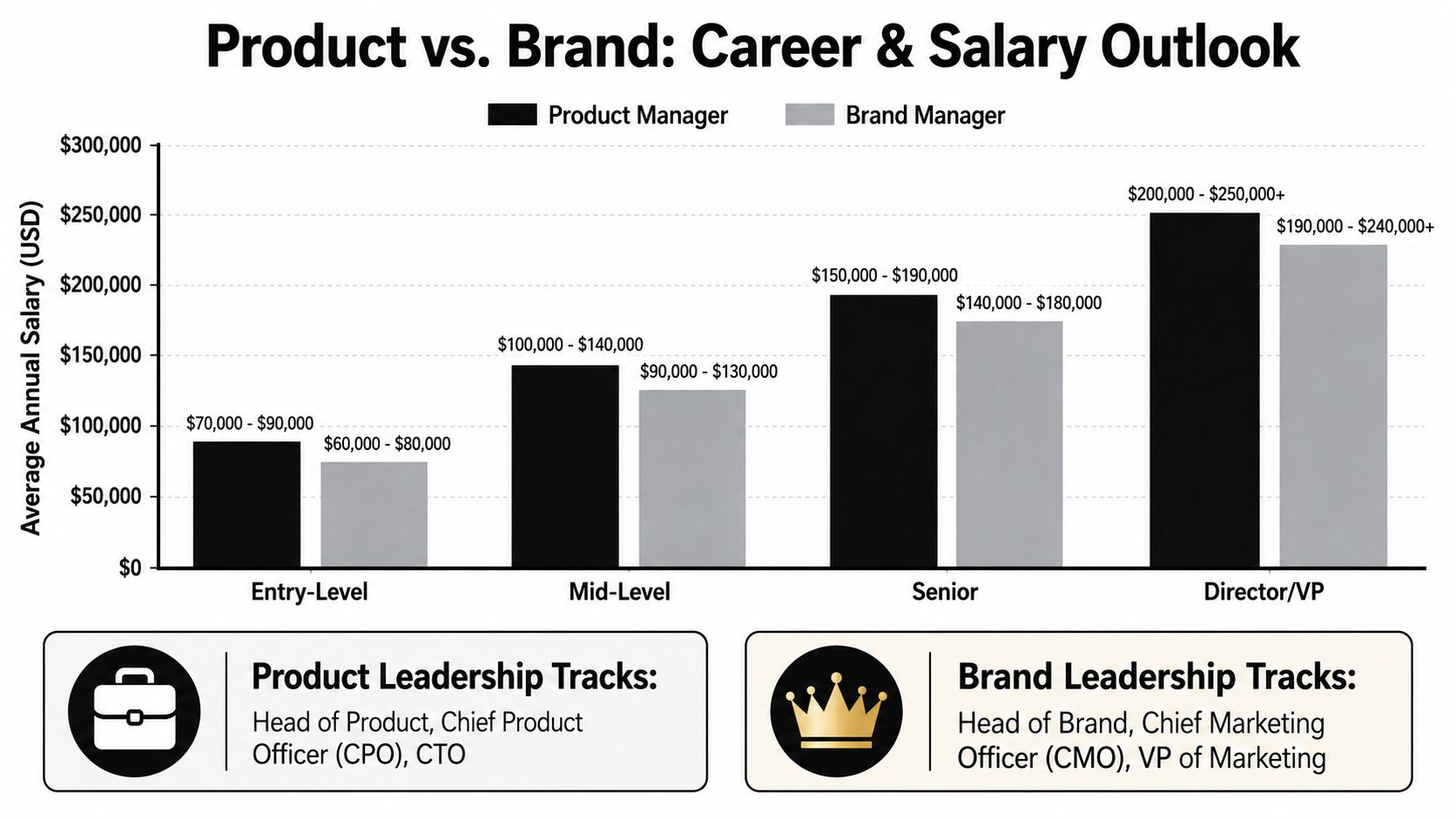
In the U.S., Indeed reports an average annual salary of $121,164 for product managers versus $91,285 for brand managers, a gap of $29,879, or about 32.8% higher for product management, in its comparison of product manager versus brand manager compensation. That spread is one of the clearest market signals about how employers value scope. Product management usually owns more direct business and delivery risk.
Why the salary gap exists
The pay difference isn't because brand work matters less. It exists because PM roles often sit at the junction of engineering, commercial outcomes, pricing, prioritization, and adoption. A product manager may not directly manage engineers, but they influence what an expensive cross-functional team does next.
That kind of decision power has downstream effects on revenue, retention, and company focus. Companies pay for that.
Brand management is still strategic. But it usually sits further from the build system and closer to reputation, message architecture, campaign execution, and long-range positioning. Those are critical capabilities, especially in consumer and category-driven businesses. They just map to a different kind of organizational advantage.
Where the paths usually lead
A product manager often builds toward one of these tracks:
- Product leadership: Group PM, Director, VP Product, Chief Product Officer.
- Business leadership: General Manager, business unit leader, startup founder.
- Specialized PM leadership: Growth, platform, AI, developer products, monetization.
A brand manager usually builds toward:
- Brand leadership: Senior Brand Manager, Director of Brand, Head of Brand.
- Marketing leadership: VP Marketing, Chief Marketing Officer.
- Category leadership: Consumer strategy, brand portfolio management, integrated marketing leadership.
Here's the practical distinction. Product management tends to create stronger optionality into GM-style roles because it trains judgment around resource allocation, product-market fit, delivery trade-offs, and measurable outcomes. Brand management tends to create stronger optionality into CMO-style roles because it trains market positioning, creative leadership, audience understanding, and multi-channel consistency.
A lot of professionals underestimate how hard that optionality is to recover later. If you spend years in brand and then want to move into core product, hiring managers will often ask whether you've owned roadmaps, trade-offs, feature outcomes, or technical cross-functional work. If you spend years in product and later want to move toward go-to-market or growth, the transition is usually easier because PMs already work with messaging, pricing inputs, launches, and cross-functional coordination.
For adjacent roles, especially in commerce-heavy companies, this guide to 2026 ecommerce manager competencies is worth reviewing because it shows how hybrid operators get evaluated when product, merchandising, and marketing start to blur.
A broader map of the product management career path is useful if your long-term target is VP Product, CPO, or GM.
Here's a good checkpoint for your own decision:
| If you want to become | Better default path |
|---|---|
| GM or startup operator | Product management |
| CPO or Head of Product | Product management |
| CMO or Head of Brand | Brand management |
| Growth leader with product depth | Product management, then growth specialization |
| Consumer marketing leader | Brand management |
This conversation also gets easier when you hear how practitioners describe the work in their own words.
Career filter: Choose product if you want responsibility for business decisions that show up in the product. Choose brand if you want responsibility for the story the market tells about the company.
Collaboration in Action A Product Launch Case Study
The cleanest way to understand the boundary is to watch both roles work on the same launch.
A SaaS company is preparing to release an AI-powered meeting summary feature. The product manager, Alex, owns the product outcome. The brand manager, Maria, owns how the launch will be understood outside and inside the market. Both care about success. They just define it differently.
Week one with discovery and framing
Alex starts with the problem. Support tickets, sales calls, and user interviews all point to the same friction: people leave meetings without a usable record of decisions and next steps. Alex writes the PRD, scopes the initial version with engineering, and aligns with design on the workflow inside the app.
Maria joins early, not late. She doesn't tell Alex what feature to build. She asks sharper market questions. Is this a productivity feature, a collaboration feature, or an AI assistant capability? Are they promising time savings, better accountability, or less admin work? The answer changes naming, launch copy, homepage placement, and who the campaign targets.
That's the first friction point. Alex wants a descriptive feature name because it sets clear user expectations in the product UI. Maria wants language that fits the broader category story. Both are right from their seat.
Week two with pre-launch alignment
The strongest teams create a shared launch brief. It usually includes:
- PM-owned inputs: User problem, target persona, functional scope, limitations, launch criteria, instrumentation plan.
- Brand-owned inputs: Message hierarchy, approved claims, narrative angle, naming guidance, visual language, channel considerations.
- Joint decisions: Audience priority, launch timing, internal FAQ, homepage treatment, executive talking points.
Weak collaboration quickly becomes evident. PMs often assume messaging can be figured out after the feature is done. Brand managers sometimes ask for campaign-level polish before the product experience is stable. Both approaches create rework.
The healthier pattern is simple. Product leads with truth. Brand turns that truth into something memorable and coherent.
When launches go badly, it's usually not because one team failed. It's because product and brand optimized for different definitions of clarity.
Launch week and post-launch review
On launch day, Alex watches product behavior. Are users finding the feature? Are they completing setup? Do they come back after the first use? Are support tickets rising around trust, accuracy, or usability?
Maria watches audience response. Are press and social conversations framing the feature the way the company intended? Does the launch strengthen the company's position, or does it create confusion about what the product is becoming? Are sales and customer success repeating the right story?
The debrief should include both views.
Alex might say the feature shipped, users tried it, but repeat usage is weaker than expected because summaries aren't editable enough. Maria might say the campaign landed well, but the term “AI assistant” overreached and created expectations the current version can't meet.
Both insights matter. One improves the product. The other protects trust.
That case is why I tell early-career operators not to reduce product management vs brand management to “internal vs external” or “technical vs creative.” The distinction is decision ownership. In a launch, the PM owns whether the product earns adoption. The brand manager owns whether the market forms the right perception around that release.
The AI Disruption and How Both Roles Are Evolving
Two candidates join the same AI company in the same year. Three years later, one is being groomed to own a product line. The other is on track to run brand or growth marketing. AI is making that split more pronounced, and the long-term career optionality is different.

How AI changes product management
AI product work is pulling PMs closer to the operating core of the business. The job now includes model behavior, evaluation criteria, fallback flows, latency trade-offs, and user trust. PMs do not need to write production code, but the strong ones can discuss why a system fails, how to measure output quality, and what should happen when the model is uncertain.
That shift matters for career trajectory. PMs who can ship AI features and improve adoption often move toward group PM, product director, GM-style roles, or founder paths because they are learning how the product works, how it makes money, and where it breaks. If you want a practical starting point, this guide to AI product management careers and skills is useful.
AI also raises the salary ceiling for PMs with real technical judgment. Generalist PMs will still have a place, but the market is paying a premium for people who can connect model capability to customer value and operating metrics.
How AI changes brand management
Brand managers are getting faster, not less important. Generative AI can produce campaign drafts, audience summaries, concept variations, and message testing inputs in hours instead of weeks. That compresses execution time.
It also reduces the premium on pure content production.
The durable value in brand now sits in judgment. Good brand managers know which claims the company can support, which narratives strengthen category position, and which shortcuts weaken trust. In AI companies, that matters even more because the product can change weekly while customer memory lasts much longer.
The leadership path is different from product. Strong brand managers can still build toward VP Brand, VP Marketing, or CMO tracks, especially if they expand into positioning, demand generation, and corporate narrative. The ceiling is real, but the path is narrower than product if your goal is broad business ownership.
What to learn now
If the question is career resilience, learn the work that teams will not hand entirely to AI tools.
For PMs:
- Learn evaluation design: Define good output, bad output, and failure thresholds before launch.
- Get strong in product analytics: SQL, Amplitude, Mixpanel, experimentation, and funnel review still separate solid PMs from slide-makers.
- Practice system thinking: Understand where the model is used, where humans intervene, and what happens when accuracy drops.
- Build communication range: The PM who can align engineers, design, legal, and go-to-market teams has more leadership upside.
For brand managers:
- Use AI to generate options, then edit hard: Speed matters, but distinctiveness matters more.
- Set clear brand guardrails: Voice, claim boundaries, review rules, and escalation paths protect the company.
- Get better at audience interpretation: Synthesizing sentiment is easier now. Knowing what to do with it is still rare.
- Broaden beyond brand craft: Operators who can connect story to pipeline, retention, and category position have better odds of reaching CMO scope.
A practical note. If you want ongoing product and AI-oriented career content, Aakash Gupta publishes resources across newsletters, podcasts, and coaching that are relevant to PM skill building.
My advice to early-career operators is straightforward. Choose product if you want the broadest route into GM-style leadership, tighter connection to revenue and product decisions, and usually a higher salary ceiling over time. Choose brand if your edge is narrative, market insight, and shaping how the company is remembered, and if the CMO track fits your strengths better. AI is not blending these careers together. It is making the trade-off clearer.
