You're in a review with the CEO, engineering lead, and go-to-market team. Someone asks a deceptively simple question: “Are we launching an MVP or an MMP?” If you answer casually, you've already lost the room.
That choice decides what your team optimizes for, what quality bar you hold, who sees the product first, and how much reputational risk you're accepting. In AI products especially, the old shortcut of “just ship an MVP and learn” breaks down fast. A weak onboarding flow in a photo-sharing app is annoying. A flawed AI workflow in hiring, finance, healthcare, or enterprise decision support can damage trust on day one.
Strong PMs treat MVP vs MMP as a release strategy, not a vocabulary test. Weak PMs use the terms interchangeably and end up with a product that is too polished to learn cheaply and too rough to sell credibly.
The Career-Defining Choice Between MVP and MMP
The PMs who move up fastest usually get one thing right. They know what decision they're making before they start arguing about features.
If you call something an MVP, you're saying the team's first job is to reduce uncertainty. You're buying learning. If you call it an MMP, you're saying the team's first job is to earn trust from real customers and support a real launch. You're buying credibility.

At Google, Meta, and AI startups, leaders rarely reward PMs for using the right jargon. They reward PMs who choose the right operating mode. That's what affects staffing, sequencing, design depth, QA expectations, legal review, and launch planning.
Why this decision changes your next six months
A bad MVP decision often creates one of two messes:
- Overbuilt learning product. You spend months polishing something that should've been a thin experiment.
- Underbuilt market launch. You take something fragile to customers and call it a release when it's still a prototype.
Neither outcome helps your career. The first burns time and budget. The second burns trust.
Practical rule: If leadership expects press, revenue, customer success readiness, or broad adoption, you're no longer discussing a classic MVP.
The PM who can say, “This should be a controlled learning release, not a market-facing launch,” sounds senior. So does the PM who says, “This category is crowded, our demand is already validated, and our first release must feel dependable enough to sell.”
What modern PMs need to internalize
For AI-native teams, this isn't only about speed versus completeness. It's about where failure is acceptable.
Use this lens in your next product review:
| Decision lens | MVP | MMP |
|---|---|---|
| Core question | Should we build this? | Can we sell this confidently? |
| Team mindset | Experiment | Launch |
| Exposure level | Limited users | Broader market |
| Quality expectation | Sufficient for learning | Sufficient for trust |
| Career signal from the PM | Good at reducing uncertainty | Good at shipping credible products |
If you can diagnose that distinction quickly, executives trust your judgment more. That's one of the most valuable skills a PM can build.
Defining the Core Concepts MVP and MMP
The cleanest way to understand MVP vs MMP is to start with purpose, not features.
The Minimum Viable Product concept was coined by Frank Robinson in 2001 and later popularized by Eric Ries, who defined it as the version of a new product that lets a team collect the maximum amount of validated learning about customers with the least effort, as summarized in this overview of MVP, MLP, and related product stages. That definition still matters because it reminds PMs that an MVP is a learning instrument, not a miniature finished product.
What an MVP really is
An MVP exists to answer a narrow question with real user behavior. Will users try the workflow? Do they understand the value? Does the core problem matter enough for repeat use or deeper engagement?
That's why strong teams often start smaller than they're comfortable with. A prototype, concierge workflow, limited beta, or single-feature release can all qualify if they generate meaningful learning. If you want a tactical primer on how to build and validate your MVP, that resource is useful because it keeps the focus on assumption testing rather than feature accumulation.
A lot of PMs still confuse “minimal” with “sloppy.” That's a mistake. An MVP can be narrow without being broken.
What an MMP really is
An MMP, by contrast, is the first version that's ready to face the market as a real product offer. It's not just usable. It's credible enough that a broader audience can adopt it without feeling like they volunteered for your internal experiment.
That shift changes almost everything:
- Positioning matters now
- Onboarding matters now
- Support paths matter now
- Product quality matters now
- Monetization matters now
A useful companion read is Aakash Gupta's piece on what's the meaning of MVP, especially if you want a sharper mental model for what belongs in an early validation release and what doesn't.
An MVP asks for evidence. An MMP asks for commitment.
That single distinction helps PMs avoid the most common planning error in early-stage roadmaps. They build a half-launch and call it an MVP, or they build a half-experiment and try to sell it like an MMP.
The simplest way to remember the difference
Use this framing in stakeholder meetings:
- MVP means “prove the hypothesis.”
- MMP means “earn the customer.”
If your team needs to discover whether the core workflow creates value, start with MVP logic. If your team already knows the demand exists and now needs something customers can trust, buy, and recommend internally, you're in MMP territory.
Head-to-Head Comparison Goals Risks and Metrics
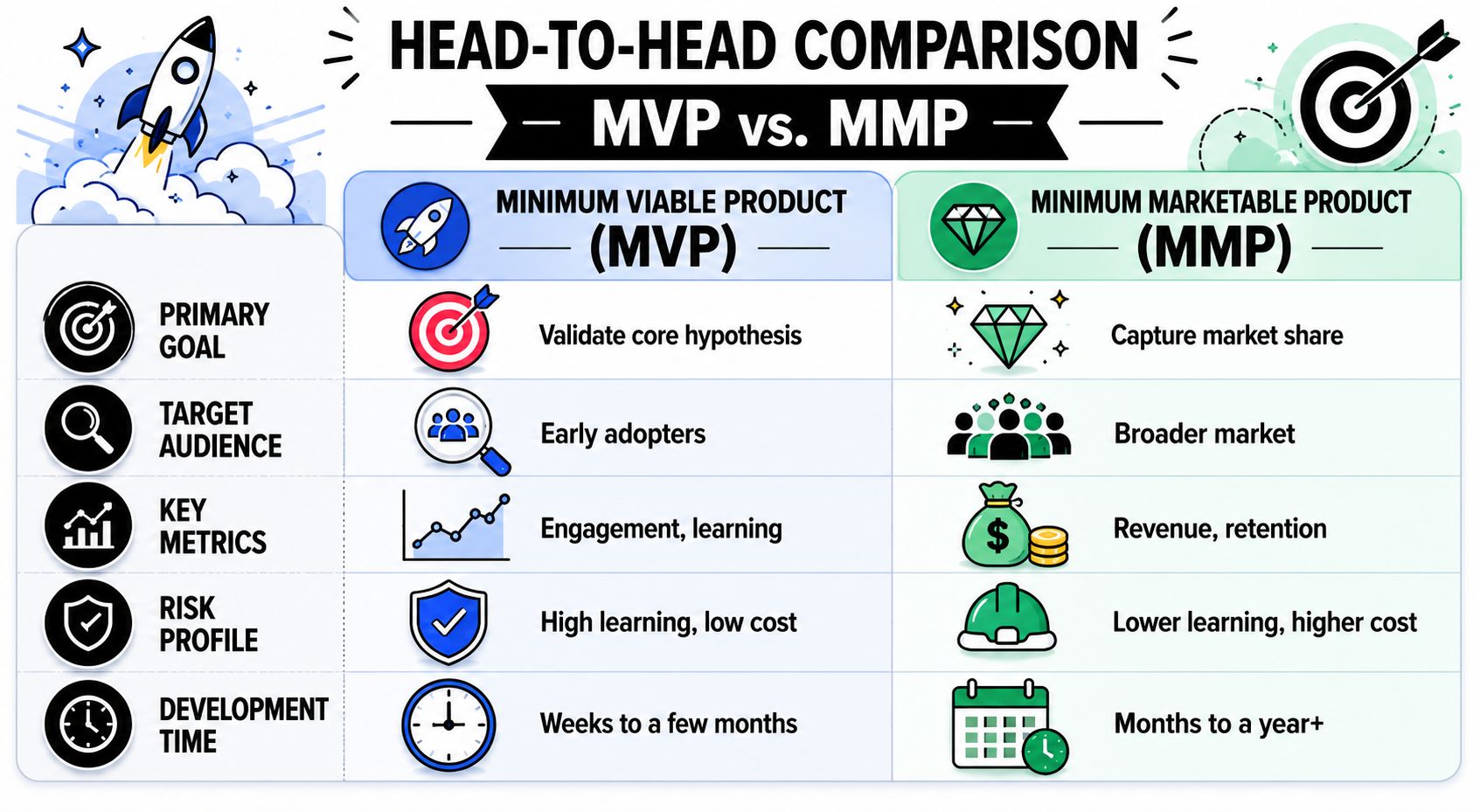
Most confusion in MVP vs MMP debates comes from teams comparing feature lists instead of comparing operating intent. Start with a side-by-side view.
| Criteria | MVP | MMP |
|---|---|---|
| Primary goal | Validate assumptions and learn quickly | Launch credibly and support monetization |
| Target audience | Early adopters, testers, limited cohorts | Broader market, paying customers |
| Scope | Core workflow only | Complete enough experience for real use |
| Success signals | Behavior, feedback, evidence of value | Revenue, retention, launch performance |
| Main risk | Building something nobody wants | Launching something customers won't trust |
| Development time | A practical rule maps MVP to roughly 6–16 weeks in one product strategy source, while a fuller marketable product sits closer to 6–18 months in that same guidance, summarized in this MVP strategy article | Same source and decision rule |
Goal matters more than scope
In practice, the deepest distinction is simple. MVPs are built to learn. MMPs are built to sell.
One practical product-development source describes an MMP as the smallest version ready for market launch, often after an MVP. That same source notes that MVP development can take about 2 to 6 months when focused on a single core feature, while an MMP is refined enough for general release, monetization, and stronger market competitiveness, as explained in this product launch comparison.
A PM who misses this difference often creates roadmaps that drift. Engineering thinks they're validating. Sales thinks they're launching. Marketing thinks they're waiting for polish. Nobody is aligned.
Audience changes the bar
An MVP is usually shown to people who tolerate rough edges because they care about the problem. These are your patient users, design partners, or controlled beta participants.
An MMP is for users who compare you with alternatives. They don't care that you're early. They care whether the product works.
If your target user is evaluating you against an incumbent, your first public release can't behave like a lab experiment.
That's why MMP work usually adds operational layers, not just product layers. Customer support, lifecycle communication, pricing logic, cancellation handling, and onboarding all start to matter. For SaaS PMs thinking about post-purchase retention as part of market readiness, tools like revenue-saving cancellation flows for SaaS are useful because they reflect the practical mechanics of shipping a product that customers can adopt and stay with.
Metrics should match the release type
The wrong metric set can ruin your judgment.
For an MVP, I'd look for evidence tied to the core assumption. Are users finishing the key action? Are they coming back? Do they understand the promise? Is the observed behavior strong enough to justify more buildout?
For an MMP, the center of gravity shifts. Now you care about commercial and operational signals. Revenue quality, retention, conversion friction, support burden, and the health of the customer journey matter much more. A good refresher is this guide on metrics for product managers, because the measurement framework should change when you move from validation mode to market mode.
Risk doesn't disappear. It changes shape
MVP risk is mostly product risk. You're trying not to waste time building something people don't value.
MMP risk is mostly market risk. You may have built something useful, but the launch still fails if the offer is weak, the experience feels incomplete, or buyers don't trust it enough to switch.
PMs who rise into senior roles know how to name that risk precisely. That's what lets them ask for the right level of quality, process, and investment.
The PMs Decision Framework When to Choose Which
A PM in a Monday planning review has to make a call. Ship a thin version now to test demand, or hold the line until the product can survive real customer scrutiny. That decision shapes burn, learning speed, brand risk, and often your credibility with leadership.
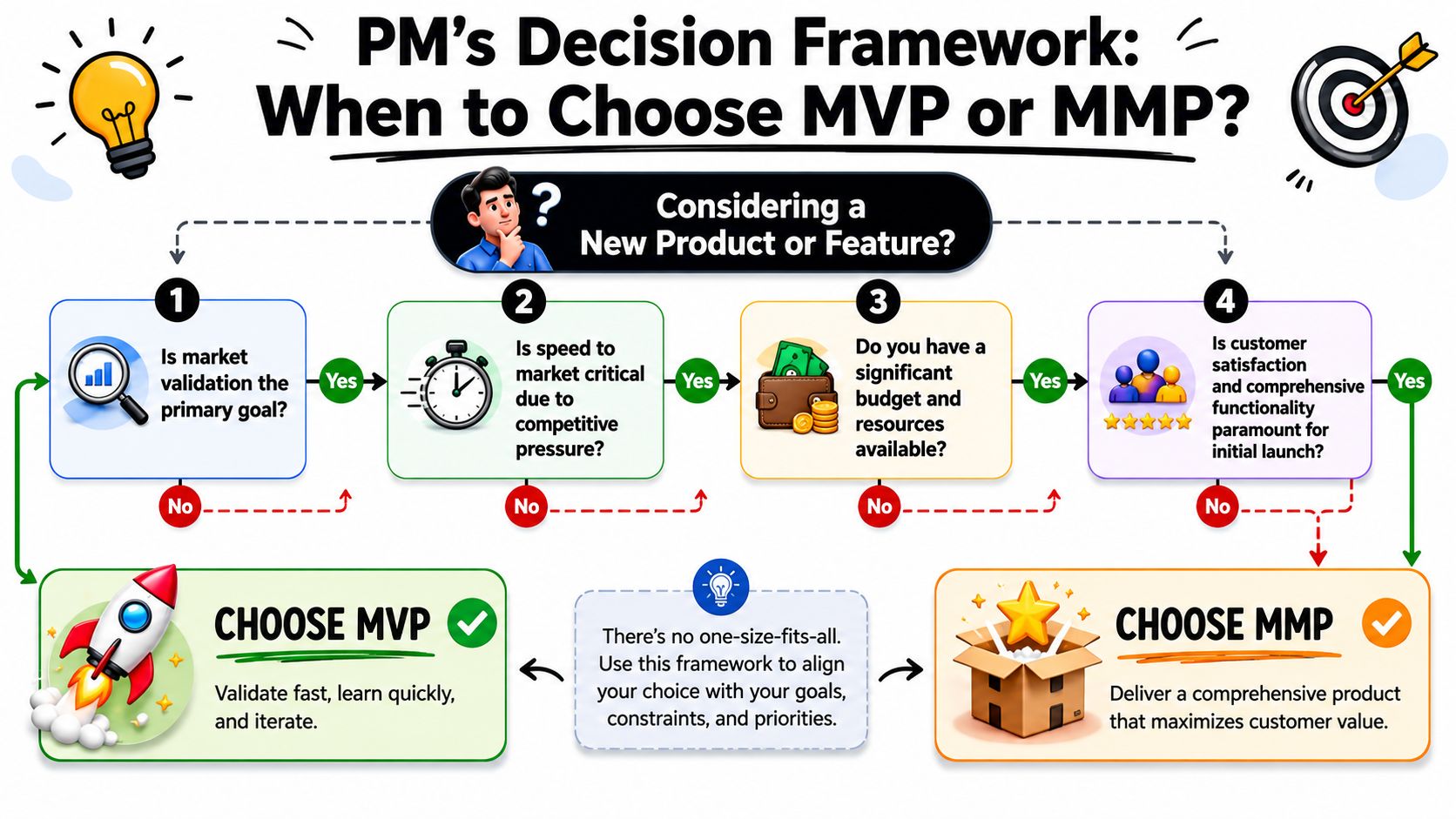
The best teams answer one question first. What kind of mistake can we afford to make?
If the affordable mistake is building too much before proving demand, use MVP logic. If the unacceptable mistake is launching something that looks incomplete, unreliable, or unsafe in front of customers, use MMP logic.
Start with the uncertainty that matters
PMs often frame this as a product question. It is usually a risk allocation question.
Use these four lenses in planning:
Problem uncertainty
Are you still testing whether the pain point is real, painful enough, and frequent enough to matter?Behavior uncertainty
Do you need to see what users do, not what they say in interviews?Commercial uncertainty
Is demand already clear, with the open question being whether the offer is credible enough to convert and retain?Reputation uncertainty
Will a weak first impression hurt trust, invite comparisons you cannot win yet, or create internal doubt about the strategy?
The first two usually point to MVP. The last two usually point to MMP.
That sounds simple. In practice, it is where strong PMs separate themselves.
A junior PM asks, “What is the smallest feature set we can ship?” A strong PM asks, “What is the smallest release that still fits the consequence of failure?” Google could test many consumer features behind flags because distribution and trust were already strong. A startup selling AI workflow automation to finance teams does not get that margin for error. One bad launch can freeze pipeline, trigger security reviews, and make the next six months harder.
Check exposure before scope
I use a simple rule. Exposure drives quality bar.
An internal tool for one ops team can ship rough if the feedback loop is fast and the blast radius is small. A self-serve SaaS launch, a press-backed release, or an AI product making visible recommendations needs a higher floor on onboarding, reliability, support readiness, and message clarity.
Ask these questions in order:
- Who sees it first? Internal users, design partners, beta customers, or the open market?
- What happens if it fails? Mild confusion, churn, legal review, angry screenshots on X, or a blocked enterprise deal?
- How reversible is the decision? Can you patch it discreetly this week, or will customers remember the failure next quarter?
- What are you buying with speed? Real learning, revenue, strategic positioning, or executive confidence?
This is the practical center of the decision. MVP is a tool for reducing uncertainty cheaply. MMP is a tool for earning trust at the moment of exposure.
To sharpen that judgment, this framework for making decisions is useful because it helps PMs separate reversible experiments from launch calls that create lasting consequences.
Use a meeting-ready decision tree
In product reviews, I push teams through a short sequence.
If demand is still unclear and the release can be contained, choose MVP. If demand is clear but customer confidence is fragile, choose MMP. If the team says “we need to learn” but the product will be public, paid, or tied to brand promise, challenge the framing. You may still need learning, but not through a public-quality MVP.
That is especially true in AI. A weak AI release does not only produce bad metrics. It can produce screenshots, trust loss, compliance questions, and a narrative that the company ships demos instead of products. Meta can absorb more public experimentation than an early-stage AI startup. Your release standard has to match your margin for reputational error.
A short explainer can help your team align on the same language before the planning debate gets muddy:
The shortcut I use
Choose MVP when failure is cheap, contained, and informative.
Choose MMP when failure is public, sticky, or trust-damaging.
That is the decision framework. Not learn versus sell. Cost of error versus quality of evidence, filtered through exposure, trust, and reversibility.
The Calculus for AI and High-Stakes Products
The classic lean startup playbook breaks when the cost of being wrong is too high.
In AI, fintech, healthcare, and enterprise workflow products, the MVP question can't be limited to “What is the smallest thing we can ship to learn?” The better question is “What is the smallest thing we can expose without damaging trust?”
Why trust changes the release boundary
Independent guidance on release strategy for regulated or trust-sensitive products points out a nuance that many PMs skip. An MMP must function at a level that protects customer trust and brand reputation, especially in domains like AI or fintech where even a small defect can create outsized risk, as discussed in this practical guide to MVP and MMP choices.
That's the heart of the modern mvp vs mmp debate.
If you're building an AI assistant for internal brainstorming, a rougher release may be acceptable. If you're building AI for claims decisions, financial guidance, clinical support, or security workflows, your “minimum” has to include safeguards, reliability checks, clear user expectations, and escalation paths.
A more useful model for AI PMs
I often advise PMs to think in three release classes instead of two:
Internal-only MVP
Best when the goal is learning and the blast radius is low.Controlled beta with strong guardrails
Best when you need real usage but can't tolerate full public exposure.Marketable launch with trust protections
Best when customers will rely on the outcome and your brand is on the line.
That middle option matters a lot for AI startups. It gives teams room to learn without pretending that every product should start as a public MVP.
For high-trust products, “viable” has to include reliability, not just functionality.
This is also where cost discipline matters. AI PMs often underestimate how experimentation, eval loops, fallbacks, and model selection affect unit economics. If you're planning an AI product with heavy inference usage, a practical resource like this Guide to GPT-5 API spending can help frame the financial side of release decisions alongside product quality.
What good PMs do differently here
They don't let stakeholders hide behind startup slogans. They ask harder questions:
- What harm can a bad answer create?
- Who reviews edge cases?
- Can users detect when the model is uncertain?
- Do we need human-in-the-loop controls?
- Is the first release testing desirability, or supporting critical work?
If you're building toward AI leadership roles, this is the skill that matters more than prompt tinkering. You need to understand product trust as a design constraint. This overview of artificial intelligence product management is a useful reference if you're building that muscle set.
Roadmap and Timeline From MVP to MMP
The healthiest way to think about MVP and MMP is as stages in a progression, not rival ideologies.
One product-development source frames MVP development as a 2–6 month build focused on a single killer feature, while the MMP adds enough functionality and UX polish to support launch and monetization, which requires more time and investment, as outlined in this comparison of MVP and MMP strategy.
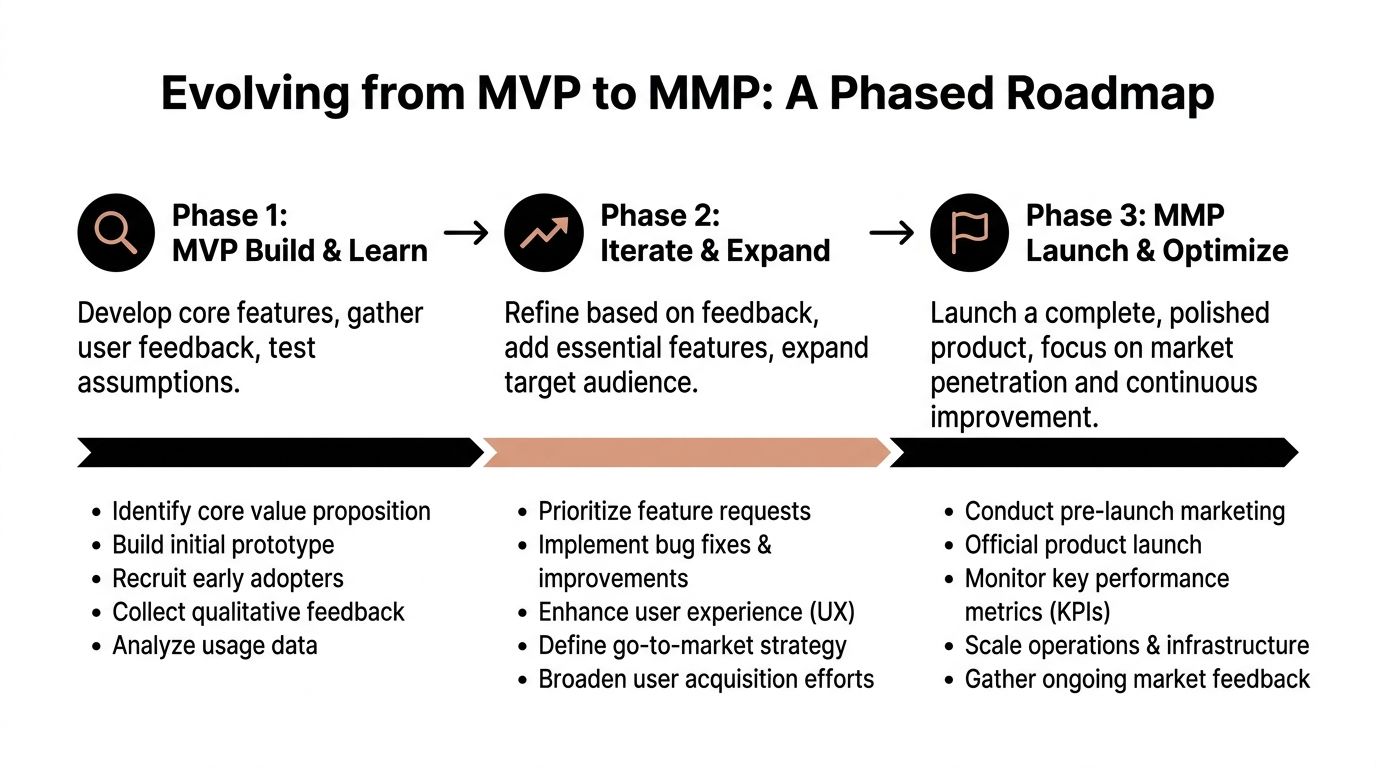
Phase one build to learn
Teams isolate the core job to be done and strip away everything that doesn't help answer the main product question.
Typical focus areas:
- Narrow workflow that proves the central value
- Fast feedback loops with design partners or early adopters
- Instrumentation around the key action, not vanity dashboards
- Manual ops where needed to avoid premature automation
The PM's job here is protecting focus. Most MVPs fail because PMs keep adding “just one more” requirement from stakeholders.
Phase two refine what the evidence supports
Once the team sees clear usage patterns, the roadmap should tighten around what users need to complete the job reliably.
This phase usually includes:
| Focus area | What changes |
|---|---|
| UX | Reduce friction in core paths |
| Reliability | Fix instability and edge cases |
| Packaging | Clarify value proposition and onboarding |
| Scope | Add only what completes the use case |
This is also where PMs earn credibility with leadership. They need to translate messy early signals into a disciplined build plan, not a wish list.
Phase three launch to market
Now the question is no longer “can this work?” It's “can customers adopt this with confidence?”
That means the team expands beyond feature delivery:
- Go-to-market readiness with clear positioning
- Support readiness so users aren't stranded
- Billing or pricing flow if monetization is in scope
- Quality bar that matches brand promise
Teams should not rush from first learning to broad launch. They should raise the quality bar deliberately as user exposure increases.
PMs often become more strategic, transitioning from managing a backlog to managing the company's promise to the market.
Real World Playbooks From Dropbox to Perplexity
Dropbox remains the cleanest example of MVP thinking. The team validated demand with a simple demonstration of the product concept before building a fully scaled experience. That's classic PM judgment. Learn first, invest after.
Figma's early approach reflected a different reality. Collaborative design software had to feel reliable enough for real work, even in early form, because users were comparing it against existing tools and evaluating whether browser-based design could be trusted. That's much closer to MMP logic than many PMs admit.
Perplexity is the more relevant modern lesson for AI PMs. AI search can't just be novel. It has to feel trustworthy enough that users return for real tasks. In AI products, the first public experience often shapes whether users see the product as helpful, risky, or gimmicky. That's why the strongest AI teams don't obsess only over model capability. They shape citation patterns, UX clarity, and guardrails around confidence.
If you want more examples of how different products choose different levels of thinness at launch, this roundup of minimum viable product examples is worth studying.
The bigger lesson is simple. Great PMs don't copy the Dropbox playbook blindly, and they don't overcorrect into launching polished products too early. They match the release strategy to the market, the user expectation, and the cost of being wrong.
If you're serious about becoming the kind of PM who can make calls like this with confidence, Aakash Gupta publishes practical resources on product strategy, growth, PM skill building, and career development that are directly useful for aspiring PMs, working PMs, and product leaders.
