In product management, MVP usually means Minimum Viable Product. In sports, it usually means Most Valuable Player, and that difference matters more than many realize.
A lot of PMs run into the same moment. Leadership asks for an “MVP,” engineering hears “small first release,” design hears “rough draft,” sales hears “something demoable,” and a non-tech stakeholder still thinks you're talking about a sports award. That confusion sounds harmless, but it causes bad scoping, bad expectations, and bad career outcomes for PMs who should know better.
If you're searching for what's the meaning of MVP, the useful answer isn't just the definition. It's how to use the term precisely enough to ship something that teaches you whether a product idea deserves more investment. That's where strong PMs separate themselves, especially in AI products where teams can waste months polishing a model before they've even validated the user problem.
The MVP Misunderstanding
A PM gets pulled into a planning review. The ask sounds simple: launch an MVP for a new workflow, maybe an AI assistant, maybe a document feature, maybe a new creator tool. Two weeks later, the spec has authentication edge cases, admin controls, analytics dashboards, export options, and a roadmap appendix that looks like a full launch plan.
That's usually the first sign the team doesn't mean the same thing when they say MVP.
Historically, MVP in the product sense was coined and defined in 2001 by Frank Robinson and later popularized by Steve Blank and Eric Ries. In sports, MVP still means Most Valuable Player, which dictionary sources define as an award for the standout contributor in a game, season, or championship, as noted in the historical overview of minimum viable product. In product work, though, the term almost always points to the smallest usable release that helps a team learn something important.
Why this misunderstanding hurts PMs
When people confuse MVP with “cheap version,” they underbuild and embarrass the team. When they confuse it with “first phase of the full product,” they overbuild and lose the learning window.
The strongest PMs use MVP as a forcing function:
- Clarify the hypothesis: What exactly are we trying to learn?
- Reduce waste: What can we remove without losing the signal?
- Align stakeholders: What will this launch prove, and what won't it prove?
- Protect credibility: What level of quality is essential?
Google and Meta teams don't advance by shipping giant first versions of every idea. They advance by narrowing risk early, learning quickly, and scaling only after the evidence gets stronger. The same principle applies whether you're testing a creator workflow, an OCR feature, or an AI assistant. If you're exploring document extraction use cases, a technical resource like this Practical guide to OCR systems is useful because it reminds PMs that the hard part isn't only model capability. It's choosing a thin slice of value you can validate quickly.
Practical rule: If two stakeholders can use “MVP” in the same meeting and mean different things, the PM hasn't done the job yet.
A good way to ground that conversation is to tie the MVP to discovery work, not delivery theater. This breakdown of product discovery is a useful companion because it pushes the team back to assumptions, evidence, and user behavior before feature accumulation takes over.
Deconstructing the Minimum Viable Product
An MVP is not “the smallest thing we can ship.” It's the smallest thing that can teach us whether the product idea has real traction with real users.
That distinction matters because plenty of teams build something tiny that no one wants, no one understands, or no one can use. That's not disciplined product management. That's just a small mistake.
According to Agile Alliance's glossary, quoting Eric Ries, an MVP is the version of a new product which allows a team to collect the maximum amount of validated learning about customers with the least effort in their MVP definition. That's the sentence many PMs should put at the top of the spec.
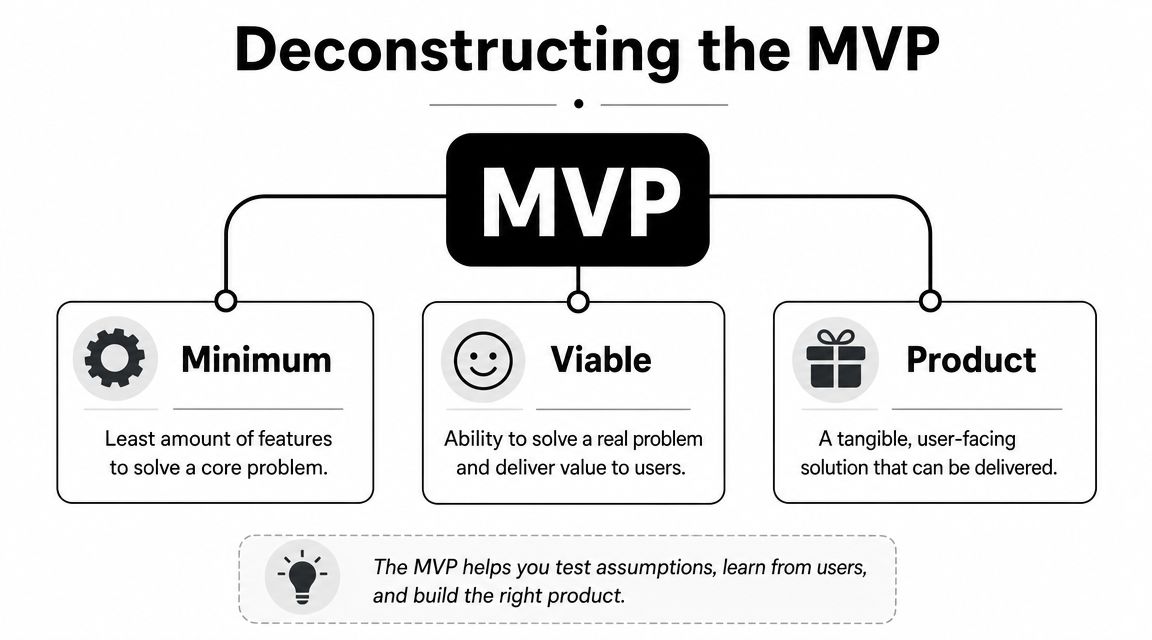
Minimum means least effort to test the core belief
“Minimum” doesn't mean low effort for every function. It means low effort relative to the learning goal.
If your hypothesis is “users will trust AI-generated summaries enough to use them in a daily workflow,” then the minimum may still require review controls, visible source text, and reliable output formatting. Remove those and you may save build time, but you also destroy the test.
Ask these questions:
- What assumption carries the most risk? Start there.
- What feature is essential to expose that risk? Build that.
- What can remain manual behind the scenes? Keep it manual if users don't care.
Viable means valuable enough to create real behavior
Weak MVPs usually fail. This happens when teams obsess over minimum and forget viable.
A viable product solves a real problem well enough that someone will actively engage with it. That doesn't mean polished across every edge case. It means the user can complete the core job and react to the value proposition, not just the missing pieces.
The test isn't “Will users tolerate this?” The test is “Will users choose this to solve the problem we care about?”
For AI PMs, viability is even stricter. If the model output is so inconsistent that users can't trust the workflow, you're not testing the market. You're testing frustration tolerance.
Product means something usable, not a slide
A prototype can help with feedback. An MVP goes further. It's user-facing enough to observe real behavior.
That could be a landing page. It could be a lightweight app. It could even be a service that appears automated but runs manually behind the scenes. The critical point is that users interact with something concrete.
The classic skateboard-to-car analogy is still useful if you apply it correctly:
- Skateboard: Delivers motion for a narrow use case.
- Scooter: Improves control for a slightly broader use case.
- Bicycle: Solves the mobility problem more effectively.
- Car: Expands comfort, range, and complexity later.
The lesson isn't “ship ugly.” It's “ship a complete but narrow value loop.”
If you want a structured way to reduce assumptions before you build, a lean canvas is one of the fastest tools to use. It forces the PM to tie the MVP to a customer problem, unfair advantage, and key hypothesis instead of a feature wishlist.
A PMs Toolkit of Common MVP Types
Not every MVP should be code-heavy. Strong PMs choose the MVP type that matches the uncertainty they need to reduce.
If the biggest risk is demand, don't start with infrastructure. If the biggest risk is workflow fit, don't start with brand campaigns. Match the test to the question.
Four MVP types worth using
| MVP Type | Description | Best For Testing | Real Company Example |
|---|---|---|---|
| Landing Page MVP | A page that explains the value proposition and captures interest or intent | Whether the problem and message resonate | Dropbox used a simple explainer approach early to gauge interest |
| Concierge MVP | A fully manual service delivered to a small group of users | Whether users want the outcome enough to engage deeply | Early wealth or coaching products often start this way before software |
| Wizard of Oz MVP | A product that looks automated on the front end but is manual behind the scenes | Whether users value the experience before automation is built | Zappos is the classic example |
| Single-Feature MVP | A focused product that does one job well | Whether one core use case is strong enough to justify expansion | Many early social and productivity products begin this way |
Landing page MVP
This is the fastest way to test whether people care about the promise. It's useful when the biggest uncertainty is market pull, not implementation.
Dropbox is the example PMs still reference because the team tested interest before building a full-scale product experience. That approach works well when users can understand the value proposition quickly.
Use it when:
- You need message clarity: Does the problem statement resonate?
- You're testing demand direction: Are people curious enough to sign up or request access?
- You want cheap signal early: Before design and engineering commit heavily
Don't use it when the product value only becomes obvious through interaction. Many AI tools fall into that category.
Concierge MVP
A concierge MVP means humans deliver the service manually to a small set of users. This works especially well when the workflow is complex, high touch, or not yet stable.
For PMs, this is one of the best career-building tools because it forces close user contact. You learn objections, handoff failures, trust issues, and “must-have” moments faster than you ever will from dashboards alone.
Good fit:
- Enterprise workflows
- Operations-heavy products
- AI copilots where output quality needs human review
The trade-off is scale. You learn extensively, but from fewer users.
Wizard of Oz MVP
This one looks automated to the user, but the team is doing significant manual work behind the scenes. Agile Alliance explicitly notes that an MVP can be a service that is manual behind the scenes as long as it reveals how customers respond, a point covered earlier through the Eric Ries framing.
Zappos remains the classic example because it tested whether people would buy shoes online without first building a full retail operation. That's the right instinct for many AI products today. Before you build orchestration, retrieval, ranking, and monitoring layers, ask whether users even value the final result.
Operator insight: If a human can simulate the intelligence for a narrow workflow, you can often validate the need before you invest in automation.
Single-feature MVP
Some products need software from day one. In that case, the right MVP is often a sharply scoped product that does one thing extremely well.
Early social apps, lightweight creator tools, and internal workflow utilities often start here. The best single-feature MVPs have one clear promise and one dominant success path. No extra tabs. No buried setup. No “platform vision” cluttering the first experience.
For PMs working on AI, a single-feature MVP might be:
- Summarize one document type
- Draft one outbound message type
- Classify one queue of support tickets
- Extract one field set from one form family
If you want more examples to calibrate what “thin but real” looks like, this set of minimum viable product examples is worth studying alongside your own roadmap decisions.
The Strategic When of Building an MVP
An MVP is a tool, not a default religion. Good PMs know when to use it and when it's the wrong move.
Use an MVP when uncertainty is high and the cost of being wrong is meaningful. Don't use it when the problem, solution, and implementation pattern are already well understood.
When an MVP is the right call
Build an MVP when you're facing one of these situations:
- New market entry: You don't yet know whether the segment cares enough.
- New behavior change: You need to see what users do, not what they say.
- Business model uncertainty: You're unsure whether the value is strong enough to support monetization or repeated usage.
- AI value ambiguity: You know the model can produce output, but you don't know if the output changes user behavior.
This is often how smart teams work at larger companies too. They may not call every experiment an MVP, but they isolate assumptions before broad rollout. That's one reason PMs who can frame risk clearly tend to earn trust faster.
When an MVP is the wrong call
Some work doesn't need MVP framing.
If you're shipping a standard password reset flow, redesigning a familiar settings page, or building a compliance requirement with little strategic uncertainty, an MVP lens can create fake complexity. The team doesn't need “validated learning” for every obvious pattern.
Be careful in these cases too:
- High-stakes enterprise commitments: If buyers expect reliability and defined service standards, “minimum” can damage trust.
- Brand-sensitive launches: A rough product in a highly visible surface can create long-lived skepticism.
- Known solutions: If the user need is already established and the challenge is execution quality, focus on delivery discipline instead.
The strongest argument for an MVP is not “we want to move fast.” It's “we want to reduce the cost of learning before we scale investment.”
If you need a practical way to decide whether an idea deserves a thin experiment or a fuller build, use a framework like testing business ideas. It helps turn “should we MVP this?” into a sharper conversation about assumptions, evidence, and risk.
Measuring MVP Success for Career Growth
A successful MVP doesn't need to become the company's next big business. It needs to produce a credible decision.
That's the mindset shift that helps PMs grow. Senior leaders don't reward activity. They reward judgment. If your MVP gives the company a clear go, no-go, or not-yet signal, you've done valuable work even when the answer is uncomfortable.
What to measure instead of vanity metrics
Downloads, page views, and raw sign-ups can mislead. They tell you something about attention, but not much about product truth.
Look for evidence closer to behavior:
- Activation on the core path: Did users reach the moment where the value should become obvious?
- Early retention pattern: Did they come back because the product solved a recurring problem?
- Feature request versus bug complaint mix: Are users asking for expansion, or are they blocked by basic reliability?
- Qualitative themes from interviews: Can users describe the value in their own words without prompting?
For AI MVPs, add a few PM-specific checks:
- Did users trust the output enough to act on it?
- Where did human review remain mandatory?
- Did the AI save effort in a way users noticed?
- Did failure modes break confidence or just create minor friction?
How to present MVP results like a senior PM
Package the story around learning, not around defending the launch.
A strong readout usually includes:
- The original hypothesis
- What the team shipped to test it
- What users did
- What surprised the team
- What decision follows from the evidence
A failed MVP can still be a career win if it prevented a much larger mistake.
Effective communication is essential. Google and Meta PMs who get promoted don't just ship. They show that they can de-risk bets, frame trade-offs, and redirect resources based on evidence. If you want a simple scorecard for that kind of thinking, review these measurements of success and adapt them to your own product review docs.
Common MVP Pitfalls and How to Avoid Them
Most MVP failures aren't technical. They're definitional. Teams say MVP, but each person hears a different instruction. That ambiguity matters because “MVP” still has two dominant meanings in mainstream English, one in sports and one in product work, as reflected in Dictionary.com's definition of MVP.
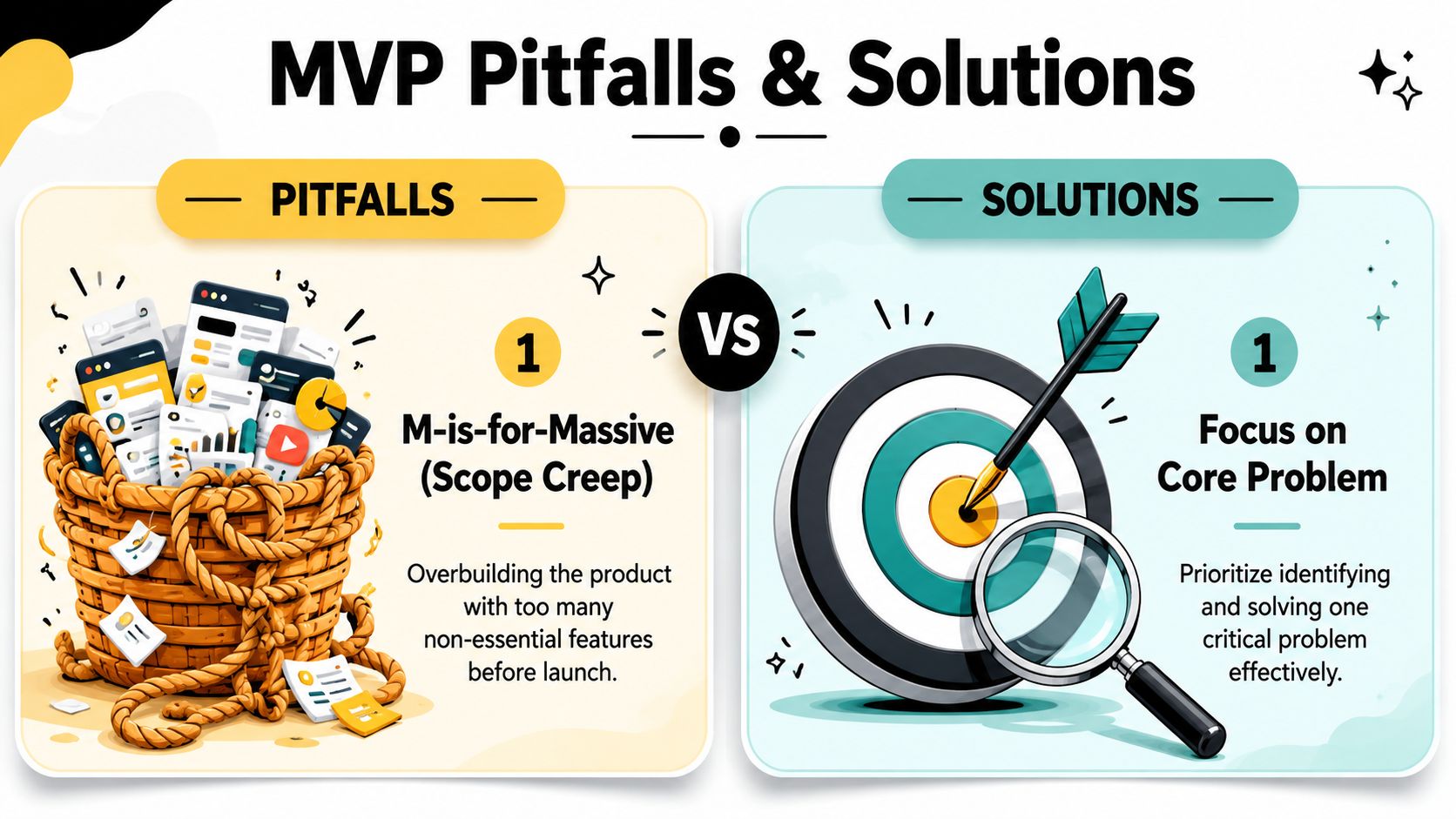
The three traps that stall PM careers
The first is M is for Massive. Scope expands, every stakeholder adds “just one thing,” and the MVP turns into a delayed launch with none of the learning benefits.
The second is non-viable minimum. The team strips so much out that users can't experience the core value. PMs sometimes make this mistake with growth shortcuts too. A tactic like buy instagram followers may create surface-level optics for a social account, but it doesn't validate durable product value or real engagement. The same logic applies to weak MVPs that generate appearances instead of signal.
The third is launch-and-leave. The team ships the MVP, checks the box, and never closes the loop with user behavior, feedback, or iteration.
What good PMs do instead
- Define one learning goal: If the team can't finish the sentence “we are testing whether…”, stop and rewrite.
- Protect the viable bar: Keep quality high enough that users can judge the product, not the brokenness.
- Plan the next decision before launch: Know what evidence would trigger expansion, revision, or shutdown.
Weak PMs use MVP as cover for underthinking. Strong PMs use it to sharpen thinking.
Your AI MVP Action Checklist
A PM gets 20 minutes with leadership to justify an AI initiative. The prototype can summarize text, draft replies, and answer follow-up questions. It still does not prove that any user will change behavior, trust the output, or come back. That gap is where strong PMs separate themselves.
For AI products, the real test is usually the workflow, not the model. Teams lose months tuning prompts, swapping models, and debating architecture before they confirm that the product solves a painful enough problem to matter. Nielsen Norman Group defines an MVP as the smallest shippable version of a product or feature that is still functional enough to test a hypothesis with real users, and their MVP definition is a useful bar for staying honest.
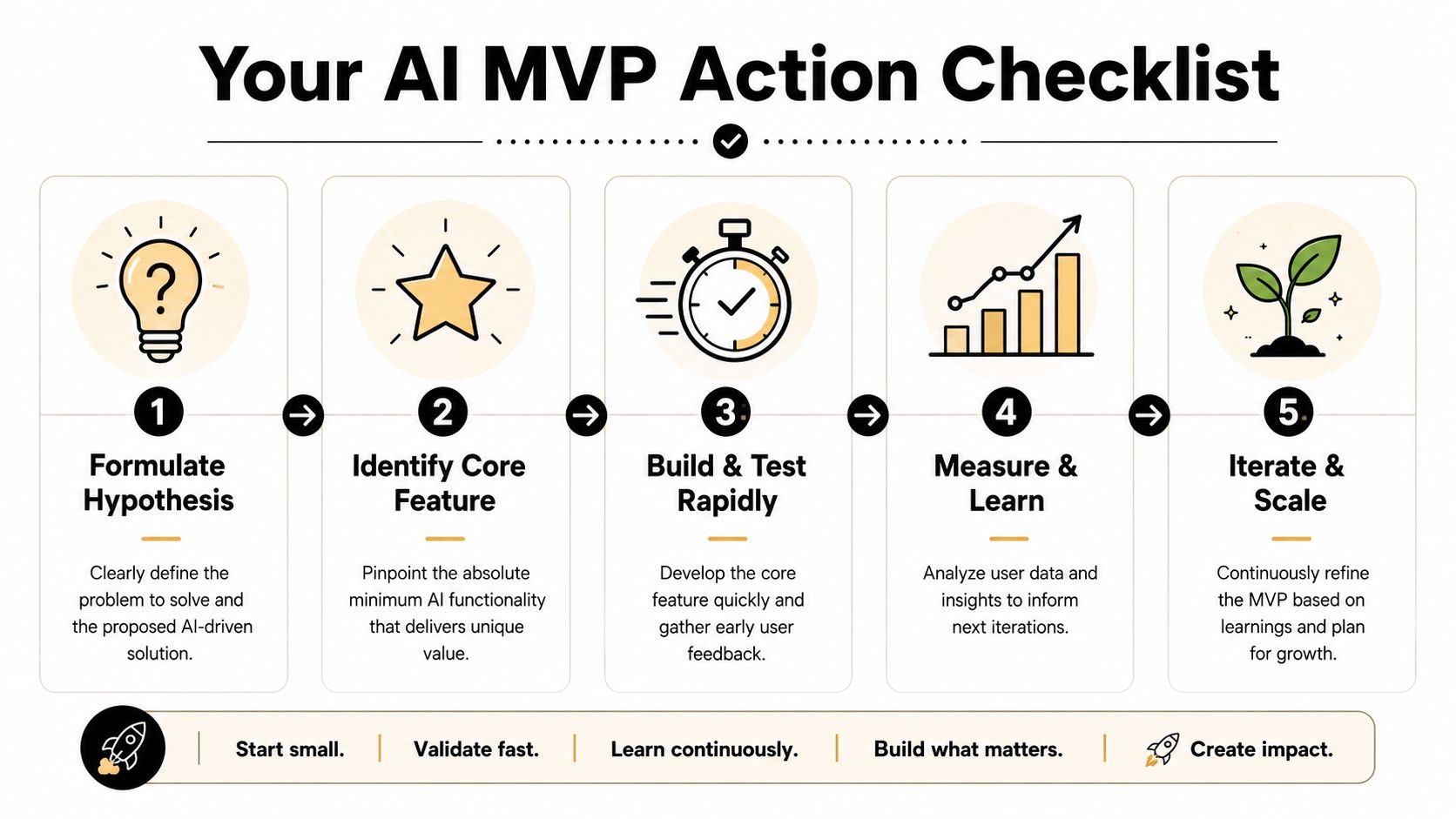
Use this checklist in the next 24 hours
Write the hypothesis
Name the user, the job to be done, and the behavior change you expect. If the team cannot state what should change after launch, the MVP is still too fuzzy.Choose the thinnest valuable workflow
Define the narrowest end-to-end experience that lets a user reach the outcome. In AI, that often means one job, one moment, and one clear output.Decide whether AI must be real on day one
A Wizard of Oz flow, manual review layer, or concierge service is often the smarter first version. I have seen teams learn more from a week of manually delivered results than from a month spent wiring up production inference.Set the viability threshold
Specify what good enough means before launch. For AI MVPs, that usually includes acceptable accuracy, clear UX around uncertainty, response time users will tolerate, and enough trust that they will use it on a real task.Pick learning metrics before launch
Track behavior that shows the product is working. Activation, repeat usage, task completion, saves, edits, and trust-related feedback are usually more useful than raw signups for an early AI MVP.Plan the stakeholder narrative
Tell leadership what the MVP is designed to learn, what corners were intentionally not built yet, and what decision will follow the results. This matters for the project and for your career. PMs who frame the decision clearly get trusted with bigger bets.
A simple explainer can help if you're aligning a broader team on AI experimentation:
One practical operating rhythm is a short hypothesis doc, a lean experiment spec, and a review template for the post-launch decision. Teams usually run this in Notion, Google Docs, Figma, or a lightweight dashboard. Aakash Gupta publishes PM-focused templates, frameworks, and analysis on MVPs, growth, and hiring, and many product teams use that material as reference.
If you remember one thing, make it this. The answer to what's the meaning of MVP is not just “minimum viable product.” It is the smallest real test that helps a PM reduce risk, prove judgment, and earn the right to lead the next investment.
