A lot of PMs run into the same problem at launch time. You know you need a strong marketing partner, but the title on the req doesn't tell you enough. Hire a marketing manager when you needed a PMM, and the launch gets plenty of activity but weak product narrative. Hire a PMM when the business needed brand and demand coverage, and you get a sharp message with no distribution engine behind it.
That's why the marketing manager vs product marketing manager question matters more to product teams than most org charts suggest. As a PM or product leader, you're not just comparing two marketing titles. You're deciding who will help turn roadmap work into market impact, who will shape customer understanding, and who will carry the product story into sales, campaigns, and adoption.
Why Marketing Manager vs PMM Is a Critical Distinction for PMs
The confusion usually starts when a product team says, “We need marketing help.” That sentence hides two very different needs. One is company-level growth work such as campaigns, channels, brand consistency, and demand generation. The other is product-level commercialization work such as positioning, launch planning, competitive framing, and sales enablement.
Why the split happened
The split between these roles didn't happen because companies wanted more titles. It happened because marketing itself changed. As Yardstick's breakdown of the two roles explains, marketing expanded from traditional advertising into digital, data-driven, multi-channel execution, while PMM emerged as a role sitting at the intersection of product, marketing, and sales.
That shift matters for PMs because the work around a product also changed. Building features is one problem. Translating those features into a clear value proposition, launch narrative, and field-ready story is a different one. PMMs exist because product teams needed someone to bridge internal product context and external market understanding.
If you want a practical startup-oriented take on that boundary, Big Moves Marketing has a useful piece on defining product marketing for B2B startups. It's especially relevant when the founder, PM, and first marketer are all stepping on each other's responsibilities.
Why PMs feel the difference immediately
A PMM usually helps answer questions like:
- Who is this feature really for
- What problem statement will resonate in-market
- How should sales talk about this against competitors
- What launch motion fits this release
A marketing manager usually helps answer a different set:
- Which channels should we use
- How should we run the campaign calendar
- What creative assets are needed
- How do we drive acquisition efficiently
Practical rule: If your biggest risk is “the market won't understand why this matters,” you probably need PMM support first.
For PMs who want a broader view of how marketing intersects with the product function, Aakash Gupta's guide on product management in marketing contexts is a helpful companion read.
Core Differences A Side-by-Side Comparison
The fastest way to think about marketing manager vs product marketing manager is this. One role markets the business through campaigns and channels. The other markets the product through positioning and go-to-market execution.
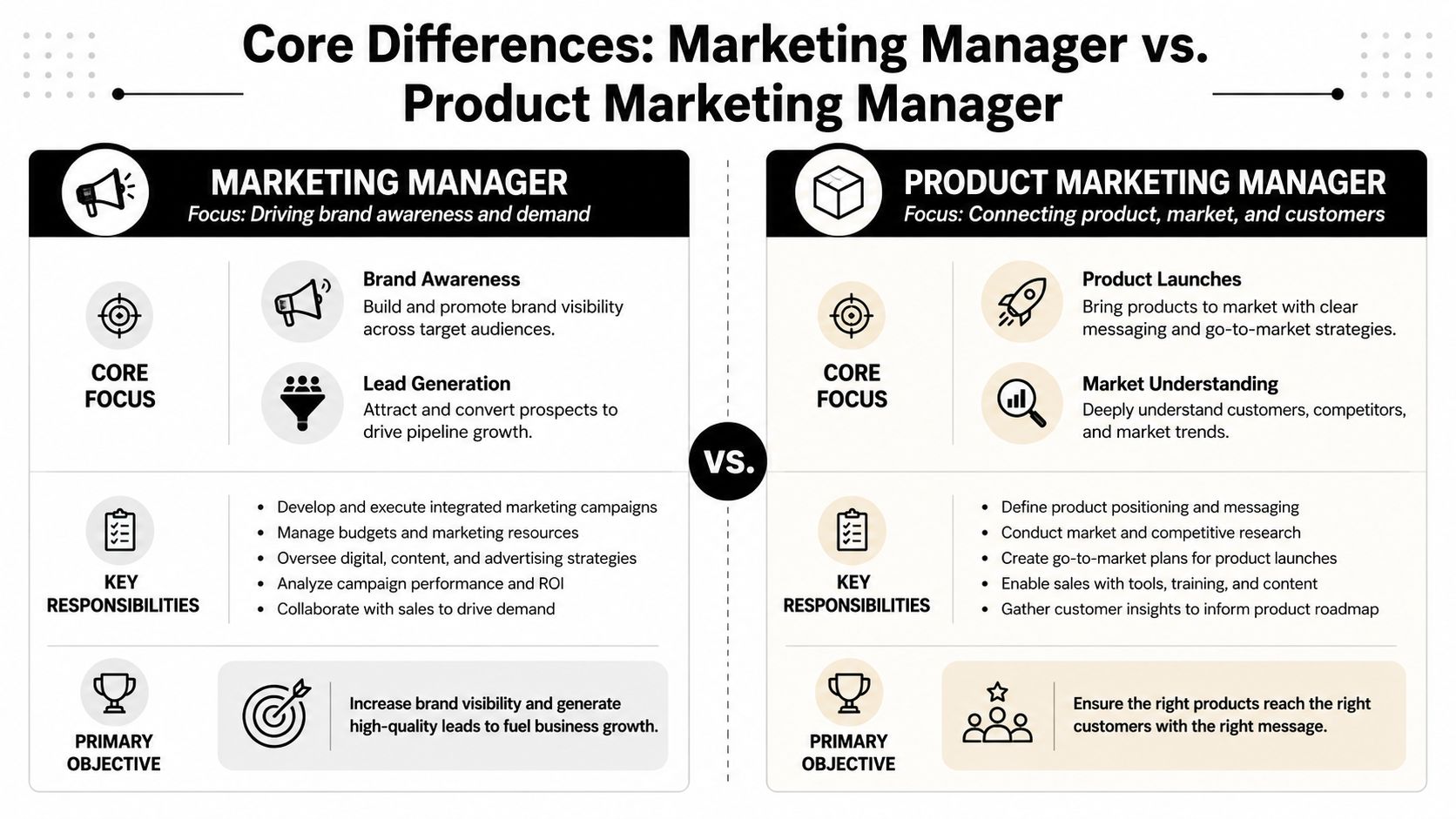
Marketing Manager vs Product Marketing Manager At a Glance
| Dimension | Product Marketing Manager (PMM) | Marketing Manager (MM) |
|---|---|---|
| Core focus | Product positioning and go-to-market | Brand, demand generation, and campaign execution |
| Primary unit of work | Product, feature, segment, launch | Channel, campaign, audience program |
| Main stakeholders | Product, sales, customer success, leadership | Marketing team, growth, creative, channel owners |
| Typical deliverables | Messaging docs, launch briefs, battlecards, sales enablement | Campaign briefs, channel plans, content calendars, performance reports |
| Questions they answer | Why this product, for whom, and against what alternative | Which channels, messages, and programs drive awareness and pipeline |
| PM collaboration style | Deeply embedded in roadmap and launch planning | More periodic collaboration around campaign needs and launch amplification |
| Success pattern | Strong narrative-market fit | Strong channel execution and consistent demand motion |
The most important difference
RocketBlocks makes the key distinction cleanly. A marketing manager is typically optimized for campaign-level performance, while a PMM is optimized for product-level adoption and positioning in work that spans product, marketing, and sales through messaging, go-to-market strategy, and competitive differentiation. You can see that framing in their explanation of PMM vs MM responsibilities.
That distinction is operational, not theoretical.
A marketing manager might look at your launch and ask whether paid, email, webinar, lifecycle, and content channels are lined up properly. A PMM might look at the same launch and ask whether the buyer will understand the problem, whether the pitch is differentiated, and whether sales can explain why this release matters.
Marketing managers market the company. Product marketing managers market the product.
Where teams get this wrong
The failure mode I see most often is expecting one person to cover both jobs in a complex product business. That can work in a small startup. It usually breaks once the product line grows, the sales motion becomes more consultative, or messaging varies by segment.
For PMs, this matters in roadmap execution. If you're shipping AI features, platform capabilities, pricing changes, or enterprise workflows, the work isn't just “announce it.” It's explain it in language customers trust, connect it to a specific use case, and make the field team confident enough to sell it. That leans PMM.
If your challenge is category awareness or broader company narrative, a marketing manager may be the more urgent hire. For teams wrestling with brand clarity, this guide to brand positioning strategies for SMEs is a useful outside perspective.
If you want a product-led version of the PM and PMM split, Aakash Gupta's article on product marketing and product management lays out the handoffs and overlap well.
A Day in the Life of a Marketing Manager and a PMM
Job descriptions flatten these roles. Their calendars make the difference obvious.
A PMM's day
A PMM usually starts close to the product. In the morning, they may join a feature readiness review with PM, design, and engineering to understand what changed, what's launchable now, and what still needs narrative framing. They're listening for customer impact, not implementation detail.
By midday, they're often working on artifacts that turn product work into market-facing clarity. That could be refining a messaging hierarchy, rewriting a one-pager for sales, or pulling together a competitive response doc after hearing repeated objections from the field.
Later in the day, the PMM may meet with sales leaders or customer success to test whether the launch story is usable in real conversations. If they're good, they don't stop at “the message sounds smart.” They ask whether an AE can explain it in a discovery call and whether a CSM can connect it to expansion value.
A marketing manager's day
A marketing manager's day usually starts in channel and program management. They may review campaign performance with the demand gen team, check whether landing page copy aligns with the quarter's priorities, and decide where creative or budget attention should go next.
Their afternoon can involve campaign operations. That might include approving webinar promotion assets, aligning email and paid timelines, reviewing content production status, or working with operations in HubSpot or Marketo to make sure programs run on schedule.
By the end of the day, they're often focused on execution quality across the portfolio. The question isn't whether one feature is framed perfectly. The question is whether the company is running a coherent, effective set of programs that drive awareness and pipeline.
How the PM experiences each partner
When a PM works with a PMM, the conversation sounds like this:
- Customer problem: Are we naming the pain clearly?
- Differentiation: Why us instead of the next-best option?
- Launch readiness: Can sales and success carry this story?
- Packaging: Is this feature, bundle, or capability understandable?
When a PM works with a marketing manager, the conversation usually sounds like this:
- Audience reach: Which segments will see this campaign?
- Asset planning: What content and creative do we need?
- Channel fit: What's the right distribution mix?
- Program timing: How does this launch fit the broader calendar?
Neither role is “more strategic” by default. They're strategic in different directions. PMMs reduce the risk that the market misreads the product. Marketing managers reduce the risk that strong messaging never gets enough reach.
Comparing Skills KPIs and Salary Benchmarks
The cleanest hiring mistakes happen when companies evaluate these roles using the same rubric. They shouldn't. The skills differ, the performance lens differs, and the labor market treats them differently too.
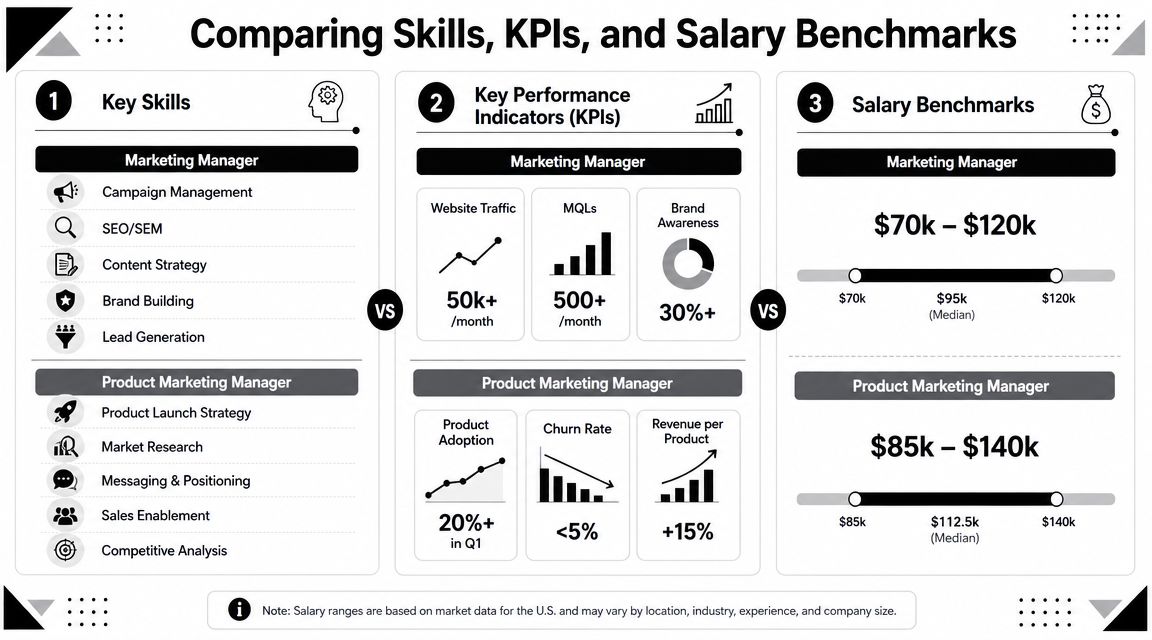
Skills that matter in practice
A strong PMM usually needs:
- Positioning judgment: They can turn feature lists into clear value propositions.
- Customer fluency: They understand segments, buying context, objections, and jobs to be done.
- Sales empathy: They know the difference between a polished launch deck and a usable talk track.
- Competitive analysis: They can frame trade-offs without sounding generic or defensive.
- Product fluency: They don't need to write code, but they do need to understand the product well enough to simplify it accurately.
A strong marketing manager usually needs a different stack:
- Campaign orchestration: They can manage cross-channel programs without losing timing or consistency.
- Channel expertise: They understand content, lifecycle, paid, events, social, and web as operating levers.
- Creative coordination: They can turn priorities into briefs that design and content teams can execute.
- Marketing operations comfort: Tools like HubSpot, Marketo, Salesforce, and analytics dashboards matter.
- Budget and planning discipline: They know how to sequence work and keep programs moving.
KPIs should follow role design
PMs need to be strict about this. If you hire a PMM and then judge them primarily on raw lead volume, you've designed the role badly. If you hire a marketing manager and then expect them to own deep competitive positioning with no product context, same problem.
A useful way to separate KPI design is to ask what each role directly influences.
| Area | PMM tends to influence | Marketing manager tends to influence |
|---|---|---|
| Product success | Adoption, launch readiness, message clarity, sales enablement quality | Awareness, campaign performance, lead flow, channel efficiency |
| Core outputs | Positioning docs, battlecards, enablement, launch plans | Campaigns, nurture programs, content distribution, event promotion |
| PM partnership | Release strategy, customer narrative, segmentation | Launch amplification, asset scheduling, audience reach |
If you need a quick refresher on the difference between output measures and business indicators, Aakash Gupta's post on KPI vs metric is worth revisiting.
A short explainer can also help frame how companies evaluate these paths differently:
Salary and labor market context
Here's the part that often gets missed in career conversations. Marketing manager is a broad labor-market category. The U.S. Bureau of Labor Statistics reports 434,000 jobs for marketing managers, with a median annual wage of $161,030 in May 2024, and projects 6% employment growth from 2024 to 2034 in the broader occupation, according to the BLS marketing manager occupation data.
That matters because PMM usually sits inside a narrower specialization. In practice, marketing manager roles are more common and more broadly defined, while PMM roles are more concentrated in product-led environments such as technology, SaaS, and consumer products where launch quality and product differentiation carry more weight.
Hiring takeaway: If you want broader labor pool access, a marketing manager search is often simpler. If you want someone who can bridge roadmap, sales, and positioning, the PMM search is usually narrower and more role-sensitive.
Where They Sit Org Structures and Collaboration Models
The org chart tells you how much influence each role will have with product. It also tells you where conflicts will show up.
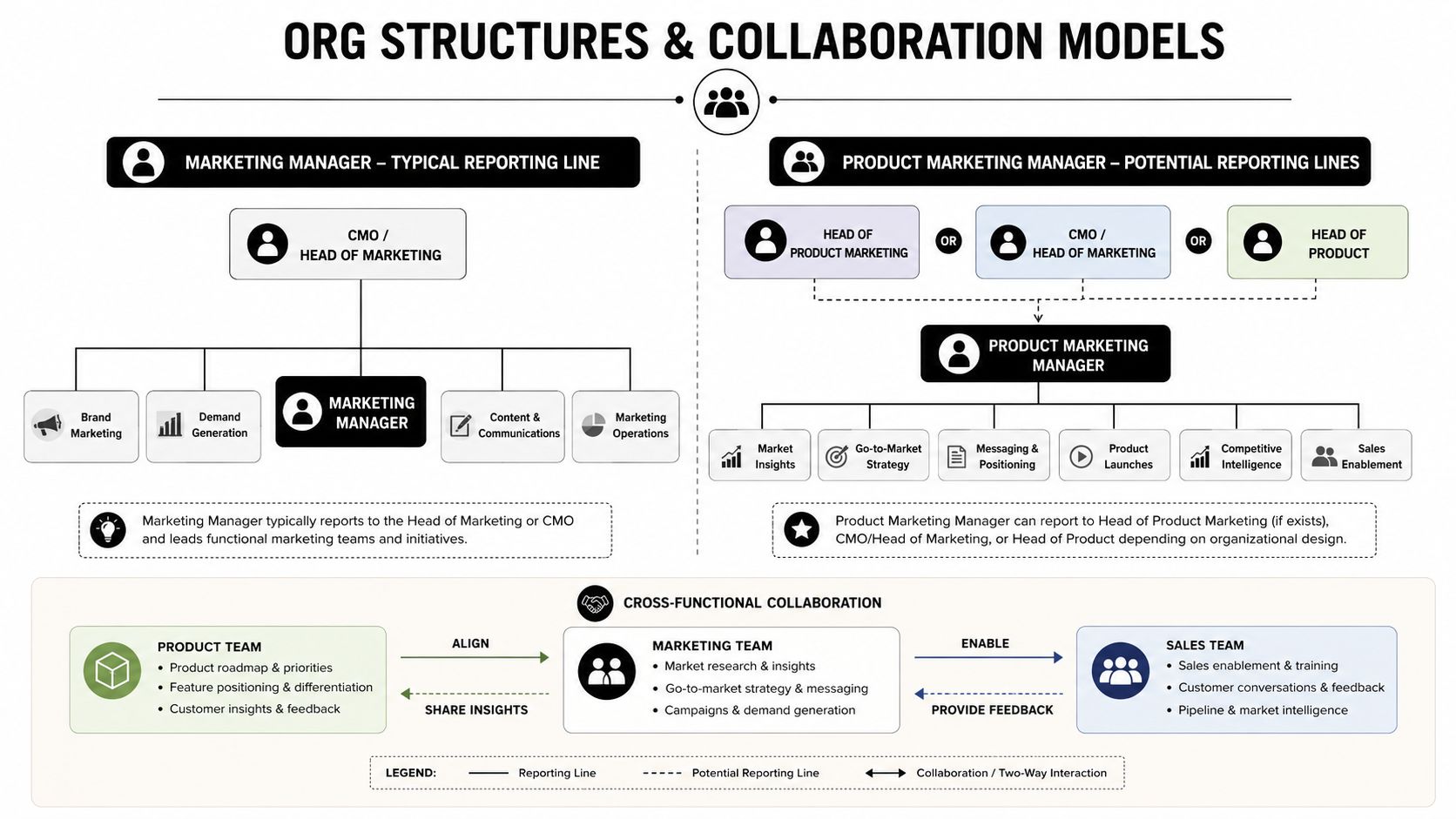
Common reporting patterns
A marketing manager almost always sits squarely inside the marketing organization. They usually report into a Head of Marketing, Director of Marketing, or CMO. That structure makes sense because most of their work depends on campaign planning, creative resources, content calendars, and channel budgets.
A PMM can sit in a few different places:
- Inside marketing: Good for launch amplification and narrative consistency.
- Embedded with product while reporting into marketing: Often the healthiest compromise in larger companies.
- Closer to product leadership: Useful when the product is technical, the sales cycle is consultative, or launch complexity is high.
What each structure changes for PMs
If the PMM reports into marketing but isn't embedded with a product team, PMs often feel the gap in discovery and launch planning. The PMM gets pulled toward company priorities and campaign deadlines. Messaging quality can stay high, but product intimacy may slip.
If the PMM sits too close to product and too far from marketing, another problem shows up. They can become a “launch PM plus copywriter” who produces sharp documents that never get proper distribution or reinforcement.
For PMs managing cross-functional work, this is why team design matters more than titles. A badly placed PMM can be less effective than a well-integrated marketing manager.
The best collaboration model usually isn't about reporting lines alone. It's about whether the role has enough product context to shape the message and enough marketing access to activate it.
If you're trying to improve the day-to-day mechanics of these partnerships, Aakash Gupta's article on cross-functional team management is directly relevant.
The PMs Guide to Hiring The Right Marketing Partner
The right question isn't “Which role is better?” It's “What problem is blocking product success right now?”
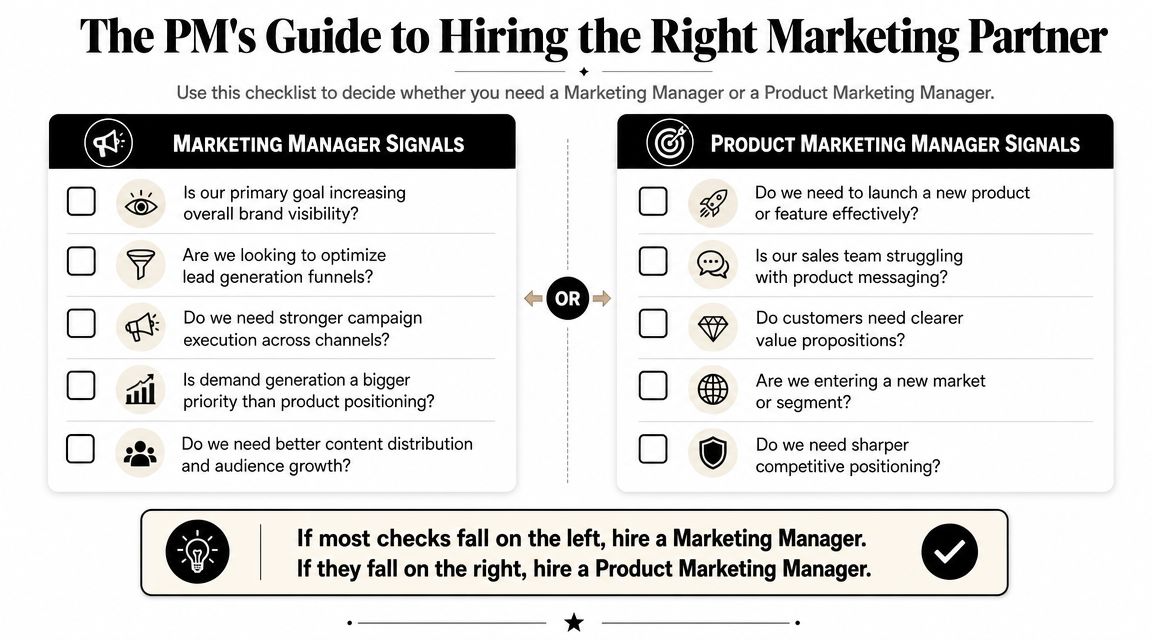
Use this decision filter
Hire a PMM when:
- Your roadmap is outpacing your narrative. Teams are shipping, but customers and sales don't understand the value.
- You're entering a new segment. Messaging needs to change, and assumptions need pressure-testing.
- Sales keeps improvising the story. Reps are building their own decks, objection handling is inconsistent, and positioning varies by person.
- AI features need careful framing. This is common now. Product teams launch AI capabilities quickly, but buyers need trust, clarity, limits, and use-case relevance, not feature hype.
Hire a marketing manager when:
- You need repeatable campaign execution. The issue isn't product story. It's distribution, consistency, and channel management.
- Brand and demand work are underpowered. The company lacks program cadence across lifecycle, content, paid, or events.
- Launches happen, but nobody hears about them. Message exists. Reach doesn't.
- The marketing team needs an operator. Someone has to coordinate briefs, calendars, assets, and channel performance.
Interview for the work, not the title
For PMM candidates, ask things like:
- Take one of our features and write a positioning statement for a specific buyer.
- Walk me through how you'd prepare sales for this launch.
- How would you respond if product says a feature is differentiated but customers don't seem to care?
For marketing manager candidates, ask:
- How would you build a campaign around this launch across owned and paid channels?
- How do you prioritize when brand, content, and demand requests all compete at once?
- Show me how you translate a company priority into an execution calendar.
What good hiring looks like from a PM seat
A PM should look for evidence of partnership behavior, not just polished output.
- With PMMs, test synthesis. Can they absorb product nuance and convert it into customer language?
- With marketing managers, test execution judgment. Can they manage trade-offs across channels and deadlines?
- With either role, test conflict handling. Launches always involve disagreement on timing, scope, and narrative. You want someone who can resolve it without turning every decision into committee theater.
Navigating Career Transitions Between PM and PMM Roles
PM and PMM are closer than many people think. The overlap is real. So is the gap.
A PM moving into PMM already brings useful strengths: customer research, prioritization logic, roadmap communication, and comfort with ambiguity. The main gaps are usually around market-facing storytelling, sales enablement, and channel-aware launch planning. The fastest way to build those muscles is to own messaging for a meaningful release, sit in on sales calls, and write assets that people outside product use.
A PMM moving into PM has a different advantage. They often understand the buyer, the market, and the commercial side of product better than early-career PMs do. The gaps tend to be in decision frameworks around scope, technical trade-offs, execution with engineering, and product discovery methods that go beyond message testing.
A practical path in either direction
- If you're a PM: Volunteer to own the full GTM narrative for one launch, not just the PRD handoff.
- If you're a PMM: Ask to lead problem discovery for a market opportunity, not just the launch plan after the roadmap is set.
- If you're in either role: Use AI tools for draft generation and synthesis, but don't outsource judgment. AI can speed up first drafts of messaging, interview summaries, and competitive grids. It won't tell you which trade-off matters most to your buyer.
For people seriously considering the shift from product marketing into product management, Aakash Gupta's guide on moving from product marketing to product management is a practical next step.
If you want more practical PM career advice, hiring frameworks, and cross-functional product guidance, Aakash Gupta publishes resources for product managers and leaders navigating exactly these kinds of decisions.
