A launch can fail even when the product is good. I've seen teams ship something technically solid, then watch adoption stall because the PM optimized for feature completeness while marketing had to guess the buyer, the message, and the moment.
That gap is what product management in marketing is really about. It's the discipline of making sure product decisions and market decisions come from the same evidence.
Why Every PM Needs to Understand Marketing Now
Google and Meta both taught the industry the same lesson in different ways. Great products don't win by default. They win when the product experience, audience targeting, positioning, and post-launch iteration are tightly connected.

A common failure mode looks like this. The PM ships a feature set aimed at “small businesses.” The PMM launches with broad messaging about productivity. Sales hears objections around setup complexity. Support hears confusion about who the product is for. Growth sees traffic, but weak activation. Nobody is fully wrong, but nobody is working from the same market truth.
That's why product management in marketing matters. It closes the loop between user behavior, segmentation, messaging, and roadmap choices.
The cost of siloed launches
Data-driven product teams are 2.9 times more likely to launch products that meet business goals, yet only 12% of companies have a fully mature product management process, according to Have Ignition's product management statistics roundup. For a PM, that means there's a real career advantage in learning how market execution works, not just how to write requirements.
When AI products entered the mainstream, this got even sharper. Teams shipping copilots, assistants, and workflow automation tools quickly learned that “useful” wasn't enough. You had to explain trust, accuracy, control, and ROI in plain language. That's one reason many PMs are now studying adjacent disciplines like lifecycle marketing, positioning, and even AI agents for B2B growth, because product value often needs orchestration across product, sales, and marketing surfaces.
Practical rule: If marketing can't explain the product clearly, the PM probably hasn't defined the audience clearly enough.
At Meta, this shows up in how product work often gets framed around user cohorts and behaviors, not just features. At Google, the strongest launches usually have crisp narratives tied to a user problem, not a technical breakthrough alone. That's not “marketing polish.” That's product judgment.
What strong PMs do differently
PMs who rise faster usually do three things:
- They define the user narrowly: They don't say “creators” or “businesses.” They say which creators, in what workflow, with what problem.
- They pressure-test the value proposition: They ask whether the launch message matches what the product helps users do.
- They connect launch results back to roadmap choices: If adoption is weak, they don't only ask for more campaigns. They ask whether onboarding, packaging, or feature scope is the underlying issue.
If you want a useful companion read on this overlap, Aakash Gupta has a solid piece on marketing in product management that looks at how PMs can think beyond the build phase.
The Core Philosophy of Product-Led Marketing
What is product management in marketing? Not a job title. A system.
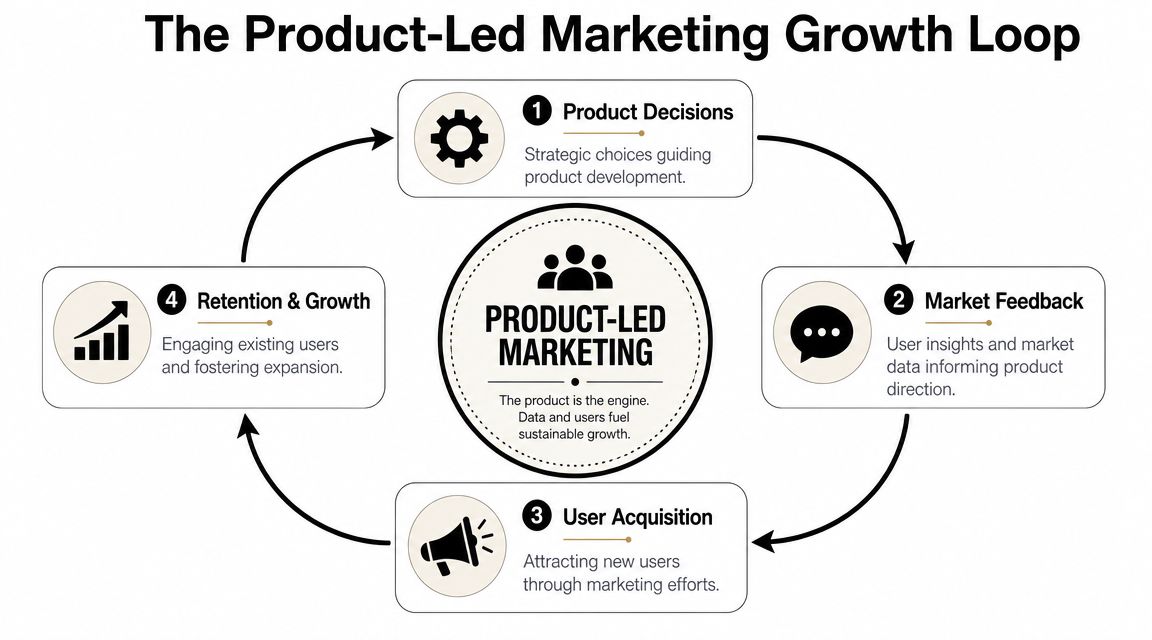
It's the operating model where product teams use customer and market evidence to shape the product, and marketing teams use that same evidence to shape acquisition, positioning, and retention. When it works, product and marketing stop acting like separate functions with a handoff. They behave like a growth loop.
The discipline is fundamentally cross-functional, starting with vision development and market research, then moving through strategy, execution, and metrics. A key technical lever is customer-needs analysis, where PMs study user behavior to directly inform marketing segmentation and messaging quality, as described in AltexSoft's overview of product management stages and roles.
Think architect and real estate agent
The cleanest analogy is this:
- The PM is the architect. They decide what house should be built, for whom, and why it deserves to exist.
- The PMM is the estate agent. They understand the neighborhood, know what buyers care about, stage the house correctly, and bring the right people through the door.
The mistake is treating those as separate worlds. If the architect designs for a family but the agent markets to investors, performance breaks. If the agent learns buyers hate the kitchen layout but the architect never hears it, the next version misses again.
That's the core philosophy behind product-led marketing. Product choices and market choices should inform each other continuously.
The loop in practice
A simple way to run it:
Start with demand, not opinions
The PM studies user behavior, support patterns, sales calls, and usage friction. The PMM studies competitive framing, category language, and buying triggers.Turn insight into product and message decisions
If users value speed but the launch message emphasizes flexibility, fix the message. If the message is right but onboarding hides the fast path, fix the product.Launch with a testable hypothesis
Strong teams don't say, “Let's announce the feature.” They say, “We believe this segment will respond to this promise because of this product behavior.”Feed outcomes back into the roadmap
If acquisition works and retention doesn't, the issue may be product value delivery. If engagement is strong but conversion is weak, packaging or positioning may be the blocker.
A launch isn't the finish line. It's the first market-quality data point.
That's why PMs who understand product-led growth often make better strategic calls. They know the product experience itself is part of the marketing system.
What doesn't work
Three patterns consistently fail:
- Feature-first launches: The team talks about capabilities before clarifying the customer problem.
- One-way handoffs: PM throws a spec to PMM and expects great positioning to appear.
- Static personas: The team creates segments once, then never updates them as adoption patterns change.
In AI products, this is even more visible. If you're shipping an assistant, the product experience is the message. If users don't trust the output, no campaign fixes that.
The PM vs Product Marketing Manager Divide
Teams often don't struggle because they lack talent. They struggle because PM and PMM responsibilities are blurry in the wrong places and disconnected in the places that matter.
Traditionally, the line was simple. PM owned product definition and customer validation. PMM owned launch, sales tools, and market-facing execution. That model still exists. But it's not enough for modern software companies, especially in AI, PLG, and usage-based businesses.
SVPG traditionally defines the PMM's role around launch and sales tools, while the Product Marketing Alliance says the role is becoming “more strategic, more technical,” with customer and market research remaining a major pillar for 69.7% of PMMs, which shows how much the boundary has blurred, as summarized in SVPG's comparison of product management and product marketing.
The practical split
Here's the version I use with teams.
| Dimension | Product Manager (PM) | Product Marketing Manager (PMM) |
|---|---|---|
| Core mission | Decide what should be built and why | Decide how the market should understand and adopt it |
| Primary focus | User problems, product strategy, prioritization, delivery | Positioning, segmentation, launches, sales enablement |
| Main artifacts | PRD, roadmap, problem statements, success criteria | Messaging framework, launch plan, competitive narrative, collateral |
| Key questions | What customer pain matters most? What should we ship? | Who should buy? Why now? How should we tell the story? |
| Daily partners | Engineering, design, data, leadership | Sales, demand gen, content, customer success, PM |
| Failure mode | Builds something useful for the wrong scope or wrong audience | Tells a compelling story about a product that isn't ready or differentiated |
At Google, a PM working on a workspace feature might obsess over user workflow efficiency, permissions, and edge cases. The PMM will care about whether the feature belongs in an admin story, a collaboration story, or a security story. Both matter. One without the other creates leakage.
Where the line actually blurs
The modern PMM often does more than “launch stuff.” They shape pricing input, website messaging, competitive response, field enablement, and even post-launch diagnosis. In AI categories, PMMs also need technical fluency because the buyer asks hard questions about reliability, control, and implementation.
That changes what good PM partnership looks like.
- PMs can't hide behind feature specs anymore
- PMMs can't wait until the launch deck is due
- Both need a shared view of segment, value proposition, and proof
Manager test: If your PM and PMM describe the target user differently, don't launch yet.
Many teams often waste time in this situation. The PM thinks the PMM is asking for “marketing fluff.” The PMM thinks the PM is too inward-looking. In reality, they're seeing different parts of the same system.
What each role should own
A healthy operating model usually looks like this:
- PM owns product truth: customer problem, product scope, trade-offs, and evidence that the solution works.
- PMM owns market truth: buyer framing, differentiation, launch narrative, sales readiness, and message testing.
- Both own business truth: whether the product is creating adoption, retention, and expansion.
If you want a deeper look at the overlap, this piece on product marketing and product management is worth reading.
For your career, the lesson is simple. You don't need to become a PMM. You do need to become a PM who can work at PMM altitude.
The Go-to-Market Playbook A Shared Workflow
Weak launches usually fail before launch day. The failure starts in discovery, when teams choose a segment loosely, define the value vaguely, and leave proof points until the last minute.
Strong launches use one shared workflow. The PM and PMM contribute differently, but they work from the same data.
Effective product marketers use two complementary data classes: user-focused data, like brand perception and message testing, and market-focused data, like trend and competitive analysis. This data flow is critical for pre-launch research, validating message-market fit, and continuously recalibrating the GTM motion, according to SlashData's guide to product marketing data.
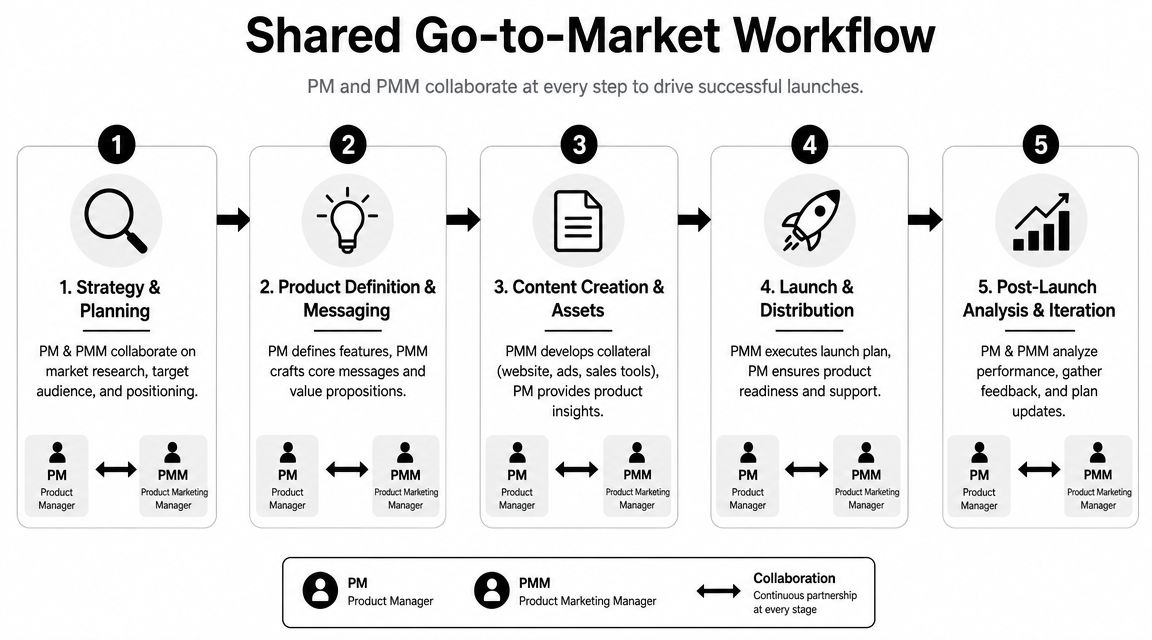
Phase one through three
Discovery and positioning
The PM brings user pain points, usage evidence, workflow friction, and technical constraints. The PMM brings market category language, alternatives, objections, and segment differences. Together, they answer one hard question: who is this for first?Pre-launch and enablement
The PM ensures the product can deliver the promised outcome. The PMM turns that into messaging, website copy, sales enablement, and launch assets. At this stage, companies like Meta tend to be disciplined. They pressure-test the story before broad rollout.Launch execution
On launch day, the PM owns readiness. Instrumentation works, support paths exist, known issues are documented, and the team can observe early behavior. The PMM owns distribution. Campaigns, web surfaces, sales talking points, and audience targeting all go live.
A practical asset in this phase is a high-quality demo. Demos are frequently underinvested in. If you're building launch materials, this guide to mastering product demo videos is useful because the demo often becomes the clearest bridge between product reality and market story.
Phase four and five
Post-launch diagnosis
Don't ask only, “Did the launch perform?” Ask where the system broke. Was awareness weak, or did the audience arrive and fail to activate? Did users adopt the feature but not return? Product and marketing need the same review, not separate dashboards.Iteration and re-segmentation
Mature teams distinguish themselves through this practice. They don't treat the first target segment or first positioning statement as permanent. They refine based on real usage, objections, and deal feedback.
The best GTM teams don't defend the launch plan. They update it.
A simple working cadence
Use a shared weekly operating rhythm:
- Monday review: segment shifts, competitive changes, launch blockers
- Midweek check: asset readiness, product readiness, analytics instrumentation
- Friday readout: user behavior, message resonance, sales feedback, roadmap implications
For PMs, this workflow is the difference between “I shipped it” and “I led it.” If you need a cleaner structure for this collaboration, Aakash Gupta's go-to-market strategy framework is a practical reference.
Measuring What Matters Shared KPIs for Success
Most PM and PMM partnerships break down in measurement. Product tracks usage. Marketing tracks pipeline or campaign engagement. Both teams claim partial success while the business gets an unclear answer.
The fix is to use bridge KPIs. These are metrics both sides can influence.
The foundation of product management in marketing is translating product analytics into market decisions. Metrics like Daily Active Users, Monthly Active Users, and conversion rate, including a 5% signup rate example, are the evidence used to validate hypotheses about user behavior and prioritize GTM resources, as outlined in Quadratic's guide to product management metrics.
The scorecard that actually helps
Start with four shared questions.
| Shared question | Metric to inspect | Why both teams should care |
|---|---|---|
| Are we attracting the right users? | Conversion rate | Positioning and audience quality show up here |
| Are users reaching value quickly? | Activation rate, time-to-value | Marketing promise and onboarding quality meet here |
| Are they using the thing we launched? | Feature adoption rate, sessions per user | Product usefulness and message clarity both matter |
| Are they staying and advocating? | Retention rate, segment-based net promoter score | Long-term fit matters more than launch-week attention |
DAU and MAU are still useful, but they're lagging if viewed alone. They tell you people are present. They don't tell you whether the market promise matched the user's first-run experience.
How I'd read the signals
Here's the practical interpretation:
- High traffic, low conversion usually points to weak targeting or weak positioning.
- Strong conversion, low activation often means the story worked better than the onboarding.
- Good activation, poor retention suggests the product solved a curiosity problem, not a recurring one.
- Strong retention in one segment only is often your cue to narrow the ICP and focus.
Disciplined experimentation is particularly important. If the team is changing onboarding, pricing page copy, trial prompts, or landing page hierarchy, follow real A/B testing best practices so you learn something usable instead of just producing noise.
Shared KPIs force honest conversations. They make it harder for PM to blame traffic and harder for PMM to blame the product.
The career signal for PMs
Senior PMs don't just recite metrics. They connect them. They can explain how top-of-funnel quality, onboarding friction, feature adoption, and retention interact.
That's also why financial literacy starts to matter. If you're moving toward growth, platform, or GM-style product roles, you need to understand how retention and segment quality affect customer lifetime value, even if finance owns the final model.
Level Up Your PM Career By Thinking Like a Marketer
The PMs who get promoted fastest usually stop sounding like backlog managers. They start sounding like business owners.
That shift often begins with one skill. They learn to think like a marketer without losing product rigor. They ask who the product is for, what alternative it replaces, why the buyer should care now, and what evidence supports the claim.
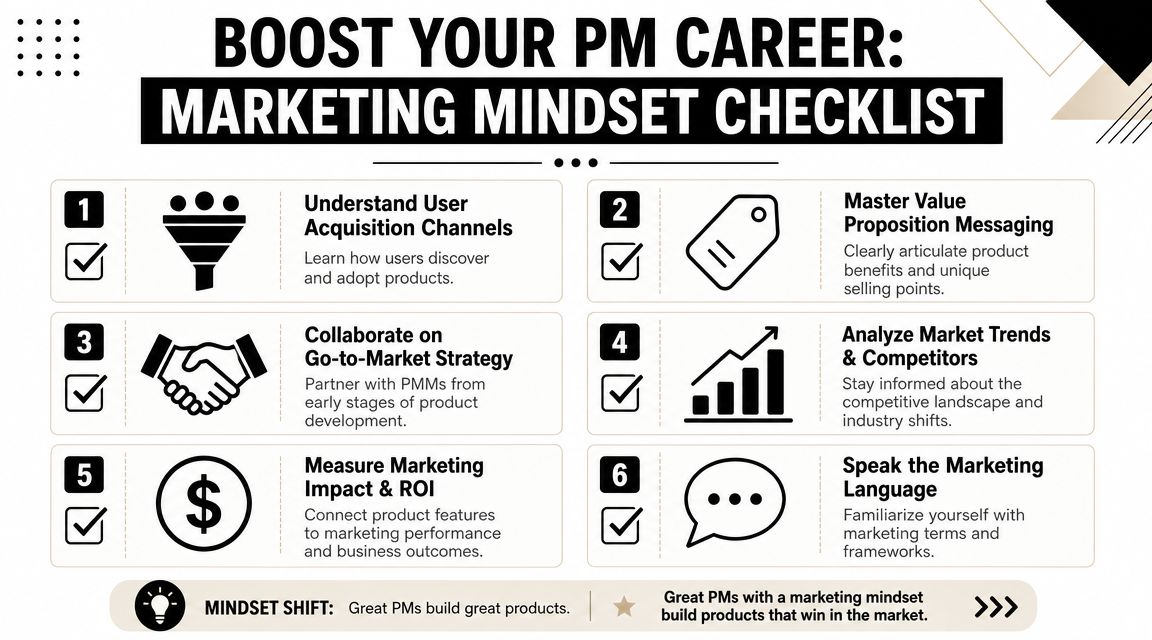
One of the biggest blind spots is segmentation. Effective product marketing doesn't treat segmentation as a one-time exercise. It uses ongoing segmentation and differentiation analysis to identify underserved niches, quantify opportunity size, and protect profitability when price competition rises, as argued in Simon-Kucher's product marketing strategy guide.
What gets PMs stuck
I see four recurring issues:
They describe users too broadly
“SMBs,” “developers,” and “creators” are not useful operating segments by themselves.They leave pricing and packaging too late
Even if PM doesn't own pricing, roadmap choices shape packaging logic.They confuse feature differentiation with market differentiation
A feature can be novel and still irrelevant to the buying decision.They outsource narrative thinking to PMM
That slows everything down. PM should bring a clear point of view on user value before messaging starts.
Here's a useful talk to pair with that shift in mindset:
Actions you can take this week
If you want to become more promotable, start adding these to your workflow.
Add a market section to every PRD
Include target segment, alternatives, buying trigger, and the reason this solution should win.Run a positioning review before roadmap review
Before asking leadership to fund a feature, state the audience, pain, promise, and proof.Use AI to pressure-test your assumptions
Try prompts like:- “Act as a product marketing manager for a B2B SaaS workflow tool. Compare three competitors based on positioning, target segment, and likely differentiation gaps.”
- “Act as a sales leader. Read this feature summary and list the top five buyer objections.”
- “Act as a growth PM. Given this onboarding flow, identify where message-to-product mismatch is most likely.”
Sit in on sales and customer success calls
PMs often discover that the product's internal language sounds nothing like the buyer's language.Bring post-launch recommendations, not just results
Don't report that activation missed target. Recommend whether to change messaging, onboarding, segment focus, or product scope.
PMs get promoted for judgment. Marketing fluency sharpens judgment because it forces you to face the market, not just the roadmap.
The long-term upside
This is especially important in AI PM work. AI products create more ambiguity in value, trust, and differentiation than traditional SaaS. The PM who can connect model capability to user problem, packaging, and adoption story becomes much more valuable.
Use tools that support that skill set. A few practical options are ChatGPT or Claude for message testing and competitive synthesis, Notion for launch briefs, Amplitude or Mixpanel for behavior analysis, and the Aakash Gupta newsletter and resources for PM-specific growth frameworks and career development.
If you can answer “what is product management in marketing” with a working operating model, not a textbook definition, you're already ahead of many PMs. The promotion case gets stronger when leadership sees that you don't just ship features. You shape demand, sharpen focus, and improve outcomes across the whole business.
If you want more practical frameworks like this, Aakash Gupta publishes product management content focused on growth, career progression, and real operating tactics for PMs at every level.
