You launch a feature because enterprise sales asked for it. The demo goes well. Prospects nod along. Your roadmap feels “aligned.”
Three months later, the accounts that adopted it aren't the ones renewing, expanding, or driving product pull inside the business. Support tickets pile up from edge-case customers. Your best-fit users barely touch the feature.
That's not a feature prioritization miss. It's an ICP miss.
For product managers, icp in sales sounds like someone else's document. It isn't. It's one of the cleanest ways to decide which customers deserve roadmap attention, onboarding investment, pricing design, and GTM support. PMs who understand ICP don't just ship more features. They shape where the company should compete.
Why Your ICP in Sales Is a Product Problem
ICP stands for Ideal Customer Profile. In modern B2B practice, it refers to the company characteristics that predict stronger outcomes like higher win rates, faster time-to-value, and better retention, not just a first purchase, as described in Apollo's explanation of ICP in sales.
That definition matters more to product than many PMs realize. If the “ideal” customer is the one most likely to get durable value, then roadmap choices should be evaluated against that customer first. Not against the loudest prospect. Not against the biggest logo in pipeline. Not against the internal team that shouts the hardest in planning.
The pattern I see in weak PM orgs
Weak PM orgs treat sales requests as evidence of market demand. Strong PM orgs ask a sharper question: demand from whom?
If a request comes from accounts that close but never expand, or from customers who require heavy customization and constant hand-holding, building for them can drag the whole product sideways. You end up with:
- Roadmap bloat that serves fringe workflows
- Positioning drift because marketing can't explain who the product is really for
- Noisy product analytics because adoption looks broad but value creation is shallow
- Career-limiting PM behavior where you become known as a feature shipper instead of a business thinker
Practical rule: If a feature serves a customer type you wouldn't intentionally acquire again, it probably doesn't belong high on the roadmap.
Why ambitious PMs should care
The PMs who get trusted with bigger scopes usually do one thing well. They connect product bets to company economics.
That's why I treat icp in sales as a strategic product input. A good ICP tells you which company traits correlate with better outcomes, which means it directly informs segmentation, packaging, onboarding, expansion design, and product-led growth. If you want a useful breakdown of where product marketing and product management intersect, this guide on product marketing and product management is a helpful complement.
The practical shift is simple. Stop asking, “Will someone buy this?” Start asking, “Will our best-fit customer adopt this, succeed with it, and want more?”
That's product strategy.
ICP vs Persona vs Segment A PMs Field Guide
PMs hear segment, ICP, and persona used like they're interchangeable. They aren't. Mixing them up creates bad research, weak messaging, and messy roadmap debates.
I use a simple mental model:
- Market segment is the city
- ICP is the building
- Buyer persona is the person inside the building
If you skip levels, your team gets confused fast. You'll see marketing talking about “mid-market SaaS,” sales talking about “series-stage companies with the right stack,” and product talking about “operations managers who hate spreadsheets.” All three can be valid. They just answer different questions.
The fastest way to separate the three
| Attribute | Ideal Customer Profile (ICP) | Buyer Persona | Market Segment |
|---|---|---|---|
| Level | Company or account | Individual stakeholder | Broad market group |
| Primary question | Which companies are the best fit? | Which person are we influencing? | Which part of the market are we playing in? |
| Used by | Sales, product, marketing, RevOps | Product marketing, sales, UX, PM | Leadership, strategy, product |
| Focus | Company traits and fit signals | Goals, pain points, objections, authority | Shared market characteristics |
| Typical inputs | Industry, size, geography, stack, buying triggers | Role, incentives, workflow, fears, success metrics | Industry category, customer type, use case family |
| Output | Account selection and prioritization | Messaging and experience design | Market sizing and strategic focus |
| Example | B2B software firms with a compatible stack and strong expansion fit | Engineering Manager Emily who owns tooling decisions | Mid-market North American SaaS |
Where PMs usually get it wrong
The most common mistake is building personas before the ICP is stable. That creates polished artifacts about buyers inside companies you shouldn't target in the first place.
A close second is treating a segment like an ICP. “Healthcare” is not an ICP. “Remote-first agencies” is not an ICP. Those are broad containers. They're useful, but they don't tell a GTM team which accounts deserve concentrated effort.
A segment tells you where to look. An ICP tells you what good looks like. A persona tells you how to communicate once you're there.
How I use each one in product work
For PMs, the distinction becomes practical when you map each tool to a decision:
- Use segments when you're evaluating market entry, expansion, and category strategy.
- Use ICPs when you're deciding what customer type the business should optimize around.
- Use personas when you're shaping onboarding, in-product flows, messaging, and stakeholder-specific journeys.
If you want a deeper reference on how these profile types work together, this article on customer profiles definition is worth bookmarking.
When teams get these layers right, conversations sharpen immediately. Leadership debates market focus. Sales debates account qualification. Product debates user and buyer needs inside the right accounts. That separation saves a lot of wasted motion.
A Data-Driven Framework for Building Your ICP
Most ICP documents fail because they start as opinions. Someone in sales says, “We win in fintech.” A founder says, “Enterprise is where the money is.” Product says, “Our best users are technical.” None of that is enough.
The better approach is to build the profile from customer evidence. Practitioner guidance summarized by Dialpad's ICP sales guide recommends starting by filtering your customer base by revenue, then looking for patterns in contract length, company revenue, product and feature adoption, industry, geography, and employee counts. It also stresses that CRM data should be the source of truth because it reflects what transpired in the market.
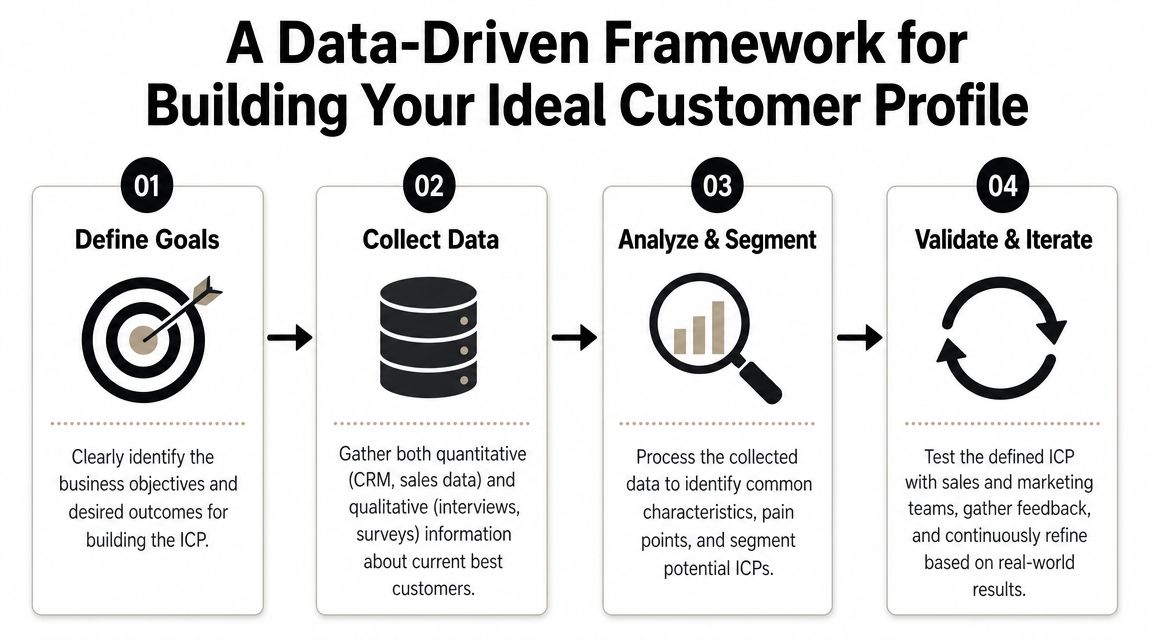
Step one starts with your golden cohort
Don't begin with prospects. Begin with customers who already proved value.
Apollo's guidance, referenced earlier, points teams toward the top 20% of customers by revenue, retention, and expansion. For PMs, that means pulling a cohort that combines business and product signals. In practice, I want data from:
- CRM systems such as Salesforce or HubSpot
- Product analytics such as Amplitude, Mixpanel, or Pendo
- Support systems such as Zendesk or Intercom
- Call intelligence tools such as Gong
- Billing systems that show plan type, expansion motion, and renewal behavior
The goal isn't to find your happiest logos. It's to find the accounts where value is real, durable, and repeatable.
Then extract patterns, not anecdotes
Once you have the cohort, compare accounts across four lenses. A good PM already thinks this way in segmentation work, and this overview of customer segmentation techniques maps closely to the exercise.
Firmographic signals
Industry, geography, employee count, company maturity, and operating model. If your best accounts consistently sit in a narrow band, that matters.Technographic fit
Which tools are already in their stack? Integration fit often predicts adoption quality better than a polished sales call.Behavioral evidence
Look for activation patterns, feature adoption, user depth, admin engagement, and repeat workflows. PMs often miss this because the data sits outside the CRM story.Commercial characteristics
Contract shape, expansion motion, implementation complexity, and post-sale friction. An account that closes cleanly but becomes expensive to support isn't ideal.
Here's a useful outside resource that complements this process well: Fypion Marketing's ICP success guide. It's helpful if you want another operator-style view on turning customer patterns into a usable profile.
Turn the profile into a scoring model
The biggest jump in maturity happens when you stop describing the ICP and start scoring against it.
That means taking the recurring traits from your golden cohort and assigning weights. For example, industry fit might matter more than geography. Stack compatibility might matter more than funding stage. Expansion potential might matter more than headline revenue if your business relies on land-and-expand.
A simple first pass can include:
- Hard-fit criteria that disqualify accounts outright
- Weighted criteria that improve priority when present
- Negative signals that flag anti-ICP patterns
- Confidence notes for attributes where data quality is messy
Build the first scorecard fast. Refine it quarterly. Teams get stuck when they try to make the first version perfect.
The point isn't statistical elegance. The point is consistency. Sales, marketing, RevOps, and product should all be able to look at the same account and reason from the same frame.
Here's a short working template you can copy into Notion or Google Docs:
| Field | What to capture |
|---|---|
| Core ICP summary | One paragraph on the best-fit account type |
| Must-have traits | Non-negotiable company characteristics |
| Strong-fit signals | Traits that increase confidence |
| Anti-ICP signals | Accounts to deprioritize |
| Product evidence | Features and workflows adopted by best-fit accounts |
| Business evidence | Revenue quality, retention quality, expansion fit |
| Open questions | Unknowns to validate next quarter |
A short walkthrough can also help if you're building this with a cross-functional team:
A one-page ICP that gets used beats a polished deck nobody opens.
Operationalizing the ICP Across Product Marketing and Sales
An ICP on a slide is harmless. An ICP embedded in daily operating systems changes behavior.
The strongest teams treat the profile like shared infrastructure. Product uses it to prioritize. Marketing uses it to target and message. Sales uses it to route, qualify, and focus attention.
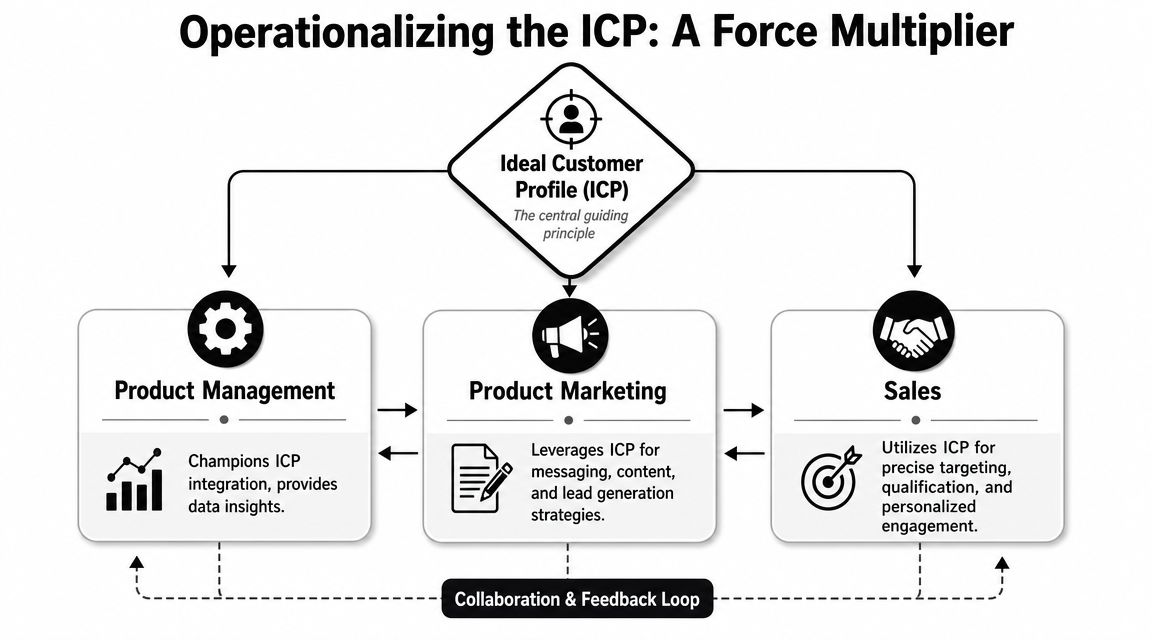
Start with sales workflow, not sales decks
A useful principle from Scrap's guide to ICP scoring in sales is to treat the ICP as a weighted scoring model over firmographic and technographic variables. That lets teams exclude poor-fit accounts, prioritize strong-fit accounts, and make the process auditable and repeatable.
That sounds operational because it is. In CRM terms, PMs should push for:
- Lead routing rules based on hard-fit criteria
- Account scoring fields visible to SDRs and AEs
- Pipeline review filters that separate strong-fit from weak-fit deals
- Rejection reasons that capture why sales pushed back on supposedly qualified accounts
When sales can see fit clearly, they stop treating every inbound lead as equal.
Product marketing is where the profile becomes language
Product marketing turns ICP from a spreadsheet into words buyers recognize.
That affects:
- Ad targeting on platforms like LinkedIn
- Account-based campaigns built for high-fit account groups
- Web copy and landing pages that call out the right pain patterns
- Sales enablement so discovery and demos line up with actual customer fit
If your PMM team is trying to sharpen account-level messaging and demand capture, this article on marketing in product management is a strong companion read.
For teams trying to make their conversion work more precise once ICP is clear, I'd also point them to LinkedFuse's resource on how to increase B2B conversion rates. It's useful because the practical gains usually come from tighter qualification and more relevant messaging, not from cosmetic funnel tweaks.
Product should use ICP as a roadmap filter
This is the PM move that separates strategic operators from backlog managers.
For every major feature, platform investment, or integration, ask:
- Does this solve a high-priority problem for our ICP?
- Will this improve adoption depth, time-to-value, or expansion inside those accounts?
- Are we building for repeatable demand, or for one noisy customer?
- Does the request come from customers we want more of?
Decision lens: “Can we sell this?” is a sales question. “Should we optimize the product around this customer type?” is the PM question.
I've seen teams make strong products weak by accommodating too many adjacent accounts. The product becomes harder to explain, harder to onboard, and harder to love. ICP discipline protects against that.
What a healthy operating rhythm looks like
A simple cadence works well:
- Monthly review of won deals, lost deals, and expansion accounts by fit
- Quarterly ICP refresh with product, PMM, sales, and RevOps
- Per roadmap cycle review of major bets against ICP relevance
- Per launch messaging validation against top-fit accounts
When that rhythm is in place, the ICP stops being a sales artifact. It becomes the Rosetta Stone for how the company decides where to focus.
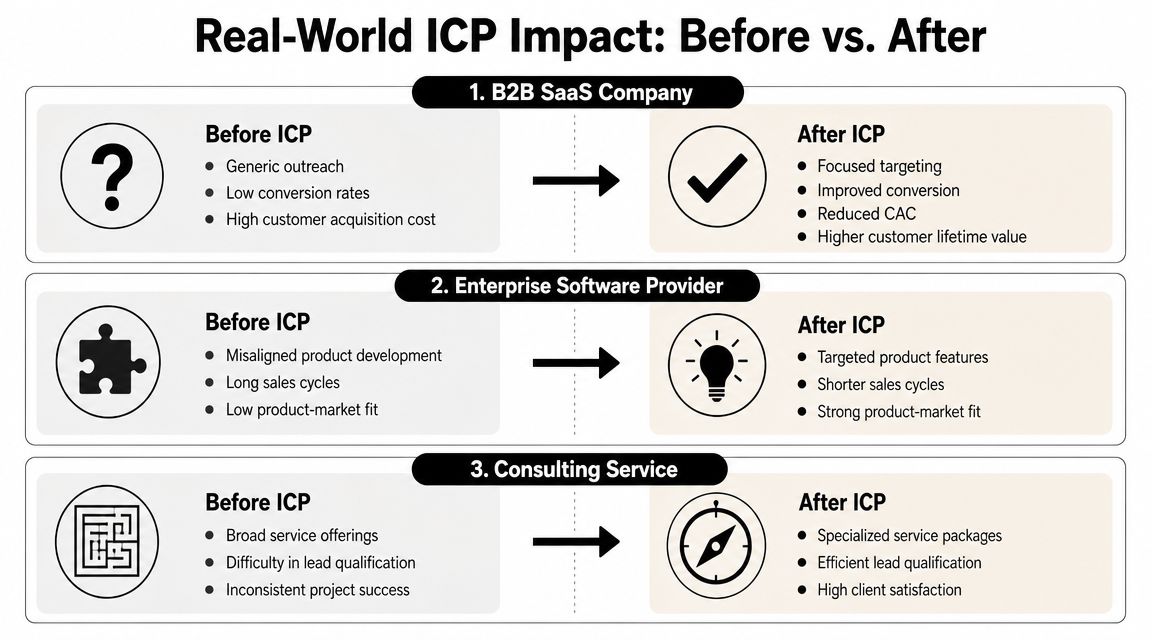
Real-World ICP Examples for Product Managers
The easiest way to understand icp in sales is to watch what changes after a PM gets serious about it. Not in theory. In product decisions.
These examples are intentionally realistic rather than over-polished. The point isn't that the PM suddenly “finds the answer.” The point is that ICP sharpens trade-offs.
Example one B2B collaboration software
A PM at a visual collaboration company starts with a broad target: “teams that work together.” Sales loves the size of the opportunity. Product keeps adding features for workshops, brainstorming, documentation, and lightweight project tracking.
The trouble shows up in usage. Teams sign up, run a few sessions, and then fragment. The PM digs into the best retained accounts and sees a clearer pattern. Product design teams in software companies have tighter workflows, stronger recurring use, and cleaner internal champions than the wider audience.
The roadmap changes. Instead of general collaboration features, the team prioritizes design review flows, reusable templates for product squads, and admin controls that matter in structured software environments.
The win isn't just better adoption. The product becomes easier to position.
Example two AI developer tooling
An AI PM on a developer platform starts with a familiar assumption: “developers are our market.” That's too broad to guide anything. Individual developers want speed and convenience. Platform teams want governance. Security stakeholders want control. Procurement wants consistency.
After reviewing the most successful deployments, the PM sees that regulated environments respond differently. These accounts care less about novelty and more about auditability, permissions, and workflow reliability.
That changes both roadmap and packaging. The product team invests in approval controls, model governance surfaces, and integration paths that fit stricter environments. Sales stops chasing every engineering team that likes AI demos and focuses on accounts where compliance and process create urgency.
Broad audiences create broad roadmaps. Sharp ICPs create products with an edge.
Example three fintech infrastructure and integrations
A PM at a fintech API company is deciding which partner integration to build next. The internal debate is noisy. Several prospects asked for one option. A strategic partnership team wants another. Existing customers have mixed opinions.
The PM goes back to the ICP. Which integration is most common in the stack of the accounts that activate well, expand cleanly, and create long-term value? Which partner ecosystem aligns with the company type the business wants more of?
That frame usually changes the answer. Instead of building for whichever request came in loudest, the team builds for the integration that compounds value for the best-fit account group.
The pattern across all three
What changed wasn't just targeting. The PM got better at saying no.
Here's the before-and-after logic in compact form:
| Before | After |
|---|---|
| Broad customer definition | Narrower account focus |
| Feature requests treated as demand | Requests filtered by account quality |
| Roadmap shaped by volume of asks | Roadmap shaped by fit and strategic value |
| Messaging tries to please everyone | Messaging speaks clearly to a best-fit buyer |
| Product spreads into edge cases | Product deepens around repeatable value |
That's why I tell PMs to learn icp in sales even if they never carry a quota. It's one of the fastest ways to make product judgment look commercial, not just user-centric.
The AI PMs Advantage Using ICP and AI
The AI edge here isn't magic. It's speed and pattern recognition.
A strong PM can already build an ICP manually with CRM exports, product analytics, and customer interviews. AI helps you compress the synthesis work, surface hidden clusters, and draft sharper hypotheses for the team to validate.
Where AI helps most
Use AI for three kinds of work:
- Data enrichment support through GTM platforms like Clay or UserGems
- Pattern extraction from exported CRM and product usage data
- Drafting artifacts such as one-page ICPs, anti-ICPs, or sales discovery prompts
If you're building an AI-heavy PM toolkit, this roundup of AI tools for product managers is a practical starting point. It's especially useful if you're trying to decide which tools belong in your weekly workflow versus your occasional research stack.
Copy-paste prompts I'd actually use
For ChatGPT or Claude, I'd keep prompts plain and structured.
Prompt for cohort analysis
I'm uploading a CSV of customer accounts. Identify the common traits among the highest-value accounts using company attributes, product adoption patterns, and expansion behavior. Summarize the likely ICP in five bullet points. Then list anti-ICP signals.
Prompt for roadmap relevance
Based on this ICP definition and this list of feature requests, group requests into three buckets: core to ICP, useful but secondary, and likely distracting. Explain each classification.
Prompt for PMM and sales alignment
Using this ICP draft, create messaging angles for product marketing, discovery questions for sales, and onboarding priorities for product. Keep the output concise and operational.
What AI won't do for you
AI won't decide strategy. It won't know whether a high-revenue customer is harmful to your product direction. It won't understand political context inside your company unless you give it that context.
Use it to accelerate synthesis. Keep human judgment for prioritization.
The PMs who stand out now aren't the ones who “use AI.” They're the ones who use AI to produce sharper decisions, faster, with cleaner cross-functional alignment. ICP work is one of the most impactful places to do that.
If you want more operator-grade frameworks like this, Aakash Gupta publishes practical product management content on growth, strategy, and career development that's useful for aspiring PMs, experienced PMs, and product leaders trying to connect product decisions to business outcomes.
