An Ideal Customer Profile, or ICP, is the data-driven description of the company most likely to buy, stay, and expand with your product. When teams define that profile well, they've been reported to see 68% higher account engagement and 33% higher conversion rates, which is why ICP matters far beyond marketing.
Most advice about what is icp in marketing is too narrow. It treats ICP like a demand gen artifact, something marketing owns while product teams keep working from user personas and feature requests. That's a mistake.
A PM can build a product that users like and still miss the market. The reason is simple. Users don't renew contracts. Companies do. Users don't expand across business units. Companies do. Users don't determine whether onboarding, security review, procurement, and rollout are worth the effort. Companies do.
That's why strong PMs don't stop at understanding the user. They understand the account shape that makes the product economically viable. In B2B, that account shape often determines whether your roadmap compounds or fragments.
Your PM Superpower Hiding in Plain Sight
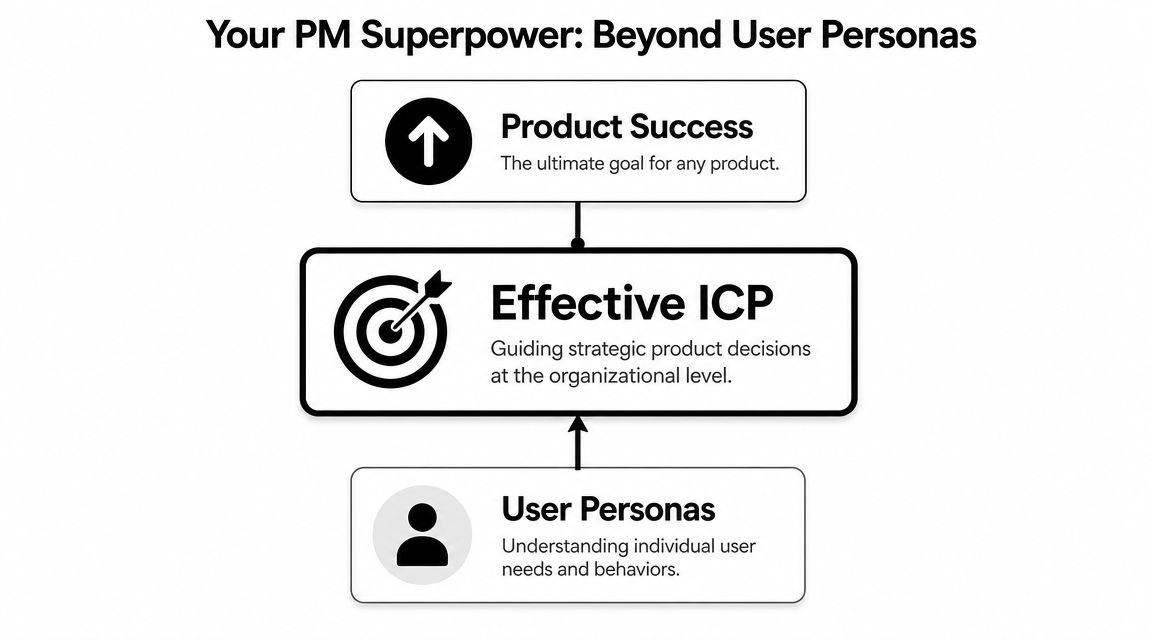
A lot of PMs over-rotate on personas. Personas matter, but they answer a different question. They help you understand who uses the product. An ICP helps you understand which companies should get your product in the first place.
That difference changes product strategy.
If you're building collaboration software, “Head of Design at a mid-market company” is a persona. “Distributed product teams with a real design-review workflow, enough cross-functional complexity to need shared tooling, and organizational readiness to standardize on one platform” is getting closer to an ICP. One tells you what the buyer might care about. The other tells you whether the account is worth pursuing and designing for.
Why product leaders should care
In B2B marketing, ICP stands for Ideal Customer Profile and refers to the type of company most likely to buy, stay, and expand over time. It's built from the traits of your best existing customers, often including company size, industry, revenue, location, technographics, and buying behavior. Companies with well-defined ICPs have been reported to achieve 68% higher account engagement and 33% higher conversion rates according to Apollo's explanation of ICP in sales and marketing.
Those numbers matter to PMs because the roadmap isn't neutral. Every feature, integration, pricing decision, onboarding investment, and reliability improvement serves some customer shape better than others.
Practical rule: If your roadmap can't name the company type it's optimized for, it's probably being driven by noise.
The PM career angle is just as real. Senior PMs and product leaders get promoted when they make choices that improve business quality, not just interface quality. Teams remember the PM who said, “This request came from a loud account, but it doesn't match our ideal customer,” and then proved it with retention and expansion logic.
ICP is where product-market fit becomes operational
Product-market fit often gets discussed as if it's one universal state. It isn't. You can have strong fit in one segment and weak fit everywhere else. A useful ICP makes that visible.
This is also why PMs working closely with growth or GTM should understand marketing in product management. The ICP becomes the bridge between market selection and roadmap focus.
Here's what works:
- Use actual customer evidence. Start from accounts that adopt thoroughly, retain well, and expand naturally.
- Define the company, not just the champion. Procurement friction, security requirements, and rollout complexity all live at the company level.
- Make trade-offs explicit. A good ICP often excludes revenue that looks tempting but drags product and support in the wrong direction.
What doesn't work is writing “our ICP is SMB to enterprise” and pretending that's strategy. That's not an ICP. That's indecision in spreadsheet form.
ICP vs Buyer Persona vs TAM
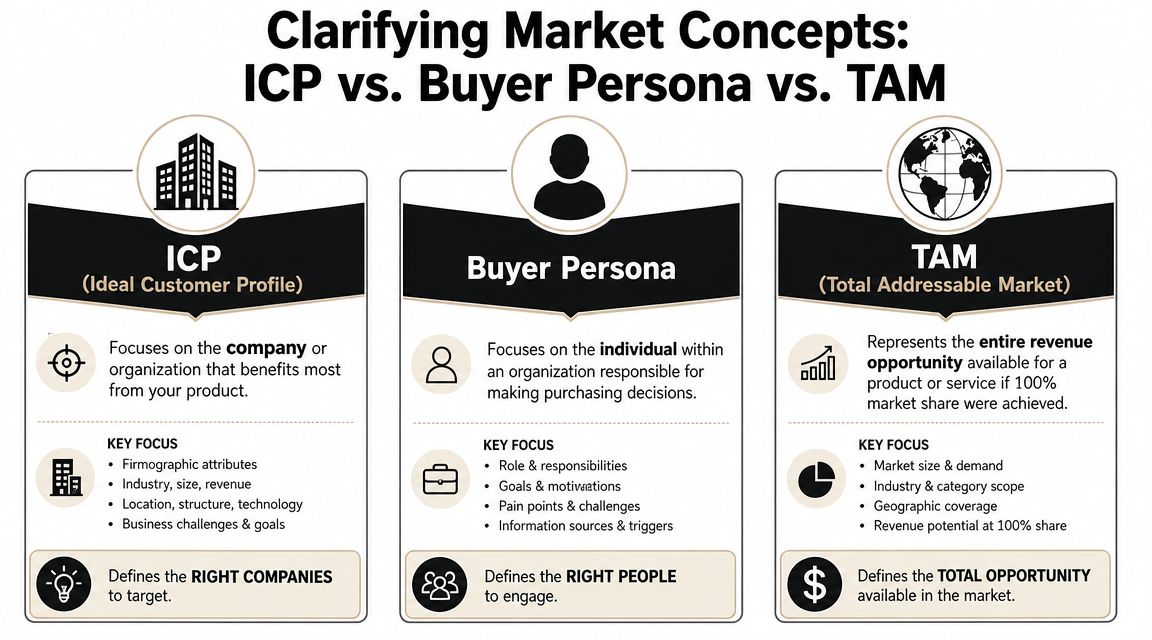
These three terms get mixed together constantly, and that confusion creates bad product bets. If you want a practical mental model, think in layers.
TAM is the total universe.
ICP is the subset you should go after first.
Buyer persona is the individual inside that company you need to understand and persuade.
A simple way to separate the terms
| Concept | What it answers | Unit of analysis | Best use |
|---|---|---|---|
| TAM | How big could this market be? | Entire market | Market sizing, investor narrative, long-range strategy |
| ICP | Which companies are the best fit now? | Company or account | Segmentation, GTM focus, roadmap prioritization |
| Buyer persona | Which people inside those companies matter? | Individual decision-maker or user | Messaging, sales conversations, UX research |
Historically, ICP moved from sales shorthand into a more formal marketing and revenue discipline as account-based approaches matured. Current guidance describes it as a blueprint for the “perfect hypothetical company” built from real customer data, and many B2B firms now maintain multiple ICPs across products, regions, or use cases. A common workflow is to analyze best customers, identify patterns, document the profile, test it against pipeline outcomes, and refresh it regularly, with some frameworks recommending quarterly updates, as described in Dreamdata's ICP guide.
Where PMs usually get this wrong
PMs often jump from TAM to persona and skip ICP entirely.
That leads to logic like this: “The market is huge, and design managers love the prototype, so let's build it.” But the missing question is whether the target company can buy, deploy, and sustain the product in a way that works for your business. Without ICP, TAM creates optimism and personas create empathy, but neither creates focus.
Later, when you're creating effective buyer personas, the work gets much better if the company-level filter already exists. Persona work without ICP often produces polished messaging for the wrong accounts.
A related concept worth grounding in your own operating model is customer profiles definition. It helps teams align on where profile-based segmentation fits versus broader market thinking.
This short clip is useful if you want a quick visual explanation before aligning your team.
TAM tells you what's possible. ICP tells you what's worth doing next.
The 5-Step Framework for Building Your ICP
A usable ICP should come from evidence, not workshop theater. If your team can't point to the customer records, product data, and win-loss patterns behind it, it's probably just a polished opinion.
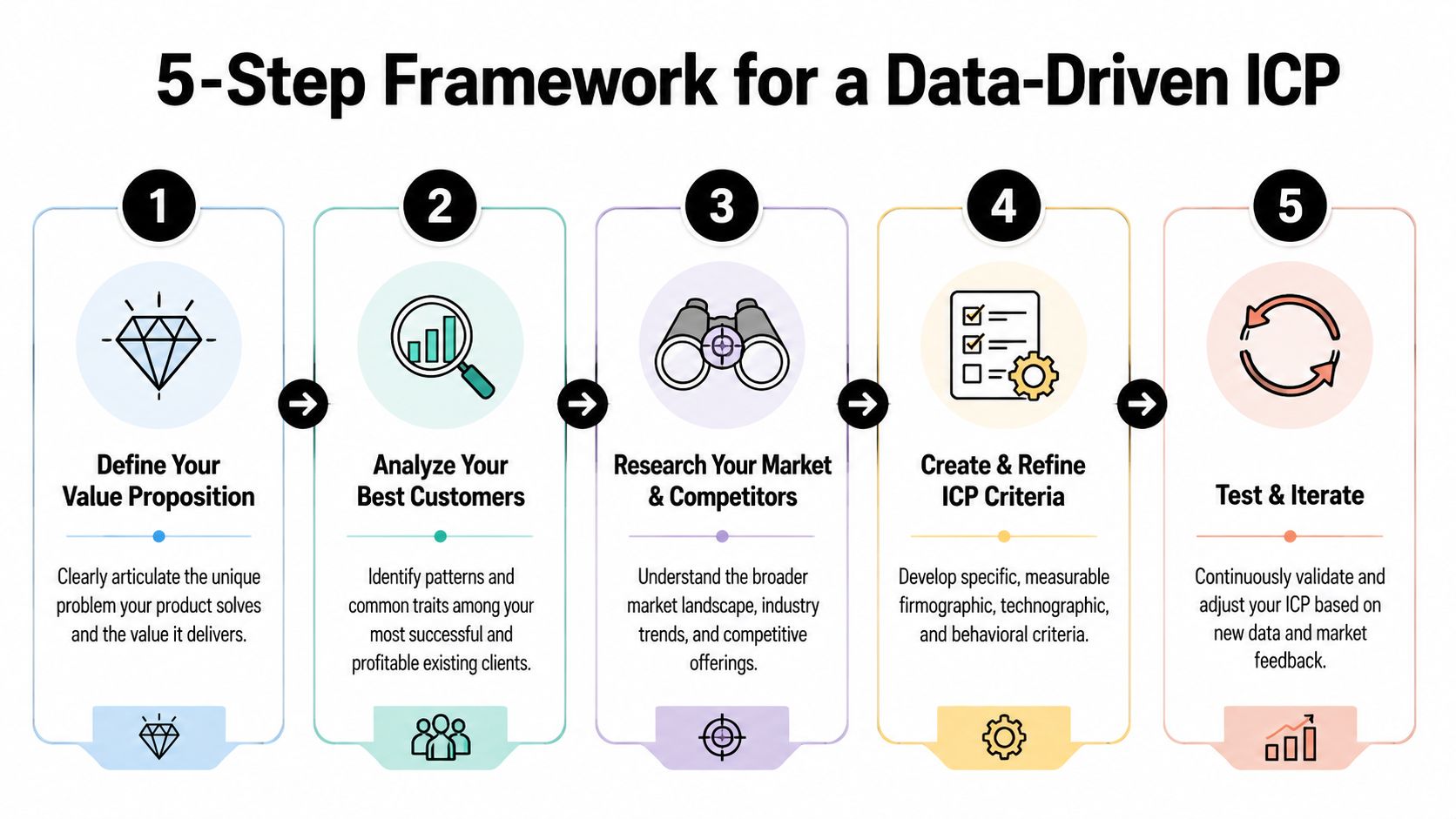
Step 1: Define the value your product delivers
Don't start with company attributes. Start with the problem you solve unusually well.
If the value proposition is fuzzy, the ICP will be fuzzy too. A product that saves time for everyone usually wins with no one. A product that accelerates security review for regulated teams or shortens handoff friction for distributed engineering orgs can be mapped to a much clearer company pattern.
Write down:
- Core pain solved: What costly problem disappears when the product is implemented well?
- Time-to-value: What has to be true for customers to realize value quickly?
- Failure mode: Which kinds of companies struggle to get value even if they buy?
Step 2: Analyze your best customers
A common misstep is employing an inappropriate customer sample. Don't confuse your biggest logo with your best-fit logo.
The better set is accounts that are successful on multiple dimensions. Look at your CRM, your billing system, and your product analytics stack. In practice, that usually means tools like Salesforce or HubSpot on the commercial side, plus Mixpanel, Amplitude, or warehouse queries on the usage side.
Look for customers that show:
- Healthy retention
- Consistent product adoption
- Expansion potential or actual expansion
- Reasonable implementation effort
- Clear alignment with your roadmap
If you work with channels or partner-led motions, it's worth looking at adjacent models too. Even something tactical like an affiliate marketing success blueprint can remind teams that acquisition quality depends on knowing which customer pattern compounds, not just which channel produces volume.
Step 3: Gather quantitative and qualitative inputs
The quantitative side tells you what's happening. The qualitative side tells you why.
Use sources like:
- CRM fields: industry, segment, geography, sales cycle notes, reason won or lost
- Product analytics: activation events, feature adoption paths, usage frequency
- Customer success notes: onboarding friction, support load, renewal themes
- Interviews: buying trigger, implementation blockers, success criteria
Ask customer-facing teams a blunt question: “Which accounts would you happily clone?”
That question gets better answers than, “Who are our best customers?” People naturally surface ease of sale, ease of onboarding, strategic fit, and expansion reality.
Step 4: Draft the ICP document
Keep the document short enough to be used. I prefer one page with explicit criteria and explicit exclusions.
Include these fields:
Firmographics
Industry, company size, region, business model, maturity stage.Technographics
Existing stack, integration readiness, data maturity, security posture.Behavioral signals
Adoption patterns, urgency indicators, internal champion patterns, rollout behavior.Value fit
Which use cases create clear ROI or operational benefits.Anti-ICP signals
Accounts that need heavy customization, lack internal process maturity, or have buying dynamics that stall repeatedly.
A practical complement to this work is how to define target audience. It's especially useful when teams are mixing market-level audience language with account-level ICP logic.
Step 5: Test and iterate
The draft isn't the finish line. You need to test whether it predicts success.
Run it against:
- Recent pipeline
- Closed-won accounts
- Closed-lost accounts
- Early churn accounts
- Expansion accounts
If your ICP includes companies that look attractive in theory but repeatedly stall in procurement, under-adopt, or churn before they're fully live, the profile is wrong or incomplete.
What works is treating the ICP like a prediction model. What doesn't work is writing it once and turning it into a slide everyone nods at and no one uses.
ICP Templates and Real-World Examples
Templates matter because teams often don't fail on theory. They fail on translation. They understand what is icp in marketing at a high level, then produce a vague paragraph nobody can use in roadmap or sales decisions.
Example one: Developer API platform
Imagine a company selling payments infrastructure to software businesses.
This ICP would likely center on digital-first companies with recurring transaction volume, internal engineering capability, and a strong need for reliable APIs, documentation, and integration flexibility. The account usually has technical teams that can implement the product without large services engagements, and leadership cares about speed, reliability, and developer experience.
Poor-fit accounts might include companies looking for a highly manual setup, organizations with little engineering capacity, or buyers whose primary decision criterion is bespoke consulting rather than scalable infrastructure.
Example two: Collaborative design and workflow SaaS
Now imagine a company selling collaborative design tooling to product and design organizations.
The best-fit customer is less about “any company with designers” and more about teams with cross-functional review cycles, distributed collaboration, and a need to standardize handoffs across product, engineering, and design. The company often values shared workflows and scale more than one-off creative output.
A weak-fit account might be a very small team with informal workflows or a procurement-heavy enterprise that wants extensive customization before basic adoption is proven.
A strong ICP should make it easier to say no than to say yes.
That's where customer segmentation techniques become useful. Segmentation helps you decide whether you need one ICP, multiple ICPs, or one core ICP with sub-variants by use case.
Copy-paste ICP template
| Category | Field | Example prompt |
|---|---|---|
| Company basics | Industry | Which industries repeatedly get fast time-to-value? |
| Company basics | Size | What employee range maps to successful rollout and retention? |
| Company basics | Geography | Are there regional constraints tied to compliance, language, or support? |
| Business model | Revenue motion | Is this company selling B2B, B2C, marketplace, or services? |
| Technographics | Current stack | What tools are commonly present in successful accounts? |
| Technographics | Integration readiness | Can they support implementation without heavy custom work? |
| Buying dynamics | Decision process | Who signs, who blocks, and how complex is procurement? |
| Behavior | Adoption signals | Which usage patterns show durable fit early? |
| Behavior | Expansion signals | What indicates the account could grow over time? |
| Use case | Core jobs to be done | Which recurring workflows make your product sticky? |
| Constraints | Risk factors | What usually delays implementation or weakens value? |
| Anti-ICP | Exclusion criteria | Which accounts consume resources but rarely succeed? |
If a PM can fill out this table with real evidence, they've got something the whole company can use.
How to Activate Your ICP in Product Strategy
The biggest failure mode is treating ICP like a marketing artifact that lives in Notion and dies in quarterly planning. A real ICP should change how product decisions get made.
An ICP in marketing is a company-level targeting model used most often in B2B to identify firms most likely to convert, retain, and expand. Guidance commonly recommends grounding it in CRM and market data, then validating it against revenue, lifetime value, usage, and retention to separate high-fit accounts from high-volume ones, as outlined in Gong's ICP sales framework.
Use ICP to prioritize the roadmap
Every roadmap has more requests than capacity. ICP gives you a weighting system.
If a feature request comes from a company outside your profile, it shouldn't automatically lose. But it should carry a higher burden of proof. If the request comes from multiple high-fit accounts and aligns with the behavior of customers who retain and expand, it deserves much more attention.
A practical product review question is: “Does this make our ideal accounts more likely to activate, adopt thoroughly, renew, or expand?”
Use ICP to filter feedback quality
Not all customer feedback is equally strategic.
A PM with no ICP treats every request as a vote. A PM with a good ICP treats requests as signals from segments with different economic value. That doesn't mean ignoring non-ICP users. It means classifying them correctly.
Here's a useful operating model:
- ICP account feedback: Prioritize for roadmap consideration and packaging decisions.
- Near-ICP feedback: Watch for repeated patterns that may justify a second segment.
- Non-ICP feedback: Route carefully. Often useful for support, docs, or edge-case understanding, but dangerous as primary roadmap input.
Use ICP in launch planning and AI product work
For launches, ICP helps product marketing sharpen positioning, sales tighten qualification, and customer success plan onboarding for the right account type. It also helps leaders decide where not to spend launch energy.
For AI PMs, ICP is even more practical. If you're building AI features, the profile can influence which workflows deserve model support, which customer environments generate high-quality data, and which deployment constraints matter. A regulated enterprise and a startup often need very different AI product behavior even if the user-level task looks similar.
If you're scaling outbound coverage around a defined ICP, the staffing model matters too. Teams that need dedicated top-of-funnel execution often evaluate options like Hire SDRs once the account definition is clear enough to operationalize.
For a tighter GTM view, ICP in sales is worth reviewing alongside your product planning. Product and sales should be using the same company definition, not parallel versions.
The roadmap gets cleaner when the company knows who it's building for, and who it's not.
Common ICP Mistakes and How to Avoid Them
The worst ICP mistake isn't getting the first draft wrong. It's pretending the first draft should stay right.
A lot of content answers what is icp in marketing as if the job ends when the worksheet is filled out. In practice, ICP quality decays. Markets shift. Products move upmarket or downmarket. Adoption patterns change. Sales teams discover new blockers. If the profile doesn't move with those signals, it starts pushing the company toward lower-quality pipeline.
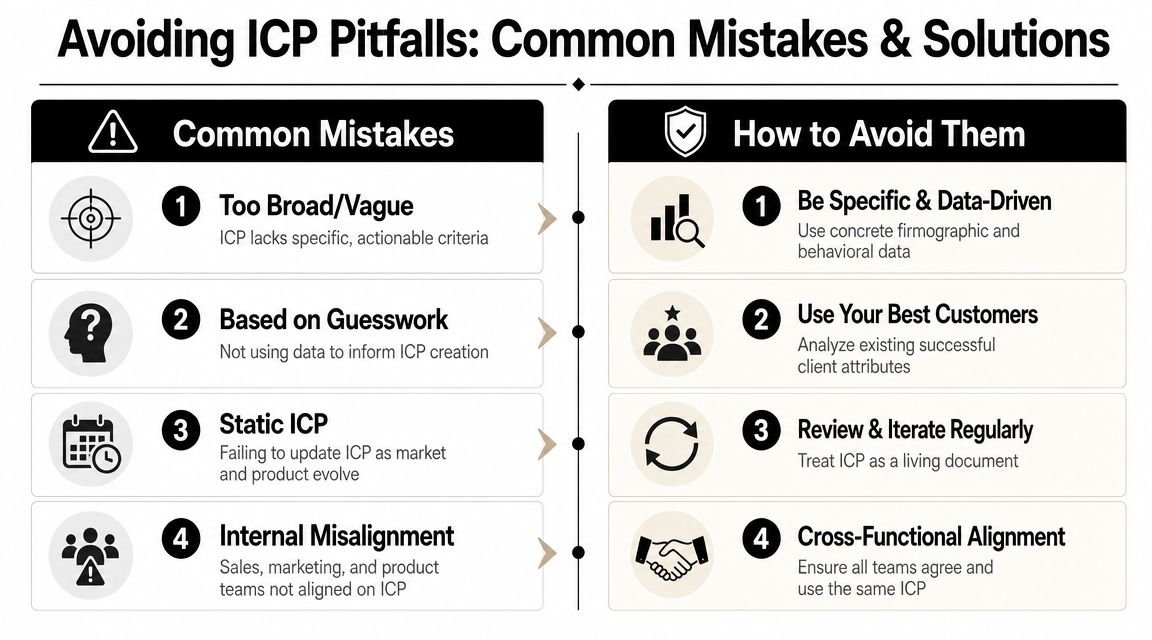
Four mistakes I see repeatedly
Too broad to guide decisions
“Mid-market and enterprise” isn't specific enough to shape roadmap or qualification.Built on intuition instead of customer evidence
Founders and PMs often describe aspirational customers, not successful ones.Confusing biggest customers with best customers
Large accounts can distort the roadmap if they need unusual support or custom work.Treating ICP as static
This is the one that quietly hurts conversion quality and product focus over time.
A common gap in ICP content is that it defines the profile but doesn't explain when to refresh it or which signals indicate drift. Guidance emphasizes using CRM and customer data, then updating the ICP as market conditions, customer behavior, and product adoption change. Leading indicators can include shifts in retention, expansion, feature adoption, or contract length, as discussed in Factors' guide to ICP maintenance.
A practical review cadence
If some frameworks recommend quarterly updates, that's a good default for most B2B teams. The point isn't bureaucracy. It's staying honest.
Use a lightweight review checklist:
- Check retention patterns: Are your best-fit segments still renewing cleanly?
- Review expansion behavior: Which account types are growing?
- Inspect product adoption: Did the sticky features change by segment?
- Look at sales friction: Are deals slowing in ways your current ICP misses?
- Revisit anti-ICP signals: Which customer patterns are draining support or causing churn?
- Align cross-functionally: Product, sales, marketing, and CS should use the same profile language.
If your team argues about a roadmap item by naming logos, not segments, your ICP isn't doing its job.
The PMs who derive value from ICPs aren't the ones with the prettiest documents. They're the ones who use the profile to make harder, clearer trade-offs. That's valuable in any product role, and it becomes career-defining at senior levels because it connects product judgment to commercial outcomes.
If you want more practical product strategy frameworks like this, explore Aakash Gupta, where you'll find resources on product growth, go-to-market thinking, and the kind of cross-functional decision-making that helps PMs move from feature ownership to business ownership.
