A lot of PMs think product mix is a retail term that matters to Coca-Cola and supermarket shelves, not to feature flags, API plans, AI models, or enterprise bundles.
That's a mistake.
If you manage a roadmap, you already manage a mix. Your “products” might be pricing tiers, workflow modules, model options, deployment modes, partner integrations, or premium features that sales keeps asking for. The hard part isn't defining the concept. The hard part is deciding when another item in the portfolio creates an advantage, and when it just creates support burden, UX clutter, engineering drag, and go-to-market confusion.
The strongest PMs I've worked with stop treating every request as an isolated build decision. They treat their area like a portfolio. That shift changes how you prioritize, how you argue with stakeholders, and how senior leaders evaluate your judgment.
Your Next Feature Request Is a Product Mix Problem
A familiar scenario: your Head of Sales wants an “enterprise-only analytics dashboard.” Marketing wants a lighter self-serve starter plan. A large customer asks for a regulated deployment option. Engineering says each variation adds another branch of complexity that someone has to maintain.
None of those are just feature requests. They're product mix decisions.
When you add a new tier, bundle, add-on, deployment type, or AI capability, you're changing the shape of your portfolio. You're affecting who you can sell to, how clearly users understand the offering, and how many edge cases your team inherits for the next few quarters.

Reframe the conversation
Average PMs ask, “Should we build this?”
Strong PMs ask:
- What line does this belong to. Is this a new line, a variant within an existing line, or a packaging change?
- What customer problem becomes easier to solve. If the answer is vague, the portfolio is probably getting noisier, not better.
- What operational cost follows. New SKUs in software show up as entitlement logic, testing paths, documentation overhead, support training, and pricing complexity.
- What gets harder to explain. If sales needs a diagram to explain the offer, buyers may need one too.
A good product mix example isn't just a list of offerings. It's a decision system for trade-offs. That matters because many explainers stop at width, length, depth, and consistency, but don't show how the right mix changes by channel or market maturity. In practice, what works for DTC can fail in wholesale, marketplaces, or enterprise SaaS because each channel has different unit economics, assortment expectations, and cross-sell potential, as noted by ProdPad's product mix glossary.
Practical rule: If a request changes packaging, pricing, segmentation, or buyer messaging, treat it as portfolio strategy before you treat it as delivery work.
This is also why prioritization frameworks break when PMs ignore portfolio shape. A roadmap can look rational at the ticket level and still become incoherent at the business level. If you need a cleaner way to surface these trade-offs with stakeholders, use one of these product prioritization frameworks and add a portfolio-complexity lens to every major bet.
What usually goes wrong
Teams often overbuild on the dimension that feels easiest.
SaaS teams often deepen one line forever. More plans, more feature gates, more enterprise exceptions. Platform teams often expand width too early. They chase adjacent use cases before the core workflow is solid. AI teams frequently do both at once. New models, new surfaces, new bundles, new copilots.
That's how PMs end up owning a roadmap they can't explain in one slide.
The Four Dimensions of a Winning Product Mix
If you can't describe your mix crisply, you can't improve it. The four dimensions are simple, but they become powerful when you attach them to actual decisions.
A classic product mix example is Coca-Cola's portfolio. In one widely cited breakdown, Coca-Cola is described as having two product lines, soft drinks and juice, with items such as Coca-Cola, Fanta, Sprite, Diet Coke, and Coke Zero in soft drinks, and Minute Maid flavors such as Guava, Orange, Mango, and Mixed Fruit in juice. The broader lesson is that related products are grouped into lines that can be managed and positioned for distinct needs, according to Corporate Finance Institute's product mix example.
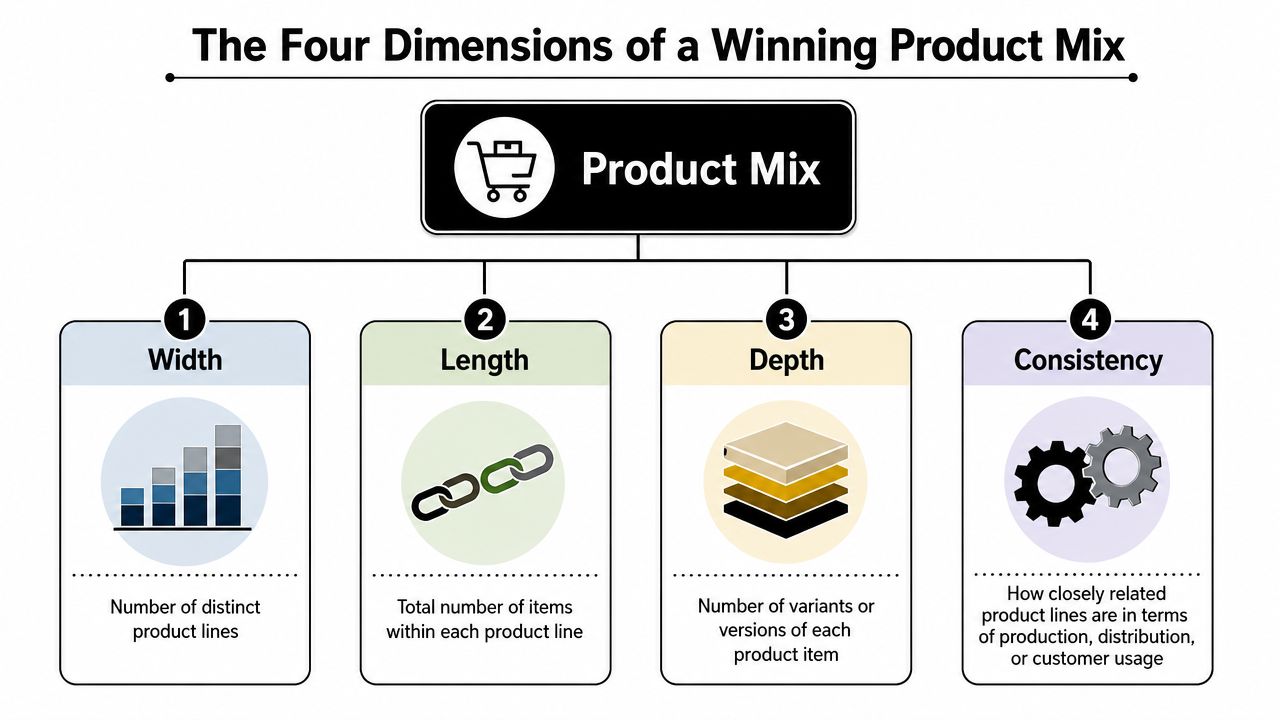
The four dimensions in plain English
| Dimension | What it means | PM translation |
|---|---|---|
| Width | Number of product lines | How many distinct problem spaces you serve |
| Length | Total number of products | How many sellable or selectable items exist overall |
| Depth | Variants within a line | How many versions, tiers, plans, or configurations you maintain |
| Consistency | How closely related the lines are | How much shared user, brand, data, and technical infrastructure exists |
For PMs, width is usually the most strategic and depth is usually the most dangerous.
Adding width can open a new market. It can also create a second company inside your company. New users, new buyer, new support motion, new analytics model, new onboarding, new roadmap politics.
Depth feels safer because it looks like “just one more version.” In reality, depth is where hidden cost accumulates. Every enterprise exception, premium variant, and channel-specific package creates long-tail maintenance.
Here's a quick visual explainer before you apply it to your own portfolio.
How PMs should actually use these dimensions
Don't stop at definitions. Use them to pressure-test roadmap proposals.
- Width question: Are we entering a new line, or are we masking a packaging issue as a product opportunity?
- Length question: How many things must the customer now understand before they can buy?
- Depth question: Which variant rules, permissions, and edge cases now hit engineering and support?
- Consistency question: Do these lines reinforce each other, or are we funding unrelated motions?
When mid-level PMs start answering in this language, they become much more credible in planning reviews. They stop sounding like feature owners and start sounding like operators. That's also where a tighter understanding of business value definition becomes useful. A wider or deeper mix only matters if it improves the business in a way leadership can measure and defend.
Product Mix Examples from SaaS, Ecosystems, and AI
The best product mix example for a PM is one that looks like your world. Consumer packaged goods help with terminology. Tech portfolios teach judgment.
Microsoft and the managed enterprise mix
Microsoft is a strong SaaS and enterprise example because the company operates across major lines like productivity, cloud, and business applications. The important lesson isn't breadth alone. It's how the company turns breadth into account-level advantage.
Office 365, Azure, and Dynamics 365 don't win for the same reason. They win together because procurement, security, identity, admin tooling, and executive sponsorship often connect across the portfolio. That's a high-value form of consistency, even when the products themselves serve different workflows.
For a PM, the takeaway is practical: broad portfolios work when shared infrastructure and shared buyer logic reduce friction. They fail when every “adjacent line” requires a different sales story, implementation path, and success motion.
Apple and the high-consistency ecosystem mix
Apple is a classic example of consistency as strategy.
Hardware, operating systems, and services reinforce each other. A user doesn't experience them as disconnected lines. They experience them as one coherent environment. That matters because consistency compounds over time. Shared design language, account systems, device handoff, subscription attachment, and trust all make the portfolio feel simpler than it is in reality.
That's what many PMs miss. A large mix doesn't automatically feel large to the user. If the transitions are clean and the model is coherent, the portfolio can expand without feeling fragmented.
The strongest portfolios don't just add products. They reduce decision cost for the customer while increasing switching cost for the business.
OpenAI and the AI-native portfolio
AI-native companies force a newer version of product mix thinking. The portfolio isn't just apps and plans. It can include foundational models, APIs, enterprise controls, developer tooling, and consumer surfaces.
OpenAI is useful here because it shows how one capability stack can support different lines. A consumer-facing experience like ChatGPT, developer access through APIs, and model-level choices are not random expansions. They're different commercial and product expressions of the same underlying capability base.
That creates advantages and tensions at the same time:
- Shared capability base: Research and platform investments can support multiple offerings.
- Channel conflict risk: Consumer simplicity and enterprise control often pull in different directions.
- Packaging complexity: Model choice, safety constraints, latency, and pricing all affect portfolio design.
- Governance burden: AI products need tighter rules around what gets exposed, bundled, deprecated, or reserved.
This is why AI PMs need to think beyond “ship a copilot.” A copilot can be a feature, a line extension, or an entirely new line depending on buyer, workflow, and monetization.
If you want more examples of how companies structure strategy at this level, these product strategy examples are useful reference points.
What separates these three examples
| Company type | Portfolio strength | Common PM lesson |
|---|---|---|
| Enterprise SaaS | Shared buyer and platform leverage | Breadth works when account value compounds across lines |
| Ecosystem business | High consistency across devices, software, services | Customers tolerate complexity if the experience stays coherent |
| AI-native company | Reusable capability stack across products | Governance matters as much as expansion |
A good product mix example in tech isn't about having more things. It's about whether the mix produces better distribution, clearer packaging, stronger retention, or more efficient product development.
A PMs Playbook for Auditing Your Product Mix
Most PMs can tell you what exists in their area. Fewer can tell you which parts of that portfolio create value and which parts just consume energy.
The audit fixes that.
Modern product-mix analysis is increasingly data-driven. One practical approach is to map every line and item, then overlay performance data such as revenue, gross margin, active users, customer satisfaction, and churn. Portfolio audits often reveal that only a few items contribute most sales while many variants add operational complexity, as described in Parallel's overview of product mix.
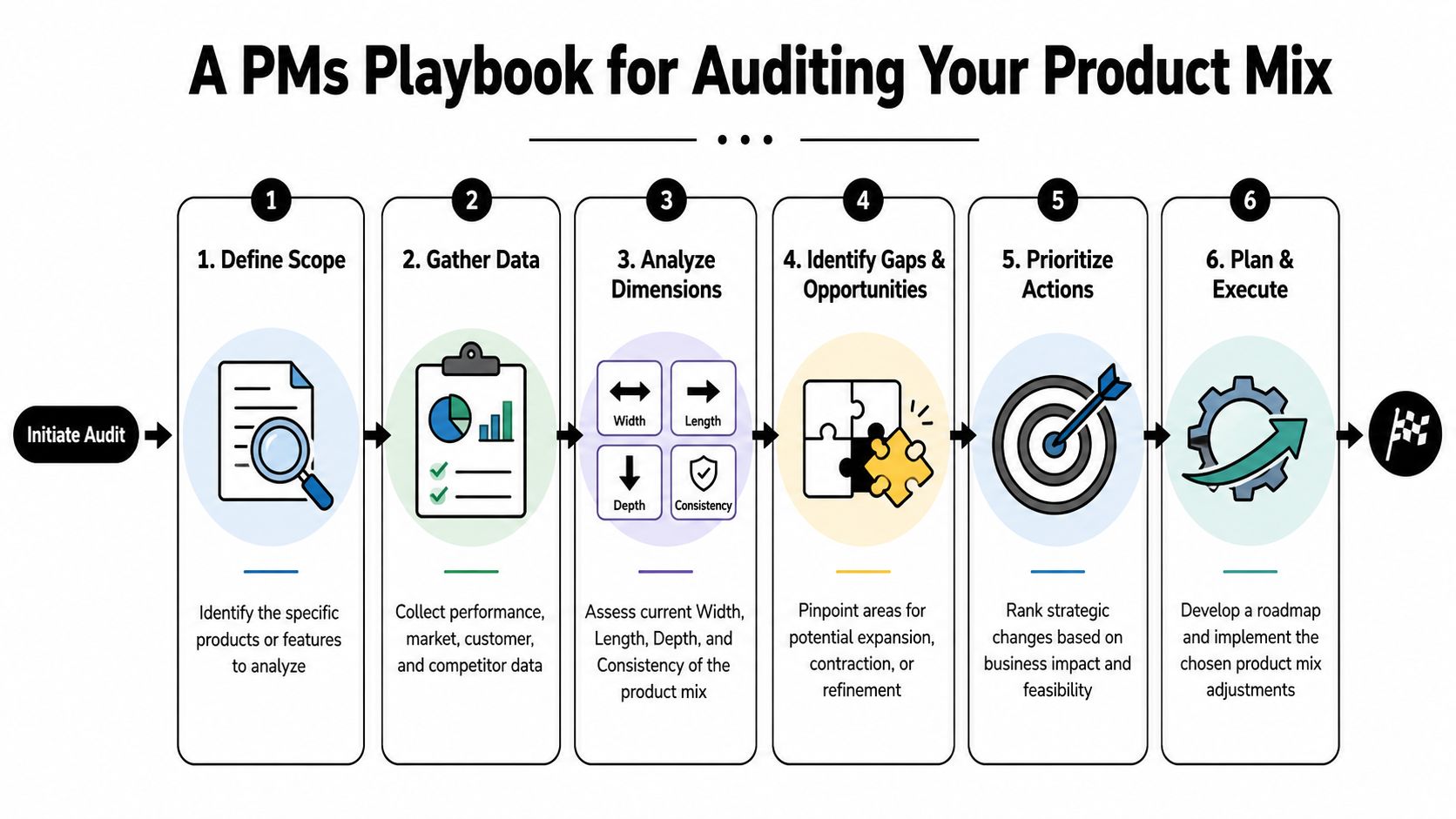
Step 1 and Step 2
Start with inventory, not opinion.
Build a sheet with every line, plan, module, add-on, integration, and deployment variant you own. If your product has feature gating by segment, list those too. Hidden variants are still variants.
Then pull a small set of decision-grade signals:
- Commercial signals: revenue, gross margin, expansion path, attach patterns
- Product signals: active users, activation, repeated usage, churn risk
- Customer signals: support burden, satisfaction, sales friction, implementation drag
- Delivery signals: engineering maintenance, QA paths, dependency sprawl
A lot of teams stop here and call it analysis. It's just collection.
Step 3 and Step 4
Map each item to the appropriate portfolio question.
Use a simple grid like this:
| Item | Strategic role | Performance read | Complexity read | Action bias |
|---|---|---|---|---|
| Core line | Essential | Strong | Acceptable | Protect and improve |
| Growth variant | Adjacent upside | Mixed | Moderate | Test and refine |
| Legacy add-on | Historical | Weak | High | Sunset candidate |
| Enterprise exception | Revenue defense | Context-specific | High | Standardize or isolate |
PM judgment is crucial. Don't confuse “has customers” with “deserves continued investment.” Some lines are worth keeping because they enable a broader account relationship. Others survive only because no one wants to own the deprecation plan.
Operator check: If a line creates disproportionate QA, docs, support, and sales enablement work, count that cost explicitly. Software complexity is still inventory.
Step 5 and Step 6
Turn the audit into a one-page narrative for leadership.
That page should answer five things:
- What are the major lines and variants
- Which items carry the business
- Which items are strategically important but operationally messy
- Which items look optional
- What decisions are blocked by missing data
I like a final slide with three buckets:
- Invest for lines that fit strategy and show healthy pull
- Rationalize for variants that may belong in simpler packaging
- Retire for items that create more drag than benefit
For tooling, teams usually combine warehouse queries, product analytics, CRM data, ticketing data, and spreadsheet synthesis. If you need a structured way to compare your offer against alternatives in the market, this competitive analysis framework template is a useful starting point. Aakash Gupta's broader library is also relevant if you want PM-focused templates for strategy and teardown work.
How to Expand or Contract Your Product Mix
Most portfolio mistakes come from one false belief. Teams assume adding options is growth.
Sometimes it is. Often it's expensive indecision.
A product mix becomes analytically useful when you break it into measurable dimensions, because a company can have broad width but low consistency. Google is a common example spanning search, ads, cloud, hardware, and media, and that's exactly why managers shouldn't treat “more products” as automatically better. The same structure that expands addressable market can also dilute focus if lines serve unrelated needs or require different systems, as explained in Sigma Computing's take on product mix analysis.
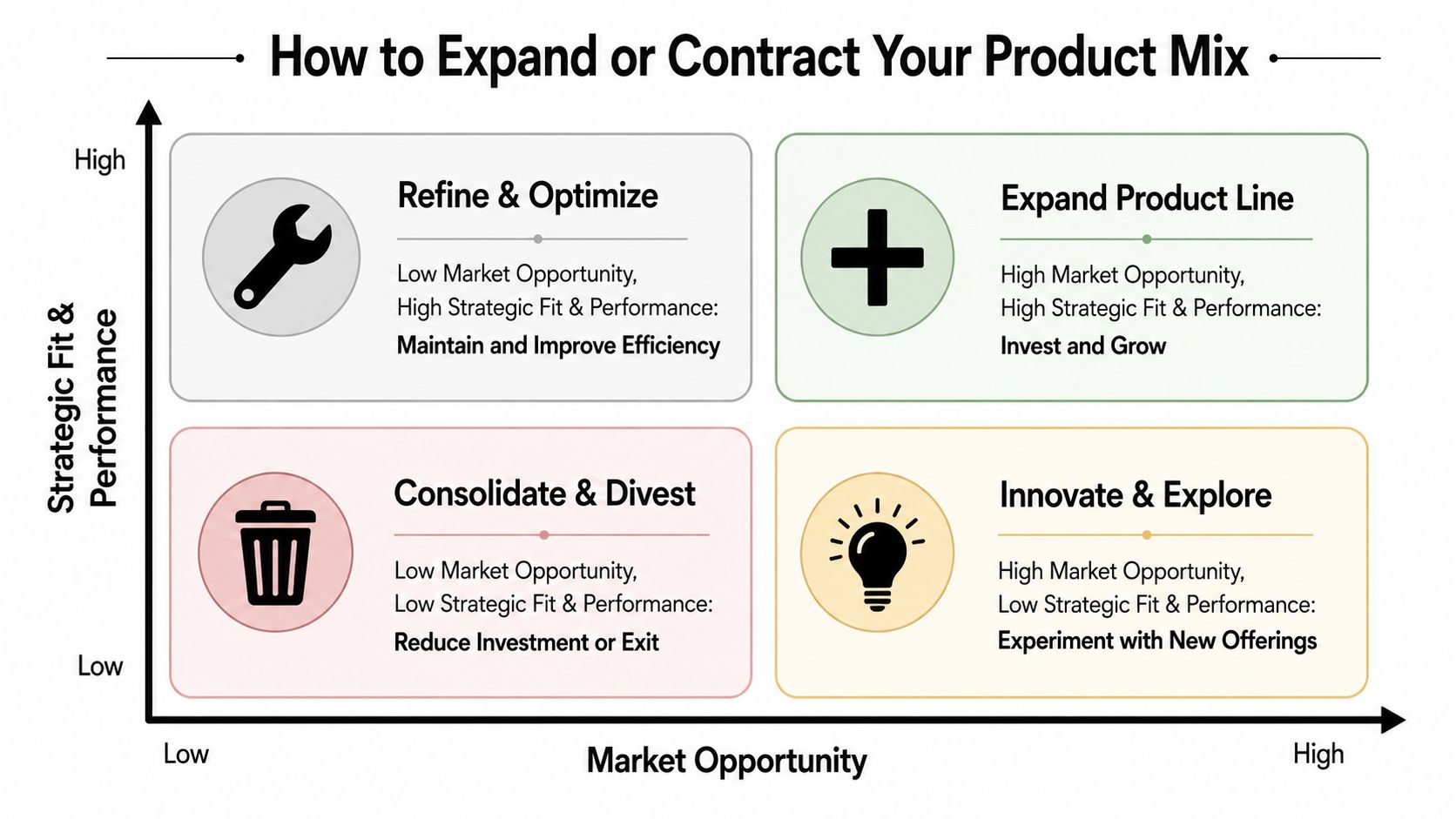
Use a simple decision matrix
Think about each line or major variant on two axes:
- Market opportunity
- Strategic fit and current performance
That gives you four plays.
| Quadrant | What it means | PM action |
|---|---|---|
| High opportunity, high fit | Clear right to win | Expand deliberately |
| Low opportunity, high fit | Useful but bounded | Optimize for efficiency |
| High opportunity, low fit | Tempting adjacency | Run contained experiments |
| Low opportunity, low fit | Portfolio drag | Consolidate or retire |
When expansion is the right call
Expand when the new line strengthens the system, not when it merely adds another revenue hope.
Good reasons to expand:
- Shared buyer motion: The same customer can credibly buy the adjacent line.
- Shared platform assets: Data, workflows, permissions, or distribution already exist.
- Clear unmet need: Users are stitching together workarounds you can solve better.
- Coherent positioning: The new offer makes the company easier to understand, not harder.
Bad reasons to expand are more common. Executive novelty. Sales pressure from one loud deal. A competitor launched something. A team wants ownership space.
When contraction is the stronger move
Sunsetting is hard because every item has a constituency. But contraction is often where senior PMs earn trust.
Retire or merge parts of the mix when:
- Variants mostly differ in packaging, not value
- Support and maintenance exceed strategic upside
- Users don't understand the distinctions
- The line blocks investment in stronger bets
Google is a good cautionary reference because a broad portfolio can create reach and confusion at the same time. PMs shouldn't copy breadth without copying governance.
If you can't explain why a product line exists in one sentence, leadership should question why the company is still funding it.
A useful habit is to write a kill memo before you write the expansion memo. If you had to remove this line today, what business would you lose, and what complexity would disappear? That thought process sharpens judgment fast.
For teams that need a cleaner framing device for these calls, a formal product strategy framework helps tie portfolio moves back to market, advantage, and sequencing.
The AI Product Manager and the Future of Product Mix
Static catalogs are dying in AI-heavy businesses. The mix is becoming more dynamic, localized, and policy-driven.
In 2025, retailers and consumer brands increasingly used AI to adjust SKUs, localize assortments, and predict demand more accurately. That's why a modern product mix example should include how a company decides which products to add, bundle, localize, or discontinue. The key lesson is simple: the best example today is often not the widest mix, but the best-governed mix, according to Product School's discussion of product mix.
What changes for AI PMs
AI shifts portfolio management in three ways.
First, personalization changes what “the product” even is. Different users can see different bundles, recommendations, defaults, or model pathways. The product mix becomes partly algorithmic.
Second, capability reuse gets faster. A new model improvement might enable changes across chat, search, agents, ranking, support tooling, and developer products at once. PMs need to decide where that capability belongs first, not everywhere at once.
Third, governance becomes part of product design. You need explicit rules for who gets which model, what gets deprecated, which features remain premium, and where reliability matters more than novelty.
A practical AI workflow
For AI PMs, I'd run a recurring review with questions like these:
- Addition prompt: Which user segment has a repeated unmet need that existing lines don't serve well?
- Bundle prompt: Which capabilities create more value when packaged together than sold separately?
- Localization prompt: Which segments need a different mix because of market, compliance, or workflow context?
- Retirement prompt: Which variants persist only because no one has cleaned them up?
The useful output isn't a giant brainstorm. It's a governed list of adds, merges, bundles, and removals with clear owner, rationale, and measurement plan.
Netflix, Amazon, and similar large-catalog businesses have trained the industry to think algorithmically about assortment and personalization. AI PMs should borrow that posture even when the “catalog” is plans, models, integrations, and workflow surfaces rather than movies or physical inventory.
From PM to Portfolio Strategist Your Career Leap
Feature PMs talk about shipping. Senior PMs talk about systems. Group PMs talk about portfolio trade-offs.
That difference shows up fast in interviews and performance reviews.
When you can explain why a new line should exist, how a variant affects complexity, or why a seemingly profitable add-on should be merged into the core offer, you signal business maturity. You're showing that you can balance growth, user experience, and operating cost at the same time.
How to frame this in your career story
Use language like this in reviews or interviews:
- Portfolio rationalization: Consolidated overlapping plans and clarified packaging across a feature area.
- Strategic expansion: Identified an adjacent line with strong fit to the existing buyer and workflow.
- Complexity reduction: Reduced variant sprawl by standardizing entitlements, onboarding, or feature gating.
- Cross-functional influence: Aligned sales, engineering, finance, and support around a portfolio decision.
Keep the story concrete. What was messy, what did you analyze, what trade-off did you recommend, and what changed in the business or product after the decision?
That's how you make the leap from “I owned roadmap delivery” to “I improved portfolio quality.” Hiring managers remember the second version.
If you want more PM frameworks, breakdowns, and practical strategy content, Aakash Gupta publishes resources for product managers who want to level up from execution into more strategic product thinking.
