A VP once reviewed a roadmap review deck at a large tech company and asked a brutal question: “What are we trying to become?” The room had twenty slides, plenty of features, and no clean answer.
That's the primary reason most product vision work fails. Teams confuse motion with direction, then wonder why every planning cycle feels like a reset.
Why Most Product Visions Fail
A weak product vision statement usually dies in one of three ways. It's too vague to guide decisions, too detailed to survive reality, or too political to challenge anyone's pet project.
Mid-career PMs often inherit this mess. The company has a slogan on a wall, leadership says the product needs a “North Star,” and engineering keeps asking for sharper priorities. Everyone sounds aligned until an actual trade-off shows up.
The failure pattern
The common anti-pattern looks like this:
- Aspirational fluff: “Delight users through innovation” sounds nice and helps nobody decide what to build.
- Roadmap disguised as vision: If the statement reads like a release plan, it will expire the moment priorities change.
- Founder brain dump: One executive knows what the future should look like, but the team can't translate that into product choices.
- No decision rule: When two ideas compete, the vision doesn't help the team say yes to one and no to the other.
A real product vision statement is a long-term strategic artifact, not an execution plan. It defines the future state of the product and should stay concise enough to guide roadmap and prioritization decisions without spelling out every step, as described in ProductPlan's definition of product vision.
That distinction matters more than most PMs realize. A roadmap is about sequencing work. A vision is about choosing the destination.
Practical rule: If your vision can't kill a feature request from an influential stakeholder, it isn't doing its job.
What good visions prevent
Strong PMs don't use vision to sound strategic. They use it to prevent waste.
A useful vision helps avoid:
| Problem | What happens without vision |
|---|---|
| Stakeholder drift | Sales, design, engineering, and execs optimize for different outcomes |
| Feature sprawl | Teams keep adding “important” work that doesn't compound |
| Strategy theater | Reviews sound polished, but priorities change every month |
| Career stagnation | PMs look reactive instead of directional |
The best product leaders I've worked with repeat the same discipline. They tie every major initiative back to a coherent view of the future state. If a proposal doesn't move the product toward that future, it gets cut, delayed, or reframed.
That's also why a vision should complement strategy, not replace it. If you want a sharper model for separating ambition from action, Aakash Gupta's breakdown of North Star thinking in strategy work is a useful mental check.
The test senior PMs use
Ask these two questions in your next roadmap review:
- What future state are we trying to create?
- Which current initiative most clearly does not help us get there?
If nobody can answer the first question cleanly, you don't have a vision.
If nobody wants to answer the second, you don't have courage.
The Anatomy of a Bulletproof Vision
Most PMs make vision harder than it needs to be. You don't need a poetic offsite exercise. You need a structure that forces clarity.
Roman Pichler's framework is still one of the most practical because it reduces vision to 4 core questions: target group, customer needs, the product and its USP, and business goals. That structure matters because it connects user value to commercial outcomes, as outlined in this guide to the product vision board.
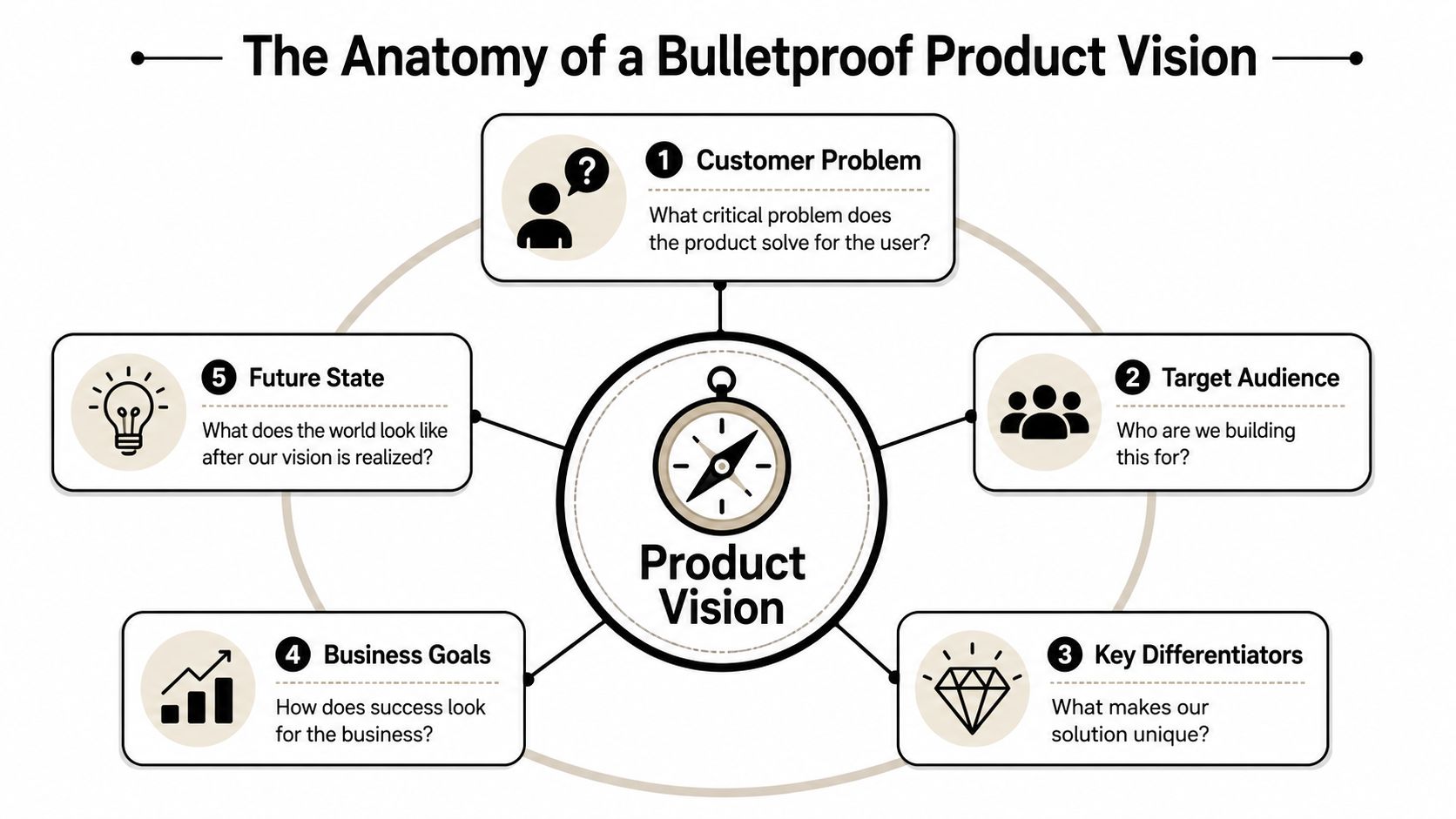
The four questions that matter
Here's the practical version.
Target group
Be specific enough that a designer, engineer, and GTM lead would picture the same user.
Useful prompts:
- Who has the problem often enough to care?
- Who feels the pain most sharply today?
- Who are we not building for right now?
If your answer is “everyone,” your team is hiding from prioritization.
Customer needs
Weak teams list feature requests. Strong teams describe underlying friction.
Ask:
- What job keeps breaking for this user?
- What workaround are they using today?
- What makes the problem expensive, risky, or emotionally frustrating?
In B2B products, this often means separating buyer pain from end-user pain. In AI products, it also means separating novelty from durable need.
Product and USP
This is not “we're building an AI platform.” That phrase says almost nothing in 2026.
Better prompts:
- What category are we really in from the user's perspective?
- What do we do meaningfully better than alternatives?
- Why will this still matter after competitors copy obvious features?
Stripe is a useful benchmark here. Its framing has always implied that the product is bigger than payments APIs. The point is economic enablement through infrastructure. That's stronger than a feature-led identity.
Business goals
Product vision statements often make PMs uncomfortable because they force honesty. Vision without business intent is branding.
Use questions like:
- What business outcome must this product create to deserve investment?
- How does this strengthen the company's position?
- What strategic advantage do we gain if we win?
A simple drafting format
Once you answer the four questions, draft in plain language:
For [target customer] who [important need], our product is a [category] that [key benefit]. Unlike [alternative], we [differentiator] and support [business goal].
Don't worship the template. Use it to expose weak thinking.
For teams that need a second lens beyond Pichler, Aakash Gupta's notes on vision and North Star alignment are useful because they push teams to connect narrative with actual decision-making.
What bulletproof actually means
A bulletproof product vision statement isn't permanent. It's durable under pressure.
That means it should survive:
- Exec review: It can hold up when leaders ask what business it enables.
- Roadmap review: It can reject attractive but distracting work.
- Hiring: New PMs can understand the direction without oral tradition.
- Market noise: It doesn't collapse because a competitor shipped a flashy launch.
The statement should be short. The thinking behind it should be deep.
Real Vision Statements from Top Tech Companies
Most PMs interpret company vision statements too narrowly. The value isn't in memorizing the line. The value is in reading what the line permits, what it forbids, and what kind of company it creates.
OpenAI
OpenAI's widely known vision centers on ensuring AGI benefits all of humanity. That's not a product statement in the narrow sense. It's a directional commitment that creates constraints as much as ambition.
What it implies:
- Product choices can't be evaluated only on speed to market.
- Safety, access, and governance become part of product thinking, not just policy work.
- The company can justify platform bets, research bets, and ecosystem bets under one umbrella.
The risk is obvious too. A broad statement can become too abstract for product teams unless each product group translates it into sharper product-level direction.
Stripe
Stripe's “increase the GDP of the internet” is strong because it frames the company around economic enablement, not payment mechanics.
That matters for PMs because it authorizes expansion beyond the first product. Billing, fraud, treasury, identity, and developer tooling all fit because the vision is tied to commercial infrastructure.
Here's the deeper lesson. Great product vision statements often expand strategic surface area without becoming vague. They create room for adjacency while preserving a core logic.
Tesla
Tesla's vision about accelerating the world's transition to sustainable energy works for a similar reason. It doesn't trap the company inside one device category.
A weaker version would have been about building better electric cars. The stronger version allows cars, energy storage, charging, and software to live inside one story.
Good visions describe the change in the world, not just the artifact you ship.
Google and Figma
Google's long-standing framing around access to information points to speed, utility, and scale. Figma's democratization-oriented positioning points to accessibility and collaboration.
What makes both effective is that they shape product quality bars. At Google, teams ask whether access becomes faster, simpler, or broader. At Figma, teams ask whether design becomes easier to create, share, and participate in.
For PMs, the move isn't copying these lines. It's learning how company identity, category strategy, and product scope reinforce each other. A good collection of these patterns appears in Aakash Gupta's examples on product strategy in practice.
A quick deconstruction lens
Use this when you read any vision statement:
| Question | What to look for |
|---|---|
| What future does it point to? | A clear change in user or market reality |
| What scope does it allow? | Narrow product, platform, ecosystem, or category |
| What trade-offs does it imply? | Speed vs trust, focus vs breadth, premium vs access |
| Where could it fail? | Too broad, too static, too detached from execution |
A mid-level PM usually asks whether a statement sounds inspiring.
A senior PM asks whether it improves decision quality.
How to Run a Vision Workshop That Actually Works
Most vision workshops fail before the meeting starts. The PM invites too many people, shows up with no evidence, and asks a room full of strong opinions to “brainstorm the future.”
That's not strategy work. That's unmanaged entropy.
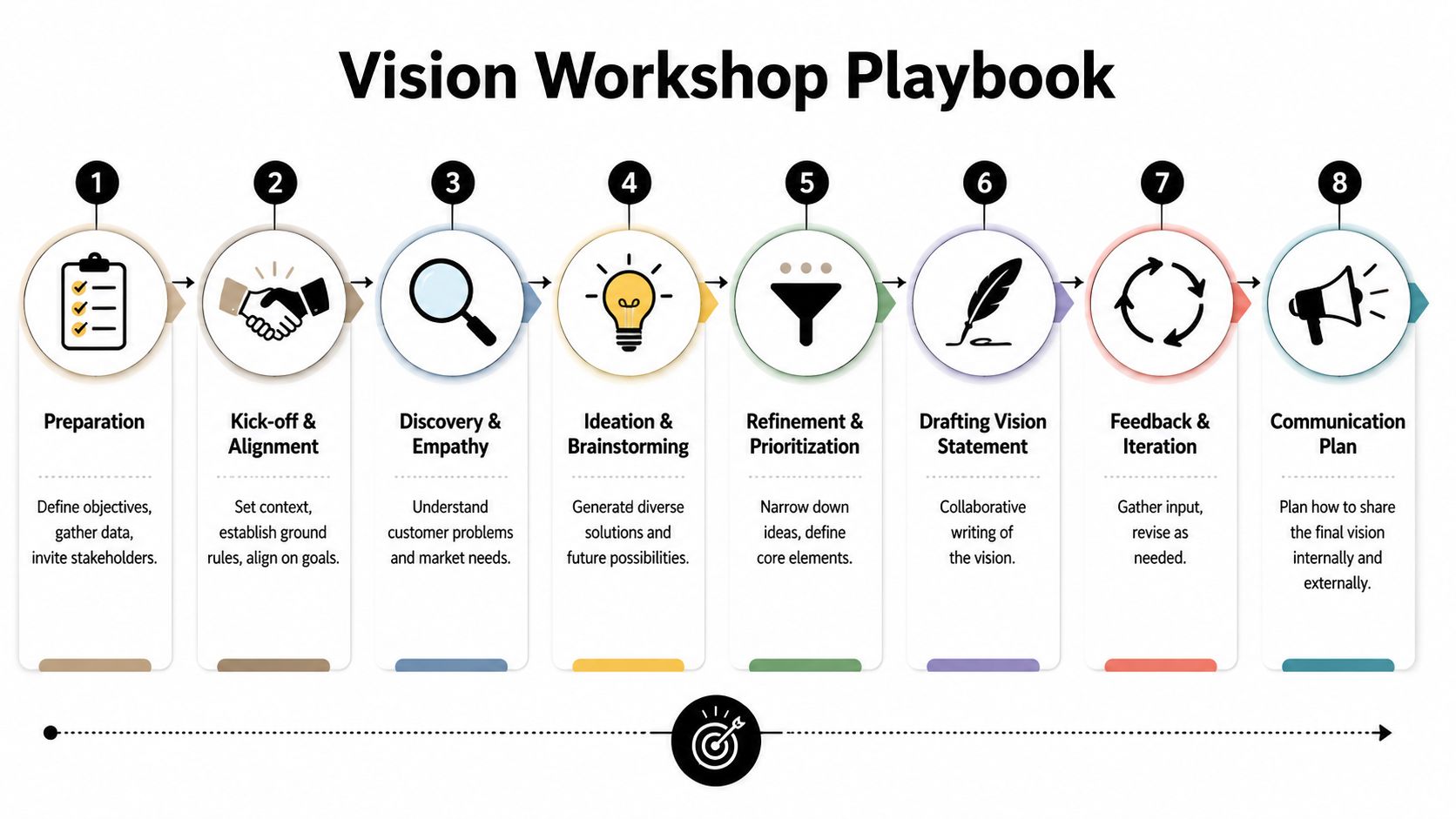
Start with the right horizon
A product vision statement usually looks 2–5 years ahead for software products and 5–10 years ahead for hardware products, which is what separates it from near-term roadmap planning according to Monday.com's guide to product vision horizons.
That gives you the first instruction for the room: don't debate next quarter's backlog.
Who should be in the room
Keep the working session small enough to make decisions.
Invite:
- Product leadership: The person accountable for the direction
- Engineering lead: The person who understands technical capabilities and constraints
- Design lead: The person who sees user workflow and quality implications
- Go-to-market partner: Usually sales, marketing, or customer success, depending on product maturity
- One strong operator from data, research, or analytics: Someone who can anchor the room in evidence
Don't invite twenty people. Run a working session, then socialize the output.
The prep that saves the session
Come in with artifacts, not opinions.
Bring:
- User evidence: Interview notes, support themes, sales objections, usage patterns
- Market context: Competitor positioning, category shifts, pricing pressure, platform changes
- Current product truth: What your product is good at, weak at, and accidentally becoming
- Strategic constraints: Revenue expectations, trust requirements, legal boundaries, platform dependencies
For workshop design, Mural and FigJam both work. If your team needs a lightweight prep template for discovery inputs before the workshop, the product discovery techniques resource from Aakash Gupta is worth using alongside your own templates.
A short explainer can help teams that haven't done this before:
A workshop format that holds up
I'd run a session like this:
Opening alignment
- State the product scope.
- Confirm the time horizon.
- Clarify what the workshop must produce by the end.
Evidence review
- Review the sharpest customer pain points.
- Note where the market is changing.
- Surface tensions already visible across functions.
Future-state drafting
- Ask each leader to write a future-state statement individually first.
- Compare drafts before open discussion.
Pichler board synthesis
- Fill in target group, needs, product and USP, business goals.
- Highlight where the team disagrees.
Draft the product vision statement
- Write three versions.
- Keep one broad, one specific, one contrarian.
Pressure test
- Which current roadmap items fit?
- Which ones now look questionable?
- What would sales hate? What would engineering challenge? What would leadership ask for proof on?
Workshop rule: Silent writing before group debate improves the quality of thinking. The loudest person in the room shouldn't write your future for you.
What “done” looks like
A successful workshop ends with:
- A first-draft product vision statement
- Explicit assumptions behind it
- Open risks and disagreements
- A communication owner
- A date for revision after stakeholder feedback
That's enough. You're not trying to leave with perfect prose. You're trying to leave with usable direction.
Your Vision in the Age of AI
The static North Star model breaks down faster in AI products than most PM playbooks admit. Generative AI changes user expectations, interaction patterns, cost structures, and competitive baselines too quickly for a frozen statement to stay credible.
That doesn't mean vision is useless. It means your product vision statement should act more like a testable hypothesis than a sacred artifact.

A strong vision now has to be stress-tested against stakeholder input, roadmap choices, and changing market conditions because generic templates don't tell teams when to pivot, as Mural notes in its discussion of product vision under rapid change.
What changes in AI products
In a traditional SaaS category, you might get away with revisiting vision occasionally. In AI, product leaders need to ask harder questions more often:
- Did a new model capability make our core workflow obsolete?
- Did user expectations shift from manual control to intelligent assistance?
- Did a competitor redefine the category around a new interaction model?
- Did trust, reliability, or cost become more important than raw capability?
A lot of AI PMs still write visions as if the category is stable. It isn't.
A better operating model
Treat the vision as stable in intent, flexible in expression.
For example, if your product vision is about helping analysts generate business insight faster, the durable intent might hold. But the expression may need to change from “better dashboards” to “agentic analysis with human review” as capability changes.
Use a simple stress-test cadence:
| Trigger | Question to ask |
|---|---|
| New foundational model release | Did the product's core UX assumption just age out? |
| Competitor pivot | Are we still differentiated in a way users care about? |
| Trust incident or governance change | Does the vision still reflect what customers will adopt safely? |
| Roadmap conflict | Are we funding work that belongs to the old world, not the new one? |
What good AI vision work looks like
The strongest AI product leaders do three things well:
- They separate trend from truth. Not every new capability deserves a vision rewrite.
- They reframe user value in plain English. Customers don't buy “LLM orchestration.” They buy speed, confidence, quality, and lower effort.
- They keep the statement credible. If your vision sounds like science fiction while your product is still solving basic reliability issues, the team stops believing you.
In AI, the worst vision isn't the small one. It's the one that assumes the environment will wait for you.
From Vision to Strategy to Roadmap
A product vision statement earns its keep when it changes daily decisions. If it doesn't shape strategy and roadmap choices, it's just internal branding.
The clean mental model is simple. Vision defines the future state. Strategy defines how you'll move toward it. Roadmap defines what gets built next.
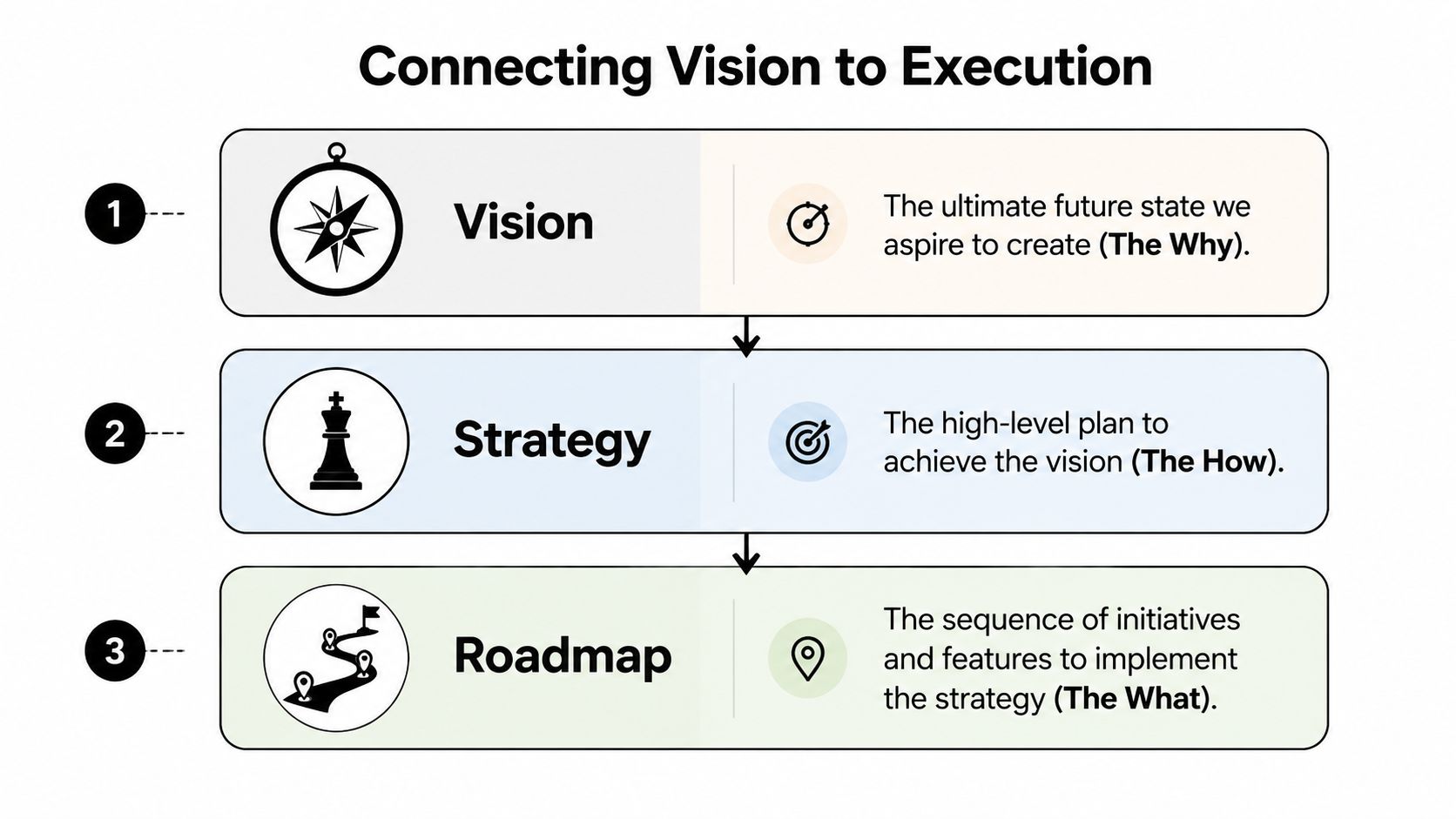
A concrete example
Take a hypothetical creator product.
Vision
Democratize professional video editing for creators.
That's the future state. It says the product should make advanced editing accessible, not just add more editing tools.
Strategy
Win by using AI to remove technical friction from the editing workflow while keeping expert users in control.
Now the team has a theory for how to compete. Not through broader feature parity with Adobe, but through simplification with trust.
Roadmap implications
That strategy would likely prioritize things like:
- AI-assisted rough cuts: Reduce blank-canvas friction
- Automatic subtitle generation: Remove repetitive manual work
- One-click color suggestions: Speed up quality improvements
- Editable AI outputs: Preserve user agency
It would probably de-prioritize deep feature branches aimed at a small slice of power users if those branches don't support the democratization goal.
The cascade PMs should make explicit
Use this hierarchy in docs and reviews:
Vision
What future state are we trying to create?Strategy
What choices will get us there?Roadmap
What initiatives express those choices now?
A lot of PM confusion disappears when this hierarchy is visible. Teams stop debating features in isolation and start debating whether a feature serves the strategy that serves the vision.
If you want a reusable way to structure this translation, Aakash Gupta's product strategy framework is a practical companion for turning directional intent into execution logic.
The trap to avoid
The biggest failure mode here is reverse engineering. A team picks a roadmap, then writes a strategy slide, then invents a vision sentence after the fact.
That creates fake coherence.
Instead, force every initiative owner to answer one question in review:
How does this move us toward the future state we said matters?
If they can't answer cleanly, the work may still be valuable. But it shouldn't hide behind the vision.
Making the Vision Your Leadership Superpower
The PMs who get promoted fastest aren't always the ones with the cleanest Jira hygiene or the most polished launch docs. They're the ones who help the company see around corners and align people around a direction worth following.
That's where a strong product vision statement becomes a leadership skill, not just a planning artifact.
What separates mid-level from senior
Mid-level PMs usually execute inside an existing frame. Senior PMs sharpen the frame. Group PMs and Heads of Product make the frame legible across teams.
That difference shows up in ordinary meetings:
- In roadmap reviews: Strong PMs connect choices to an explicit future state.
- In executive reviews: They explain what the company is betting on, not just what the team shipped.
- In 1:1s with engineers and designers: They make the work feel coherent, not random.
- In interviews: They can tell a convincing story about where a product should go and why.
Hiring panels at companies like Google, Meta, Amazon, and OpenAI care about this because strategy without directional clarity turns into expensive thrash.
How to make it visible
Don't write the vision once and wait for people to remember it.
Use it repeatedly:
- Open roadmap decks with it
- Reference it when cutting work
- Use it in QBRs and planning reviews
- Teach your team the language behind it
- Revise it when reality changes, but explain why
This is one of the few PM skills that compounds with seniority. The more scope you own, the more your job becomes sense-making, alignment, and strategic constraint.
One practical option if you want structured practice is Aakash Gupta's site, which includes resources like a Product Strategy Playbook and related material on vision and strategy. Use it the same way you'd use Mural templates, PRFAQs, or internal docs. As a working aid, not as a substitute for judgment.
A PM who can write tickets is useful. A PM who can define direction becomes hard to replace.
If you want to move from PM to Senior PM, or from Senior PM to Director, learn to write a product vision statement that survives scrutiny and changes decisions. Then learn to communicate it until other people start using it without you in the room.
If you want more practical PM frameworks, career advice, and strategy resources, explore Aakash Gupta. He publishes product management content across newsletters, podcasts, and playbooks for PMs who want sharper thinking and stronger execution.
