A lot of PMs get assigned pricing the same way they get assigned incident response for the first time. Someone senior says, “You're closest to the product, take the first pass,” and suddenly you're in a meeting with finance, sales, growth, and engineering trying to answer questions you were never formally trained to own.
That's why subscription pricing models matter so much for PMs. They don't just determine how money comes in. They shape onboarding, packaging, upgrade paths, retention loops, sales motion, and even what engineering has to build. If you treat pricing as a finance artifact, you'll make a clean spreadsheet and a weak product decision. If you treat pricing as part of the product, you'll build a system that helps customers understand value faster and buy with less friction.
The job isn't to pick a fashionable model. The job is to match how customers experience value with how you charge for it, then instrument the whole thing so you can improve it over time.
Pricing Is a Product Not a Spreadsheet
A new PM often starts with the wrong question. “What should we charge?” sounds sensible, but it skips the more important question. What customer behavior are we trying to create?
Pricing changes behavior. A flat plan tells buyers, “Don't think too hard, just start.” A seat-based plan tells managers, “Expansion happens when more people adopt.” A usage model tells power users, “You can start small, but spend will scale with value.” That's product design, not back-office administration.
Why this became a core PM skill
The modern software market was built on the move from one-time licenses to recurring SaaS billing. That shift turned software revenue into a predictable stream and made MRR and ARR standard operating metrics. It also changed what mattered operationally. Retention, expansion, and churn became central to product performance instead of being secondary concerns after a one-time sale. The economics were strong enough to reshape the industry. A KeyBanc survey of 100 software companies found a median gross profit margin of 80% on subscription or SaaS revenue, and only about 10% of respondents reported margins of 60% or lower, as summarized by Wall Street Prep's overview of subscription pricing.
That's why senior PMs at software companies get pulled into pricing work early. The company isn't asking for a price list. It's asking for a growth system.
Practical rule: If pricing affects adoption, retention, or expansion, it belongs in the PM toolkit.
What good PMs do differently
Strong PMs don't start with a feature matrix. They start with these questions:
- Who gets value first: The individual user, the team manager, or the procurement buyer?
- What expands naturally: More seats, more usage, more workflows, or more business units?
- Where friction shows up: Sign-up, upgrade, invoice review, renewal, or enterprise approval.
- What the price communicates: Simplicity, flexibility, premium positioning, or fairness.
For smaller teams and solo founders, it's useful to study how simple packaging works in practice. Resources like plans for indie builders are helpful because they show how pricing itself can frame the product before a customer ever talks to sales.
Netflix, Slack, and OpenAI feel very different as products partly because their pricing logic feels different. That isn't accidental. The pricing model teaches the user how the business works.
The Six Core Subscription Pricing Models
Most PMs don't need more jargon. They need a clear mental model for which pricing structure fits which product shape.
Start with this comparison view.
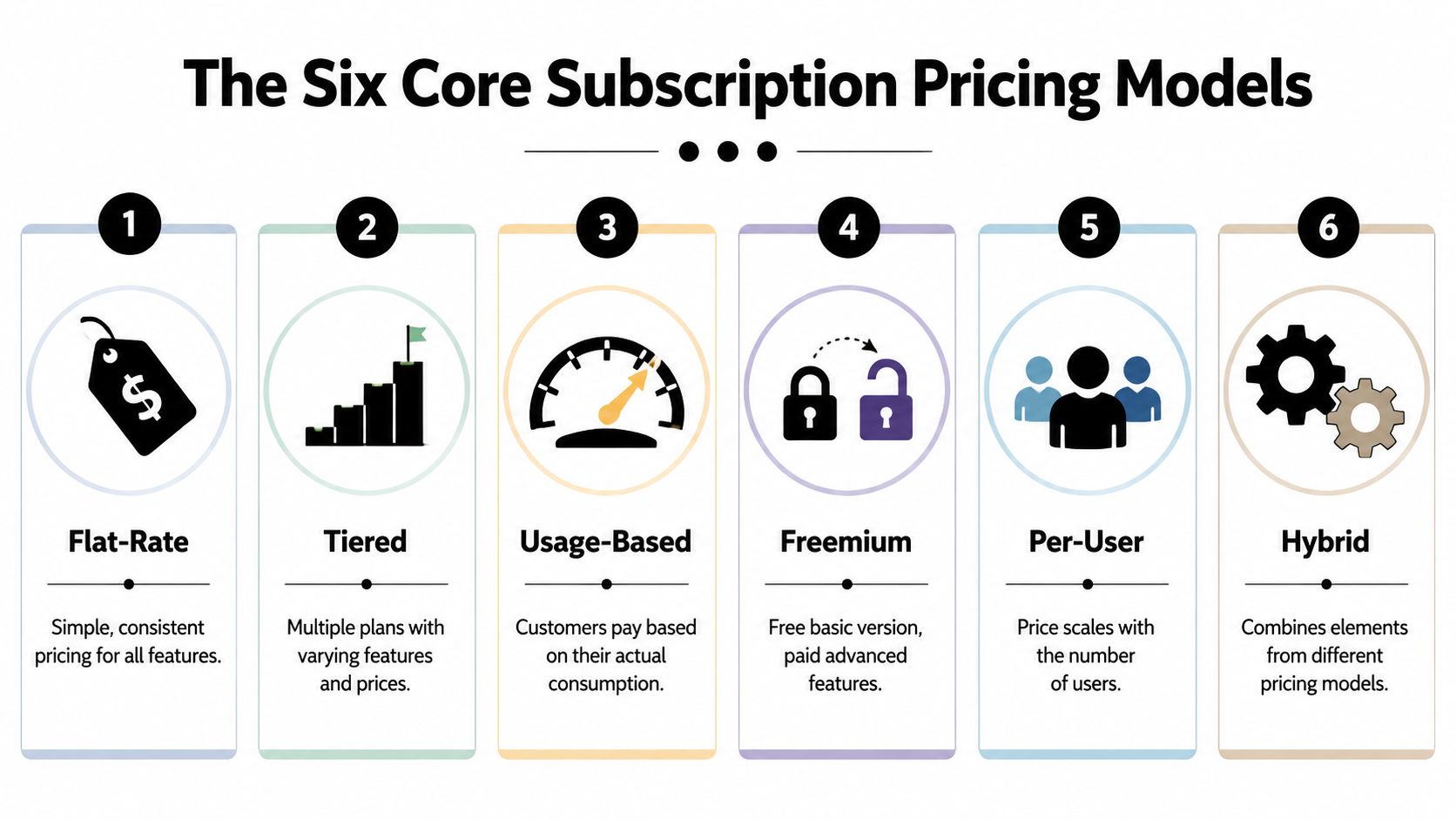
Flat-rate pricing still matters more than many PMs assume. In 2023, flat-rate pricing was the most popular subscription charging method among merchants worldwide, and Stripe reported that 40% of respondents in a 2024 survey felt they had too many subscriptions, according to Statista's summary of global subscription pricing models. Simplicity isn't lazy. In many categories, it's a competitive advantage.
Flat-rate pricing
One plan. One recurring fee. Minimal decision load.
Netflix is the mental model many PMs already understand. Customers don't want to estimate consumption every month. They want access.
Best when
- Value is broadly similar: Most users get roughly the same benefit.
- You want low-friction self-serve: Buyers should understand pricing immediately.
- Billing predictability matters: Internally and externally.
Trade-offs
- Pros: Easy to market, easy to understand, easier revenue planning.
- Cons: Weak monetization of heavy users, limited segmentation, fewer natural upgrade triggers.
A flat-rate model works well when the product promise is simple and repeatable. It struggles when one customer consumes vastly more than another or when enterprise buyers need packaging flexibility.
Tiered pricing
Tiered pricing gives customers multiple plans with different combinations of features, limits, or support.
HubSpot is a familiar example because it uses tiers to separate customer segments without forcing every deal into custom pricing. Tiering is often the default move when a company starts serving both SMB and larger teams.
Best when
- Customer segments differ clearly: Startup, growing team, enterprise.
- Feature needs diverge: Admin, governance, integrations, reporting.
- You need upgrade ladders: The product should encourage growth.
What PMs get wrong
- They create too many tiers.
- They make adjacent tiers too similar.
- They put essential value in the wrong plan.
Recent guidance around transparency and comprehension suggests simpler structures often perform better. The common pattern is three clear tiers with one plan positioned as the default choice for the target segment.
Per-user pricing
This model charges by seat, member, host, or active user. Slack made this model intuitive for software buyers because collaboration value often increases as more teammates join.
Best when
- Value maps to team adoption: More users usually means more value.
- Individual identity matters: Permissions, audit trails, collaboration history.
- Expansion happens through rollout: Team by team, function by function.
Watch-outs
- Seat friction: Managers hesitate before adding users.
- Shadow behavior: Teams share logins or limit adoption.
- Misaligned value: The buyer may get huge value from a small number of users, or little value from many.
Per-user pricing often works for collaboration software. It works less well when AI dramatically increases output for a small number of users. That's one reason AI PMs are rethinking seat-based assumptions.
For a broader breakdown of how these structures compare, Aakash Gupta's guide to pricing models for SaaS is a useful companion read.
Usage-based pricing
Customers pay according to consumption. In AI and infrastructure products, that consumption might be API calls, tokens, jobs, minutes, or events.
OpenAI is the obvious real-world anchor because many AI buyers already expect metered usage. The attraction is fairness. Small customers can start small, and high-value customers can scale spend as they scale outcomes.
Best when
- Usage varies a lot across customers
- The product has a measurable unit of value
- Heavy use strongly correlates with delivered value
Hard parts
- Revenue becomes less predictable.
- Billing requires instrumentation and trust.
- Customers worry about surprise invoices.
This model is powerful, but only if the metering feels legible to the customer. If the user can't understand what they're being billed for, the model creates anxiety instead of confidence.
A short explainer can help anchor the concepts before you take them into your next pricing review:
Freemium
Freemium gives users a real free experience and asks them to pay for more capability, more capacity, or more control.
Spotify is a clean example because the free tier does useful work. It builds habit, brand, and acquisition efficiency, while the premium tier removes friction and improves the experience.
Best when
- Time-to-value is short
- The product has strong habit loops or collaboration pull
- The free tier naturally reveals the need for paid features
Failure modes
- Free users consume support and infrastructure without converting.
- The free tier is too generous.
- Upgrade triggers are weak or poorly timed.
Freemium is often treated as a growth decision. It's also a product decision about what value you're willing to deliver before monetization begins.
Hybrid
Hybrid combines multiple models. The most common pattern in modern SaaS is a fixed subscription plus a variable component such as seats, usage, add-ons, or overages.
Salesforce is the classic enterprise example. Many AI tools are moving here too. They need some revenue predictability, but they also need a way to monetize meaningful differences in consumption and support complexity.
| Model | What customers pay for | Works best when | Main risk |
|---|---|---|---|
| Flat-rate | Access | Product value is consistent | Under-monetizes heavy users |
| Tiered | Package level | Segments differ clearly | Confusing plan design |
| Per-user | Seats or users | Adoption spreads by team | Limits rollout |
| Usage-based | Consumption | Value scales with usage | Spend unpredictability |
| Freemium | Advanced access | Product is easy to try | Free tier cannibalization |
| Hybrid | Base plus variable | Needs differ across segments | Billing complexity |
Good pricing isn't about choosing the smartest-looking model. It's about choosing the one customers can understand and your systems can support.
Metrics That Matter Your North Star KPIs
A pricing strategy without instrumentation is just opinion. PMs need a dashboard that connects customer behavior to revenue behavior.
This visual is useful as a mental map, but treat the numbers shown in the graphic as illustrative design elements, not benchmarks.
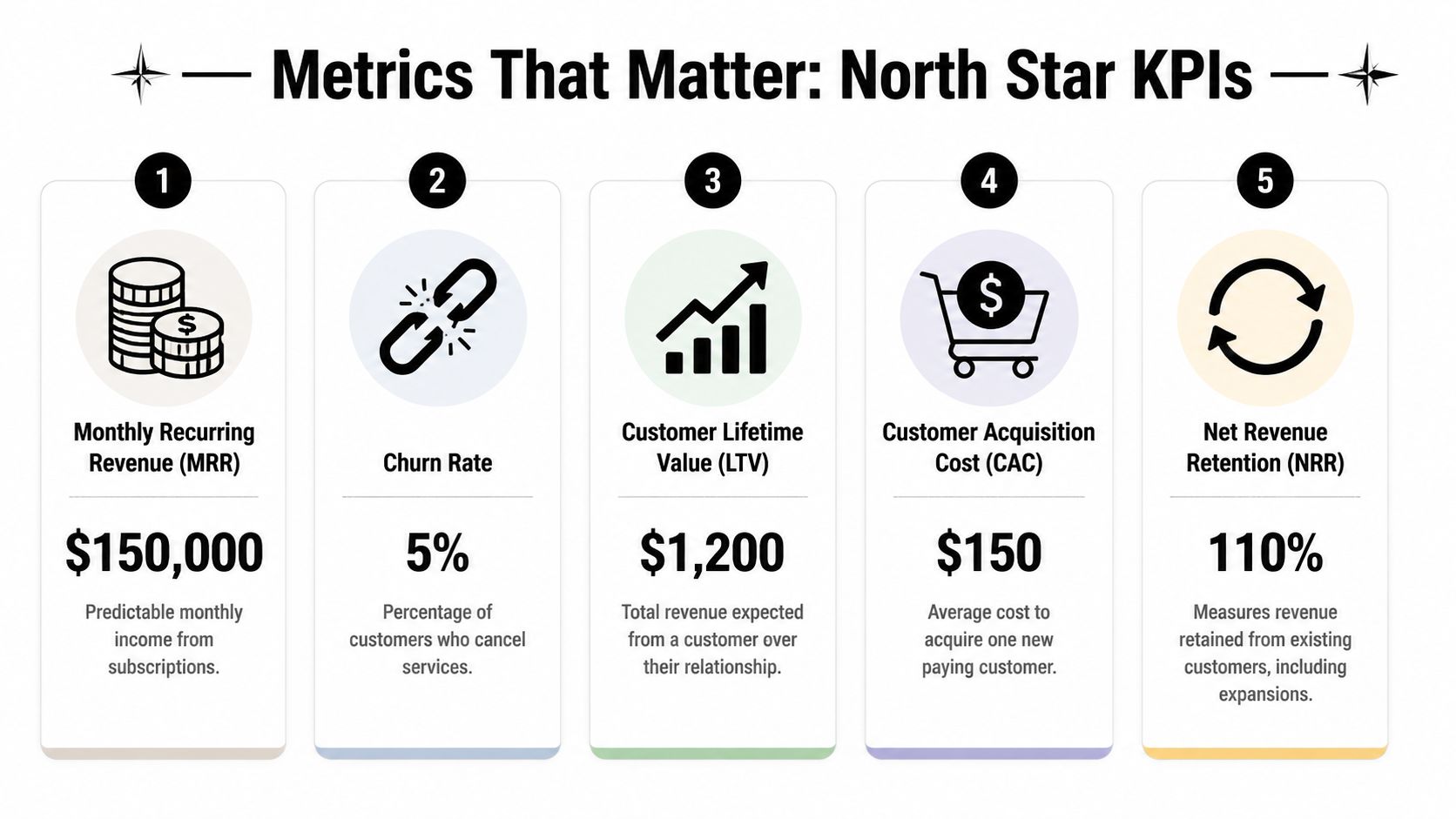
Start with the price metric
A subscription business lives or dies on the price metric, the unit you charge against. Zuora's subscription pricing glossary makes the key point clearly: your revenue formula depends on that metric, and MRR can be calculated as Active Accounts × ARPA. If the metric is weakly tied to customer value, you get leakage, awkward upgrades, and churn pressure, as explained in Zuora's guide to subscription pricing models.
That single idea is more useful than memorizing a long finance glossary. Before you ask whether your MRR is healthy, ask whether the thing you charge for tracks value.
The KPI set I'd put on a PM dashboard
- MRR: Your recurring monthly revenue base. PMs influence this through packaging, activation, upgrade prompts, and retention.
- ARR: The annualized view of recurring revenue. This matters more when your team is selling annual plans or doing enterprise planning.
- Churn: Customers or revenue leaving the product. PMs should split this into behavioral causes, not treat it as one blob.
- Expansion: Revenue growth from existing accounts through upgrades, more seats, more usage, or add-ons.
- Retention quality: Whether customers stay because they're trapped or because they're getting deeper value.
I also track qualitative inputs next to the revenue metrics. Support tickets about billing confusion, plan comparison page exits, and sales call objections often tell you what the metrics will say later.
How PMs should interpret the numbers
Here's the shortcut.
| KPI | What it tells you | What PMs should inspect |
|---|---|---|
| MRR | Current recurring base | Activation, conversion, packaging clarity |
| ARR | Longer-term revenue trajectory | Annual plan design, contract structure |
| Churn | Value breakdown | Onboarding gaps, product fit, billing fairness |
| Expansion | Monetization depth | Upgrade paths, add-ons, seat growth, usage triggers |
| ARPA | Revenue per account | Segment fit, plan architecture |
If you're revisiting monetization, I'd also brush up on the mechanics behind customer lifetime value so you can judge pricing changes against the full customer relationship, not just short-term conversion.
Diagnostic question: When a customer grows, does your pricing capture that growth naturally, or does the account stay flat until sales intervenes?
That question usually reveals whether your model has room for compounding expansion or whether you're relying on manual rescue work.
A Decision Framework for Choosing Your Model
A pricing project gets easier when you stop asking for the “best” model and start diagnosing fit. You're matching product behavior, customer behavior, and business goals.
Use this as the working frame.
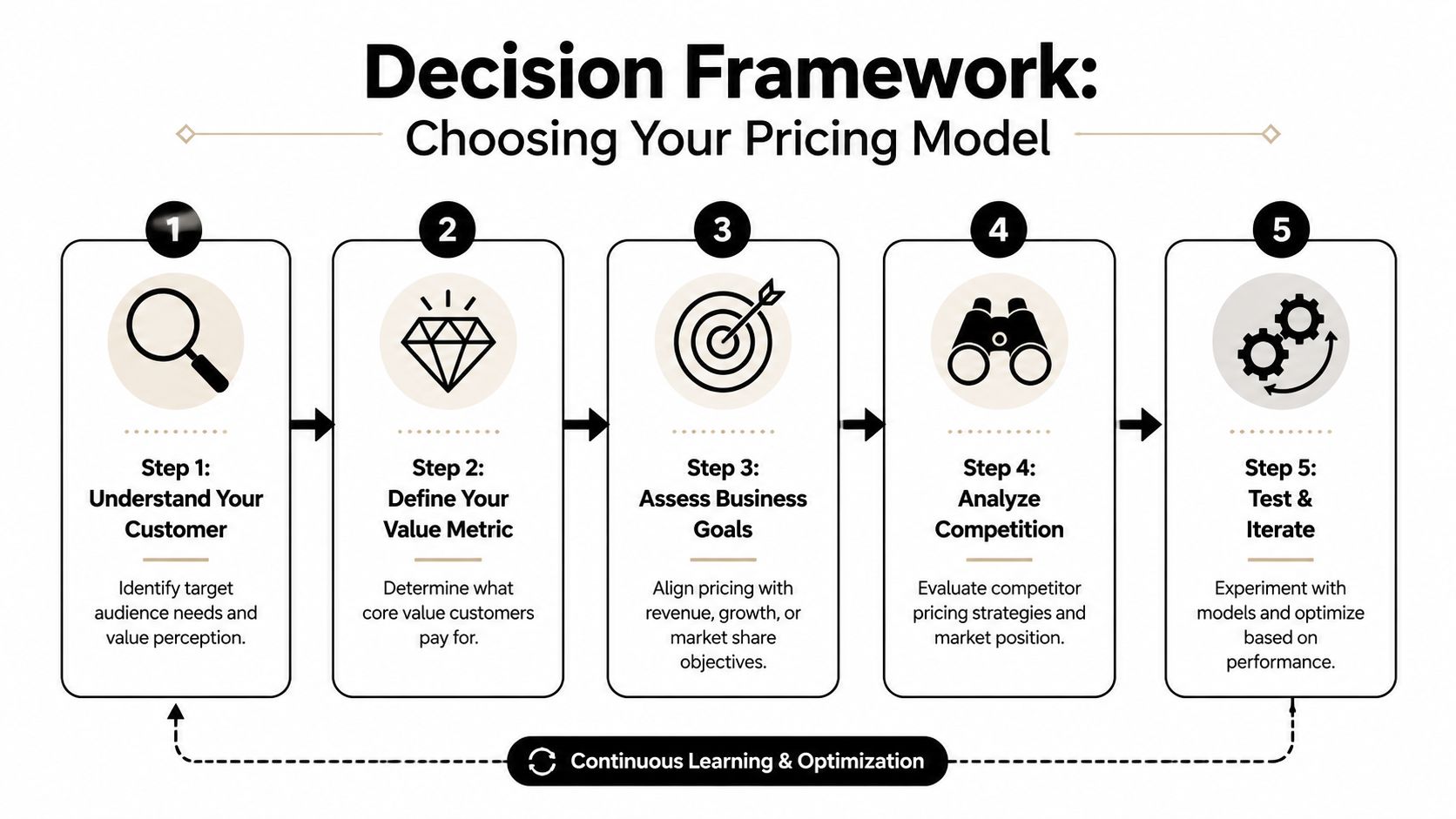
Step one gets skipped too often
Understand the customer before you draft the plans.
New PMs often jump straight into competitor screenshots. That's useful later. First, determine who is buying, who is using, and who feels the pain of switching. Those are not always the same person.
Ask questions like:
- Who sees the value first
- Who approves spend
- Who complains when pricing feels unfair
- Who benefits when the account expands
A product for an individual creator, a team collaboration product, and an enterprise AI workflow platform should not start from the same pricing assumptions.
The core value metric decides most of the battle
Choose the thing you want the customer to think about when they judge fairness.
That could be:
- Seats for collaboration
- Usage units for infrastructure or AI
- Feature access for capability-based segmentation
- Account capacity for workflow or operations products
If you can't explain the value metric in one sentence, the model probably isn't ready.
Match the model to the business goal
At this point, PMs can finally stop debating in circles.
| If your goal is… | The likely direction |
|---|---|
| Rapid adoption | Flat-rate or freemium |
| Clear segment packaging | Tiered |
| Team expansion | Per-user |
| Fairness across uneven demand | Usage-based |
| Enterprise flexibility and monetization depth | Hybrid |
The point isn't that one model maps perfectly to one goal. The point is that your primary objective should heavily influence your starting point.
For PMs who want a reusable structure for this kind of judgment, I'd keep a small library of decision-making frameworks and apply the same discipline you'd use for roadmap trade-offs.
Signals your current model is wrong
This is the part most pricing guides underplay.
Recent industry guidance points to operating signals that should force a rethink. High-variance consumption, enterprise procurement friction, and stagnant expansion revenue are all signs that the current structure may be wrong and that hybrid or usage-based options deserve serious consideration, as discussed in this framework on subscription pricing model mismatch.
Here's how that shows up in practice:
- High-variance usage: Some customers barely use the product while others push it hard. A single flat plan starts feeling unfair to both groups.
- Enterprise friction: Procurement wants commitments, controls, included allowances, and predictable billing. Pure usage can feel too open-ended.
- Stalled expansion: Customers love the product but spend doesn't grow as value grows. That usually means the metric is too weak.
The wrong pricing model creates recurring product problems that teams mistakenly try to solve with packaging tweaks.
A practical draft flow
When I guide a PM through a first pricing recommendation, I usually ask for five outputs:
- Segment map with SMB, mid-market, enterprise, or consumer distinctions.
- Value metric options with pros and cons for each.
- Current friction list from sales, support, product analytics, and finance.
- Draft model recommendation with one primary model and one fallback option.
- Instrumentation plan so the launch can be evaluated.
That's enough to move pricing from opinion to decision.
Pricing in the AI Era A Playbook for AI PMs
AI broke a lot of lazy pricing habits. Seat-based pricing assumes value scales with the number of users. AI often breaks that relationship. One user with a strong model, good prompts, and workflow automation can create outsized output.
That's why AI PMs need to think in terms of economic units, not legacy SaaS defaults.

What AI products are really charging for
In AI SaaS, the monetized unit is often invisible to the user unless you make it legible. Tokens, API calls, compute-heavy jobs, generated assets, processed documents, and automation runs are all common candidates.
OpenAI made token-based and usage-linked pricing familiar to technical buyers. That changed buyer expectations across the market. People building AI features now understand that intelligence can be metered.
The practical implication is important. Your billing system can't be a bolt-on. It has to observe events, aggregate them into billable units, apply entitlements, and surface that information clearly to customers.
Why hybrid wins in many AI products
A pure usage model is fair, but it can feel risky to buyers. A pure flat subscription is simple, but it can destroy margin when model costs vary heavily.
That's why the hybrid pattern is so common. Industry guidance notes that usage-based and hybrid models are standard for AI SaaS, and that the technical design requires metering consumption such as API calls or tokens and translating those events into billable units, often with a fixed base fee plus overages after an included threshold, as outlined in Flexprice's explanation of common subscription pricing models.
In product terms, that means:
- The base fee buys confidence and predictability.
- The included allowance reduces anxiety.
- Overage pricing captures upside from power users.
- Enterprise buyers get a structure procurement can reason about.
What AI PMs should build with pricing
Pricing in AI is part UX, part systems design, part monetization strategy.
If you're building AI-native workflows, your checklist should include:
- Metering events: Define exactly what counts as billable usage.
- Entitlement rules: Determine what is included in each plan.
- Spend visibility: Give customers dashboards, warnings, and alerts before surprise invoices.
- Fallback behavior: Decide what happens at the limit. Hard stop, soft warning, or auto-upgrade path.
- Sales packaging: Equip GTM teams to explain tokens, credits, and overages in plain language.
A lot of PMs who are moving into this space benefit from AI-specific product training and examples. A practical place to deepen that lens is Aakash Gupta's resource on artificial intelligence product management, especially if your roadmap includes both self-serve users and enterprise AI buyers.
Customers don't mind paying for AI value. They mind being confused about what they're paying for.
Slack still teaches us a lot about collaboration monetization. OpenAI teaches us a lot about usage monetization. The strongest AI PMs know when to combine those lessons instead of copying either one blindly.
The Pricing Test and Learn Playbook
Your first pricing model is a draft. Treat it that way.
The teams that get pricing right don't rely on one perfect launch. They build a repeatable loop for testing assumptions, reducing risk, and improving clarity.
Use hypotheses, not opinions
Start with a written pricing hypothesis. Not “we should add an enterprise tier.” Write the behavior you expect to change.
Examples:
- If we simplify from many plans to three, buyers should compare options faster and ask fewer clarification questions.
- If we move AI usage into a base-plus-overage structure, power users should feel less constrained while finance gets more predictable billing.
- If we reposition the middle plan around the highest-value workflow, more customers should choose it because the value story is clearer.
Then define what evidence would prove or disprove the hypothesis. Many PM-led pricing projects often fail at this stage. The launch happens, but no one agrees what success looks like.
What to test before a full rollout
You don't always need a dramatic A/B test on the live pricing page. In many B2B settings, PMs can test through controlled exposure.
Try a mix of:
- Sales-assisted comparisons: Give different packaging narratives to different lead cohorts.
- New-customer experiments: Keep existing customers stable while testing on fresh signups.
- Plan-page language tests: Change wording, order, and emphasis before changing the actual economics.
- Upgrade flow tests: Measure whether customers understand when and why they should move up.
If your team needs a refresher on experimental hygiene, A/B testing best practices are useful because pricing tests are easy to contaminate with messaging, segmentation, and sales behavior.
Protect trust during changes
Customers can tolerate price changes. They don't tolerate confusion.
Recent guidance on pricing transparency argues that while some tactics push toward complexity, consolidating to three clear tiers can improve comprehension and conversion, reinforcing the trade-off between monetization and simplicity, as discussed in CCBill's guidance on subscription pricing transparency.
Use this rollout checklist:
- Grandfather carefully: Protect loyal customers when possible, especially if they bought under a different value promise.
- Explain the why: Customers should understand what changed in the product or packaging.
- Train internal teams: Sales, support, and success need one consistent explanation.
- Update billing UX: Invoices, plan pages, and overage alerts must all tell the same story.
- Review cohorts after launch: Watch retention, upgrade behavior, objection themes, and support volume.
Simplify more often than you add complexity
PMs love flexibility. Customers love clarity.
That tension shows up hardest on pricing pages. Teams add one more plan, one more add-on, one more exception for edge cases, and suddenly the page is doing the opposite of its job. If a customer has to study your pricing, they'll often delay the purchase and keep evaluating alternatives.
A strong pricing page acts like good onboarding. It narrows decisions, names the default path, and gives the buyer confidence that they understand the trade they're making.
From Model to Money Pricing Is Your Most Powerful Feature
The PMs who grow fastest in their careers learn to connect product decisions to business outcomes. Pricing is one of the clearest places to practice that muscle.
A good pricing model tells the market who the product is for. It helps the right customers start quickly, gives successful customers a natural path to expand, and prevents the team from hiding weak value communication behind custom deals and discounting. It also forces rigor. If you can't explain why a customer should pay in a certain way, you probably don't fully understand your product's value yet.
That's why I teach new PMs to treat subscription pricing models as part of the product surface area. They sit alongside onboarding, packaging, activation, and retention. They aren't downstream from product strategy. They are product strategy.
If you're leading your first major pricing project, don't aim to sound like finance. Aim to understand customer value better than anyone else in the room. Bring a model, a metric, a decision framework, and a test plan. That's what credible PM ownership looks like.
And once you see pricing this way, you won't hand it off so quickly again.
If you want more PM-focused frameworks like this, Aakash Gupta publishes practical resources on product strategy, growth, AI PM work, and career development that are useful when you're trying to connect product decisions to business results.
