Design thinking is a framework for innovation that puts people first. For a Product Manager, it's your most reliable playbook for de-risking new ideas and ensuring you build products people actually need. It’s an iterative, non-linear process for solving fuzzy problems by forcing you to deeply understand the people you're designing for before you write a single line of code.
As a PM leader who has hired and mentored dozens of Product Managers at companies like Google and Meta, I can tell you this: the ability to rigorously apply this process is a key differentiator between a junior PM who ships features and a senior PM who ships value. This approach is your best defense against building a product nobody wants.
Your PM Playbook for Design Thinking
As a Product Manager, your most critical job is ensuring your team solves the right problem. Design thinking isn't a task for the UX team; it's a strategic framework that de-risks your entire product roadmap. It’s the difference between guessing what users want and knowing what they need.
This structured process prevents you from jumping straight to solutions based on your own assumptions. Instead, it guides your team through a deliberate journey of discovery, learning, and validation.
From Vague Problem to Validated Solution
The power of design thinking lies in its structure, which takes you from a deep, almost anthropological understanding of your users to tangible, tested ideas. While often shown as a straight line, the reality is messy. You’ll constantly jump back and forth between stages as you uncover new insights.
Think of it as a cycle of continuous learning and refinement, perfectly suited for the uncertainty of building new products. This entire process ties directly into foundational product discovery, ensuring every decision is grounded in real user needs from the start.
This visual from the Interaction Design Foundation perfectly captures the interconnected, looping nature of the stages.
See how insights from the "Test" phase can send you right back to "Ideate" or even "Define"? That's the process working as intended—it's all about refining your understanding before committing expensive engineering resources.
The Five Core Phases of Design Thinking
The modern framework gained significant traction after 2004 when David Kelley founded the d.school at Stanford University. The d.school popularized a five-phase process that has since become the gold standard for high-performing product teams globally.
Here’s the essential breakdown every Product Manager must master:
- Empathize: Get a deep, empathetic understanding of your users’ problems and their world through observation, interviews, and immersing yourself in their context.
- Define: Synthesize everything you learned to nail down a clear, actionable problem statement, often called a Point of View (POV).
- Ideate: With a clear problem in hand, generate a wide range of creative solutions. At this stage, it’s all about quantity over quality—no bad ideas.
- Prototype: Make your ideas real. Create cheap, scaled-down versions of your best ideas to investigate the solutions you came up with. Think low-fidelity.
- Test: Get your prototypes in front of actual users and gather feedback. This feedback loop is critical for refining solutions and deepening your understanding of the user.
A solid grasp of this process doesn't just help with product features; it can also sharpen your approach to bigger creative design and branding initiatives, ensuring they resonate with your target audience.
To tie it all together, here's a quick cheat sheet for how these phases translate directly into your work as a PM.
The 5 Phases of Design Thinking for Product Managers
| Phase | Core Objective | Key PM Activities & Tools | Critical Output |
|---|---|---|---|
| Empathize | Gain a deep, emotional understanding of the user's context, needs, and pain points. | User interviews, contextual inquiry, surveys, creating empathy maps, persona development. | Rich qualitative insights, detailed user personas, and a clear picture of the "user's world." |
| Define | Synthesize research into a clear, concise, and actionable problem statement. | Affinity mapping, "How Might We" statements, creating a Point of View (POV). | A well-defined problem statement that aligns the entire team on what to solve. |
| Ideate | Generate a broad range of creative ideas to solve the defined problem. | Brainstorming sessions (e.g., SCAMPER), mind mapping, sketching, storyboarding. | A large pool of diverse and innovative solution concepts to explore further. |
| Prototype | Create tangible, low-cost representations of the most promising ideas to test them. | Wireframes (Figma, Balsamiq), paper prototypes, clickable mockups, role-playing scenarios. | A testable artifact that allows users to interact with and react to the proposed solution. |
| Test | Gather user feedback on prototypes to validate assumptions and refine the solution. | Usability testing sessions, A/B tests, user feedback surveys, observation. | Actionable user feedback, validated (or invalidated) hypotheses, and clear next steps for iteration. |
Think of this table not as a rigid set of rules, but as a flexible guide to keep you grounded in a user-centered approach as you navigate the complexities of product development.
A Tactical Breakdown of the Five Phases
Let's move beyond high-level theory. As a Product Manager, your ability to execute each phase of design thinking is what separates game-changing insights from just going through the motions. This is a practical playbook for de-risking your product bets and building things people actually want to use.
The process flow below shows how each phase connects, guiding you from human-centered discovery all the way to a validated solution.
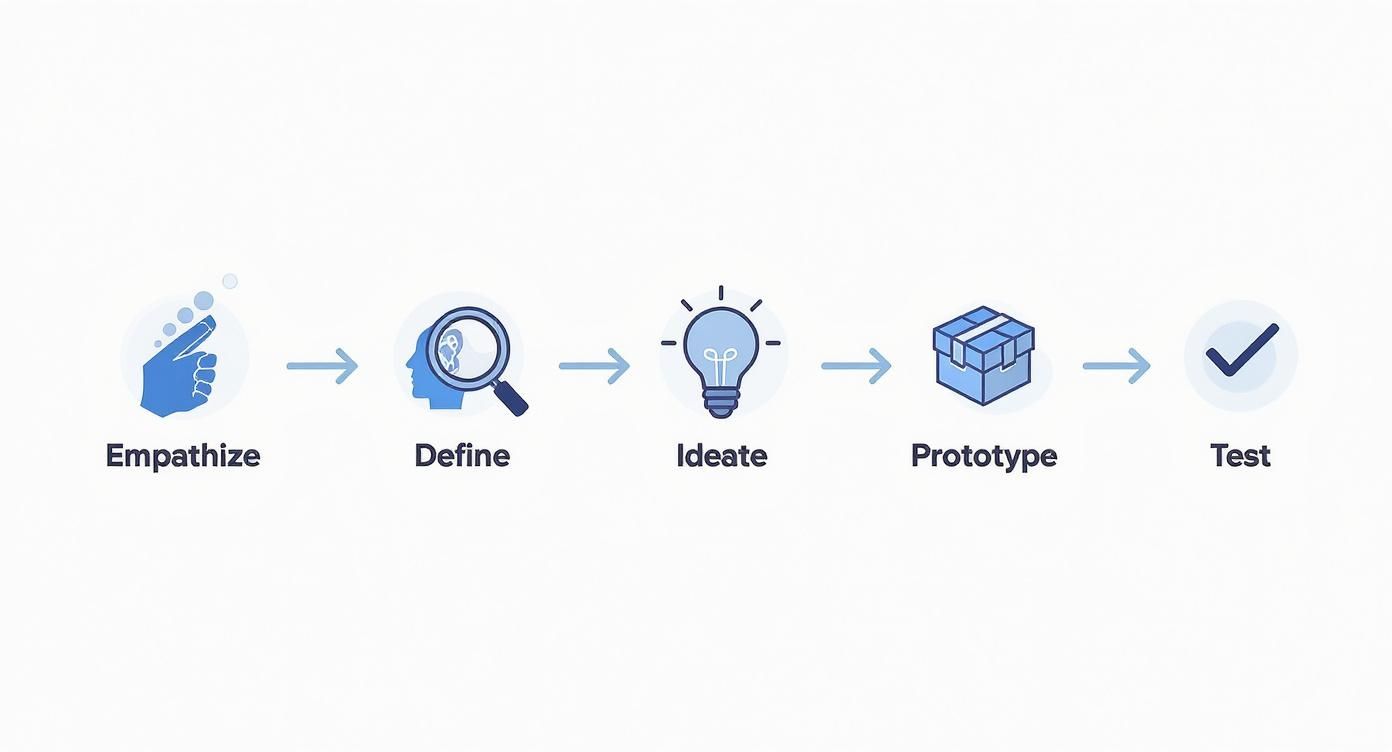
Notice the loops. This visual makes it clear that the process is iterative. What you learn in the "Test" phase often sends you right back to Ideation or even forces you to redefine the problem entirely. That's not a failure; that's the process working.
Phase 1: Empathize — Understand the Human Need
Your first, and most critical, job is to get out of the building. The Empathize phase is about shutting down your own assumptions and developing a deep, visceral understanding of your user's world. You're not just collecting data; you're observing their behaviors, listening to their frustrations, and getting a handle on their motivations at an emotional level.
Many junior PMs think a survey is enough. It's not. Real empathy comes from rich, qualitative stories, not quantitative checkmarks.
Here's how you build genuine empathy:
- Contextual Inquiry: Go to your user's natural habitat. Building software for accountants? Spend a day in their office. Watch their actual workflow, notice the sticky notes plastered on their monitors, and pay close attention to the clever "workarounds" they've invented. Those are gold mines.
- User Interviews: These are foundational. Your goal isn't to pitch your solution; it's to listen. Ask open-ended questions that encourage people to tell you a story. Our detailed guide offers specific techniques on how to conduct user interviews that uncover powerful insights.
For example, instead of asking, "Would you use a feature that does X?" try this: "Tell me about the last time you tried to accomplish Y. What was that like for you?" The difference in the answers you'll get is staggering.
Phase 2: Define — Frame the Right Problem
After immersing yourself in your users' world, you’ll be sitting on a mountain of notes, transcripts, and observations. The Define phase is about finding the signal in that noise. Your job is to synthesize all that raw data into a clear, concise, and actionable problem statement.
A weak problem definition leads to a weak solution. Period. But a powerful one becomes a north star for your entire team.
PM Leader Insight: A great problem statement is always human-centered. It should be broad enough to allow for creative freedom but narrow enough to be solvable. Crucially, it focuses on the need, not the solution.
Your go-to tools in this phase are:
- Point of View (POV) Statements: A simple template that packs a punch:
[User] needs to [user's need] because [surprising insight].For instance: "A busy working parent (user) needs to plan a week of family meals in under 15 minutes (need) because their limited time is spent on decision-making, not the cooking they enjoy (insight)." - "How Might We" (HMW) Questions: Reframe that POV statement into an optimistic, open-ended question that sparks brainstorming. The POV above becomes: "How might we help busy working parents feel confident and efficient in planning their weekly meals?"
Phase 3: Ideate — Generate a Universe of Solutions
With a sharply defined HMW question, it's time to unleash your team's creativity. The Ideate phase is about quantity over quality. You want a massive range of ideas, from the painfully practical to the wildly absurd. This is divergent thinking at its finest—no idea is too "out there."
As a PM, your role here is to facilitate, not dictate. Create a psychologically safe space where engineers, designers, and marketers feel empowered to contribute.
Structured techniques work better than just saying, "Okay, let's brainstorm!"
- SCAMPER: A fantastic checklist of questions to transform existing ideas:
- Substitute: What if we swapped out this component?
- Combine: What if we merged this with another feature?
- Adapt: How could we adapt this for a different user type?
- Modify: Can we change the size, shape, or color?
- Put to another use: Could this be used in a different context?
- Eliminate: What could we remove to simplify it?
- Reverse: What if we did the absolute opposite?
- Storyboarding: Don't just talk about the idea; visualize the user's journey. This simple exercise helps the team think through the entire experience, not just a single feature, and often uncovers friction points you'd otherwise miss.
Phase 4: Prototype — Make Your Ideas Tangible
An idea in a document is just a guess. The Prototype phase turns your most promising concepts into something real enough for users to react to. The key principle here is low fidelity. You are not building an MVP; you are building an artifact designed to answer a specific question.
Wasting weeks of engineering time on a polished prototype for an unvalidated idea is a cardinal sin in product management. The fidelity of your prototype should always match your learning goal.
Here’s how to choose the right fidelity:
| Prototype Fidelity | Best For Testing… | Key Tools | Example |
|---|---|---|---|
| Low-Fidelity | Core concepts, user flows, information architecture. | Paper sketches, Balsamiq, Whimsical | A series of hand-drawn screens showing how a user signs up. |
| Mid-Fidelity | Basic interactivity, layout, component placement. | Figma, Sketch, Adobe XD | A clickable wireframe that lets a user navigate between pages. |
| High-Fidelity | Visual design, micro-interactions, the "feel". | Figma (with components), Framer, ProtoPie | An interactive mockup that looks and feels like the final app. |
Phase 5: Test — Learn from Real Users
Finally, the Test phase is where your assumptions meet reality. You put your prototypes in front of actual users and observe. This isn't about defending your idea; it's about listening with humility and being completely open to being wrong. The feedback you get here is pure gold.
Running an effective usability test is a skill. Your goal is to see if users can complete key tasks and to understand their thought process.
Here’s a simple framework for a usability test session:
- Welcome and Context: Make the user comfortable. Emphasize that you're testing the prototype, not them.
- Give a Scenario: Provide a realistic task. Instead of "Click the sign-up button," say, "Imagine you've just heard about this app and want to create an account. Show me how you'd do that."
- Observe and Probe: Be quiet and watch. When they pause, ask open-ended questions like, "What are you thinking right now?" or "What did you expect to happen there?"
- Synthesize Feedback: After a few sessions, you'll see patterns. Group feedback to identify critical usability issues and insights that will fuel your next iteration.
The outcome of the Test phase is rarely a simple "go" or "no-go." More often, it's a set of validated learnings that sends you back to an earlier phase—maybe to Ideate with a new insight, or back to Define, realizing you were solving the wrong problem. This loop is the real engine of design thinking.
Tool and Technique Matrix for Each Design Thinking Phase
To make this even more practical, here’s a quick-reference table that matches tools and techniques—including some AI prompts—to each phase. This is a starter kit to get you and your team moving.
| Phase | Recommended Tool | Example AI Prompt (for ChatGPT/Claude) | Best-Fit Scenario |
|---|---|---|---|
| Empathize | Miro (for affinity mapping), Otter.ai (for transcripts) | "I've interviewed 5 users about their experience with X. Here are the transcripts. Identify the top 5 recurring pain points, emotions, and direct quotes for each." | When you have a large volume of qualitative data from interviews or surveys and need to quickly spot patterns. |
| Define | The human brain + Whiteboard, Notion | "Based on this user insight: '[insert insight]', generate 10 'How Might We' questions that reframe the problem from different angles, like technology, service, and emotion." | When you have a clear user insight but are struggling to frame it as an inspiring and open-ended challenge. |
| Ideate | FigJam, Mural, a room with sticky notes | "Act as a creative facilitator. Using the SCAMPER method, generate 20 ideas to improve a weekly meal planning app based on this HMW: '[insert HMW question]'." | When the team feels stuck in a rut and needs structured provocations to break out of conventional thinking. |
| Prototype | Balsamiq (lo-fi), Figma (mid/hi-fi) | "Create a textual description of a 3-screen low-fidelity prototype for a user onboarding flow. Screen 1: Welcome. Screen 2: Value Prop. Screen 3: Action." | For rapidly outlining the key steps and information architecture of a user flow before committing to visual design. |
| Test | Maze, Lookback, UserTesting.com | "Here is the user feedback from a usability test. Synthesize it into 3 key positive findings, 3 critical issues to fix, and 2 new opportunities we should explore." | After completing a round of testing to quickly process and categorize user feedback into actionable takeaways. |
This matrix isn't exhaustive, but it provides a solid foundation. The best product teams master picking the right tool for the job, moving fluidly between these phases to continuously learn and de-risk their path to building something valuable.
Integrating Design Thinking into Agile and Scrum
I see many Product Managers treat design thinking and Agile as competing philosophies. This is a huge mistake.
Design thinking doesn't replace Agile—it supercharges it. It’s the critical upfront work that ensures your sprints are aimed at solving the right user problems.
Think of it this way: design thinking is the "why" and the "what," while Agile is the "how" and the "when." One finds the destination, the other drives the car. Without that initial discovery, Agile can become a very efficient way to build the wrong thing.
Pre-Sprint Discovery: The Engine of Value
So, how do you merge these two? Treat the early stages of design thinking as a dedicated "discovery" period that happens before your team writes a single line of code for a new epic. This de-risks your roadmap and stops you from wasting expensive engineering time on unvalidated ideas.
The Empathize and Define phases are your best tools for grooming the backlog. When you conduct user interviews and boil down insights into a sharp "How Might We" statement, you guarantee that every epic that makes it into your backlog is rooted in a real, validated user need.
This work directly feeds your agile product development process and gives your engineering team the crucial context they need to build with purpose.
From Ideas to User Stories
Once an epic is defined, the Ideate and Prototype phases come into play. Instead of just cranking out user stories from a dry requirements doc, you can pull your team into a quick ideation session to brainstorm multiple solutions.
From there, you whip up low-fidelity prototypes to test these ideas with actual users. This is a game-changer. You can validate an entire approach in an afternoon, not after a two-week sprint. The winning prototype becomes the direct source material for writing clear, evidence-backed user stories for upcoming sprints.
This isn't a new-fangled idea. The design methods movement that gave us modern design thinking started taking shape back in the 1960s. Herbert Simon's 1969 book, 'The Sciences of the Artificial,' was one of the first to frame design as a rational, scientific way to solve problems.
PM Leader Insight: Don't just use a "Sprint Zero" or a "Discovery Sprint" for technical planning. Run a compressed design thinking cycle. Investing one week upfront can easily save you months of building the wrong features down the road.
A Practical Integration Timeline
Let’s make this real. Imagine you're tasked with improving user retention. Here’s how you could blend the two methodologies:
| Timeframe | Activity (Design Thinking Focus) | Key Output | Agile Connection |
|---|---|---|---|
| Weeks 1-2 | Discovery Sprint (Empathize & Define): Interview churned users. Synthesize findings into a clear problem statement. | A validated problem and core user needs driving churn. | A new, evidence-backed epic is created and added to the backlog. |
| Week 3 | Ideation & Prototyping Workshop: Brainstorm solutions. Create paper prototypes of the top 3 ideas. | A set of testable, low-fidelity prototypes. | Helps you prioritize which features to build first within the new epic. |
| Week 4 | User Testing (Test): Show the prototypes to 5-7 target users and get their raw feedback. | Actionable insights and a validated solution concept. A clear "winner" emerges. | The winning concept is broken down into specific, groomed user stories for the sprint backlog. |
| Weeks 5-6 | Development Sprint 1 (Agile): The engineering team builds the first shippable piece of the validated feature. | A working piece of software to demo and review. | The team executes on well-defined stories and shows off the new feature in the sprint review. |
| Ongoing | Continuous Feedback (Test): The 'Test' phase provides ongoing qualitative insights during UAT and reviews. | A deeper understanding of why users behave a certain way, beyond just metrics like click-through rates. | This qualitative data informs the next iteration and helps prioritize work for future sprints. |
Following a structured approach like this turns your team from a feature factory into a value-creation engine. Every sprint doesn't just ship code; it makes meaningful progress on a problem that actually matters to your users.
How Top Companies Master the Design Thinking Process
Design thinking isn't a fuzzy, academic concept—it's a battle-tested playbook that the world's best companies use to de-risk new ideas and build products people love. These examples show a relentless, obsessive focus on the user.
As a product manager, your job isn't just to manage a backlog; it's to find and solve valuable problems. Understanding how leading organizations apply these five phases will give you a framework you can adapt for your own work.
Airbnb Empathy and Prototyping a Turnaround
In the early days, Airbnb was failing. Revenue had flatlined at $200 per week, and the founders were running out of money. Instead of digging into code, they went back to the first phase: Empathize.
They realized they had a huge blind spot—they didn't understand their users. So, they flew to New York to meet them in person.
They discovered the photos of the listings were terrible—dark, blurry, and didn't capture the experience of staying in someone's space. This was a human problem, not a technical one.
Their solution? A scrappy, real-world Prototype. They rented a high-quality camera and went door-to-door, taking professional photos of their hosts' apartments themselves. It wasn't scalable, but it was a direct test of their hypothesis. The results were immediate: listings with better photos saw 2-3 times more bookings, and the company's weekly revenue doubled overnight.
PM Takeaway: The most powerful insights come from getting out of the building. Airbnb didn't need a complex data model; they needed to see the world through their users' eyes. Their low-fi prototype—simply taking better photos—validated their most critical assumption and saved their business.
IBM Scaling Design Thinking Across an Enterprise
It's one thing to build a user-centric culture at a startup. It's another to do it at a behemoth like IBM. IBM's answer was to go all-in, investing heavily in a standardized design thinking framework. They hired over 1,500 designers and trained thousands of employees, including every product manager, on their unique flavor of the process.
For a company that size, the Define and Ideate phases became crucial for aligning massive, cross-functional teams. IBM created a shared vocabulary and toolkit, including their "Hills" framework for defining user-centric outcomes, which replaced vague, traditional business requirements.
This structured approach forced teams building complex B2B software to constantly ask, "How might we solve this user's problem?" instead of just jumping to "What feature should we build next?" This cultural shift helped them launch more intuitive products and see a significant jump in customer satisfaction. It's a classic example of using this mindset for robust business process optimization.
Chime Disrupting Banking with User Understanding
Fintech startup Chime disrupted banking by deeply understanding a group the big banks had overlooked. They leaned hard into the Empathize phase to get inside the financial anxieties of millennials living paycheck-to-paycheck.
Through interviews, they uncovered a deep-seated distrust of traditional banks and a burning hatred for overdraft fees. This single insight became the bedrock of their entire product strategy.
The Define phase then became laser-focused on a clear problem statement: "How might we help our users avoid fees and feel more in control of their money?" This led directly to their home-run features like SpotMe (fee-free overdrafts) and Get Paid Early. By building a product around a genuine user pain point, Chime connected emotionally with its audience, propelling them to over 12 million customers.
Avoiding Common Pitfalls in Design Thinking
As a PM leader, I've seen countless teams get excited about design thinking, only to watch their efforts fall flat. The framework is powerful, but it’s not a magic wand. Navigating organizational realities and avoiding common traps is just as important as mastering the five phases.
Executing the process correctly requires discipline. The biggest failures happen when teams treat design thinking as a rigid, linear checklist rather than the messy, iterative loop it truly is.
Mistake 1: Empathy Theatre
The most common pitfall is "Empathy Theatre." This is when teams go through the motions of user research—conducting interviews, sending surveys—but fail to uncover any genuine, challenging insights.
They hear what they want to hear, confirming existing biases instead of confronting uncomfortable truths. To avoid this, you must approach the Empathize phase with radical curiosity. Dig deeper than surface-level answers and actively search for the surprising, counterintuitive insights that will change your perspective.
Mistake 2: Endless Ideation Paralysis
Another classic trap is getting stuck in the Ideate phase, a state of "analysis paralysis." Teams generate hundreds of sticky notes and have fantastic brainstorming sessions, but they never converge on a testable idea. The creative energy is high, but the forward momentum is zero.
As a PM, your job is to facilitate and know when to switch from divergent to convergent thinking. Set a hard deadline for ideation and force the team to vote, rank, and commit to the 1-2 most promising concepts to prototype. Momentum is more valuable than a perfect idea.
Mistake 3: Confusing a Prototype with the Product
Engineers and stakeholders can misunderstand the purpose of a prototype. They see a polished Figma mockup and think it's nearly ready to ship, leading to scope creep and pressure to build something that was only meant for learning.
Set expectations clearly. A prototype is not a pre-release version of the product; it is a question embodied in an artifact. Its only job is to get an answer from a real user as quickly and cheaply as possible. Once it has served that purpose, be ready to throw it away.
Understanding the history here can provide useful context. The roots of design thinking go way back, paralleling shifts in industrial design and human-centered innovation in the late 19th and early 20th centuries. Thinkers like John Dewey emphasized experiential learning, laying the groundwork for the iterative, learning-focused nature of prototyping.
Answering Your Key Questions About Design Thinking
As you start using the design thinking process, you're going to have questions. Here are the straight-up answers to the questions I hear most from the Product Managers I mentor.
How Is Design Thinking Different from Lean or Agile?
This one trips up almost everyone. They aren't competing; they work together.
- Design Thinking is about exploring and solving the problem. It’s your go-to when you’re in a fog of ambiguity and aren't sure what the right solution is.
- Lean Startup comes next. It’s for building and validating a business model around the solution you just found. You use the Build-Measure-Learn loop to figure out if you can deliver this thing to the market sustainably.
- Agile is how you efficiently build and deliver the product. It's an execution framework for incrementally shipping high-quality software in short cycles.
Simply put: Design thinking helps you find the right thing to build. Lean helps you find the right way to sell it. Agile helps you build it the right way.
Is the Process Different for B2B vs B2C Products?
The five phases don't change, but how you execute the Empathize phase is a completely different ballgame.
With B2C, you're usually solving for a single user's needs. It's relatively straightforward—you can interview them directly.
B2B is a whole other beast. Your "user" is rarely just one person. It's a collection of people with different, often competing, priorities:
- The End User: The person clicking around in your software every day.
- The Buyer: The director or VP who holds the budget and has to justify the expense.
- The Implementer: The IT admin who has to make sure it's secure and works with existing systems.
You must do empathy research with all three. I've seen countless products that end-users adored but failed because the buyer couldn't see the ROI or the IT team vetoed it for security reasons. Your problem definition must work for the whole organization, not just one person.
Who Should Be in a Design Thinking Workshop?
The magic happens when you get a mix of brains in the room. Fight the urge to just grab other PMs and designers. The more varied the perspectives, the better your ideas.
Here's my dream team for a workshop:
- Product Manager: The voice of the user and the business.
- UX/Product Designer: Essential for guiding visual thinking and advocating for usability.
- Lead Engineer: Brings a dose of reality on what’s possible and sparks technical solutions.
- Customer Support/Sales Rep: Your secret weapon. They hear raw, unfiltered customer feedback every day.
- Marketing Manager: Provides insight into how an idea might land in the market.
The sweet spot for group size is 5-7 people. It's big enough for a clash of good ideas but small enough that everyone gets a voice.
How Do You Measure the ROI of Design Thinking?
This is the question every stakeholder asks. You can absolutely measure its impact by looking for metrics that show you're cutting down on waste and shipping more value.
- Reduced Rework: How often do your engineers have to make huge changes to a feature post-launch? A solid discovery process catches fundamental flaws before code is written.
- Increased User Adoption: Track the usage of new features. When you build something born from a real, validated user need, people actually use it.
- Improved Customer Satisfaction: Keep an eye on your CSAT or NPS scores. Products that genuinely solve painful problems make for happier customers.
- Faster Time-to-Market-Fit: A design-led approach systematically kills bad ideas early. This helps you zero in on true product-market fit without burning through years of time and cash on things nobody wants.
Ultimately, the ROI of design thinking isn't just in the home runs you hit; it's in the expensive, soul-crushing strikeouts you avoid.
At Aakash Gupta, we're dedicated to helping you master frameworks like these to accelerate your career. Get weekly insights on product growth and strategy by subscribing to our newsletter and podcast.
