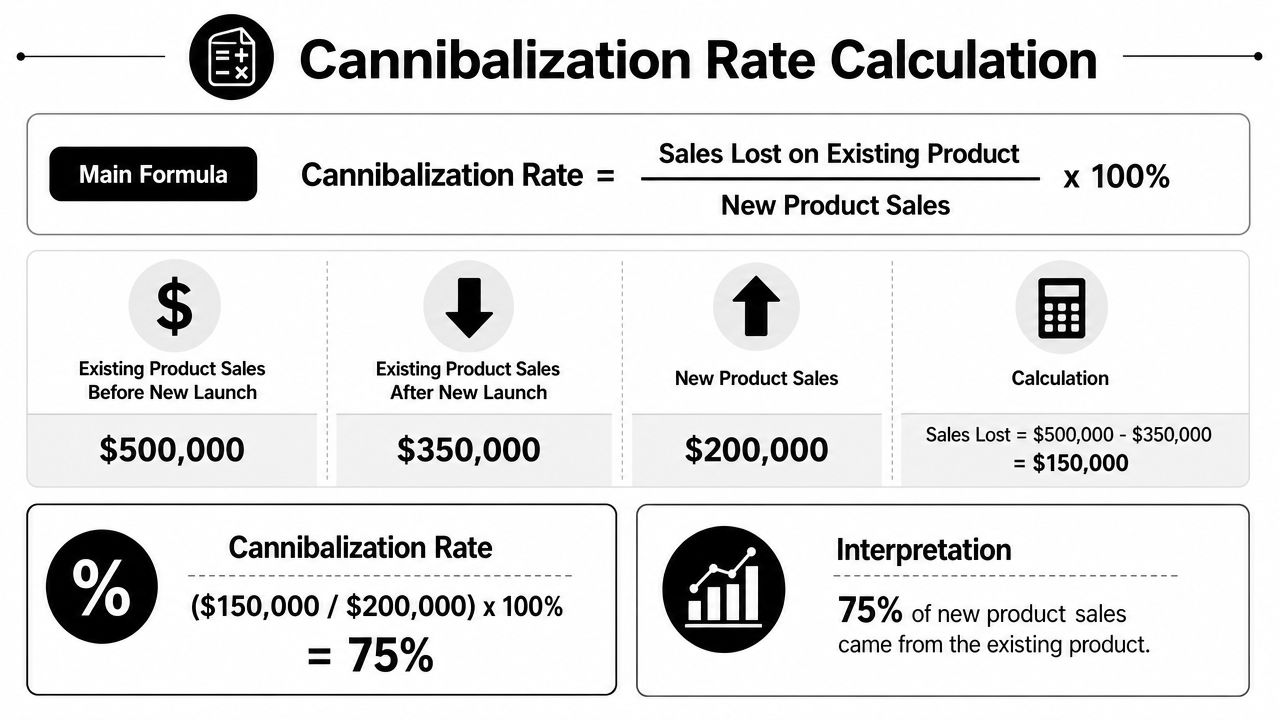
Product cannibalization is when a new product takes sales from one of your existing products, and the standard way to measure it is (Sales Lost on Existing Product / Sales of New Product) x 100. If an older product loses 200 units and the new product sells 500 units, the cannibalization rate is 40%.
Most PMs meet this concept in a tense roadmap meeting. The team has a new tier, bundle, AI feature, or premium plan ready to launch. Sales worries it will hurt the current offer. Finance worries it will shift revenue instead of growing it. Leadership asks the question that matters: are we creating demand, or just moving it around?
That's why knowing what product cannibalization is isn't enough. Strong PMs learn how to use it. Great PMs learn when to cause it on purpose.
The Cannibalization Question Every PM Faces
A familiar scenario: your company's “Standard” plan pays the bills, but the team wants to launch “Pro” with better workflows, automation, and AI support. The fear sounds rational. What if loyal customers just downgrade or switch plans in a way that lowers total value?
That fear is only partly useful. Product cannibalization is the situation where a company's new product takes sales away from its own existing product, reducing volume, revenue, or market share for the older item, as defined in this overview of cannibalization in marketing). The mistake is treating that outcome as automatic failure.
Why this shows up constantly
This problem keeps appearing because overlap is normal. With about 30,000 new consumer products launched each year, overlap between new and existing offerings is common, and in many retail sectors a cannibalization rate of 10% to 20% is considered acceptable or even healthy for a line extension, according to AYTM's product cannibalization discussion.
For product managers, that changes the job. Your role isn't to eliminate overlap at all costs. Your role is to decide whether overlap is strategically justified.
Practical rule: If your new product can't be clearly explained as portfolio improvement, you're probably shipping confusion.
In software, this shows up everywhere:
- New pricing tiers that pull customers from an older plan
- AI copilots that replace manual workflows in the core product
- Self-serve offerings that eat into sales-assisted deals
- Mobile-first experiences that reduce engagement in desktop flows
- Bundles that reduce standalone SKU sales but improve retention
A lot of PMs try to avoid these collisions by making the new offer too weak. That usually creates the worst outcome. The old product remains dated, the new one lacks conviction, and competitors get the stronger story.
The mindset shift that matters
The better question is simple: if one of your products is going to lose, should it lose to you or to a competitor?
Apple's history, Google's packaging decisions, and nearly every serious SaaS pricing evolution point to the same pattern. Companies rarely win by freezing the portfolio. They win by refreshing it before the market forces their hand.
That's why PMs who work on packaging, monetization, growth, or AI features should actively study portfolio strategy. A solid starting point is a curated list of products for product managers that helps you see how product teams frame tiers, workflows, and differentiation in the market.
The career signal here isn't whether you can define cannibalization. It's whether you can walk into a launch review and explain when cannibalization is healthy, when it's dangerous, and what the company should watch next.
The Cannibalization Decision Framework for PMs
The best PMs don't ask, “Will this cannibalize?” They ask, “If it cannibalizes, do we still win?”
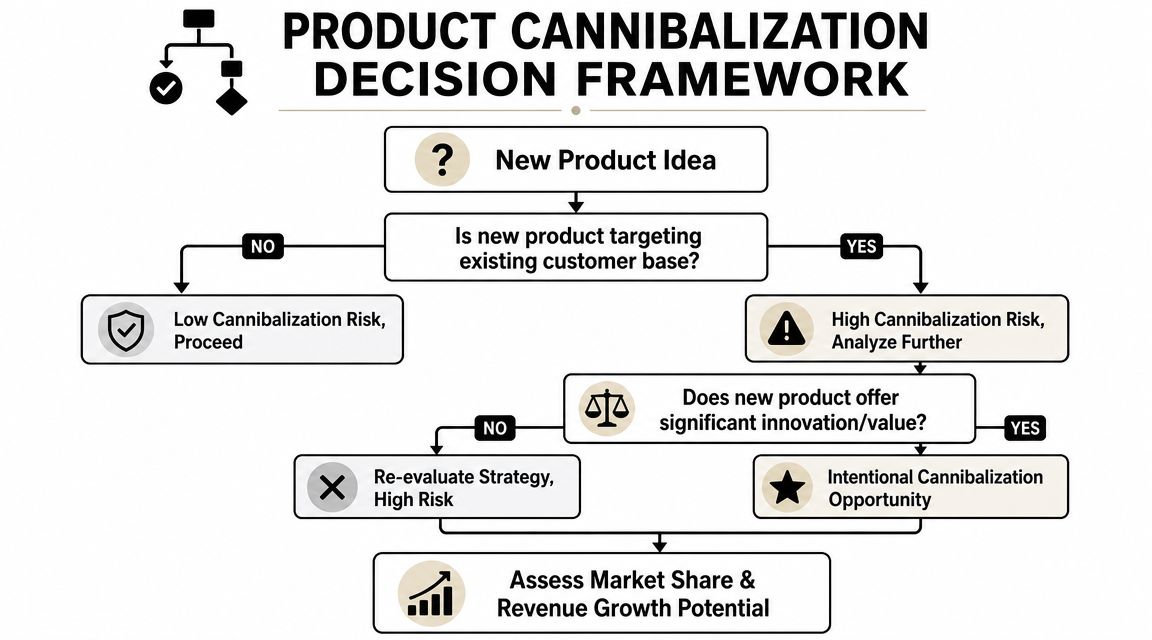
Start with portfolio value, not SKU emotion
The critical distinction is whether cannibalization is intentional and healthy. The right lens is portfolio-level performance, including net revenue, gross margin, customer retention, and overall category share after launch, because cannibalization can look bad at the SKU level while being the correct strategic move for the portfolio, as explained in Channelsight's analysis of product cannibalization.
That means your decision framework should work like this:
| Question | If yes | If no |
|---|---|---|
| Is the new product clearly better for a meaningful customer segment? | Continue evaluation | Rework the concept |
| Does it improve portfolio economics such as margin or retention? | Likely acceptable | Risk is rising |
| Does it defend against a real competitor or market shift? | Cannibalization may be strategic | Harder to justify |
| Does it expand usage, market access, or willingness to pay? | Accept and manage | Avoid or mitigate |
A launch is rarely justified because it's “novel.” It's justified because it improves the business.
Use this decision tree in roadmap reviews
When I coach PMs, I push them to answer four questions before they ask for launch approval.
Who is this really for?
If the answer is “everyone on the current product,” you likely have a substitution problem, not a segmentation strategy.What improves at the portfolio level?
If the new offer doesn't improve margin quality, retention quality, competitive position, or customer value, then internal switching is mostly noise.What happens if you don't ship it?
Here, many teams get more honest. If a competitor could launch the same thing and pull your users away, self-cannibalization may be the safer choice.Can you explain the trade-off in one sentence?
If leadership can't repeat the rationale, Sales and Finance won't align behind it.
A weak new product cannibalizes revenue. A strong new product can cannibalize an old product and still increase enterprise value.
If you want a sharper way to structure these calls, keep a few proven decision-making frameworks for product leaders nearby and adapt them to pricing, packaging, and launch planning.
Accept and manage versus avoid and mitigate
Two outputs come out of this framework.
Accept and manage fits when the new product strengthens the portfolio, even if an old SKU weakens.
Avoid and mitigate fits when the launch mostly shifts existing demand with no real economic or strategic upside.
The PM skill isn't avoiding uncomfortable trade-offs. It's naming them early and making the company choose with eyes open.
Case Studies in Mastering Intentional Cannibalization
Intentional cannibalization is easiest to understand when you look at companies that used it to reset their portfolio before the market did it for them.

Apple and the willingness to replace your own hit
Apple's iPhone eventually made the standalone iPod less central. That wasn't product confusion. It was product succession.
The strategic lesson for PMs is straightforward. If a new product solves a broader, more durable job for the customer, protecting the old standalone experience becomes the wrong objective. The portfolio should move toward the product with the stronger future, even if the legacy winner declines.
This is one reason many PMs study Apple's packaging and migration behavior. The lesson isn't “merge products.” The lesson is “replace narrow value with broader value before the market makes you obsolete.”
Tesla and the ladder problem
Tesla offers a different pattern. A company can introduce a more accessible product without wanting to destroy the premium halo of higher-end products.
That creates a classic cannibalization challenge. If the lower-priced or more practical product becomes too attractive, some buyers will switch. But if the company structures positioning, features, and brand cues carefully, it can widen market reach while preserving a reason for the premium tier to exist.
For PMs, this is the hard middle. You want portfolio expansion without flattening differentiation. Pricing, packaging, feature gating, and go-to-market language all matter.
A useful analogy comes from growth history in adjacent markets. The evolution of product expansion, payment flows, and user migration is well illustrated in this breakdown of PayPal as an original product growth company.
Google and feature absorption
Google often folds capabilities from narrower experiences into broader surfaces. When that happens, some standalone product identity gets weaker while the core platform gets stronger.
That's cannibalization in a platform form. One surface loses distinct usage because the ecosystem wants the capability in the default journey.
This matters for modern PMs building AI features. A standalone AI assistant may help discover use cases quickly. Later, the smarter move may be embedding that capability inside the primary workflow, even if the original standalone surface loses traffic or relevance.
Teams usually regret delayed integration more than early internal overlap.
Here's a short clip worth watching if you want another lens on competitive replacement and product evolution:
The pattern behind the examples
These companies didn't win because they avoided cannibalization. They won because they understood three things:
- The future product often starts by hurting the present one
- Customer value matters more than internal attachment to legacy revenue
- The portfolio should optimize for the next market shape, not the last one
That's the test. If your roadmap only protects today's winner, you may be training your team to miss tomorrow's category.
How to Measure Cannibalization Like a Data-Driven PM
A launch looks strong in the first dashboard review. New signups are up, the team is celebrating, and finance asks a harder question. Did the new offer bring in new demand, or did it just pull existing customers into a different SKU?
That is the measurement job.
Cannibalization analysis is not about proving a launch was good or bad. It is about determining whether the substitution you created is acceptable for the portfolio. Strong PMs measure that trade clearly enough to decide whether to speed up migration, hold position, or redesign the offer.
Start with the standard formula
Use the basic cannibalization rate first:
(Sales Lost on Existing Product / Sales of New Product) x 100
The formula is simple, and that is why it matters. It forces the team to estimate how much of the new product's volume came from your own base rather than net-new demand.
Do not stop there, though. A high rate is not automatically a problem. If the new product has better retention, better margins, lower support cost, or stronger strategic fit, intentional cannibalization can still be the right move. The formula gives you a starting point, not a verdict.
Build a baseline you can defend
Weak baselines create fake panic. They also create false confidence.
Before launch, define what would likely have happened without the new product. For many teams, that means using a full year of historical sales or usage data to account for seasonality, then comparing post-launch behavior against that trend. If you sell across regions or channels, add market-level and channel-level comparisons. CARTO's guide to cannibalization analysis using spatial and channel data shows why simple before-and-after reporting often misses where substitution occurs.
A baseline worth trusting usually includes:
- Historical trend view: Prior sales, usage, conversion, and retention patterns for the product being exposed to risk
- Customer cohort view: Existing customers who migrated versus new customers who adopted
- Geo holdout or phased rollout view: Markets that saw the launch versus similar markets that did not
- Channel view: Self-serve, sales-led, partner, retail, and marketplace paths that may shift demand between offers
If your segmentation is still fuzzy, fix that before you argue about the outcome. Better customer discovery market research gives you a cleaner picture of who is trading down, who is upgrading, and who would never have bought the old product in the first place.
Measure the business outcome, not just unit switching
Unit loss is only one part of the story.
I usually want four additional cuts before I trust the conclusion:
| Metric | Why it matters |
|---|---|
| Net revenue | Shows whether the portfolio actually grew |
| Gross margin | Exposes trade-down behavior and margin pressure |
| Retention | Reveals whether the new offer creates stronger long-term value |
| Portfolio share | Indicates whether you improved your position in the category |
Weaker PM teams often get trapped. They report that Product B stole demand from Product A, then stop the analysis before answering the strategic question. Did Product B steal low-value demand you were going to lose anyway? Did it move customers into a more defensible package? Did it reduce churn risk by meeting a price point competitors were already attacking?
Those are portfolio decisions.
If you need a cleaner method for isolating switching behavior over time, use cohort analysis for product teams. It is one of the most reliable ways to separate migration from expansion and to see whether cannibalization is a temporary launch effect or a durable behavioral shift.
If you cannot distinguish user migration from user acquisition, you cannot judge whether cannibalization is creating long-term value.
AI-Powered Cannibalization Analysis The Modern PMs Edge
The spreadsheet is still useful. It just shouldn't be your only tool.
PMs working on AI products, pricing experiments, and packaging changes now have a major advantage. Large language models can accelerate scenario design, expose hidden assumptions, and help translate messy data into decision-ready analysis. They won't replace judgment, but they can speed up the work that usually delays launch decisions.

Three prompts worth saving
Use AI for simulation first, not conclusions. The model is most useful when you give it your pricing tiers, feature sets, migration assumptions, and customer segments, then ask it to pressure-test the logic.
Try prompts like these:
Scenario simulation
“Given Product A and Product B, with Product B launching as a premium tier, compare likely substitution risks across current customer segments. Identify where switching may be healthy versus harmful based on net revenue, gross margin, retention, and competitive defense.”Data pattern review
“Analyze this exported sales or subscription dataset for signs of substitution after launch. Highlight product pairs, channels, customer cohorts, or geographies where changes suggest cannibalization rather than net-new growth.”Stakeholder communication draft
“Write an internal memo for Sales, Marketing, and Finance explaining why we may accept cannibalization in this launch, what portfolio metrics we'll monitor, and what would trigger a mitigation plan.”
What AI does well and what it doesn't
AI is good at spotting patterns, organizing assumptions, and generating scenario trees. It's especially helpful when PMs need to compare multiple packaging options quickly.
It's weaker when the inputs are fuzzy or politically distorted. If your sales forecast is inflated, your segmentation is vague, or your baseline is broken, the model will give you polished nonsense.
Use AI to sharpen the discussion, not to outsource accountability.
- Best use case: Compare launch options before you commit engineering and GTM effort.
- Second-best use case: Summarize post-launch patterns from raw exports, dashboards, and customer feedback.
- Bad use case: Asking the model for a magic forecast with no historical context.
A broader stack of AI tools for product managers can help here, especially if you want to move from static analysis into repeatable operating workflows for launch reviews.
A practical working rhythm
A good operating pattern is simple. First, calculate the baseline and define the hypotheses manually. Then use AI to stress-test scenarios and draft narratives. Finally, review the results with Finance, Data, and GTM leads before treating any recommendation as real.
That flow keeps the PM in control. Which is exactly where you should be.
Your Tactical Playbook for Managing Cannibalization
Once you've decided the risk is real, execution splits into two paths. You either need to reduce harmful cannibalization, or you need to manage intentional cannibalization without losing internal alignment.
If cannibalization is unwanted
Use this checklist when the new offer is stepping on the old one without enough upside.
- Sharpen differentiation: Make the old and new products serve different jobs, not the same job with vague overlap.
- Create pricing distance: A weak price gap invites random switching. Stronger structure supports better self-selection. This matters even more if you're refining your broader pricing strategy for new products.
- Separate channels when needed: Some products belong in self-serve, some in enterprise sales, some in partner-led distribution.
- Fix feature packaging: Remove accidental overlap that teaches customers the cheaper or newer option is the obvious default.
- Train customer-facing teams: If Sales and Support can't explain who each offer is for, the market won't do it for you.
If cannibalization is intentional
Many PMs underperform in this scenario. They make the strategy call, then fail to socialize it.
Use a simple stakeholder message:
We expect some customers to move from the old offer to the new one. We're accepting that because the new offer improves portfolio health through stronger positioning and better long-term value. We'll judge success by portfolio outcomes, not by protecting every legacy SKU.
Then align teams on operating rules:
- Sales needs guardrails: Define who should migrate now, who should stay put, and where exceptions require approval.
- Marketing needs one narrative: Don't market both products as the best answer for the same user.
- Finance needs measurement windows: Decide in advance when you'll review impact and what signals count as success or concern.
- Support needs migration language: Customers should feel guided, not pushed.
The PM habit that separates strong operators
The strongest PMs write down the cannibalization thesis before launch.
Not a slide with generic optimism. A plain-language statement of what you expect to happen, why it's acceptable or not acceptable, and what evidence would change your mind.
That discipline does two things. It prevents post-launch spin, and it makes you much better at future portfolio bets.
Product cannibalization isn't a concept to memorize for an interview. It's a strategic lever. If you learn how to measure it, explain it, and use it deliberately, you'll make better product decisions than PMs who only optimize the current SKU.
Aakash Gupta publishes some of the most practical product management thinking available for PMs who want to level up in strategy, growth, AI, and career execution. If you want sharper frameworks, operator-grade breakdowns, and content built for ambitious product leaders, start with Aakash Gupta.
