Most PM advice tells you to stay out of the weeds. Focus on vision. Prioritize ruthlessly. Leave implementation to engineering.
That advice breaks down fast in AI, data products, and internal platforms.
If you're building retrieval pipelines, agent workflows, analytics exports, or cross-system automations, your product quality depends on how data gets combined, transformed, and passed forward. A PM who understands only the screen-level experience will miss the strategic importance. A PM who understands the plumbing will ask better questions, scope smarter MVPs, and catch avoidable architecture mistakes early.
That's why what is the paste command is a better question than it first appears. Not because you need to become a terminal power user. Because paste encodes a durable product lesson: great systems are often simple, composable, and explicit about how data moves.
Why an AI PM Should Care About a 50-Year-Old Command
The lazy take is that a PM doesn't need to care about old command-line tools. The stronger take is that foundational tools reveal how enduring product principles work under pressure.
The cut, copy, and paste method still underpins modern work. It saves an estimated 15 to 20% of time in the $10T global knowledge work market, equating to over $1.5T in annual value, and 95% of PMs in a 2024 Productboard survey said it's essential to their workflow, as summarized by Hackaday's history of cut, copy, and paste. PMs already rely on the concept every day. Most just never examine the design philosophy underneath it.
High-level PMs still need low-level literacy
At Google, Meta, and other product-heavy environments, strong PMs learn to zoom in and zoom out. They can discuss market segmentation in one meeting, then switch to event schemas, ranking pipelines, and API contracts in the next.
That isn't engineering cosplay. It's operational competence.
When a PM understands how systems combine inputs, preserve structure, and fail without warning, they make better calls on:
- Scope control: What can ship as a thin composition of existing services versus what needs a new platform layer.
- AI workflow design: Whether an agent should chain tools together or rely on one oversized, fragile step.
- Analytics quality: Whether a dashboard reflects joined, appended, or misaligned datasets.
- Execution speed: Whether teams can reuse primitives instead of rebuilding transformations from scratch.
The PM advantage isn't writing shell commands. It's recognizing the same logic inside product architecture.
The history of product management is full of moments where the best PMs won by understanding systems, not just features. That's one reason the broader history of product management matters. The role has always expanded when products became more complex.
Why this matters more in AI
AI products amplify hidden complexity. A simple user action can trigger retrieval, ranking, filtering, prompt construction, tool invocation, and post-processing. If you don't understand how data flows between those steps, you'll approve workflows that look elegant in a deck and break in production.
paste is useful here because it teaches a compact lesson. Inputs matter. Order matters. separators matter. Composability matters. Silent errors matter.
Those are not terminal lessons. They're PM lessons.
The Paste Command Explained as a Data Assembly Line
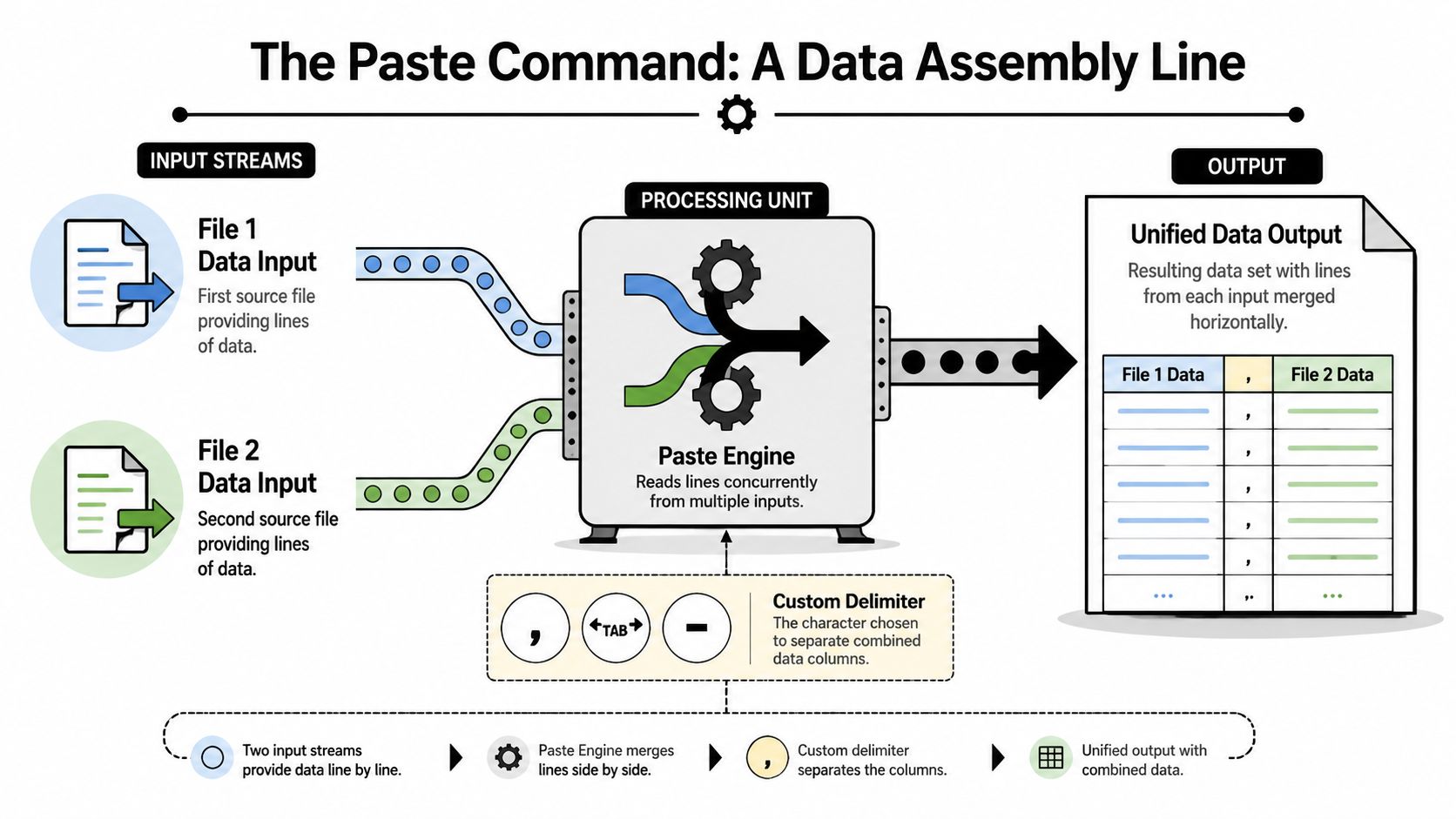
At the command-line level, paste takes lines from multiple inputs and combines them side by side. By default, it separates those values with tabs. That's the whole mechanic, and it's more important than it sounds.
Think of it as a data assembly line. One conveyor brings in names. Another brings in account IDs. Another brings in plan tiers. paste doesn't interpret the business meaning. It aligns the incoming pieces and produces one wider record.
The simplest way to understand it
If file A contains one column and file B contains another, paste merges them horizontally.
Example:
paste file1.txt file2.txt
If the first file has:
alice
bob
carol
and the second file has:
premium
free
enterprise
the output becomes:
alice    premium
bob      free
carol    enterprise
That basic pattern is why the command is such a strong mental model for PMs. It represents a system that does one thing well. It combines synchronized streams without pretending to be a database, workflow engine, or reporting suite.
The product lesson hidden inside the command
The roots of this idea go back to Xerox PARC. The foundational cut/copy/paste functionality was invented in 1974-1975 by Larry Tesler for the Gypsy word processor, mirroring the physical act of cutting and pasting paper layouts to create a modeless editing experience that transformed interface design, as described in Tiny's history of the copy-paste inventor.
That design instinct still matters. Good products remove unnecessary mode-switching and let people manipulate information directly.
For PMs, paste is a reminder that the strongest systems often come from a narrow, explicit contract:
- Input: Multiple ordered streams
- Transformation: Align line by line
- Output: One combined stream
- Customization: Change separator when needed
Teams building analytics, workflow automation, or internal tooling should care about this because many product failures come from fuzzy composition. If you're building a powerful product feedback loop, the challenge often isn't collecting more inputs. It's deciding how to structure them so downstream teams can use them.
A useful parallel exists in physical product flow too. The best platform PMs think about software the way operations leaders think about product packaging and conveyor systems. Inputs move. Hand-offs matter. Bad alignment compounds downstream.
Simple systems scale when their contracts are obvious.
From Command Flags to Product Principles
A shallow reading of paste says it's a utility for combining text. A better reading says it's a miniature handbook for product architecture.
The Unix paste command can merge up to 32,767 input files in parallel, uses tab delimiters by default, and can read from standard input with -, which makes it composable with commands like cut or grep, as documented in Wikipedia's overview of the Unix paste command).
Delimiters are data contracts
The -d flag lets you change the delimiter. That sounds tiny. It isn't.
A delimiter is a contract. It tells downstream systems where one field ends and another begins. In product terms, this is the same problem as API shape, event naming, and schema consistency.
If a team says, "we'll clean it up later," they usually mean they haven't agreed on a contract. Later becomes expensive.
Ask these questions in design reviews:
- What separates one field from another: Is the boundary explicit and stable?
- Who consumes this output next: An analyst, another service, a model, or a customer export?
- What breaks if we change structure: Are we versioning the contract or just hoping consumers adapt?
Parallel versus serial is a product choice
paste also supports serial behavior with -s. That distinction matters far beyond the shell.
Parallel composition is for side-by-side comparison. Serial composition is for appending one block after another. Product teams face this choice constantly.
A few examples:
- Exports: Should CRM activity, billing state, and support history appear as columns in one row, or as a time-ordered activity feed?
- AI context assembly: Should retrieved facts be grouped by source in blocks, or normalized into aligned attributes for deterministic prompting?
- Ops tooling: Should teams see one wide incident table or separate service logs stitched in sequence?
If you don't make this choice deliberately, engineering will make it implicitly.
Standard input is the composability lesson
The hyphen - tells paste to read from standard input. For PMs, that's the deeper principle. Good systems accept structured input from upstream tools without forcing unnecessary intermediate steps.
That's the logic behind modern pipelines, internal tooling, and agentic workflows. One component produces. Another consumes. Neither needs to own the whole stack.
Practical rule: Prefer systems that can participate in a flow over systems that insist on being the flow.
This is why spec quality matters so much in AI-enabled product development. Teams working with spec-driven AI development are really trying to make interfaces between steps more explicit, so humans and models don't improvise the contract every time.
For PMs, the strategic takeaway is straightforward. Study architecture the way you study user journeys. The same discipline you use in a customer funnel should apply to data flow, service boundaries, and composition logic. That's where strong decision-making frameworks become useful. They help you choose between flexibility, reliability, and implementation speed instead of debating abstractions.
Applying the Paste Mental Model in Your PM Workflow
Take a common B2B SaaS request. Customers ask for an export feature. On the surface, it sounds simple. Add CSV export, ship it, move on.
In practice, export design exposes whether a PM understands data shape.

A realistic product scenario
Say you're the PM for a customer success platform. Users want to export accounts, recent tickets, usage activity, and renewal status.
There are at least two legitimate product paths.
One path is a parallel paste mindset. Put core attributes side by side in a wide file. That works when the user wants comparison, filtering, and spreadsheet analysis. Sales ops and CSM teams usually prefer this when they're triaging accounts.
The other path is a serial mindset. Produce a consolidated activity log where different event sources stack into a single timeline. That works when the user cares about sequence and context, not just attribute comparison.
Questions that improve the spec immediately
Expert-level Unix pipelines often combine cut and paste to extract specific fields and merge them horizontally in one line, showing how composable utilities can create strong data transformation systems without new infrastructure, as illustrated by GeeksforGeeks examples of cut and paste pipelines. That's the exact instinct PMs should borrow.
Before writing the PRD, ask engineering and design:
- What is the unit of analysis: one customer, one event, one subscription, or one workspace?
- Will users compare entities side by side: if yes, a wide export is often better.
- Will users reconstruct a story over time: if yes, a chronological format may be better.
- Which source owns truth for each field: billing, support, product telemetry, or CRM?
- What happens when one source has missing data: blank field, fallback value, or omitted row?
These questions prevent a common PM mistake. Teams often frame exports as formatting work when the hard part is semantic alignment.
A weak export spec asks for CSV. A strong export spec defines row logic, column ownership, and failure behavior.
Where this shows up in AI products
This mental model also helps with AI features. If you're building an internal AI assistant for account reviews, you still have to decide how context gets assembled.
Do you feed the model a side-by-side structured summary of account health signals? Or do you append raw notes, tickets, and events into a long prompt? The first is closer to parallel composition. The second is closer to serial composition. The decision changes latency, interpretability, and debugging difficulty.
Choosing Your Tools A Strategic PM Decision
A good PM doesn't just ask, "Can we combine this data?" The better question is, "What level of tool complexity does this job justify?"
That's where paste becomes useful as a strategic analogy. It's rarely the universal answer. It's often the cleanest answer when the job is straightforward.
The practical trade-off
A critical documentation gap around paste is troubleshooting. Delimiter mismatches, files ending without newlines, and binary-data issues can produce silent, incorrect output. For mission-critical pipelines, alternatives like awk or Python can be safer, as noted in IBM's discussion of paste command considerations.
That trade-off maps directly to product work. Simpler primitives are faster and easier to reason about. They're also easier to misuse when the problem becomes more complex than the primitive can handle.
If you're evaluating workflow design, internal tools, or AI orchestration stacks, it helps to compare the options explicitly. Product leaders exploring next-gen AI tools for product leaders run into the same issue. New tooling can compress work, but it can also obscure what the system is doing.
PM's Guide to Data Combination Tools
| Tool | PM Analogy | Best Use Case | Complexity |
|---|---|---|---|
paste |
MVP composition layer | Side-by-side merging of ordered inputs when structure is already aligned | Low |
join |
Relational feature expansion | Combining datasets based on a shared key when matching logic matters | Medium |
awk |
Custom workflow engine | Complex transformations, conditional logic, validation, and reshaping | High |
| Clipboard paste | UI convenience action | One-off human editing and formatting inside an app | Low, but not system-grade |
What works and what doesn't
Use paste when the sources are already aligned and the output contract is simple. Don't use it when correctness depends on relational matching, heavy validation, or complex transformation logic.
A practical PM lens:
- Use the simple tool for MVPs: Fast iteration matters when you already trust input order.
- Escalate when failure is expensive: Finance, compliance, and customer-visible reporting usually need stronger validation.
- Separate UI paste from system paste: A keyboard shortcut is a human interaction. The Unix command is a data operation. Mixing them conceptually leads to bad requirements.
- Treat silent failure as a product risk: If the wrong output still looks plausible, your review process needs explicit checks.
The same discipline applies when reading a tech stack diagram. Look for where data is merely being assembled versus where it's being interpreted, validated, or joined. Those are different product risks and different resourcing conversations.
The Differentiator Thinking in Systems
The point of learning what is the paste command isn't to impress engineers with terminal trivia. It's to train your eye to notice the building blocks underneath product behavior.
The strongest PMs I've worked with had this trait in common. They could identify the primitive inside the complexity. They'd look at a messy architecture and ask: where are we passing data through, where are we combining it, where are we interpreting it, and where can it fail undetected?
What separates strong PMs from average ones
Average PMs stay at the feature layer. Strong PMs connect user value to system behavior.
That difference shows up in meetings quickly:
- Average PM question: Can we add an export?
- Stronger PM question: What is the row model, which systems own each field, and where does alignment break?
- Average PM question: Can the agent use more context?
- Stronger PM question: Should the context be appended, normalized, or composed from reusable steps?
The career advantage comes from seeing products as systems of contracts, not just collections of screens.
This matters even more in AI. Agents, retrieval stacks, evaluation pipelines, and tool-calling systems all rely on composition. They succeed when each step is narrow, inspectable, and reusable. They fail when teams hide too much complexity inside one magical black box.
A practical habit for your next design review
In your next technical review, look for the hidden paste operations. Find the spots where the system is combining streams, passing structured output to the next layer, or assuming two inputs line up cleanly.
Then ask one more question than usual.
What is separating fields? What guarantees ordering? What happens when one input is missing? When should we stop composing and move to a richer transformation layer?
That habit won't make you an engineer. It will make you a sharper PM, a better partner to engineering, and more effective at creating real product differentiation examples that competitors can't easily copy because they're grounded in better system design.
If you want more practical thinking like this from a product leader who's spent years helping PMs sharpen their judgment, follow Aakash Gupta. His writing, podcast, and resources are built for PMs who want to level up from feature execution to strategic product leadership.
