As a Product Manager, the quality of your decisions defines your career trajectory. Some choices are small, reversible bets. Others—the "one-way doors"—are high-stakes, irreversible moves that can alter the future of your product, team, and even the company. A top-tier PM at Google or Meta isn't just making gut calls; they're using a specific mental model to classify decisions and match their process to the risk.
This is the one-way vs. two-way door framework. It’s not just jargon; it’s a critical tool for building credibility, de-risking major initiatives, and accelerating your career. A PM who can’t articulate this difference often stalls out at the Senior PM level (around a $220k total compensation ceiling), while those who master it are trusted with the complex, multi-million dollar bets that lead to Principal and Director roles ($350k+).
The Framework for High-Stakes Product Decisions
Coined by Jeff Bezos in a 1997 Amazon shareholder letter, this framework sorts decisions into two distinct categories:
- Type 1 (One-Way Doors): Consequential, high-impact decisions that are difficult, costly, or impossible to reverse. Think launching a new hardware product, sunsetting a core API used by enterprise customers, or committing to a multi-year technology stack. You walk through this door, and there's no easy way back.
- Type 2 (Two-Way Doors): Reversible decisions that allow you to walk back through the door if you don't like what you see. These are perfect for rapid iteration and learning. A/B testing a headline or tweaking the color of a sign-up button are classic examples.
Bezos observed that large companies often grind to a halt because they treat 80-90% of their decisions like massive, high-stakes Type 1 choices. They apply heavyweight processes to everything, creating friction where speed and agility are needed.
Classifying Your Decisions
The power of this framework is its brutal simplicity. Before committing a single engineer, it forces you to ask: "If we get this wrong, can we easily go back?"
- A one-way door demands deep analysis, data, stakeholder alignment, and a robust risk mitigation plan. You must be slow and deliberate.
- A two-way door should be made quickly, often by a single person or a small, empowered team. The goal is to learn fast by running cheap experiments.
To sharpen your process for these critical choices, it's worth taking a look at how you can refine your existing decision making framework to achieve clearer outcomes.
One Way vs Two Way Doors At a Glance
Use this table as a rapid-fire checklist to classify any decision that lands on your desk.
| Attribute | One-Way Door (Type 1) | Two-Way Door (Type 2) |
|---|---|---|
| Reversibility | Difficult, costly, or impossible to undo. | Easy and inexpensive to reverse. |
| Impact | High and wide-reaching; affects customers, brand, and revenue significantly. | Low and contained; impact is limited and measurable. |
| Process | Slow, deliberate, data-heavy, involves extensive stakeholder review. | Fast, iterative, relies on quick experiments and learning. |
| Example | Sunsetting a major product line. | A/B testing a new call-to-action button. |
For a broader toolkit, our guide on PM decision-making frameworks is a valuable resource for building out your strategic capabilities.
Correctly identifying which door you're facing is a hallmark of senior-level judgment. You stop burning out your team on low-stakes choices and save your political and engineering capital for the few decisions that truly define your product's success and your career advancement.
How to Identify a One Way Door in Product Management
Spotting a one-way door before you walk through it is a foundational skill for any Product Manager. This isn't about a spidey-sense; it’s a quick, tactical diagnostic. A senior PM at Meta or Google doesn’t just feel the risk; they have a mental checklist they run through to classify the decision and justify their process to leadership.
As a PM leader who has hired and mentored dozens of product managers, I can tell you that the ability to articulate why a decision is a one-way door is a massive credibility builder. It shows you respect engineering time, the company’s money, and most importantly, customer trust.
The following flowchart gets right to the core question, showing the immediate split between a choice you can walk back and one you can't.
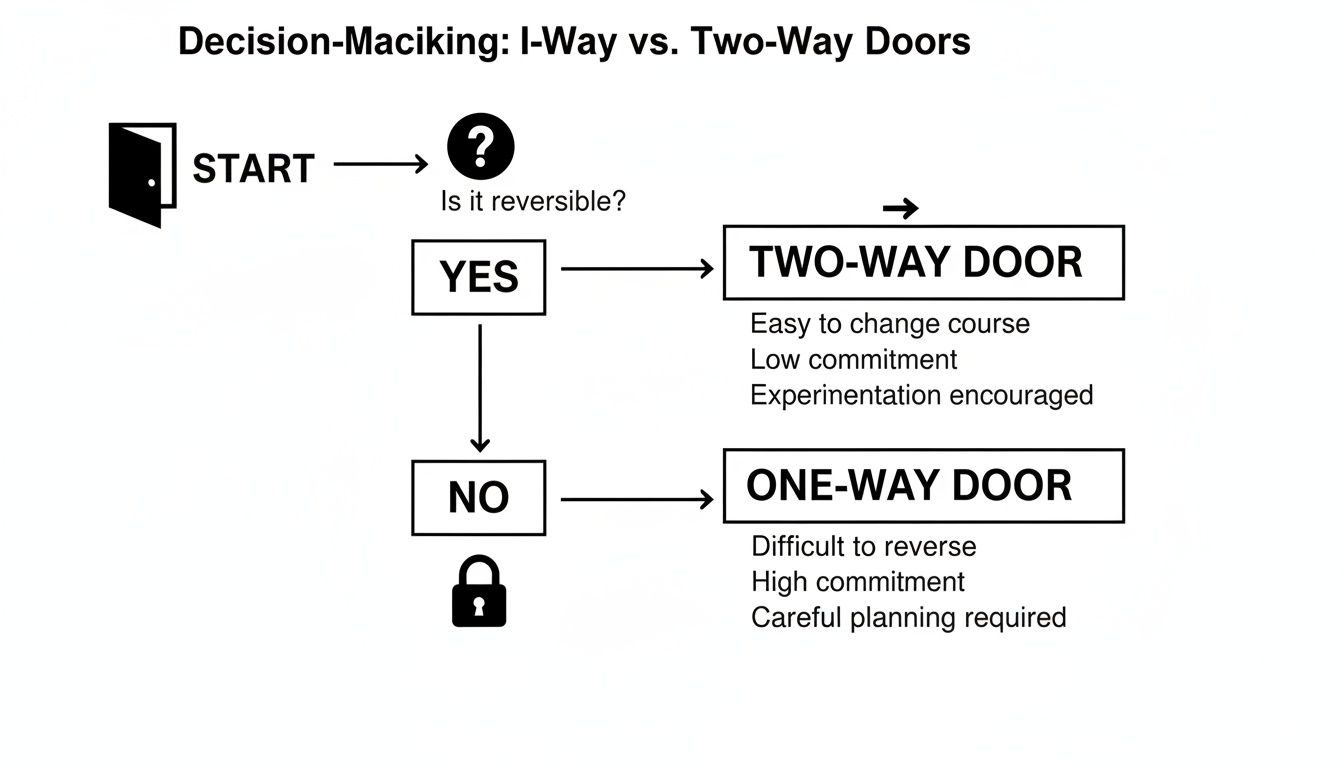
This visual hammers it home: the first and most critical check is always reversibility. If you can't easily turn back, you're staring down a one-way door.
The Diagnostic Toolkit for One Way Doors
How do you know you're facing a one-way door? Look for triggers that signal high cost, massive effort, or permanent consequences. Start by asking hard-hitting questions about what it would take to reverse course.
- Financial Cost: Does reversing the decision eat up more than 10% of your annual product budget? Does it require breaking a multi-year vendor contract with heavy penalties, like those common with enterprise cloud services (e.g., a large Snowflake commitment)?
- Engineering Effort: Will it take a full team six or more months of dedicated engineering work just to undo this? Does it involve a complex data migration that can't be easily unwound? A simple AI prompt for your Eng lead: "Generate a rough, t-shirt sized estimate (in engineering-months) for the work required to revert a shift from our current Postgres database back from a new NoSQL implementation."
- Customer Impact: Will this change a core user workflow that would be incredibly jarring to revert? Even worse, does it involve deleting user data that’s impossible to ever get back? Think about a change to a company's terms of service.
The most dangerous one-way doors are often the ones that look like two-way doors at first. A small change in terms of service, for instance, can feel minor but may create a binding public promise to your customers that is almost impossible to walk back without significant brand damage.
Strategic and Reputational Red Flags
Beyond hard numbers, some of the most critical one-way doors involve strategic commitments and reputation. These are harder to quantify but their impact can be far bigger.
Ask yourself and your team these questions to uncover the hidden icebergs:
- Public Promises: Are we making a public commitment to customers, partners, or the market? Announcing a product sunset or a new pricing model sets an expectation that is incredibly damaging to reverse.
- Brand Reputation: Could walking this back make the company look indecisive, unreliable, or untrustworthy? This is especially critical for anything touching privacy, security, or platform stability.
- Team Morale and Focus: Will this decision lock the team into a path that eats up their focus for multiple quarters? A major architectural shift can become a one-way door simply because it drains all oxygen away from other initiatives, making it a point of no return.
By rigorously running through these questions, you're shifting from assumption to real analysis. For those looking to go deeper on this, it's helpful to see an example of an assumption being put to the test. This is the exact process that builds the analytical muscle you need to confidently identify and navigate high-stakes product decisions.
Real-World Case Studies from Amazon, Google, and Slack
Talking about frameworks in a vacuum is easy. Seeing how they play out when billions of dollars are on the line is where the learning happens. Let's break down how high-stakes choices at Amazon, Google, and Slack were navigated. These aren't just stories; they're battle-tested blueprints for your own career.
Amazon: The Quintessential One-Way Door
Amazon's culture is steeped in the one-way door concept. No decision illustrates this better than their monumental migration to a microservices architecture for AWS. This was a root-and-branch re-architecting of their whole platform. They knew it was a one-way door from the start.
Look at the numbers from their AWS migration decisions between 2016-2017. They treated the shift to a new architecture as a one-way door and dedicated 18 months to analysis, pulling in over 200 engineers. They estimated a potential reversal cost of $5-10 billion—a staggering figure that was nearly 15% of their $136 billion revenue at the time.
The bet paid off. After they walked through that door, AWS revenue exploded from $12.2 billion in 2016 to $90.8 billion by 2023, a mind-boggling 650%+ growth. That's the ROI of getting a one-way door right. You can find more on how this model drives outperformance on blueprints.guide.
PM Takeaway: For a decision with a multi-billion dollar reversal cost, you have to slow down. The deep analysis and extensive consultation weren't bureaucracy; they were the necessary price of admission for making an irreversible choice.
Slack: The Masterful Two-Way Door Pivot
Now, for the flip side. Before Slack was the collaboration giant we know, the company was Tiny Speck, and their product was a quirky online game called Glitch. The game wasn't catching on, and cash was running out.
The decision to ditch the failing game and launch their internal chat tool was a textbook two-way door decision.
Stewart Butterfield and his team didn't need 18 months of deep analysis. They already had a working prototype of their communication tool—they were using it themselves! They saw its value internally and decided to test it with a few outside teams. If that test flopped, they could have tried another pivot or just shut down. The door back was wide open.
This fast, low-cost experiment let them learn and iterate quickly with real user feedback. Its initial success gave them the confidence to double down, which ultimately led to a multi-billion dollar company. Seeing the drivers behind a move like that is a critical part of building a solid product strategy.
PM Takeaway: Know when you have a cheap, reversible option. The Slack team didn't get stuck in analysis paralysis; they launched a minimal version to test their hunch. Their advantage was speed.
Google: A Strategic Bet on AI's Future
Fast forward to a more recent example: Google’s all-in commitment to Transformer models and generative AI. While AI research is iterative, the decision to re-center the entire company’s product and research DNA around this architecture was a modern one-way door.
- Massive Investment: Redirecting billions in R&D, re-skilling thousands of engineers, and completely rethinking core products like Search and Ads. For a concrete example, Google invested $300 million in AI startup Anthropic in late 2022, a clear capital commitment to this new paradigm.
- Public Commitment: By announcing products like Bard (now Gemini), Google put its reputation on the line. Backing out would have been a catastrophic signal to the market.
- Competitive Positioning: Allowing competitors like OpenAI and Microsoft to own the defining architecture of this generation would create a strategic hole almost impossible to dig out of.
This wasn't just a tech choice. It was a one-way bet on the future of the company, locking Google into a long-term fight where the cost of failure isn't just financial—it's existential.
Your Documentation and Communication Playbook
You've identified a one-way door. Your job just shifted from analyst to aligner. The biggest mistake PMs make here is assuming that because they’ve done the work, everyone else will "get it." That’s a fast track to getting your decision shot down by a surprised VP or having your engineers silently resent a choice they never understood.
Senior-level product management isn't just about making the right call. It’s about making the right call and bringing everyone along. This means disciplined documentation and a rock-solid communication plan. These aren't bureaucratic hoops—they are the tools you use to build consensus, show your work, and de-risk the decision itself.

The One-Way Door Decision Doc
At Amazon, any big decision lives and dies by the "6-pager" document. This isn’t tradition; it’s a brilliant mechanism for forcing clear thinking. You can't hide behind flashy slides. Your logic has to stand on its own in writing.
This decision doc becomes your single source of truth. Here’s a structure you can steal, modeled directly on how the best tech companies operate:
- 1. Background: Start with the "why." What's the customer problem or business opportunity? Lay out all context and crucial data upfront.
- 2. Tenets: What are the core principles guiding this choice? (e.g., "We will prioritize long-term platform stability over short-term feature velocity.") These help justify your final recommendation.
- 3. Options Weighed: Detail at least three viable paths, including the one you're recommending. Honestly lay out the pros and cons for each. One of these options should almost always be "do nothing."
- 4. The Recommended Path: State your recommendation clearly. More importantly, tie it directly back to your tenets and background data. Explain why this path is superior.
- 5. Pre-Mortem Analysis: Imagine the recommended path has failed spectacularly. What went wrong? Brainstorm the most likely failure modes and their impact. This shows foresight and builds incredible trust.
- 6. AI Integration Plan (for AI PMs): How will AI/ML models be developed, deployed, and monitored? What are the data dependencies? What are the accuracy and latency requirements? What tools will be used (e.g., PyTorch, TensorFlow, monitoring with Datadog)?
Proactively Managing Stakeholder Concerns
Once your doc is solid, get ahead of the questions with an FAQ document. It lets you control the narrative and stamp out any FUD (Fear, Uncertainty, and Doubt) before it festers.
Your FAQ should be a living document that you update as new questions come in. It’s a killer tool for scaling your communication.
A well-crafted FAQ does more than answer questions; it demonstrates empathy. By anticipating the concerns of your legal, finance, or marketing partners, you show you've thought through the decision's impact beyond just the product and engineering teams.
Take, for instance, a company like AWS introducing a new service term that creates a 24-month lock-in. That is a massive one-way door for customers. A proactive FAQ would need to tackle the "why" behind such a long commitment, what happens if the project fails, and what "completed" even means. For one-way doors, transparency isn't optional.
The Communication Rollout Plan
Finally, you need a rollout plan for the decision itself. A chaotic announcement can sink a brilliant, well-documented decision.
- Phase 1 (Pre-Briefing): Go private. Share the decision doc and FAQ with key leaders and stakeholders who could block this. Get their feedback and secure buy-in before any big announcement.
- Phase 2 (Team-Wide Announcement): Now, bring it to the core team—PM, Eng, Design, Data Science. This is where you share the "why" and get the people who will build the thing excited and aligned.
- Phase 3 (Company-Wide Communication): Depending on the decision's scale, broadcast it to the wider company via email, Slack, or an all-hands meeting. Keep it high-level, focusing on customer benefit and business impact.
Mastering this playbook is a career accelerator. It’s what separates a feature manager from a business leader who can be trusted with high-stakes initiatives. To go deeper, learn more about building a stakeholder communication plan that keeps everyone aligned.
Advanced Risk Mitigation for Irreversible Decisions
Spotting a one-way door is just step one. The mark of a principal-level PM at a place like Google or Meta isn’t just making the right call; it’s building a parachute in case you’re wrong. Senior leaders don’t just accept risk—they actively build in guardrails to manage the downside. This is where you graduate from simply choosing a path to architecting the journey.
De-Risking with Phased Rollouts
One of the most effective tools is the phased rollout. Instead of a "big bang" launch where 100% of users get the new experience at once, you expose it in carefully managed stages. This strategy turns a potential catastrophe into a manageable incident.
- Internal Dogfooding: Start with your own team. They're a forgiving first audience for finding bugs and awkward user flows.
- Friends and Family Beta: Expand to a small, trusted group of external users who have opted-in. Their feedback is gold.
- Percentage-Based Rollout: Use feature flags (with tools like LaunchDarkly or Statsig) to release to 1%, then 5%, then 20% of your user base, watching key metrics like a hawk at every step.
This entire approach is useless without one critical component: a kill switch. This is your big red button. It's a mechanism that lets your team instantly disable the new feature and revert everyone to the old experience. Without a kill switch, a phased rollout is just a disaster in slow motion.
Using Pilots to Gather Real-World Data
For one-way doors that involve huge changes to workflows, a pilot program is your best friend. A beta tests the software; a pilot tests the entire operational model with a hand-picked group of customers. It’s your chance to see how your beautiful plan holds up against the messiness of reality.
A well-designed pilot lets you stress-test core assumptions before you bet the farm. When you need to see if an idea truly works in practice, you have to prototype and test your concepts in a controlled, real-world setting.
At its core, a pilot program is an exercise in humility. It's a formal acknowledgment that your decision doc, no matter how well-researched, contains assumptions that might be wrong. The pilot’s goal is to replace those assumptions with hard data.
Designing for Failure with Modular Architecture
Sometimes, the smartest way to de-risk a one-way door is to build your product so that failure is contained, not catastrophic. A modular architecture treats your system like a set of independent, loosely connected services. If one piece breaks, it doesn't take the whole ship down with it.
This is critical for big infrastructure decisions. Committing to a new database technology is a classic one-way door. By designing your application to talk to the database through a well-defined abstraction layer, you build a firewall. Swapping the database is still monumental, but the damage from a performance snag is isolated. It's the engineering equivalent of building firebreaks in a forest.
Answering One-Way Door Questions in PM Interviews
Your ability to discuss one-way doors is one of the clearest signals of seniority you can send in a product management interview, especially at companies like Amazon, Google, and Meta. Interviewers aren’t looking for a definition; they want to see your judgment in action.
When a question about a high-stakes decision comes up, your goal is to showcase strategic depth. The STAR-L framework (Situation, Task, Action, Result, Learning) is the perfect structure.
- Situation: Quickly paint the picture. What was the business context?
- Task: What was your specific job? What critical decision was on your plate?
- Action: What did you do? How did you identify it as a one-way door and what process did you run?
- Result: What happened? Use real, quantifiable metrics to show the impact.
- Learning: What was the big takeaway? This demonstrates self-awareness and a growth mindset.
Using this structure turns a simple story into a powerful case study of your product leadership.
Common Interview Questions and How to Answer Them
Hiring managers use behavioral questions to see how you think under pressure. Be ready for these prompts.
Question 1: "Walk me through a decision you led that was a one-way door."
This is a direct test. Your answer needs to prove you can spot an irreversible decision and give it the rigorous process it deserves.
Sample STAR-L Answer (Successful Outcome):
Situation: At my last company, our monolithic platform was killing our ability to ship. We were getting lapped by competitors.Task: I had to lead the decision on whether to migrate to a microservices architecture. It was a classic one-way door. Once you start, there’s no going back without wasting millions and setting the product back years.
Action: I authored a six-page decision doc outlining three paths: do nothing, a partial refactor, or a full migration. Working with senior engineers for six weeks, we mapped everything out. We estimated the full migration would take 18 months and cost $2.5M. Critically, our pre-mortem led us to build an abstraction layer to de-risk the process.
Result: We went all-in on the full migration. A year later, our deployment frequency was up 400%, and we launched a new product line that brought in $5M in ARR in its first year.
Learning: I learned that for a true one-way door, over-investing in upfront analysis isn't a delay; it's an accelerant. Getting that deep buy-in from engineering leads early was the single biggest reason it succeeded.
Showing Humility by Discussing Failures
Great PMs aren't afraid to talk about their mistakes. It shows self-awareness and resilience.
Question 2: "Tell me about a high-stakes decision you made that you got wrong. What did you learn?"
Sample STAR-L Answer (Unsuccessful Outcome):
Situation: We decided to sunset a legacy feature. On paper, it was a no-brainer. Engagement was low—only 2% of our user base touched it.Task: I was in charge of the end-of-life plan. I treated it like a two-way door because the user numbers were so small, which meant we moved fast.
Action: We sent out an email with a 30-day notice. I completely failed to dig into who those users were. It turned out that the 2% comprised our highest-paying enterprise customers, who had built entire workflows around this one feature.
Result: It was a disaster. The backlash was immediate. We lost two major accounts worth over $500k in ARR. We had to issue a public apology and cancel the sunset, which was a huge hit to our team's credibility.
Learning: My biggest lesson was that a decision's impact isn't just about the percentage of users. It's about the strategic value of those users. I now always analyze the revenue and strategic importance of an affected user segment. A decision can be a one-way door for a small but vital customer group, even when it looks like a two-way door for everyone else.
Beyond showing you can answer tough questions, knowing what strategic questions to ask during an interview flips the script and shows the interviewer your own strategic thinking.
Frequently Asked Questions
Once you start using the one-way and two-way door framework, theory will inevitably crash into reality. Navigating these scenarios is what separates good PMs from great ones.
How Do You Handle Disagreement on a Decision's Type?
What do you do when you see a clear one-way door, but your boss insists it's a two-way? This is a test of your ability to influence without authority.
Pull the conversation out of opinion and into data. Your argument should revolve around the cost and time of reversal.
- Lay out your case with estimates. How many engineering hours would it take to roll this back? What’s the budget impact? What’s the potential brand damage if we have to publicly reverse course?
- If they're still not convinced, propose a time-boxed "reversibility spike." A small team spends a week not building the feature, but mapping out the exact steps, cost, and timeline to undo it.
This transforms an emotional debate into a pragmatic business discussion based on concrete numbers—a language every leader understands.
Can a Two-Way Door Become a One-Way Door?
Absolutely. Spotting this transformation is a skill that distinguishes senior PMs. A single A/B test on a button color is a two-way door.
But what about a series of hundreds of small UI changes made over two years? Each one felt reversible. But taken together, they've created an entirely new user experience that is now incredibly difficult and expensive to untangle.
This is often called "death by a thousand paper cuts." No single decision is fatal. But their cumulative effect slowly locks you into a new reality, creating a one-way door you never saw coming.
This requires you to zoom out. Senior PMs constantly look ahead, mapping out the product's trajectory over multiple quarters to see where a string of seemingly harmless two-way doors might be leading.
What Is the Biggest Mistake PMs Make?
The most common trap, especially for aspiring and junior PMs, is treating too many decisions as one-way doors. This comes from a fear of being wrong.
It leads to analysis paralysis. You end up applying a heavyweight, slow-moving process to every little choice.
This defeats the purpose of the framework. The whole point is to increase velocity by quickly identifying the many two-way doors and moving fast. You want to earn the time to be slow and deliberate on the few decisions that truly matter—the one-way doors. Master this balance, and you'll build momentum, ship faster, and earn a reputation for getting things done.
Ready to accelerate your product management career? Aakash Gupta offers a world-class newsletter and podcast packed with actionable advice from over 15 years of industry experience. Join the largest community of PMs and get the insights you need to land your next role and lead with confidence at https://www.aakashg.com.
