A stakeholder communication plan template isn't just another document to fill out; it's your project's central nervous system and a critical tool for your career advancement. For a Product Manager, especially at a competitive tech company like Google or Meta, mastering communication is the difference between leading a successful launch and being the scapegoat for a failed one.
This guide provides an actionable framework—a system you can implement in the next 48 hours to move from reactive fire-fighting to proactive, strategic leadership.
The Actionable Stakeholder Communication Plan Template
Here's the downloadable template in a table format. The rest of this guide will walk you through how to fill this out with the precision of a senior PM at a top-tier company.
| Stakeholder Name & Role | Influence/Interest (High/Low) | Communication Goal (Inform, Consult, Collaborate, Decide) | Communication Channel | Cadence (Frequency) | Key Message/Metric | Owner (RACI) |
|---|---|---|---|---|---|---|
| Example: Sarah Chen, VP of Engineering | High Influence / Low Interest | Keep Satisfied | Monthly Email Summary | 1st Monday of month | Project Status (Green), No blockers | PM (Accountable) |
| Example: Core Dev Team | High Influence / High Interest | Collaborate & Execute | Daily Stand-up, Slack | Daily | Sprint velocity, blockers | Eng Lead (Responsible) |
| Example: Marketing Team | Low Influence / High Interest | Keep Informed & Enable | Bi-weekly GTM Sync | Every other Friday | Launch date, key features for messaging | PMM (Responsible) |
Why Your PM Career Depends on Stakeholder Alignment
I've hired and mentored dozens of Product Managers, and I’ve seen more careers stall due to poor communication than bad product decisions. It’s a harsh reality of the job.
At a fast-moving organization, a single misaligned VP of Sales or a skeptical Principal Engineer can derail a project that has millions in revenue potential. When that happens, the blowback lands squarely on the PM. This isn't about sending more emails. It's about strategic alignment, which is the bedrock of a long and successful career in product. A well-crafted stakeholder communication plan is what separates the mid-level PMs from the senior product leaders earning upwards of $220,000+ who are masters of influence. That influence is built on methodical, predictable communication.
My "Project-Salvaging" Communication Plan: A Real-World Example
Early in my career, I was leading a critical integration with a third-party vendor. It was a complex project touching engineering, legal, finance, and marketing. We were two weeks from launch.
Then, disaster struck. The vendor's lead engineer quit, and no one from their side told us.
Our project dashboard turned red overnight. My first instinct was panic. But my stakeholder communication plan became my lifeline. I didn't have to invent a crisis response; I just had to execute it.
Here’s what the pre-defined plan let me do instantly:
- Executive Alert (High Influence/Low Interest): I had a pre-agreed "red flag" email template for our VP of Product. Within 10 minutes, she received a concise summary of the problem, the business impact (a potential $2M revenue risk), and my proposed next steps. No panic, just facts and a plan.
- Internal Huddle (High Influence/High Interest): The plan dictated an immediate "all-hands" with my core team (Eng Lead, Marketing Manager) to pause non-essential work and re-evaluate our timeline. No wasted time, just focused action.
- Vendor Escalation: I already had the contact info for my counterpart's boss. I used a calm, fact-based script to explain the situation and request an urgent meeting to realign resources.
Because we acted quickly and professionally, we got a new engineering lead assigned within 48 hours. We still delayed the launch by a week, but the transparent and controlled communication actually built trust with leadership. They saw a PM who was in control, even when things were going sideways. That’s the kind of performance that gets you noticed and promoted.
Mastering how to influence without authority is central to this process.
Step 1: Map Your Stakeholder Universe with the Power/Interest Grid
Before writing a single email, you need a map. Not just a list of names, but a strategic breakdown of everyone who can influence your project. In my experience hiring PMs, this skill is a massive differentiator. It’s what separates a "feature owner" from a true "product leader."
Most PMs stop at the obvious: their manager, their engineering lead, the core team. But real product leadership means digging deeper to find the hidden influencers—the Head of Legal concerned about data privacy, the Sales Director for a key region, or the tenured Principal Engineer who holds immense sway over technical decisions. Ignoring them is a rookie mistake I’ve seen kill promising products.
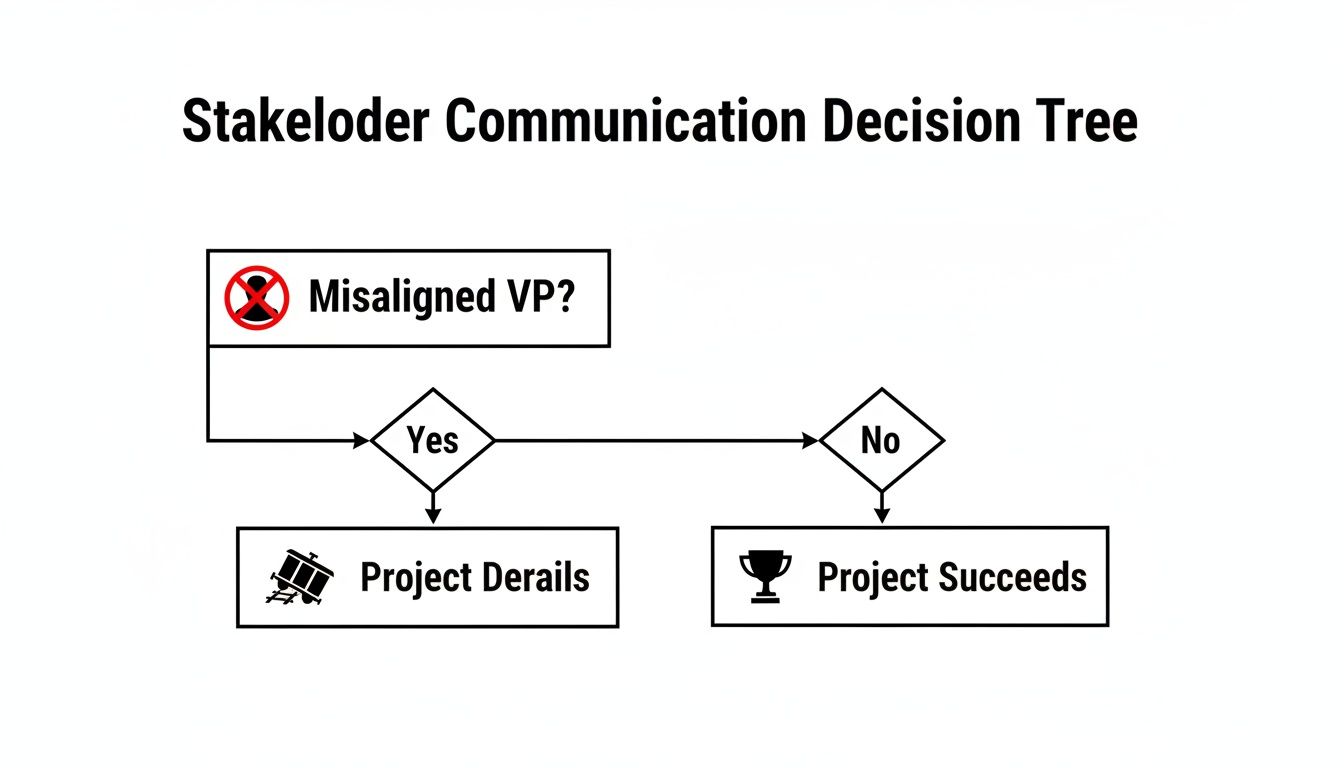
The takeaway is brutally simple: proactive alignment isn't a "nice-to-have." It’s a direct prerequisite for success.
From Identification to Strategic Mapping
The best tool for this is the classic Power/Interest Grid. It’s a simple 2×2 matrix, but it forces you to be brutally strategic with your most limited resource: your time and energy. Plot every stakeholder based on their level of power (their ability to impact the project's outcome) and their level of interest (how much they care about it).
- High Power, High Interest (Manage Closely): Your sponsor, CPO, lead architect. These are your collaborators. Involve them in decisions, seek their input constantly, and make them feel like partners.
- High Power, Low Interest (Keep Satisfied): The CFO, Head of Legal. They have veto power but don't care about daily stand-ups. Your job is to give them concise, high-level updates that reassure them everything is under control. Don't drown them in details.
- Low Power, High Interest (Keep Informed): Users in a beta program, customer support teams. They are valuable allies who can provide amazing feedback. Keep them in the loop with regular updates, newsletters, and dedicated feedback channels.
- Low Power, Low Interest (Monitor): This group needs minimal effort. Monitor them in case their status changes, but don't overload them (or yourself) with communication.
This isn't just about getting organized; it directly impacts velocity. Smartsheet has a solid guide to building engagement plans that puts this into practice.
AI Prompt for Stakeholder Discovery
To get started, use this prompt with an AI tool like ChatGPT to brainstorm your stakeholder list.
"I am a Product Manager at a B2B SaaS company launching a new AI-powered analytics feature. My core team includes an engineering lead, a designer, and a data scientist. Based on this, generate a comprehensive list of potential stakeholders I need to consider for my communication plan, categorizing them by department (e.g., Executive, Sales, Marketing, Legal, Customer Support, etc.) and suggesting their likely level of interest and influence."
This AI-generated list is your starting point. Now, validate it with your team, asking critical questions: Who approves the budget? Who has veto power? Who controls the resources we need? Whose bonus is tied to this project's success?
This mapping process is the bedrock of managing your extended team. For a deeper look, check out our guide on cross-functional team management.
Step 2: Define Communication Goals, Cadence, and Channels
You've mapped your stakeholders. Now, turn that analysis into a concrete plan. For every stakeholder group, you need a specific objective: are you trying to Inform, Consult, Collaborate, or secure a Decision? Your objective changes everything.
I’ve seen this go wrong countless times. A PM sends a deep technical spec to a VP (wastes the VP's time), or a vague summary to an engineering lead (creates frustration and delays). Precision is key.

Matching the Channel and Cadence to the Objective
Here are real-world setups I’ve used and coached my teams on:
Goal: Secure a Decision
- Who: Project Sponsor, VP of Product (High Power, High Interest).
- Channel: 30-minute steering committee meeting.
- Cadence: Monthly.
- Tools: A tight slide deck in Google Slides or Pitch, sent 24 hours beforehand. No surprises.
Goal: Collaborate
- Who: Core product team (Eng Lead, Designer, Marketing).
- Channel: Daily stand-ups, dedicated Slack or Microsoft Teams channel.
- Cadence: Daily syncs, real-time async chat.
- Tools: Jira for tasks, Confluence for documentation.
Goal: Inform
This structured approach delivers real results. And if you want to discover more insights about stakeholder engagement on asana.com, there's a wealth of info out there.
The Channel-to-Stakeholder Matchmaker
Think of communication channels like tools in a toolbox. You wouldn't use a sledgehammer to hang a picture. The same logic applies here.
| Stakeholder Group | Communication Objective | Primary Channel | Cadence | Tool Example |
|---|---|---|---|---|
| Executive Leadership | Secure Decision & Align | Live Presentation, Exec Summary | Monthly/Quarterly | Google Slides Deck |
| Core Product Team | Collaborate & Execute | Daily Stand-up, Shared Channel | Daily, Real-Time | Jira, Slack/Teams |
| Sales & Marketing | Inform & Enable | Demo Sessions, Newsletter | Bi-Weekly/Monthly | Loom, Mailchimp |
| Customer Support | Inform & Train | Knowledge Base Update, Q&A | Weekly, As Needed | Confluence, Zoom |
| Entire Company | Inform & Inspire | All-Hands, Internal Blog | Monthly/Quarterly | Company Intranet |
A Framework for Your Decisions
As a PM leader, I coach my teams to think of communication as a product: the channel is the delivery mechanism, the message is the feature, and the stakeholder is the user. If the user can't easily consume what you're delivering, the feature is a failure.
Use this simple framework to guide your choices:
- Urgency & Complexity: Urgent and complex? High-bandwidth, synchronous channel (video call). Low-urgency and simple? Asynchronous (email, Slack).
- Audience Power Level: High-power stakeholders need concise, outcome-focused communication. A well-written executive summary is better than another meeting.
- Goal of Interaction: Need a debate? A Miro workshop. Just a status update? A shared dashboard or an async Loom video.
Getting this right is similar to differentiating between OKRs vs KPIs—it’s about choosing the right tool for the right job to drive clarity and focus.
Step 3: Crafting the Message and Assigning Ownership
You've mapped stakeholders and set a cadence. Now, you have to actually say something. The single biggest mistake PMs make is blasting the same update to everyone. An engineer needs technical details; a C-level exec wants the bottom-line impact. If you mix those up, you're not just inefficient—you're eroding your credibility.
Start with a single, detailed source of truth (like a project doc in Confluence), then create different "views" for each audience. Think of it as creating an API for your project's status.
AI Prompt for Tailored Messaging
Use this prompt to turn technical updates into audience-specific messages:
"I'm a Product Manager. Take this technical project update: 'The backend team has finished refactoring the database schema, which has resolved the latency issue but will require a one-week delay to run regression tests.'
Rewrite this for three different audiences:
- An executive summary for my CPO, focusing on business impact and timeline.
- A detailed update for the engineering team.
- A high-level notification for the sales team, focusing on the impact to the launch date."
This simple prompt saves you 30 minutes and ensures your messaging is always on point. Here’s what that looks like in practice:
Scenario: A 'Red Flag' Alert
- For your Engineering Lead: "We need to talk. The latest performance tests for the new checkout flow show a 2-second latency spike. Let's get a war room going ASAP to diagnose this before it kills the release." (Urgent, technical, collaborative)
- For your VP of Product: "Heads-up: we've hit a critical performance risk in the new checkout flow that could threaten our conversion goals. My team is digging into the root cause now. I’ll have a full impact assessment and a mitigation plan for you by 5 PM today." (Proactive, business-focused, solution-oriented)
Nailing this translation is a core PM skill. For a deeper dive, our guide on how to present to executives offers tactical advice.
Assigning Ownership with a RACI Model
A plan without owners is a wish list. The best tool for this is the RACI model—Responsible, Accountable, Consulted, and Informed.
I’ve seen projects go off the rails because everyone assumed someone else was handling the exec update. Getting clear on ownership isn't micromanagement; it's the oil that keeps the product engine running.
- Responsible: The person who does the work (e.g., The PM who writes the weekly update).
- Accountable: The person who owns the outcome. Only one person. (e.g., The Director of Product is accountable for overall stakeholder alignment).
- Consulted: People you need input from (e.g., The Eng Lead is consulted for technical accuracy).
- Informed: People who just need to be kept in the loop (e.g., The Sales team is informed of progress).
Go through every communication item in your plan and assign these roles. It eliminates ambiguity and ensures critical updates don't fall through the cracks.
Adapting Your Plan for High-Stakes Scenarios
Your communication plan is a living document. The plan that works during business-as-usual will fail during a product launch or a crisis. Great PMs—the ones leading teams at OpenAI and Netflix—are masters of situational communication. They know when to stick to the script and when to throw it out.

Modifying for a Product Launch
A product launch is a communication sprint. Your focus pivots from internal alignment to market readiness. Your new best friends are Sales and Marketing.
- Cadence: Move from weekly check-ins to daily GTM syncs.
- Channel: Spin up a dedicated, cross-functional Slack/Teams channel. This is your command center.
- Message: Communication becomes about enablement. You're arming the front lines with battle cards, final messaging, and demo environments.
Use an ultimate product launch checklist template to keep everyone aligned and prevent last-minute chaos.
Adjusting for a Roadmap Update
Presenting a roadmap isn’t just reporting; you're selling a vision for the future. Your primary audience is leadership.
I’ve seen junior PMs present a list of features. Senior PMs, however, frame the roadmap as a narrative about value creation, linking every initiative to a core business objective. They are selling a vision, not a plan.
- Pre-Socialize, Always: Never let the big presentation be the first time an influential VP sees the roadmap. Schedule 1:1s to get their input and turn them into allies.
- Focus on the "Why," Not the "What": Frame your roadmap around themes like "Increase New User Activation by 15%" or "Reduce Customer Churn by 10%."
- Prepare for Objections: Know which projects were cut and have the data ready to explain why. This is a conversation about strategic trade-offs.
Our detailed product launch checklist template can provide structure for these critical conversations.
Executing a Crisis Communication Plan
When a crisis hits—a major outage, a security breach—your standard plan is useless. Speed, clarity, and authority are all that matter. Your objective is to restore trust.
- Establish a War Room: Immediately create a dedicated virtual space (Zoom, Slack huddle) with a small, core team of decision-makers (PM, Eng Lead, Comms Lead).
- Appoint a Single Spokesperson: All communication must flow through one person to avoid mixed messages.
- Communicate Early and Often: Your first message should be out in minutes. "We are aware and investigating. More updates in 15 minutes." Silence breeds panic.
- Segment Your Updates: Use pre-drafted templates. Technical details for engineers, customer-facing language for support, and business impact for leadership.
Your Top Questions, Answered by a PM Leader
I've seen where even experienced PMs get stuck. Here's how I coach my teams to handle the toughest challenges.
How Do I Handle a Stakeholder Who Is Unresponsive or Difficult?
First, diagnose why. Are they busy, uninterested, or actively opposed? Don't just send another email.
- Change the Medium: If emails are ignored, book a single, non-negotiable 15-minute call. Frame it as respecting their time while getting critical input.
- Find a Friendly Ally: A quiet word from a respected peer or their manager is more powerful than another message from you.
- Frame it in Their Language: Connect your request to their goals. Instead of "I need your feedback," try "We need your input on the design by Friday to avoid a two-week delay for the enterprise launch you're championing."
- Escalate as a Risk: If they remain a roadblock, flag it to your manager as a formal project risk, not a personal complaint.
How Often Should I Update My Stakeholder Communication Plan?
It’s a living document. Formally review it quarterly and at the start of any major project phase. Update it immediately if:
- Scope Changes: A pivot means your stakeholder map is obsolete.
- Timeline Shifts: A delay requires rebuilding your GTM communication cadence.
- Personnel Changes: A key stakeholder leaves. Update the plan that day.
How Can I Measure If My Communication Plan Is Working?
Look for both hard numbers and soft signals.
- Quantitative Signals: Are you seeing fewer "fire drill" meetings? Faster decisions in steering committees? A drop in repetitive questions?
- Qualitative Signals: Get direct feedback. Send a simple 3-question poll to key stakeholders:
- On a scale of 1-5, how well-informed do you feel?
- Is our communication cadence too much, too little, or just right?
- What's one thing we could do to make our updates better for you?
This feedback is gold. It tells you if your plan is truly working.
Can I Use AI to Help Manage My Communication Plan?
Absolutely. AI is a force multiplier for a busy PM. It can't manage relationships, but it can slash time on tactical tasks. Use tools like ChatGPT or Claude as your communication co-pilot. Use the prompts I shared earlier to translate technical updates for different audiences, summarize long meeting transcripts, and draft initial plans. This frees you from documentation drudgery to focus on the strategic conversations that build trust and advance your career.
At Aakash Gupta, we focus on providing the frameworks and real-world tactics you need to advance your product management career. Explore more insights and strategies at https://www.aakashg.com.
