If you're an aspiring or practicing Product Manager, you need to understand one thing: "competitive benchmarking" isn't a stuffy MBA term. It’s the playbook you use to get ahead and stay ahead. Top PMs at places like Google and Meta aren't just building features; they're systemically dismantling their competition's strategy. This is how.
Think of it like a pro sports team obsessively watching game film of their rivals. They aren't just looking at the final score; they're breaking down every play to spot weaknesses, copy winning strategies, and find that one unguarded opening to exploit. That's what we're doing for our products. For a PM, this skill is a direct path to a higher salary and more influence. A PM who can say "Our onboarding is 40% less efficient than Stripe's, and here's a plan to fix it" gets promotions. A PM who says "I think our onboarding is clunky" gets ignored.
Your 5-Step Benchmarking Playbook (Actionable Today)

We're going to dive right into the practical framework I teach my PMs. You can start using this today to see how your product truly stacks up. This is how you move past simple feature checklists and start measuring what actually drives success: user engagement, market positioning, and growth velocity.
This is the art of using specific, measurable data to compare your product's performance against your top competitors and the best-in-class leaders, turning guesswork into a quantifiable advantage.
Why Benchmarking Matters (Especially for Your Career)
In product management, gut feelings are a good starting point, but they're a terrible way to build a roadmap. Making decisions on intuition alone is a fast track to building something nobody wants, and it's a career-limiting move. As one PM I hired from a top startup put it, "Relying on gut feel is how you become a feature factory PM. Data-backed benchmarking is how you become a strategic leader."
Benchmarking grounds your strategy in objective reality. It's the map that shows you exactly where you are, where your competitors are, and where the treasure is buried. The competitive benchmarking space is projected to explode to USD 111.32 billion by 2032.
Why? Because it works. Businesses that consistently benchmark their performance see 10-20% faster revenue growth simply by spotting and fixing inefficiencies their rivals miss.
At its core, competitive benchmarking is the difference between saying, "I think our onboarding is clunky," and proving, "Our onboarding flow has a 40% higher drop-off rate than our top three competitors, which costs us an estimated $2M in annual recurring revenue."
One statement gets you a pat on the back; the other gets your project funded and you noticed. For a solid overview of the fundamentals, this guide is a good read: What is Competitive Benchmarking: A Guide for Bank Executives. While it's geared toward banking, the core principles are universal.
By systematically measuring where the gaps are, you can:
- Secure buy-in from leadership with cold, hard data they can't ignore.
- Prioritize roadmap features that will actually move the needle on key metrics.
- Identify untapped opportunities and market gaps your competitors have completely overlooked.
This whole process is a cornerstone of a much larger strategy. To see how benchmarking fits into the bigger picture of building a successful product, check out our deep dive on data-driven decision-making for product managers.
The Four Types Of Benchmarking Every PM Must Know
To be a great PM, you need the right tool for the job. Benchmarking isn’t a one-size-fits-all game; picking the right approach is everything if you want real, actionable insights. As a hiring manager, I can tell a junior PM from a senior one by which of these they choose.
Forget the academic definitions. Let's break down the four types you’ll actually use.
Think of it like this: knowing these four types is like a mechanic knowing the difference between a torque wrench and an impact driver. Both tighten bolts, but you’d never use them in the same situation.
Internal Benchmarking
This is where you look inside your own house first. Internal benchmarking is all about comparing processes, metrics, and performance within your own company. It’s about finding those pockets of genius that already exist and spreading them around.
- When to Use It: You have a gut feeling one team has cracked a problem that others are still banging their heads against. For example, a senior PM at Google could compare user engagement and retention between the Google Photos team and the Google Drive team. The goal isn't to crown a "winner." It's to figure out why one team’s onboarding flow leads to 15% higher 7-day retention and apply those lessons to the other.
Competitive Benchmarking
This is the one most people think of first. Competitive benchmarking is where you go head-to-head, directly comparing your product, features, and key metrics against your direct rivals.
- When to Use It: You need to know exactly where you stand in the market and pinpoint specific feature gaps or performance issues. For instance, you can bet Meta’s product team for Instagram Reels is constantly benchmarking against TikTok. They’re analyzing things like average session time, time-to-create (how fast users can create a video), and the adoption rate of new AR filters. It helps them answer the critical question: "Are we falling behind, and if so, where?"
Functional Benchmarking
This is where things get interesting. Instead of looking at your direct competitors, you look outside your industry for best-in-class examples. Functional benchmarking means comparing your processes to companies that are legendary at a specific function, no matter what they sell.
- When to Use It: You want to make a huge leap forward in one specific area of your operations. A PM at a meal-kit startup like HelloFresh shouldn't just look at Blue Apron. For world-class logistics and delivery tracking, they should be functionally benchmarking against Amazon. Study its communication, its package tracking interface, and its return process. That's how you set a world-class standard, not just an industry one.
Strategic Benchmarking
Finally, there’s strategic benchmarking. This is the most forward-looking of the four. It’s about analyzing the long-term strategies and disruptive business models of other companies—even tiny startups—that could completely upend your market.
- When to Use It: You’re a senior PM or product leader responsible for the long-term vision. You need to see around corners for future threats and opportunities. A Principal PM at a big bank like Chase wouldn't just benchmark against Bank of America. They would strategically benchmark against a fintech disruptor like Revolut to understand its customer acquisition model, its global expansion playbook, and its "super app" strategy.
Knowing which of these four to pull out of your toolkit prepares you to ask the right questions. This is the critical first step of any meaningful analysis. You can learn more about this initial discovery phase by reading our guide on how to conduct effective market research.
A Step-By-Step Framework For Actionable Benchmarking
Theory is one thing, but what separates the top-tier Product Managers from the pack is turning concepts into a repeatable, high-impact process. Competitive benchmarking isn't about building a monster spreadsheet that no one ever reads. It’s about a disciplined workflow that spits out insights ready for your roadmap.
This is the exact five-step playbook I've personally used and taught to my PMs at multiple companies. It’s designed to ensure your analysis leads to action, not just more data gathering.
Step 1: Define Your Focus
Before you even peek at what your competitors are doing, you need to know exactly what you’re trying to solve. Are you bleeding users during onboarding? Is your pricing model falling flat? Are you trying to convince leadership to back a new strategic bet?
Your goal is your north star—it tells you what to measure. Starting with a vague objective like "see what competitors are doing" is a recipe for wasting weeks. Get specific.
- Weak Goal (Entry-level PM): "Improve onboarding."
- Strong Goal (Senior PM): "Benchmark our user onboarding flow against Figma and Miro to identify friction points. My goal is to present 3 testable hypotheses to cut user drop-off by 10% in Q3."
Step 2: Identify Your Rivals
With a sharp goal in hand, it’s time to pick your sparring partners. Don't just list the biggest names in your space. I coach my PMs to think about three distinct groups to get the full picture:
- Direct Competitors: The obvious ones, offering a similar product to the same audience (e.g., Figma vs. Sketch).
- Indirect Competitors: These companies solve the same user problem but with a totally different approach (e.g., project management tool Asana versus a collaborative doc tool Notion).
- Aspirational/Functional Leaders: Who is the absolute best-in-class at a specific function, even if they're in a completely different industry? For instance, if you're working on notifications, you must benchmark against Duolingo's legendary engagement mechanics.
Step 3: Master Data Collection
This is where the real detective work begins. Your mission is to gather both quantitative data (the 'what') and qualitative data (the 'why'). The secret is to blend different methods to paint a complete picture of the competitive landscape.
Benchmarking Data Collection Methods
Digging for competitive gold requires more than a Google search. You need a mix of techniques to get a 360-degree view. Here's a quick rundown of the methods I've found most effective for product teams.
| Method | Pros | Cons | Best For |
|---|---|---|---|
| Hands-On Product Teardowns | Deep, firsthand understanding of UX/UI. Uncovers nuances missed by others. | Time-consuming. Can be expensive if subscriptions are required. | Deeply understanding user flows, feature execution, and overall user experience. |
| App Store & Forum Reviews | Direct, unfiltered user feedback (the good, the bad, the ugly). Great for qualitative insights. | Can be noisy and anecdotal. Requires sifting through a lot of irrelevant comments. | Identifying top user complaints, most-loved features, and unmet needs. |
| Public Financial Reports | Official data on revenue, user growth, and strategic priorities (for public companies). | High-level data. Doesn't reveal product-specific performance. | Understanding a competitor's overall business health and strategic direction. |
| Third-Party Tools | Tools like Similarweb or App Annie provide traffic, engagement, and demographic data. | Data is estimated, not exact. Can be costly. | Getting quick, quantitative estimates of market share and user engagement. |
| AI-Powered Research | Using tools like Perplexity to rapidly synthesize public information. | Output quality depends heavily on the prompt and data sources. | Quickly summarizing user sentiment, feature lists, and market news. |
No single method tells the whole story. The best insights almost always come from combining a few of these, like pairing a hands-on teardown with a deep dive into app store reviews.
You can combine insights from multiple sources, from internal data to publicly available information. Many PMs find our detailed breakdown on creating a competitive analysis framework and template helpful for structuring this phase.
AI Prompt for PMs: Let AI do the grunt work. Use a prompt in a tool like Perplexity: "Act as a market research analyst for a B2B SaaS company. Scour app store reviews, Reddit threads (/r/productmanagement), and tech blogs from the last 6 months for [Competitor X]. Summarize the top 3 user complaints, top 3 most-praised features, and any mentions of pricing or missing integrations."
Step 4: Synthesize And Analyze
Data without synthesis is just noise. This is where you connect the dots and find the "so what?" Your job is to transform raw data points into strategic insights. Don't just state that a competitor has a certain feature; analyze how that feature impacts their user experience or gives them a market advantage.
This diagram shows how you can pull insights from different places—looking inward at your own performance (Internal), sizing up your rivals (Competitive), or learning from the best in any field (Functional).
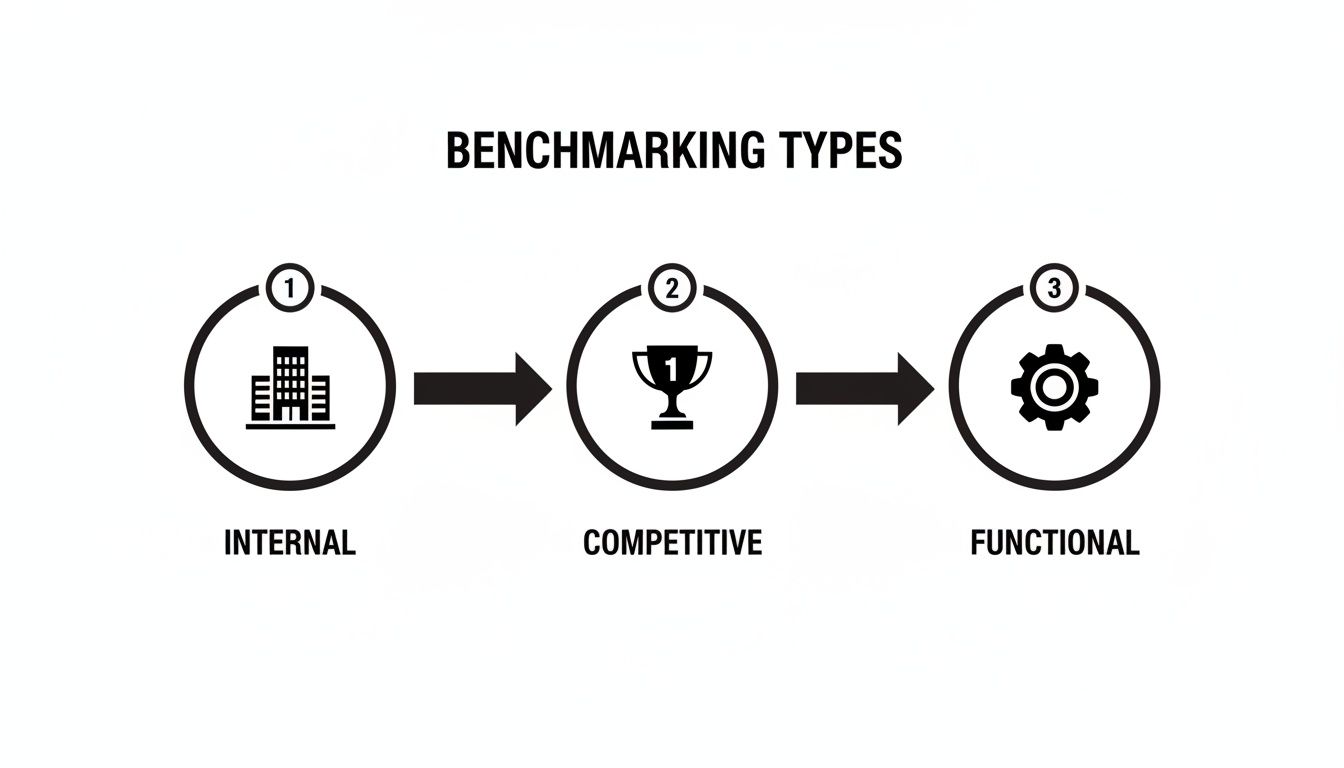
The key is realizing that great ideas aren't confined to your industry.
A simple "Insight, Impact, Opportunity" framework works wonders here. Try organizing your findings this way:
- Insight: "Competitor X's onboarding flow is three steps shorter and requires no credit card upfront."
- Impact: "This likely contributes to their 20% higher Day 1 retention reported in their last earnings call."
- Opportunity: "We should run an A/B test removing the credit card requirement during signup. Hypothesis: this will increase trial signups by 15% and have a negligible impact on conversion-to-paid."
Step 5: Prioritize And Act
This is the final—and most important—step. An insight is worthless until it actually changes your roadmap. You have to take your analysis and turn it into real, tangible action.
Use the opportunities you identified in Step 4 to build data-backed pitches for new features, experiments, or even strategic pivots.
Don't just present a report; present a proposal. Frame the opportunity with a clear hypothesis and success metrics. For example: "By adding a one-click Google sign-up, just like our top competitor, we hypothesize we can decrease registration drop-off by 15%."
This is how you close the loop. It’s how competitive benchmarking stops being a chore and becomes a core driver of your product’s success.
What To Measure: The PM's Benchmarking Scorecard

Knowing you need to benchmark is the easy part. The real challenge, and where most PMs trip up, is figuring out what to actually measure. A fuzzy analysis gives you fuzzy, unusable results.
To get ahead, you need a scorecard. Think of it as a clear, structured checklist that forces you to build a complete, 360-degree picture of the competitive landscape.
Instead of just making a laundry list of features, the best PMs organize their benchmarking into three distinct categories. This framework guarantees you cover all your bases.
Product Benchmarks
This is the most obvious place to start, as it zeroes in on the tangible user experience. But it's about so much more than a simple feature checklist. You need to measure the quality and effectiveness of your competitor's product.
- Feature Parity and Quality: Don't just ask, "Do they have this feature?" Instead, ask, "How well does their feature solve the user's problem compared to ours?" Time yourself completing key jobs-to-be-done in both products to get a real feel for it.
- Onboarding Flow Completion: How many new users actually make it through their setup process? Count the steps, the clicks, and the data fields they demand. A shorter, more streamlined flow is a massive competitive edge.
- User Engagement Metrics: You won't have their internal dashboards, but you can find proxies. Look for daily active users (DAU) to monthly active users (MAU) ratios if they're public, or just dig into the qualitative sentiment in app store reviews and forums.
- Integration Ecosystem: How many third-party apps can connect to their product? Slack's aggressive, early focus on building a huge integration marketplace is a perfect example. It created an unbeatable moat, turning them into the default communication tool for thousands of companies.
Go-To-Market Benchmarks
A phenomenal product can still crash and burn with a terrible go-to-market (GTM) strategy. This category is all about measuring how your competitors find, win, and keep their customers. It’s about reverse-engineering their business engine.
- Pricing and Packaging: Get forensic here. Document their pricing tiers, what's included in each, and their core monetization model (e.g., per-seat, usage-based). HubSpot’s freemium GTM strategy was a masterstroke; they benchmarked against expensive, locked-down marketing tools and won by offering huge value upfront for free.
- Customer Acquisition Channels: Where are they finding their users? Sift through their ad spend, content marketing, and social media. Use tools to see what keywords they're bidding on and what their top-performing content is.
- Market Share: This is a fundamental metric. As of Q2 2022, Samsung held a 21.6% global smartphone market share to Apple's 18.8%, an advantage they built through aggressive pricing in emerging markets. This stuff matters: companies that benchmark market share quarterly grow 2.5x faster than their peers.
Company Benchmarks
Finally, you need to zoom out and look at the health and momentum of the competitor's organization. These metrics are like reading tea leaves—they signal future strategic bets and potential vulnerabilities.
- Hiring Velocity and Roles: Scour their open job postings on LinkedIn. Are they suddenly hiring 20+ AI/ML engineers? That’s a huge tell about a strategic pivot. A spike in sales roles for the APAC region could signal a push into a new market. A recent job posting for a "Senior PM, AI" at a competitor could command a salary of $220,000-$280,000, signaling heavy investment.
- Customer Support Response Time: This is a fantastic guerilla tactic. Use a burner email to submit a support ticket and literally time how long it takes them to respond. It's a direct measure of how much they're investing in customer success.
- Funding and Financials: If they're a startup, find out when they last raised money and how much. This tells you about their financial runway and how much confidence investors have in them.
By systematically working through this scorecard, you graduate from random observation to strategic assessment. A huge piece of this puzzle is also listening to what your users are saying, a discipline often called the Voice of the Customer. For a deeper dive, check out our guide on what is Voice of the Customer.
Integrating AI Into Your Benchmarking Workflow
Manual competitive benchmarking is a soul-crushing, time-sucking task that’s quickly becoming obsolete. Trying to keep up with every competitor's pricing change, feature launch, and wave of user reviews by hand is a losing battle. The sheer volume of data is just too much.
As a product manager, your real value isn't found in a spreadsheet cell. It's in the strategic insights you pull from the data. AI is the key to automating the grunt work of data collection so you can focus on what you're actually paid to do: think. A PM who masters AI for this will be twice as productive as one who doesn't. This is a non-negotiable skill for career advancement in the 2020s.
Automating Data Synthesis with AI Prompts
You can get started right now with Large Language Models (LLMs) like ChatGPT-4 and Claude 3. They are incredible at synthesizing huge amounts of qualitative data. Instead of losing a whole day reading hundreds of app store reviews, you can automate the entire process.
Here’s an advanced prompt you can use in the next 5 minutes:
Act as a Principal Product Manager at OpenAI. I am providing 500 user reviews for our top competitor, [Competitor X]. Analyze this raw text and produce a concise, executive-level summary that covers:
- The top 3 most frequently requested new features, with direct quotes as evidence.
- The top 3 most common user complaints or pain points, categorized by theme (e.g., "Performance," "UI/UX," "Pricing").
- A list of "magic moments" that users mention—the things that make them loyal advocates.
- Any time our product is mentioned as an alternative. Note the context: are users switching to us or from us, and why?
- An estimate of overall user sentiment on a scale of 1-10.
Present your findings in a clean, bulleted list formatted in markdown, ready to be dropped into a stakeholder presentation.
A prompt like this turns what used to be a multi-day slog into a 15-minute task. For a deeper dive into these tools, check out our guide on AI tools for Product Managers, which breaks down the best options out there today.
Leveraging AI-Powered Intelligence Platforms
Beyond simple LLM prompts, a new wave of AI-powered competitive intelligence platforms has emerged. Think of these tools as a 24/7 analyst for your team, constantly monitoring the competitive landscape so you don't have to.
- Website & Product Change Tracking: Tools like Kompyte are brilliant for this. They automatically track every change on a competitor's website, from a subtle tweak in their homepage messaging to a full-blown pricing page overhaul. You get real-time alerts so you're never caught flat-footed.
- Market & News Monitoring: Instead of spending your morning doomscrolling through news sites, platforms like Crayon use AI to do it for you. They scan news articles, press releases, and social media for any mention of your competitors, curating a live feed of their public moves.
Adopting AI isn't a choice anymore; it's a necessity. If you want to see how this shift is playing out in other analytical fields, Mastering AI in venture capital workflows offers great parallels for product managers. The goal is to work smarter, not harder, to keep your edge.
Common Benchmarking Pitfalls And How To Avoid Them
Competitive benchmarking is an incredible tool, but it's also littered with traps that can turn a high-value strategic exercise into a massive waste of time. I’ve seen way too many PMs fall into these common pitfalls, leading to flawed strategies and missed opportunities.
This is your guide on what not to do. Recognizing these traps is the first step to making sure your benchmarking efforts actually give you a real strategic edge.
Pitfall 1 The Copycat Syndrome
This is easily the most common trap: blindly copying a competitor’s feature or pricing without understanding the "why" behind their move. You see a rival launch something new, you panic, and you immediately add "build feature X" to your backlog. That’s reactive, not strategic.
Cautionary Tale: A mid-stage SaaS startup saw their main competitor drop prices by 20%. In a panic, they matched the price cut overnight. What they didn't realize was the competitor had just closed a massive funding round and was intentionally running at a loss to gobble up market share. The startup, with very different unit economics, crippled its own margins and shortened its runway.
How to Avoid It: Never, ever copy without context. For every competitor move, you have to ask: What strategic goal does this serve for them? What resources do they have that we don’t? Instead of copying, use their move as a trigger to re-evaluate your own unique value proposition.
Pitfall 2 Analysis Paralysis
This is that dreaded state of endlessly gathering data without ever making a decision. You create these beautiful, comprehensive spreadsheets packed with metrics, charts, and detailed notes, but the analysis never translates into a roadmap item or even a small experiment. The report becomes the goal, not the action it's supposed to drive.
The purpose of benchmarking is not to create a perfect report. It's to make a better decision, faster. An 80% complete analysis that leads to a concrete action today is infinitely more valuable than a 100% perfect analysis that sits on a drive for a month.
How to Avoid It: Timebox your analysis. Give yourself one week, max. Start with a clear question you need to answer, and once you have a directionally correct answer, move on. Frame your findings as proposals with clear hypotheses, like "Competitor X has feature Y, which we believe reduces their churn by 5%. We propose building a lightweight version to test this hypothesis in a 2-week sprint."
Your Questions On Competitive Benchmarking Answered
Okay, we've covered the framework. But I know that when the rubber meets the road, specific questions pop up. These are the most common ones I hear from PMs I mentor and hire, answered directly.
How Often Should I Conduct Competitive Benchmarking?
This depends on your career level and market speed.
- For most PMs: A major benchmark should be done semi-annually, lining up with your strategic planning cycle. This is your deep dive that informs major bets.
- For AI PMs or those in fast-moving markets: You need a quarterly deep-dive benchmark. An annual review is a surefire way to get left behind.
- For all PMs: Set up continuous monitoring. Use AI tools for real-time alerts and do quick "pulse-checks" on your top 3 rivals monthly.
What Is The Difference Between Competitive Benchmarking And A Competitive Analysis?
I get this one a lot. Let’s make it simple. It's the difference between being a reporter and being a strategist.
A competitive analysis tells you what your competitors are doing. It's a fact-finding report: "They have these features, this is their pricing." It’s the "who" and the "what."
Competitive benchmarking is the crucial next step. It’s about measuring how you actually perform against them using specific metrics. Benchmarking answers the "how well" and "by how much."
- Analysis (Reporter): "Competitor X has a mobile app."
- Benchmark (Strategist): "Our app's onboarding takes 90 seconds longer than Competitor X's, which correlates with a 15% lower Day 1 retention rate. This gap represents a $500k ARR opportunity."
One is an observation. The other is a data-backed proposal you can take to leadership.
I Am An Aspiring PM How Can I Use Benchmarking To Land A Job?
This is my favorite question because it's such a killer move in an interview. Forget just talking about your skills—show them. This single tactic has helped multiple PMs I've mentored land offers at top companies.
Before your next interview, do a quick benchmark of the company's product against one of its main competitors. You don’t need expensive tools. Just use your own product sense.
Create one slide that shows your work. It could be as simple as comparing the number of steps in their signup flow ("Your flow has 7 steps and 11 fields; Stripe's has 4 steps and 6 fields") or pulling sentiment from App Store reviews using an AI prompt.
Then, in the interview, when they ask "Do you have any questions for us?", you say: "I was so curious about your position in the market that I did a quick analysis comparing your onboarding flow to [Competitor]'s. I noticed a potential opportunity to reduce friction. Can I show you what I found?"
This one move proves you have initiative, you think in terms of data, and you have strategic sense. These are the three things hiring managers at Google, Meta, and fast-growing startups are desperate to find. It immediately separates you from 99% of other candidates.
As a leader in product management education, Aakash Gupta provides the frameworks and career advice you need to excel. To get more actionable insights like these delivered to your inbox, explore the newsletter at https://www.aakashg.com.
