The most popular advice on outsourcing product development is still wrong. It treats outsourcing like a procurement exercise. Find a cheaper team, write a spec, manage the timeline, hope for the best.
That mindset creates most of the failures I've seen.
Good outsourcing decisions don't start with rate cards. They start with a product question: what work should stay close to the core team, and what work can an external team accelerate without weakening product judgment, architecture, or customer context? If you get that answer right, outsourcing can increase velocity. If you get it wrong, you buy coordination overhead, rework, and a slower roadmap.
Product managers often inherit this decision after engineering headcount gets tight or leadership wants faster delivery. That's why this topic matters beyond vendor management. It sits right inside roadmap execution, team design, and operating model. If you're working through the product development lifecycle, outsourcing changes how discovery, delivery, QA, and launch should work across every stage.
The New Reality of Outsourcing Product Development
The old pitch was simple: outsource to save money.
That's not how strong teams think about it anymore. The global software development outsourcing market is estimated at about $618 billion in 2026 and projected to reach nearly $977 billion by 2031, according to industry reporting summarized here. That scale matters because it shows outsourcing product development has become a mainstream operating model, not a niche move for startups or distressed companies.
The practical shift is this. Product leaders now use external teams to add capacity, specialized expertise, and delivery flexibility. That's especially relevant when you need hard-to-hire skills, want to parallelize execution, or need to reduce bottlenecks without waiting through a long recruiting cycle.
Why the cheapest vendor usually loses
The cheapest option often creates the highest total cost. You pay less per hour, then lose time to weak product judgment, avoidable bugs, architecture shortcuts, and endless clarification loops.
A vendor brochure will call this “cost efficient.” A PM living through it will call it what it is: expensive confusion.
Practical rule: Buy speed, capability, and reliability. Don't buy labor and hope those other things show up.
That's also why outsourcing product development works best when you define its role clearly. An external team can absolutely ship meaningful work. But they can't replace ownership. Your company still owns product direction, customer context, prioritization trade-offs, and the final call on what good looks like.
What product leaders should optimize for
When outsourcing goes well, the internal team keeps the hard judgment calls and gives the partner enough context to execute with confidence. That usually means:
- Internal ownership of product strategy: The PM, design lead, and tech lead keep control of the problem space, priorities, and trade-offs.
- External ownership of bounded execution: The partner owns clearly scoped implementation, testing, support, or platform work.
- Shared operating rhythm: Both teams work from the same backlog, quality bar, demo cadence, and escalation path.
If you approach outsourcing product development as “handing off software,” you'll struggle. If you approach it as extending the delivery system without outsourcing product judgment, you'll make better decisions from the start.
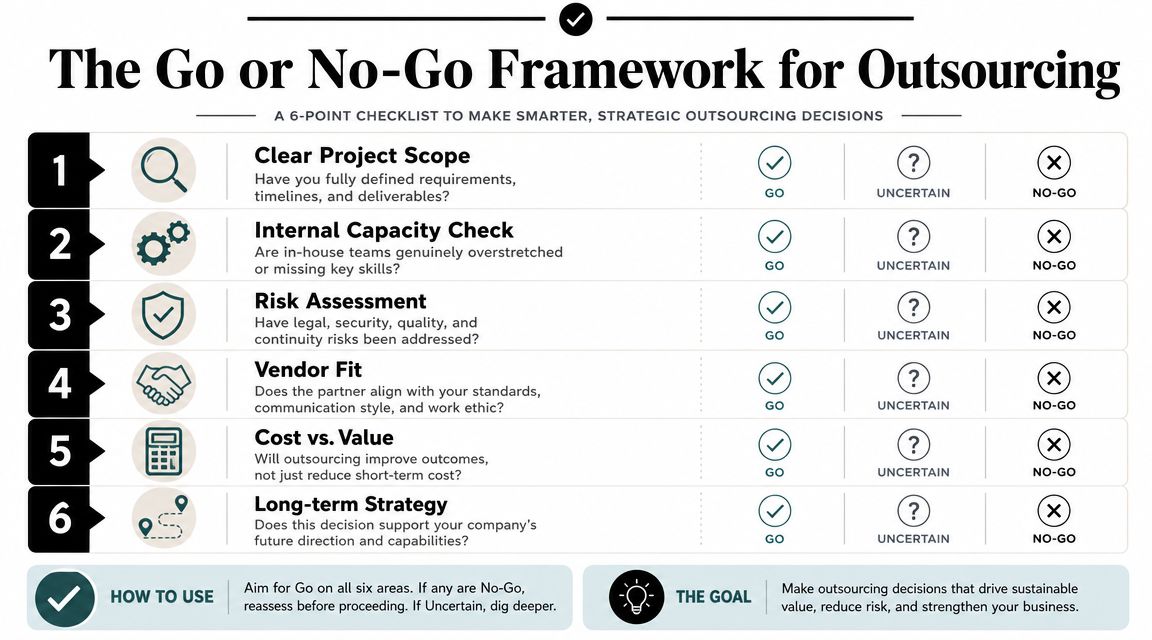
The Go or No-Go Framework for Outsourcing
Most outsourcing mistakes happen before vendor selection. The team decides to outsource because delivery feels slow, then starts searching for a partner before answering the hard question: should this work be outsourced at all?
Use this as a forcing function.
Start with core versus context
A simple way to decide is to separate core IP from context work.
| Work type | Usually keep in-house | Often reasonable to outsource |
|---|---|---|
| Product strategy | Yes | Rarely |
| User research synthesis | Yes | Limited support only |
| Core recommendation or ranking logic | Yes | Sometimes implementation support |
| Internal admin tools | Sometimes | Yes |
| Platform migrations | Sometimes | Yes |
| Regression QA and test automation | Sometimes | Yes |
| Feature work with clear requirements | Sometimes | Yes |
If the work defines your differentiation, pricing power, or customer insight loop, keep it close. If it's important but not identity-defining, a partner may be a strong fit.
A related decision often comes up in platform work, integrations, and infrastructure-heavy projects. That's where a build vs buy framework for product teams can sharpen the call before you decide whether an outside team should build it.
Use the six-question screen
I like six questions. If you answer “no” to more than one, stop and fix the operating problem before you outsource.
Is the problem well understood?
Not every requirement needs to be final, but the team should understand the user problem, target outcome, and key constraints.Can your team name what must remain internal?
If nobody can explain what product judgment, architecture, or customer insight needs to stay in-house, the boundary is too fuzzy.Do you have an internal product owner and technical lead?
Without them, the vendor becomes the decision-maker by default.Can the work be modularized?
Outsourcing breaks down when the partner needs constant access to half-finished decisions across every function.Will success be measurable?
If you can't define what “good” means operationally, you'll end up arguing about effort instead of outcomes.Are you solving a capacity issue or avoiding a management issue?
If internal priorities are chaotic, outsourcing will amplify the chaos.
The discovery trap
Many PMs get burned. Teams assume a vendor can help with everything from research to roadmap to release. In practice, outsourced teams are strongest when requirements and design intent are already clear. One guide on outsourced product development explicitly argues that pre-coding product work should not be outsourced and notes that outsourced teams perform best when there's clarity in design and requirements, as described in this product development outsourcing guide.
That doesn't mean external partners are useless in discovery. It means you should use them carefully.
Keep problem discovery, user insight synthesis, and product trade-offs internal. Invite the partner into solution exploration after the team has framed the problem clearly.
Good candidates and bad candidates
Good candidates for outsourcing product development
- Well-bounded feature delivery: Clear acceptance criteria, known dependencies, obvious users.
- Specialized technical work: AI integration, DevOps, mobile performance, QA automation, data engineering.
- Execution bursts: Temporary capacity to hit a launch window or reduce a backlog.
Bad candidates
- Net-new zero-to-one discovery: The team is still figuring out the user, workflow, and commercial model.
- Founder instinct products: The product direction lives in a few people's heads and changes daily.
- Politically ambiguous initiatives: Stakeholders don't agree on goals, ownership, or scope.
A no-go decision is often the mature move. It's better to delay outsourcing than to pay a vendor to absorb your internal ambiguity.
How to Vet and Select a True Development Partner
The biggest selection mistake is evaluating vendors like interchangeable suppliers. They're not. You're choosing a team that will shape code quality, team velocity, and sometimes even roadmap credibility inside your company.
Treat the process like hiring a senior cross-functional team.

Four signals that matter more than price
I look for four things before I care about commercial terms.
Technical judgment
Ask them to explain trade-offs, not tools. A weak vendor lists frameworks. A strong one explains why they'd choose one architecture over another, what failure modes they expect, and where they'd simplify.
Use a practical artifact review. Ask for a sanitized architecture diagram, QA plan, or sprint report. You're not just checking polish. You're checking whether they think in systems.
Product sense
A good partner doesn't act like an order-taking factory. They ask where the user friction is, which assumptions are still soft, and what edge cases matter before they commit to a timeline.
This is especially useful when reviewing clickable concepts or product flows. If you need a way to structure that exercise, a guide on how to create a prototype of a product can help frame what you put in front of a vendor during evaluation.
Communication maturity
Communication isn't about friendliness. It's about whether they surface risk early, document decisions, and escalate clearly when things move off track.
Ask direct questions:
- “What do you do when a sprint commitment is at risk?”
- “Who raises architecture concerns, and when?”
- “What decisions must come back to us versus stay with your team?”
If answers are vague, the future relationship will be vague too.
Run a paid trial task
Don't start with a giant contract if the engagement is complex. Run a small paid trial that tests how they think under realistic conditions.
A useful trial task might include:
- A narrow product brief: Enough context to reveal ambiguity.
- A prototype or flow critique: See whether they challenge assumptions.
- A small implementation spike: Something that touches architecture, QA thinking, and communication.
- A playback session: Have them present decisions, trade-offs, and unresolved questions.
After you've seen their early working style, this walkthrough is worth sharing with the broader team before final selection:
Reference checks that actually help
Most reference calls are wasted because buyers ask if the client was “happy.” Ask questions that reveal how the partnership behaves under stress.
- “What happened when requirements changed midstream?”
- “Did the team sold in the pitch match the team that delivered?”
- “What did you still need to own heavily on your side?”
- “Where did they push back in a helpful way?”
- “Would you use them again for work with some ambiguity?”
The best vendors create a little productive discomfort in the sales process. They ask hard questions, narrow fuzzy scope, and resist premature certainty.
A simple scorecard
Use a weighted scorecard even if the weights are informal. It helps leadership compare vendors on the right dimensions.
| Criteria | What to look for |
|---|---|
| Technical depth | Clear trade-off thinking, solid architecture habits |
| Product sense | Challenges assumptions, understands user impact |
| Communication | Crisp updates, written documentation, risk escalation |
| Delivery process | Defined QA, demos, retros, dependency management |
| Team continuity | Named leads, low bait-and-switch risk |
| Commercial fit | Contract model matches the work, not just the budget |
The right partner should feel capable and slightly opinionated. If they agree with everything you say during selection, they'll probably stay silent when it matters later.
Crafting an Ironclad SOW and Contract
A bad Statement of Work doesn't fail loudly on day one. It fails slowly through ambiguity. The team starts building. Questions pile up. Decisions happen in Slack. Then scope, accountability, and expectations drift apart.
That's why the SOW matters more than the kickoff deck.
What the SOW must define
An effective SOW makes execution boring in the best possible way. Everyone knows what's being delivered, how decisions get made, and what happens when something changes.
Include these essential elements:
- Scope boundaries: Define what is included, what is explicitly excluded, and what assumptions the estimate depends on.
- Acceptance criteria: Tie deliverables to observable behavior, not vague phrases like “feature complete.”
- Roles and approvals: Name who approves requirements, designs, releases, and change requests.
- Dependency ownership: Call out which systems, teams, environments, or credentials your company must provide.
- IP ownership: State clearly that your company owns the agreed work product and related code deliverables under the contract terms.
- Security and data handling: Specify how the team can access environments, data, and internal tools.
- Knowledge transfer: Require documentation, handoff materials, and support expectations near release.
Good scope versus bad scope
Bad scope sounds like this:
Build an AI assistant for customer support with dashboard, analytics, and integrations.
It looks clear until you ask basic questions. Which channels? Which support workflows? What counts as done? Which analytics? What integrations? What fallback behavior exists when the model output is wrong?
Good scope sounds more like this:
Deliver authenticated web-based agent assist for support reps, including conversation summary generation, internal knowledge retrieval for approved content sources, admin controls for prompt configuration, audit logging, and staging-to-production deployment support. Success is measured against approved acceptance criteria for each story and environment readiness checklist.
That version still leaves room for agile execution, but it narrows arguments later.
Change control is where trust survives
Every outsourced engagement changes. The issue isn't whether scope shifts. The issue is whether the contract gives both sides a sane way to handle it.
A clean change process should answer:
- Who can request a scope change
- How impact gets assessed
- Who approves timeline or cost implications
- What happens while the change is under review
If this process is missing, teams either freeze work or absorb extra work until resentment builds. For PMs, this is inseparable from handling scope creep in product delivery.
Strong contracts don't eliminate change. They make change legible.
Tie payments to meaningful progress
Milestones should reflect validated progress, not just elapsed time.
A pragmatic structure often looks like this:
- Kickoff milestone: Discovery alignment, architecture approach, and environment readiness complete
- Mid-build milestone: Agreed features implemented and demoed in staging
- Pre-launch milestone: QA thresholds met, defects triaged, release checklist complete
- Final milestone: Production handoff, documentation delivered, support transition accepted
This isn't legal advice. Your counsel should shape the final contract language. But as a PM, you should insist that the commercial structure supports product reality. If the SOW can't survive ambiguity, the engagement won't either.
Your Onboarding and Governance Operating System
Most outsourced projects don't fail because the partner lacks talent. They fail because the operating system is weak. People don't know where decisions live, what success looks like, or how risk gets surfaced.
That's fixable.
One of the strongest signals from outsourcing data is operational, not technical. 55% of organizations start outsourced engagements without defined success metrics, and the same source identifies inadequate change management (53%) and poor vendor-service integration (47%) as leading failure drivers. The same summary notes that organizations with a defined sourcing strategy and strong governance are more likely to succeed, as outlined in these outsourcing statistics and governance findings.
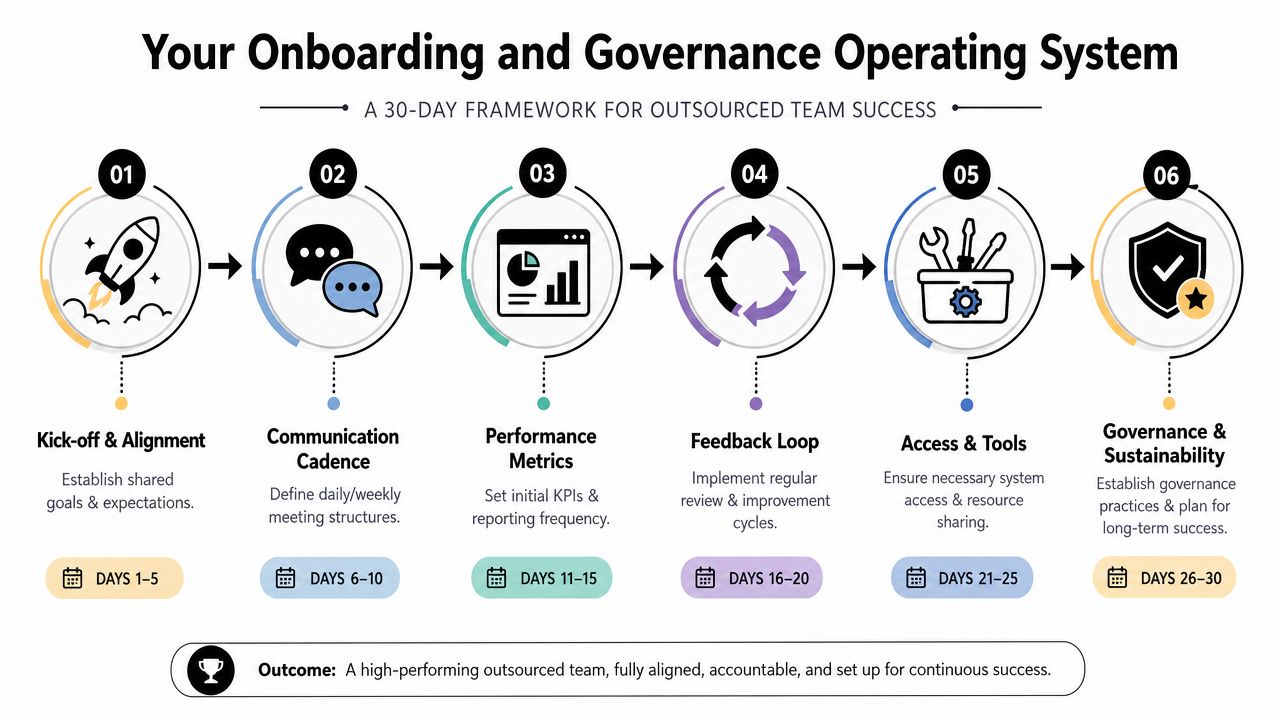
The first 30 days
The goal of onboarding isn't friendliness. It's operational clarity.
Week one
Set up access, environments, documentation, and working agreements. Put the vendor into Jira, Linear, Asana, or whatever your team already uses. Don't let them operate from a separate task universe unless there's a very good reason.
Also define:
- Where decisions are documented
- Who owns backlog priority
- What the escalation path is
- What “blocked” means operationally
Week two
Run architecture reviews, domain walkthroughs, and product context sessions. Here, the PM and tech lead transfer customer understanding, business rules, and risk areas.
A vendor can work around missing code comments. They can't work around missing context.
Weeks three and four
Start the actual delivery rhythm. By this point, the team should be participating in standups, backlog refinement, sprint planning, demos, and retrospectives with the same rigor as internal contributors.
The minimum governance cadence
You don't need a bureaucracy. You need a rhythm.
| Meeting | Purpose | Typical owner |
|---|---|---|
| Daily standup | Surface blockers and dependencies | Engineering lead |
| Weekly delivery review | Track progress, decisions, and risks | PM or delivery manager |
| Sprint demo | Review shipped work against acceptance criteria | Product and design |
| Retrospective | Fix process issues early | Shared |
| Monthly steering review | Handle roadmap, budget, and resourcing decisions | Leadership |
Use whatever tools your organization already trusts. Jira and Linear work well for execution tracking. Confluence, Notion, or Google Docs work for decisions and specs. Slack or Microsoft Teams can handle daily coordination, but important decisions should never live only in chat.
Define done with painful clarity
A common pitfall is that many teams stay too vague. “Done” can't mean “developer says it works.”
A shared definition of done should include:
- Code completed and reviewed
- Tests passed
- Acceptance criteria verified
- Analytics or logging included if required
- Documentation updated
- Release readiness confirmed
If QA sits outside this definition, bugs become political instead of operational.
A one-team culture doesn't come from warm words. It comes from shared rituals, shared tools, and shared accountability.
A simple weekly status report also helps. Keep it short: completed work, upcoming work, risks, blocked decisions, and any changes needing approval. If the report can't be read in a few minutes, it won't get used.
Measuring True ROI and Avoiding Common Pitfalls
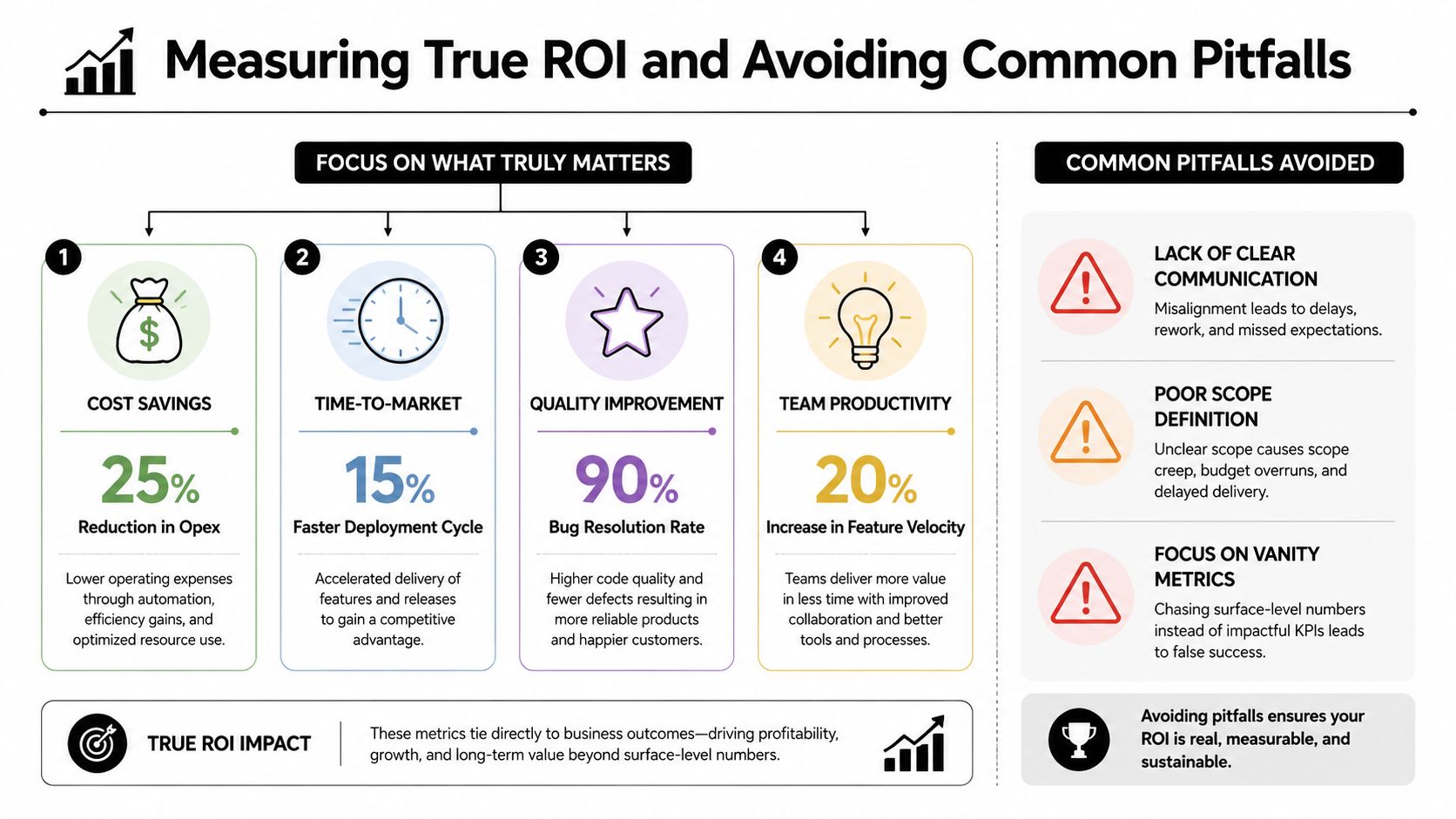
A vendor can ship lots of code and still lower your product velocity. That's why ROI in outsourcing product development needs to be measured beyond utilization, hours logged, or raw output.
A key question is whether the partnership improves your delivery system without degrading quality, clarity, or product control.
What to measure instead of vanity metrics
Skip metrics like lines of code, story points in isolation, or hours consumed. Those are easy to produce and easy to misread.
Look at a balanced set of delivery and business signals:
- Cycle time: Is work moving from approved scope to production faster?
- Rework load: How often does delivered work come back for clarification or fixes?
- Bug-to-feature balance: Is the team creating a healthy release stream or drowning in defect cleanup?
- Predictability: Do sprint commitments and milestone forecasts hold up?
- Business impact: Did the outsourced work unblock launch, improve customer workflows, or reduce internal bottlenecks?
If finance asks for return framing, tie the discussion to speed, opportunity cost, and avoided delay. A simple payback period lens for product investments can help leadership evaluate whether the external spend accelerated value realization enough to justify the model.
The hidden cost problem
This is the part brochures gloss over. Outsourcing isn't automatically cheaper once you include management overhead, communication friction, and rework.
That trade-off matters because the broader market has expanded far beyond pure cost arbitrage. One industry summary estimates the global IT outsourcing market at about USD 651 billion in 2024 and projects about USD 850 billion by 2030, while also noting practical challenges such as communication across time zones, language differences, and iterative change management in this outsourcing product development guide.
The lesson for PMs is simple: calculate total operating cost, not vendor invoice cost.
Five common pitfalls
Treating the vendor like a black box
If you only review outputs at the end, issues surface too late. Bring the partner into demos, decision logs, and backlog conversations.
Outsourcing fuzzy discovery
When the problem is still unstable, external teams can burn cycles on the wrong solution. Keep core discovery close to the internal product trio.
Letting governance become informal
Teams think trust means fewer process controls. Usually it means the opposite. Trust grows when metrics, decisions, and escalation paths are explicit.
Hiring for speed without checking integration
A capable team that can't plug into your tools, release process, and culture will still slow you down.
Measuring cost instead of value
A cheaper monthly invoice can hide slower learning, lower quality, and more PM overhead. Product leaders should care about throughput and impact, not just rates.
The best outsourcing relationships don't feel cheap. They feel clear, fast, and well-governed.
Outsourcing product development is now a mainstream strategic choice. PMs who treat it like a serious product operating model, not a purchasing shortcut, are the ones who get the upside.
If you want more practical PM playbooks like this, explore Aakash Gupta for deep product management guidance on execution, growth, career progression, and the operating habits that separate solid PMs from high-impact product leaders.
