A lot of PMs are in the same trap right now. The roadmap is full. The sprint board looks healthy. Teams are shipping on time, metrics are moving, and leadership still has a nagging reaction that the product feels busy instead of meaningful.
I've seen this in growth teams, platform teams, and AI teams. Nobody is lazy. Nobody is confused about the sprint. The problem sits one level higher. The team has goals, but it doesn't have a usable mission. Or it has a mission on a slide, but the goals have drifted so far from it that the roadmap became a feature factory.
That's why mission vs goal matters more than most PMs realize. If you understand the distinction well, you can prioritize better, argue for resources with more credibility, and connect day-to-day execution to something bigger than quarterly reporting. If you miss it, you'll optimize local metrics while the product slowly loses strategic coherence.
The Cost of Confusion Why Mission and Goals Matter
A common PM failure mode looks good from the outside. The team launches onboarding improvements, a pricing experiment, and a reporting dashboard in the same quarter. Stakeholders are happy because work shipped. The analytics deck is full of movement. Yet when you ask three people on the team what the product is trying to do for customers, you get three different answers.
That's not an execution issue. It's an alignment issue.
When a team confuses mission and goals, two bad outcomes show up fast. First, every metric starts to look equally important. Second, prioritization debates become political because there's no stable decision filter. The loudest stakeholder wins, or the metric that looks best in a board slide wins.
What this looks like in practice
I've seen PMs inherit a mission statement that sounds noble but never affects trade-offs. I've also seen teams with sharp quarterly goals but no shared view of why those goals matter. In both cases, product work gets fragmented.
A strong mission is present-focused and explains why the organization exists, while goals are narrower, measurable targets that move that mission forward, as outlined in this strategic management guidance on vision, mission, and goals.
The real cost of confusion isn't semantic. It's that teams can't tell the difference between meaningful progress and motion.
For PMs, this distinction affects everything from roadmap sequencing to stakeholder management. If your team can't explain how a goal advances the mission, you're not doing strategy. You're doing project management with better vocabulary.
If you want a useful companion framing, Aakash's breakdown of objectives vs goals vs strategies helps sharpen where each layer belongs in product planning.
Mission vs Goal The Product Leader's Cheatsheet
Most explainers stop at dictionary definitions. That's not enough when you're trying to write a roadmap, negotiate scope, or explain why a team should kill a feature that still has an executive sponsor.
Use this mental model instead.
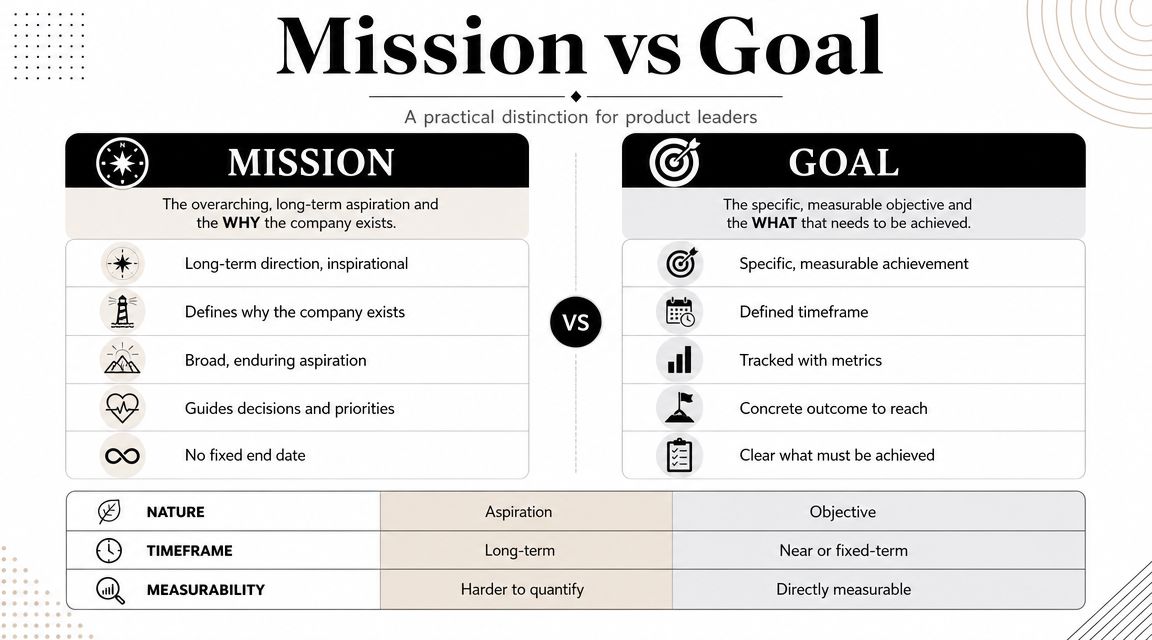
| Dimension | Mission | Goal |
|---|---|---|
| Core role | Explains why the organization exists today | Defines a specific target to pursue |
| Time horizon | Ongoing | Time-bound |
| Scope | Broad and directional | Narrow and operational |
| Measurability | Not a KPI list | Measurable by design |
| Typical owner | Company or product organization | Team, function, or initiative |
| PM use | Prioritization filter | Execution commitment |
The clean boundary
A mission answers: what are we here to do, for whom, and why does it matter right now?
A goal answers: what specific outcome must we achieve within a defined period to make that mission real?
That sounds simple, but teams blur it constantly.
Practical rule: If the statement needs a deadline and a dashboard, it's a goal. If it needs to guide trade-offs across many deadlines, it's closer to a mission.
For example, “become the leading platform for creators” is not a good mission. It's competitive positioning disguised as purpose. It doesn't tell the team what customer problem they exist to solve today. But it could sit underneath strategy as an ambition that informs later goals.
The tests I use with PMs
When I'm coaching a mid-career PM, I use a few blunt tests.
- The replacement test. If you can swap in another market, user, or feature area and the sentence still sounds fine, the mission is too generic.
- The sprint test. If a team can finish the statement within a quarter, it's not a mission.
- The metric test. If the sentence is only meaningful when paired with a chart, it's probably a goal.
A useful companion distinction is Aakash's take on objectives versus outcomes, especially if your team tends to confuse what it plans to do with what it needs to change.
What strong PMs do differently
Strong PMs don't just repeat the mission in kickoff decks. They use it to reject work. That's the difference.
They'll say no to a revenue opportunity that distracts from core customer value. They'll challenge a feature request that improves an isolated metric but weakens the product's central promise. They know that goals are there to operationalize the mission, not replace it.
From North Star to Roadmap The Mission-to-OKR Playbook
Many teams often get stuck. They understand the hierarchy in theory, then fail to convert it into work that an engineering manager, designer, and data scientist can execute against on Monday.
The simplest fix is to use an OKR chain.
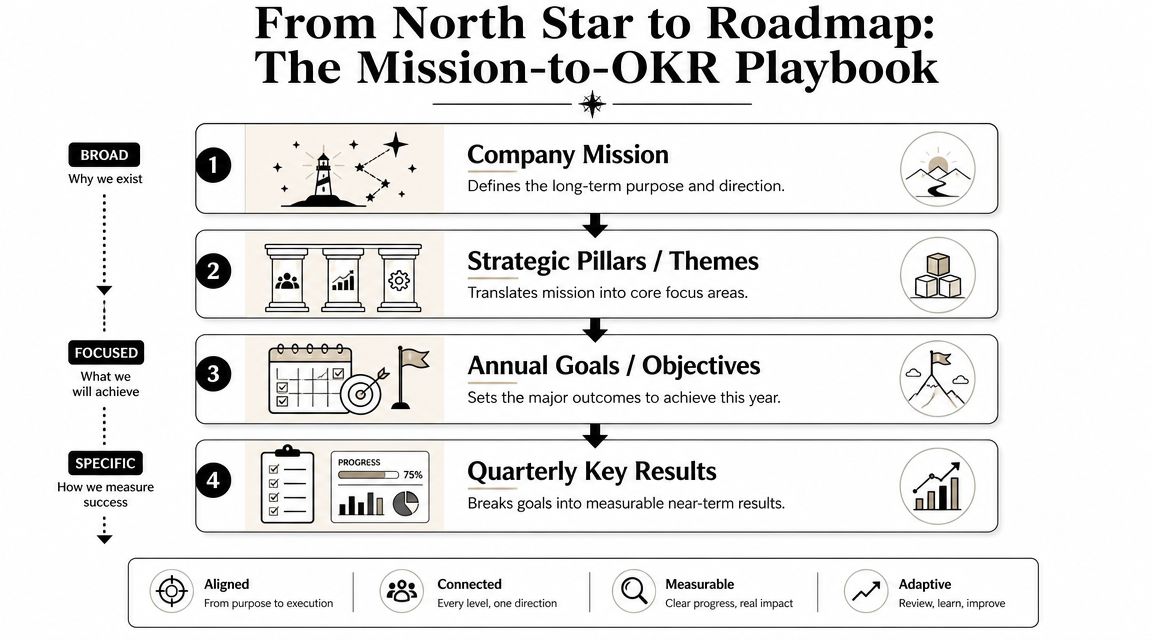
WorkBoard's framing is useful here. It defines mission as what an organization does today and notes that it should anchor objectives, measurable goals, guide resource allocation, and shape weekly work decisions in practice, not just messaging, as described in this mission vs vision article.
Step 1 Pull themes out of the mission
Start by breaking the mission into actionable themes. Most missions contain hidden strategy signals if you read them carefully.
If your product mission is to help small businesses manage cash flow with confidence, the themes might be trust, visibility, and speed of decision-making. If your AI product mission is to make advanced AI useful for everyday work, the themes might be accessibility, reliability, and workflow integration.
Don't jump straight from mission to feature ideas. That's the mistake.
Step 2 Write a small number of objectives
Write one to three objectives that express those themes in a way a cross-functional team can rally around. Keep them directional, not numeric.
Examples:
- Traditional product objective. Improve financial clarity for first-time business owners.
- AI product objective. Increase confidence in AI-assisted drafting for professional use.
- Platform objective. Reduce integration friction for new developer teams.
If you want a sharper lens for this layer, a good PM should understand how objectives connect to a North Star metric without collapsing strategy into a single number.
Step 3 Define key results that prove the objective matters
Now turn each objective into measurable proof, which is why SMART thinking matters. Goals should be specific, measurable, achievable, realistic, and time-bound, so broad purpose turns into execution criteria teams can track, as noted in the earlier strategic management guidance.
For an AI PM, this often means resisting vague language like “make the model better.” Better in what way? Faster response? More grounded output? More task completion? Fewer escalation cases?
If a KR doesn't change team behavior, it's theater.
A practical prompt set I use with teams:
- What user behavior would prove this objective worked?
- What business behavior would prove it mattered?
- What quality threshold would make us trust the result?
- What can we measure this quarter without gaming it?
Step 4 Attach initiatives only after the KRs are clear
Only now should you define roadmap items. Features, experiments, model tuning, onboarding changes, pricing tests, and integrations are initiatives. They are not goals.
For AI teams, this matters even more because the temptation is to ship “AI capability” as if capability itself were the strategy. It isn't. A new summarization feature, agent workflow, or retrieval layer only deserves roadmap space if it plausibly moves a KR that supports an objective tied to the mission.
Later in your career, people will call this strategic judgment. In practice, it's disciplined translation.
For PMs working on company-wide alignment, it also helps to study how visionary leadership turns broad direction into repeated operating choices. That's the bridge between a mission statement and a roadmap.
A useful explainer on the mechanics of OKRs is below.
How Google and OpenAI Connect Mission to Product Goals
You don't need an internal strategy memo from a famous company to learn from how strong product organizations operate. You can reverse-engineer the pattern from the outside.
Google's operating pattern
At Google, the useful lesson isn't the brand or the scale. It's the discipline of translating broad product ambition into measurable operating commitments. Teams don't get credit for saying “organize information” or “help users find answers.” They get credit for moving concrete product outcomes that support a larger mission.
In practical PM terms, that means a search team, workspace team, or infrastructure team can hold different goals while still serving the same higher-order purpose. That's what healthy strategic decomposition looks like. The mission stays stable enough to guide trade-offs. The goals change as the product matures, competition changes, or new technical constraints appear.
OpenAI and the AI PM version of this problem
OpenAI is useful because AI products make the mission-versus-goal confusion worse. In AI organizations, teams often blur mission, research aspiration, safety principle, and product goal into one messy narrative.
A mission in an AI context should still answer a present-tense question: what are we trying to make possible for users today? Then product goals can target concrete outcomes such as improving trust, reducing failure in critical workflows, or increasing useful adoption in a defined segment.
AI PMs get into trouble when they confuse model capability with user value. The model can improve and the product can still miss the mission.
That's the modern version of feature factory thinking. Instead of shipping random features, AI teams ship random capabilities.
What to copy and what not to copy
Copy the decomposition logic. Don't copy the theater.
Good product organizations connect mission to product goals through repeated choices:
- They define a stable reason to exist.
- They let teams own measurable outcomes.
- They force initiatives to justify themselves against those outcomes.
What they don't do is stuff the mission statement full of metrics, or let every quarterly goal pretend to be the company's purpose. That distinction is what keeps large organizations coherent as they scale.
Three Mission Goal Mistakes Sinking Product Teams
Many teams don't fail because they've never heard the terms. They fail because they apply them sloppily.
The boundary matters. Iowa State's strategic planning guidance makes a subtle but important point: mission is the organization's what, why, and how today, while goals are the specific outcomes used to implement strategy, and confusion increases because goals and objectives are often used interchangeably in practice, as noted in this planning resource.
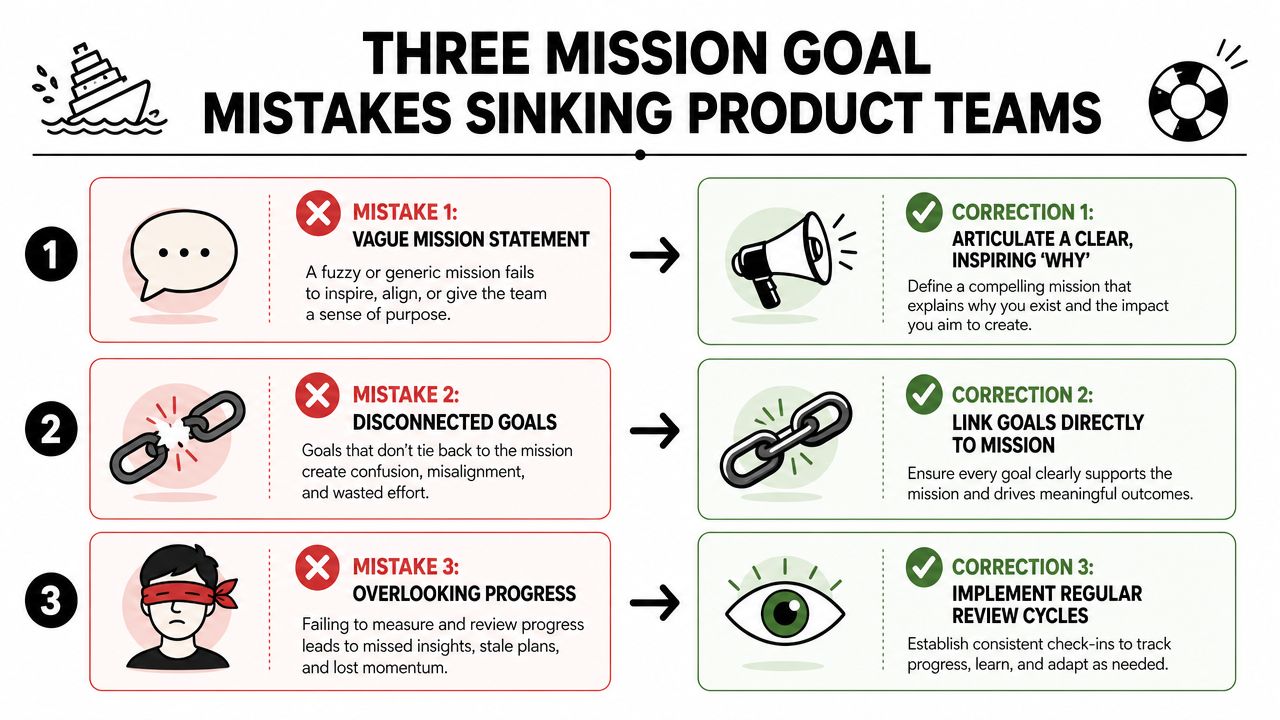
Mistake 1 Chasing vanity metrics
This is the classic growth-team trap. A PM chooses a number that looks impressive in a dashboard review, then builds the roadmap around it even though it has weak connection to customer value.
Symptoms show up quickly:
- Planning drift. Teams prioritize launch volume over product usefulness.
- Review theater. Stakeholders celebrate movement without asking what changed for the user.
- Roadmap inflation. Every initiative gets justified by the same broad metric.
Correction: ask a harsher question in planning. If this metric improves, what customer problem gets solved better? If nobody can answer, the goal is ornamental.
Mistake 2 Turning the mission into a KPI
This usually comes from good intentions. Leadership wants everyone aligned, so they convert an inspirational statement into something teams are supposed to “hit.”
You can't run a product organization on slogans pretending to be measurable goals. “Enable creators,” “connect professionals,” or “make AI work for everyone” can guide strategy. They can't tell an engineering team what success looks like this quarter.
Correction: keep the mission as a decision lens, then build goals underneath it that can be reviewed.
Mistake 3 Setting orphaned goals
This is the quietest failure mode and one of the most dangerous. The team writes a perfectly respectable SMART goal. It's measurable. It's time-bound. It may even get delivered. But it has no logical thread back to the company's purpose.
I've seen PMs do this when they inherit adjacent responsibilities and start optimizing a local process that isn't strategically important. The work is competent, but it doesn't matter enough.
For a sharp diagnostic on broader PM failure modes, Aakash's list of deadly sins PMs should avoid is worth reading alongside this issue.
Good goals without mission alignment create efficient irrelevance.
The fix is simple but not easy. In every quarterly review, force each major goal to answer one sentence: how does this move our mission forward for a real customer?
A Checklist for Aligning Your Team Around Your Mission
Use this in your next staff meeting, roadmap review, or one-on-one with an engineering manager. If a team can't answer most of these cleanly, alignment is weaker than it looks.
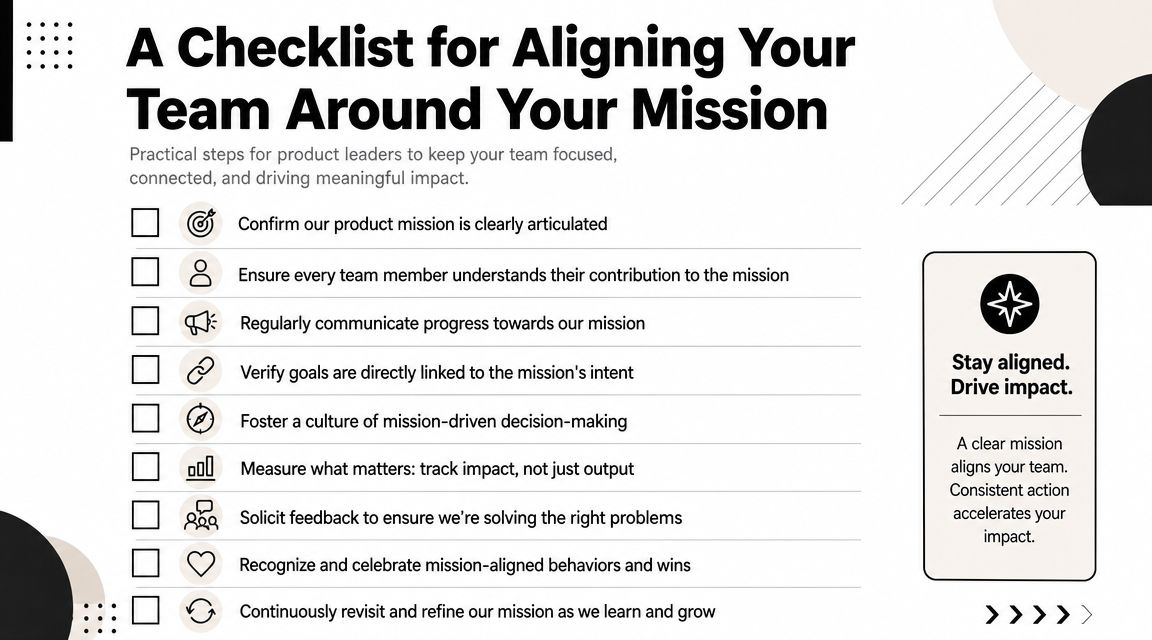
The audit questions
- Can every person on the team explain the customer problem our current goals are solving?
- Would design, engineering, data, and GTM describe the mission in roughly the same way?
- Can we trace each major initiative to a goal, and each goal to the mission?
- Do we use the mission as a tie-breaker when priorities conflict?
- Have we accidentally promoted a metric into a strategy?
- Are our goals written so progress is reviewable within a clear timeframe?
- Do AI-related initiatives have user-value hypotheses, not just model-improvement claims?
What to do if the answers are weak
Don't start with a rewrite workshop. Start with live decisions.
Pick one active roadmap item and ask the team to map it upward: initiative to goal, goal to objective, objective to mission. If that chain breaks, you've found your problem faster than any offsite will.
A structured stakeholder template also helps here. If you need one, Aakash's stakeholder communication plan template is a practical way to make sure every audience hears the same strategic story.
If you want a lightweight operating rhythm, review this checklist monthly and before each roadmap reset. Teams rarely drift in one dramatic moment. They drift through small unchecked assumptions.
Using Mission and Goals to Advance Your PM Career
This skill is one of the clearest separators between an execution PM and a senior product leader.
Junior PMs usually describe their work in terms of output. They shipped a feature, launched an experiment, or coordinated a release. Senior PMs describe the chain from mission to outcome. They explain why the work mattered, which goal it served, and how it advanced the product's purpose.
That difference changes how leaders evaluate you. A PM who says, “I launched a new onboarding flow” sounds competent. A PM who says, “I focused the team on onboarding because our mission required faster time to value for new users, then aligned design and engineering around a clear adoption goal” sounds promotable.
How to talk about your work
In performance reviews and interviews, use a simple structure:
- Start with the mission context. What customer or business purpose mattered?
- Name the goal clearly. What specific outcome did your team pursue?
- Explain your judgment. What trade-offs did you make?
- Close with the learning. What did you change because of the result?
For aspiring PMs, this framing shows strategic maturity even if your title is small. For mid-career PMs, it helps you look like someone who can lead a group, not just a backlog. For senior PMs and AI PMs, it proves you can turn broad ambition into operating discipline, which is exactly what leadership teams need.
Why this compounds
People trust PMs who can connect the abstract and the concrete. They become the ones invited into planning conversations earlier. They get broader scopes. They're given ambiguous product areas because leadership believes they can create clarity.
That's the upside of mastering mission vs goal. You won't just write better docs. You'll operate at a higher level.
If you want more practical PM frameworks like this, browse Aakash Gupta for product strategy, growth, hiring, and execution resources built for PMs who want to move from shipping work to driving real business impact.
