A VP asks for a major feature on Monday. Design starts mocking it up by Tuesday. Engineering wants a decision by Thursday so they can protect the sprint. Sales says three prospects asked for it. Nobody can show whether the problem is real, whether the proposed solution is the right one, or whether the request came from the loudest customer in the room.
That's where most PMs misuse user research methodologies. They treat research like a ritual you do when there's extra time, a UX team artifact, or a post-hoc justification deck. In a healthy product org, research is none of those things. It's how you prevent the company from spending months building the wrong thing.
The job isn't to “do research.” The job is to reduce uncertainty fast enough to make a better product decision than politics alone would produce. Sometimes that means three interviews before backlog grooming. Sometimes it means a usability test on a prototype before you commit engineers. Sometimes it means a survey, analytics review, or an experiment because the question is no longer why users struggle but whether a change improves behavior.
The strongest PMs I've worked with were not the ones who knew the most methods by name. They were the ones who could say, calmly and quickly, “This is an explore problem, not an optimize problem,” or “We don't need a giant study, we need five days and the right users.”
Your Guide to User Research Methodologies
Tuesday afternoon, the roadmap is already under pressure. Sales wants a promise for next quarter. Design has a polished prototype. Engineering wants to know whether this is real demand or another expensive detour. In that moment, user research methodologies are not a theory topic. They are a decision tool.
PMs who use research well do one thing consistently. They match the method to the decision, the risk, and the clock. The question is rarely, “Should we do research?” The question is, “What is the fastest credible way to reduce uncertainty enough to act?”
User research became a serious product discipline when teams stopped treating design review as expert opinion and started watching real users attempt real tasks. That shift still matters. Good teams do not collect insights for a slide deck. They use research to choose what to build, what to cut, and what needs proof before more engineers get pulled in.
Practical rule: If the team cannot name the decision the research will inform, do not start the study.
I've seen strong PMs treat methods as instruments, not identities. Interviews help explain behavior. Usability tests expose friction in a flow. Surveys can size a pattern if you already know what you are measuring. Product analytics show where behavior changes, but not always why. AI now speeds up recruiting, transcription, synthesis, and pattern detection, which changes the cost curve, but it does not remove the need for judgment.
That is the playbook. Choose the lightest method that can answer the question with enough confidence to move a product decision. If you need a sharper starting point for discovery work, this guide to product discovery techniques for PMs is a useful companion.
In real product orgs, research breaks down in predictable ways:
- It starts after the decision is effectively made. The team is looking for cover, not learning.
- It uses the wrong method for the job. A survey gets asked to uncover unmet needs. A few interviews get stretched into a claim about market size.
- It ends with interesting observations but no operating change. Nobody updates scope, priority, success metrics, or launch criteria.
Good research holds up under pressure. It is tied to a decision, sized to the stakes, and honest about trade-offs in time, sample quality, and confidence. That standard matters a lot more than whether the team can recite a textbook list of methods.
The PMs Research Decision Framework
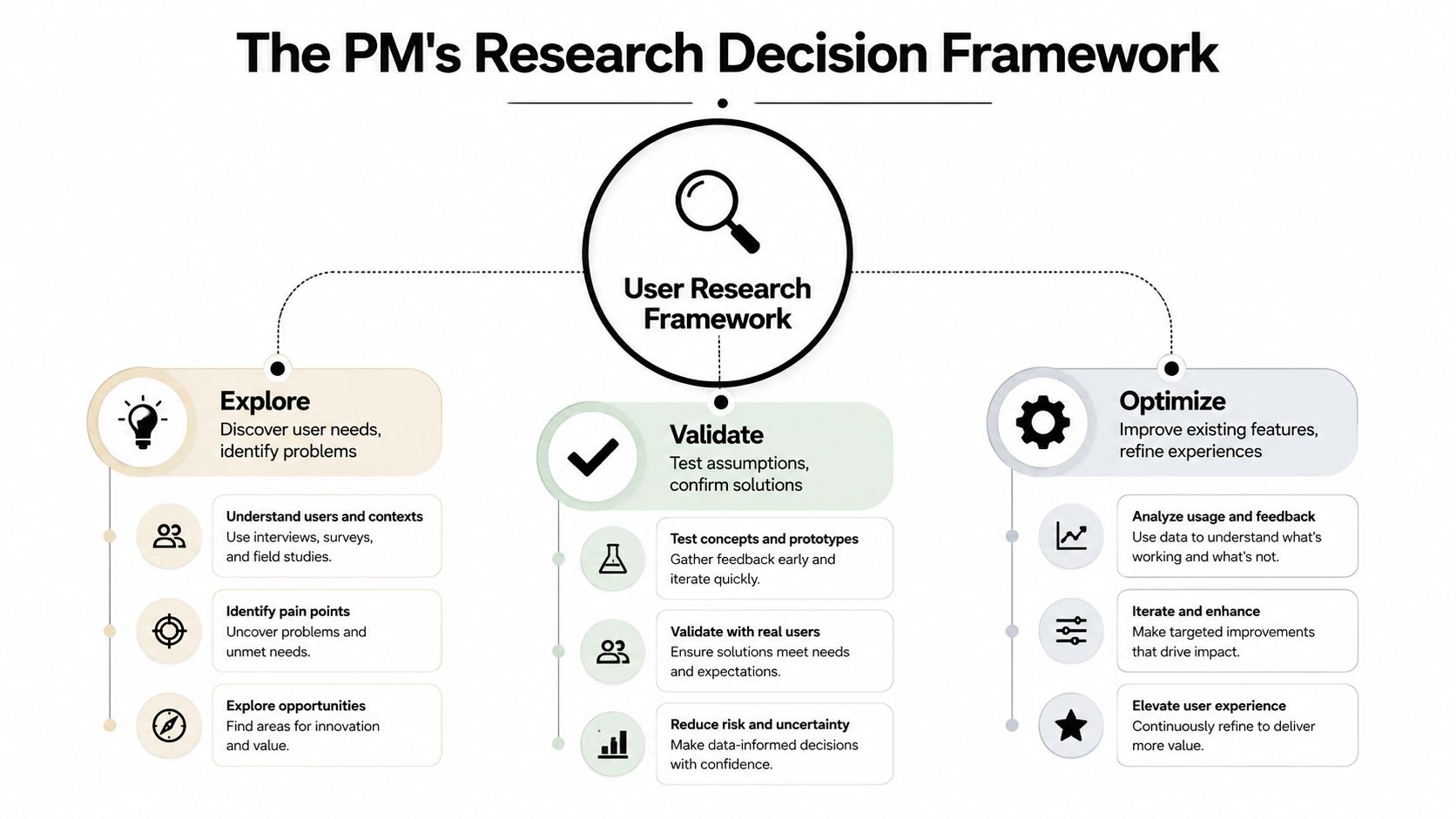
Most PM teams don't need more methods. They need a better way to choose one. The cleanest model I know is Explore, Validate, Optimize.
Explore
Use Explore when the problem space is still fuzzy. You're trying to understand unmet needs, workflows, pain points, or why a segment behaves the way it does. For this, interviews, diary studies, field studies, and open-ended observation earn their keep.
Typical PM questions:
- What problem should we solve next?
- Where does the current workflow break down?
- What are users trying to accomplish before they ever touch our product?
If you skip this phase, teams often build polished solutions to shallow problem statements.
Validate
Use Validate when you already have a product hypothesis. You think you know what to build, but you need evidence before scaling commitment. At this stage, prototypes, concept tests, and usability testing matter most.
A PM in validation mode is asking:
- Does this concept solve the problem we think it does?
- Can users understand and use this flow?
- Are we reducing risk before engineering spends real time?
This is the phase where a lot of roadmap waste can be prevented. Not by perfect certainty, but by killing weak ideas early.
Optimize
Use Optimize when the core experience exists and the question is performance. You're no longer asking what problem matters. You're asking where friction remains and which change improves the metric that matters.
That usually points to analytics, surveys, and experiments.
Mixed-method research is strongest when qualitative methods explain the why behind behavior and quantitative methods measure the scale of those patterns, connecting motivation with behavioral evidence and reducing the risk of optimizing for anecdotes alone, as outlined in Outset's guide to user research methods and best practices.
The operating rule
Here's the mistake I see constantly. PMs jump from Explore straight to Optimize. They identify a problem in interviews, then rush to metric movement without testing whether the proposed solution makes sense.
A better default is simple:
| Product question | Stage | Primary method | Secondary method |
|---|---|---|---|
| “What's really broken?” | Explore | Interviews | Field observation or analytics review |
| “Will this concept work?” | Validate | Usability testing | Follow-up interviews |
| “Which version performs better?” | Optimize | A/B testing | Survey or session review |
If your team needs a broader discovery workflow around these decisions, Aakash Gupta's piece on product discovery techniques for PMs is useful as an adjacent operating model.
Qualitative Methods Deep Dive The Art of Why
Qualitative work is where PMs learn to stop confusing feature requests with user needs. People rarely hand you the underlying problem in the first sentence. You have to get underneath the first answer.

User interviews that don't produce fluff
A bad PM interview sounds like a demo wrapped in polite questions. A good one sounds like investigative work.
A practical interview script has four parts:
- Warm-up and context
Ask about their role, workflow, team, and recent behavior. Get them talking about what already happened, not what they imagine they might do. - Recent specific example
“Tell me about the last time you tried to do this.” Specific stories beat opinions every time. - Pain and workaround
Find where effort, delay, confusion, or manual work shows up. - Current alternatives and trade-offs
If they're not using your product, what are they using instead? Spreadsheets count. Slack threads count. Human labor counts.
Questions that usually work:
- Walk me through the last time this happened.
- What made that frustrating?
- What did you do next?
- How are you handling it today?
- What's the hardest part of that process?
Questions that usually fail:
- Would you use a feature that does X?
- How valuable would this be?
- Do you like this idea?
Those invite politeness and speculation.
Ask for past behavior, not future intent. Users are much better witnesses than forecasters.
For a more detailed execution workflow, this guide on how to conduct user interviews is a practical companion.
Usability testing for real sprint decisions
If interviews uncover the problem, usability testing tells you whether the solution is understandable. This is the most underused fast-feedback tool in many PM orgs.
Say you're testing a new SaaS onboarding flow. Don't ask users whether they like it. Give them a realistic task:
- Create an account
- Connect the first data source
- Invite a teammate
- Complete the setup milestone
Then watch where they hesitate, misinterpret language, ignore key UI elements, or take the wrong path.
Here's the lean test plan I'd use:
| Step | What to do |
|---|---|
| Define goal | Name the one workflow you're evaluating |
| Pick participants | Recruit users who resemble the target segment |
| Write task prompts | Describe outcomes, not UI instructions |
| Facilitate neutrally | Don't rescue too early |
| Debrief immediately | Capture friction before memory smooths it out |
The most important facilitation skill is restraint. Don't explain the design. Don't translate labels. Don't hint at the “right” click. If the user is confused, that confusion is data.
A lot of PMs still hesitate because they think a small sample won't matter. That's usually wrong for early usability work. NielsenIQ states that there is a good probability of detecting problems affecting 30% or more of a user population by testing only seven users, which is why small moderated studies are such a practical starting point for product teams, according to NielsenIQ's analysis of meaningful sample sizes in user research.
That principle changes how fast a team can move. You don't need a giant panel to find obvious friction.
A quick explainer helps if your team is still new to this practice:
Common PM mistakes in qualitative work
- Leading the witness
If you frame the problem too tightly, users will validate your framing. - Talking more than the participant
PMs often fill silence because they're uncomfortable. Don't. - Over-indexing on quotes
A memorable quote is not a strategy. Look for repeated patterns. - Skipping synthesis
Tag observations by theme, severity, and affected workflow. Otherwise the research dies in a notes doc.
Quantitative Methods Deep Dive The Science of What
Qualitative methods tell you why people struggle. Quantitative methods tell you whether the pattern is broad enough to shape strategy, whether the change improved behavior, and whether your intuition survives contact with actual usage.
Surveys that PMs can trust
A survey is not a dumping ground for every stakeholder question. It's a measurement instrument. If you're sloppy with wording, the output will look crisp and still be useless.
Use surveys when you need breadth. Don't use them when the team still doesn't understand the problem language, the user's workflow, or the root cause.
A simple rule:
| If you need to know… | Better method |
|---|---|
| Why users behave a certain way | Interview |
| Whether a behavior or attitude appears broadly | Survey |
| What users actually do in product | Analytics |
| Which change performs better | Experiment |
Poor survey question:
- How much do you love the new onboarding experience?
Better survey question:
- How easy or difficult was it to complete onboarding?
Poor survey question:
- Would you pay for advanced automation features?
Better survey question:
- Which of these workflow problems takes the most effort today?
The first version in each pair smuggles in bias. The second gives users room to respond honestly.
A/B testing that isn't cargo cult
PMs love A/B testing because it feels objective. But bad experiments produce false confidence fast.
Start with a real hypothesis. Not “let's test a new button.” More like: if the current button copy creates uncertainty, then changing the copy to emphasize immediacy should reduce hesitation during checkout.
Then decide what success means before the test starts. If you don't, someone will cherry-pick the chart they like afterward.
For an e-commerce example, say you're testing purchase CTA copy. You should care about more than just whether more users click the button. Look for downstream quality too:
- Did users continue through checkout?
- Did support contacts rise because the new copy misled people?
- Did behavior change differently across new versus returning users?
That kind of segmented read is where PM judgment matters. A statistically clean result can still be strategically messy if it harms trust or shifts the wrong user behavior.

What strong communication looks like
When you bring quantitative findings to stakeholders, don't show a dashboard first. Start with the decision.
Use this order:
- State the business question
- State the hypothesis
- Summarize the observed behavior
- Call the decision
- Name the remaining uncertainty
The metric moved. That doesn't automatically mean the product got better. Ask whether the behavior reflects user value or just easier clicking.
If your team needs stronger instrumentation around retention and segmented behavior before running experiments, this primer on cohort analysis for product teams is worth reviewing.
Where PMs get quantitative work wrong
- They survey before learning the language of the problem
- They test too many things at once and learn nothing
- They confuse correlation with explanation
- They report outcomes without a recommendation
Numbers don't remove PM judgment. They sharpen it.
Choosing Your Method A Practical Decision Tree
Monday morning. The dashboard says activation dropped. Design wants five usability tests. Engineering wants better event tracking. The GM wants a survey by Friday. A good PM does not ask, “What research should we do?” A good PM asks, “What decision do we need to make, and what is the fastest credible way to reduce the risk?”
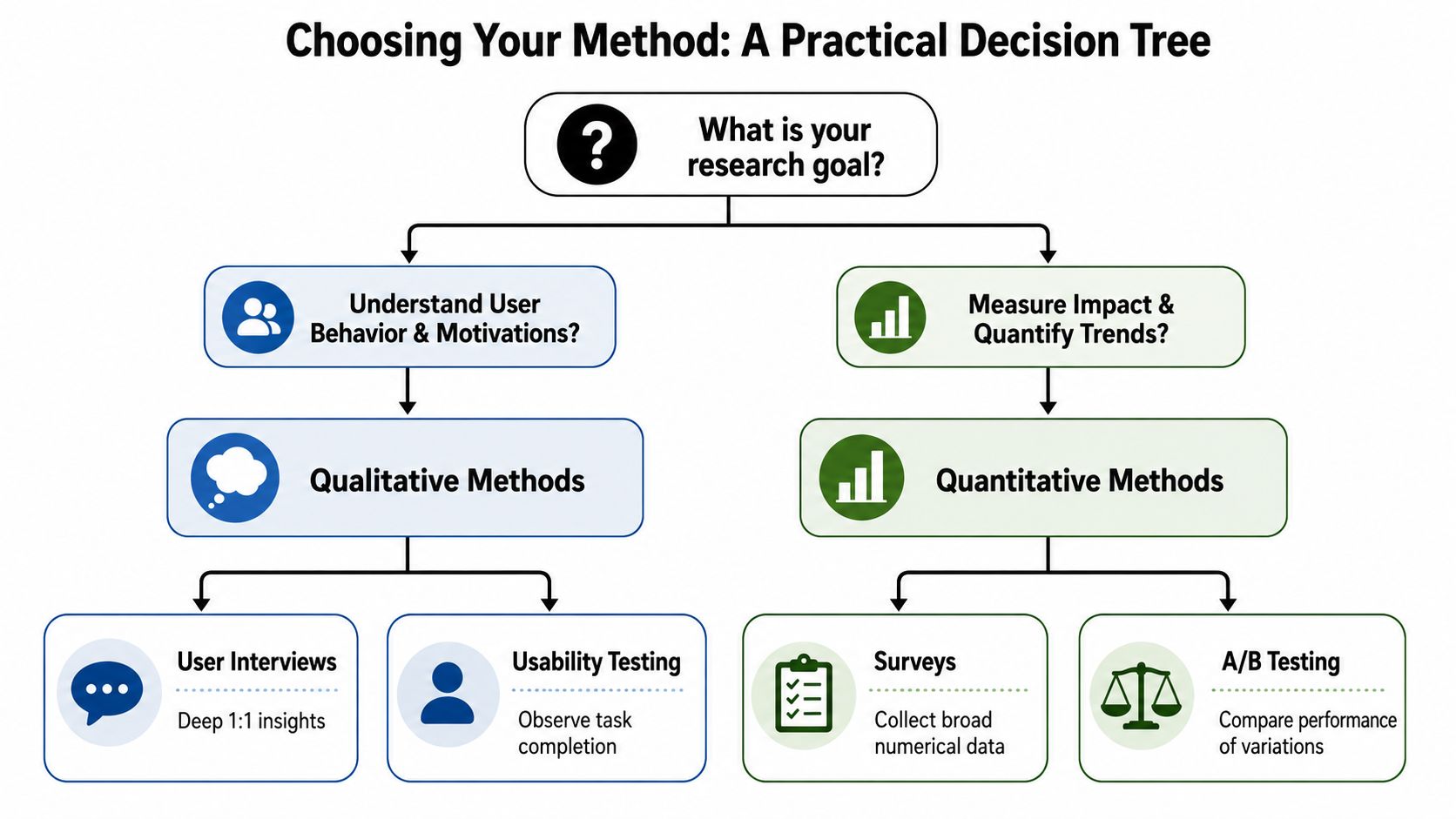
The practical mistake I see in product teams is choosing a method based on familiarity. Researchers ask for interviews. Growth teams ask for experiments. Executives ask for a survey because it feels broad and fast. Method choice should follow the decision, the risk, and the constraint. As noted earlier, established UX research frameworks are useful because they treat research as a portfolio. Different methods answer different questions at different stages.
The decision tree I'd use in a planning meeting
Start with the decision under review, not the method.
| Your real question | Primary method | Pair it with |
|---|---|---|
| We don't understand the user problem | User interviews | Analytics review |
| We have a concept and need feedback | Usability testing | Follow-up interview |
| We need to compare alternatives | A/B testing | Session review or short survey |
| We need broad sentiment or prevalence | Survey | Earlier qualitative work |
| We see a metric issue but don't know why | Analytics | Interviews or usability testing |
That table looks simple. In practice, it saves weeks.
If the team is debating whether to build, ship, or roll back, use three filters:
- Question type: Are you diagnosing a problem, evaluating a solution, or measuring impact?
- Speed needed: Do you need directional input this sprint, or confidence for a larger bet?
- Cost of being wrong: Is the risk a minor UX annoyance, or a launch that burns a quarter of engineering time?
Those filters help you push back with precision. Say, “This is a solution-risk question. Five prototype tests will answer it faster than a survey.” Or, “This is an instrumentation problem first. We cannot explain a funnel drop with opinions.”
Method pairing beats method purity
Strong PMs rarely use one method in isolation. They sequence methods to move from signal to decision.
For example:
- Problem unclear
Run interviews first. Then review product analytics to see whether the behavior shows up at scale. - Prototype looks promising
Use usability testing to catch failure points. Then send a short post-task survey if confidence or clarity matters to the launch call. - Experiment result is messy
Review sessions or run follow-up interviews to explain why users behaved differently than expected.
This is how product teams move faster without kidding themselves. Qualitative work gives you language, motivation, and failure modes. Quantitative work tells you whether the pattern is isolated or widespread. Together, they give you enough confidence to act.
One more rule from hard experience. Under stakeholder pressure, default to the cheapest method that can credibly answer the question. Not the cheapest method overall. A fast survey is cheap and often useless if users do not share the same vocabulary yet. Five good interviews are cheaper than building the wrong thing.
If your team is trying to fold AI into this process without lowering the bar on judgment, this guide on AI for product managers is a useful companion.
The Rise of AI in User Research
AI hasn't replaced product judgment. It has compressed the boring parts of research and raised the bar on speed.
The biggest shift is in synthesis. PMs used to leave interviews in a pile of notes because turning conversations into patterns took too long. Now tools like Dovetail, UserTesting's AI features, Grain, Notably, and general-purpose models can help cluster themes, summarize transcripts, draft insight memos, and surface contradictory evidence much faster.
That changes the pace of work, but it also creates a new failure mode. Teams can now generate polished summaries without understanding the users. AI can accelerate synthesis. It can't own the interpretation.
Where AI helps most
The strongest use cases I'm seeing are operational:
- Transcript synthesis
Feed interview transcripts into a model and ask for recurring pain points, workflow stages, objections, and evidence snippets. - Survey drafting
Use AI to generate neutral question variants, then review them manually for bias and clarity. - Tagging and clustering
Let AI propose themes across notes, then have a PM or researcher validate the taxonomy. - Research repository search
Ask natural-language questions across prior interviews, usability sessions, and feedback logs.
A practical internal workflow might look like this:
| Task | Human role | AI role |
|---|---|---|
| Plan study | Define decision and risks | Draft interview guide options |
| Run sessions | Facilitate and probe | Transcribe and summarize |
| Synthesize | Judge patterns and severity | Cluster themes, extract evidence |
| Share findings | Recommend action | Draft memo structure |
Prompts PMs can use immediately
Use prompts that force evidence, not vibes.
Examples:
Analyze these interview transcripts. Identify the main pain points by workflow stage. For each pain point, provide supporting excerpts, note any conflicting evidence, and separate observed behavior from stated preference.
Review this prototype test transcript. List every moment of hesitation, confusion, or incorrect action. Group them by severity and suggest which issues are wording problems versus flow problems.
Draft a short survey to measure the prevalence of the themes found in these interviews. Avoid leading language and keep each question tied to one idea.
One useful resource for PMs building these habits is Aakash Gupta's broader work on AI for product managers, which covers how PMs can fold AI into day-to-day execution.
The non-obvious risk
AI makes weak teams look organized. That's dangerous.
If you upload junk inputs, you'll get polished junk outputs. If you conduct leading interviews, AI will summarize your bias beautifully. If you haven't clarified the decision, the model will give you a tidy document that still doesn't help the team choose.
The PM who wins with AI in research isn't the one who automates the most. It's the one who keeps the chain of reasoning clean.
From Insights to Influence Advancing Your PM Career
Research skill is one of the clearest lines between a PM who manages tickets and a PM who shapes strategy.
Junior PMs often report what stakeholders want. Senior PMs can challenge the request, reframe the problem, and produce evidence that changes the roadmap. That's promotion-grade behavior because it reduces wasted effort and improves decision quality.
When you talk about this work in interviews or performance reviews, don't say, “I ran user research.” Say what decision changed.
Better language:
- I identified the core workflow breakdown through interviews and changed prioritization.
- I used usability testing to invalidate the original onboarding concept before engineering committed to it.
- I paired behavioral data with user feedback to explain a conversion issue and align design and engineering on a fix.
That framing matters with executives too. Leaders don't reward research theater. They reward risk reduction, sharper prioritization, and clearer strategic choices. If that's an area you want to improve, this guide on how to present to executives is directly relevant.
Good PMs bring answers. Great PMs bring evidence that changes what the company does next.
If you want to move up, get known for three things: asking sharper questions, choosing the right method under pressure, and translating insight into action. That combination is rare. It's also what makes you far more valuable than someone who just keeps the backlog moving.
If you want more practical PM systems like this, explore Aakash Gupta for deep dives on product thinking, user research, AI workflows, and career growth.
