A PM gets pulled into this scenario constantly. The CEO sees a competitor launch an AI copilot. Sales says customers are asking about it. Engineering says they can spin up a version quickly. The roadmap gets rearranged before anyone answers the only question that matters.
Should this exist for your users, in your product, right now?
That's what product validation is for. Not paperwork. Not a ritual before kickoff. It's the discipline that keeps teams from burning quarters on momentum theater.
The PMs who rise fastest at companies like Meta, Google, and OpenAI-adjacent startups usually share one trait. They can reduce uncertainty before the org commits real resources. They don't just ship. They help the company avoid shipping the wrong thing.
If you're working through feature pressure, founder pressure, or AI hype pressure, validation is the skill that protects your team and sharpens your judgment. It's also one of the clearest ways to stand out in your career. A PM who consistently says “yes” to good bets and “no” to bad ones becomes trusted very quickly.
The Billion Dollar Question Every PM Must Answer
A competitor demo can wreck a roadmap in a single afternoon.
I've seen this play out in large tech companies and growth-stage startups alike. Leadership watches a polished launch video. Suddenly the room shifts from strategy to imitation. Nobody wants to be the PM who appears slow, skeptical, or “not customer-centric.” So teams rush into delivery mode.
That's usually when strong PMs separate themselves from feature factories.
At Google or Meta, nobody gets credit for building a trendy capability that users ignore. You get credit for making a sound bet, aligning the org, and producing evidence that the investment is worth making. That means your real job isn't to greenlight ideas. It's to de-risk them.
Product validation is how you answer the billion dollar question: should we build this?
Here's the trap. Many teams treat validation like a lightweight survey, a few customer calls, or executive intuition dressed up as research. That's not validation. That's a search for agreement. Real validation tries to disprove the idea before the company spends heavily.
Practical rule: If your test can only confirm the idea, but can't kill it, you're not validating. You're campaigning.
A PM facing an AI feature request needs to know several things fast:
- Problem reality: Is this a real pain point, or just executive fear of missing out?
- User behavior: Will customers change workflow, or will they praise the concept and ignore the feature?
- Business fit: Does this improve the product's core value, or just create complexity?
- Timing: Is now the right moment, or are you too early for the market and your own team?
If you need a clean way to pressure-test whether demand is real, these product market fit questions are a good lens. They force you to move beyond “customers asked for it” and toward “customers will change behavior because of it.”
PM careers often hinge on moments like this. The junior PM rushes to spec. The senior PM asks what has to be true for the bet to work, then designs the fastest way to test it.
Product Validation Defined The Right Way
Most PMs mix up verification and validation.
Verification asks, can we build it?
Validation asks, should we build it?
Engineering usually leads verification. Product has to lead validation.

What product validation actually means
A formal definition is useful here because it cuts through startup slang. Product validation is formally defined as the process of confirming that an end product meets stakeholder expectations and intended use, with NASA describing it as a lifecycle step requiring preparation, conduct, analysis, reporting, and capturing work products in NASA's product validation reference.
That matters because it makes one thing obvious. Validation isn't vibes. It's a structured evidence process.
In PM terms, what is product validation? It's the work of proving, with evidence, that a product or feature will perform as intended for the target user in the actual environment where it will be used. Not in a strategy deck. Not in a workshop. Not in a polished prototype review.
Why most PM teams get this wrong
Teams usually fail in one of two ways:
- They validate too late: They build most of the feature, then ask users if they like it.
- They validate the wrong thing: They test whether users understand the demo, not whether they'll adopt the behavior.
At a company like Google, a PM proposing a new workflow has to do more than show technical feasibility. They need evidence that the workflow removes friction, fits user intent, and earns repeated use. At Meta, the standard is similar. A feature that's technically elegant but behaviorally weak is still a miss.
A practical way to think about it is this:
| Question | What it means | Owner |
|---|---|---|
| Can we build it? | Technical feasibility, architecture, dependencies | Engineering |
| Will it work reliably? | Performance, quality, correctness | Engineering + Design + QA |
| Should we build it? | User value, demand, adoption, trust, business impact | Product |
If you've ever used a Lean Canvas for product ideas, you've already touched validation. The difference is that a canvas captures assumptions. Validation tests them.
Good PMs don't confuse articulated demand with proven demand.
The right operating mindset
Treat validation like applied science. Start with uncertainty. Define what would need to be true. Gather evidence. Make a decision. Then keep monitoring after launch because validation doesn't stop the day a feature ships.
That's one reason experienced PMs get promoted faster. They don't just create plans. They create confidence.
The PMs Validation Toolkit Methods and Metrics
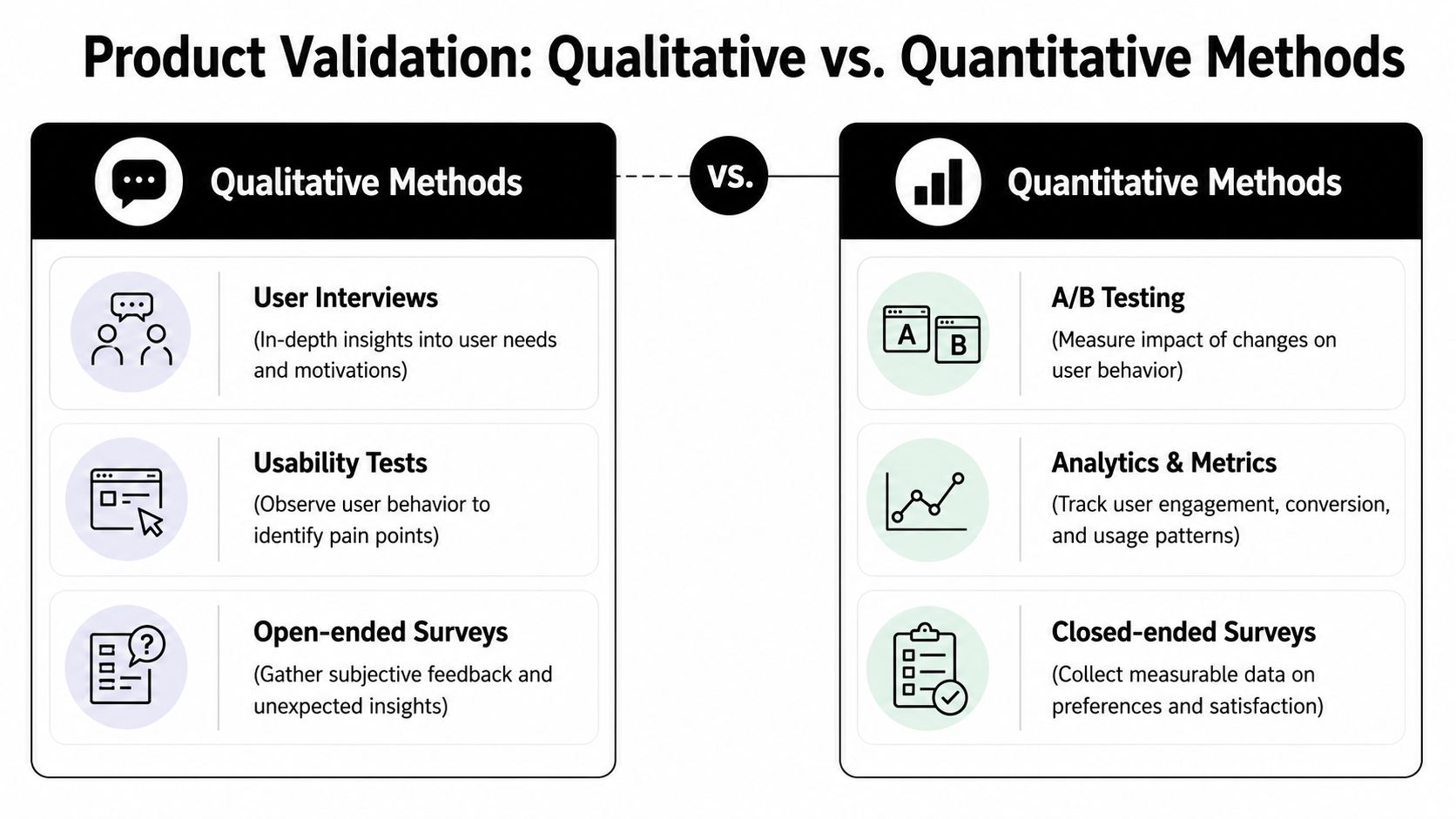
Once you understand what product validation is, you need a field kit. In practice, I split the toolkit into two buckets. Qualitative methods help you understand why. Quantitative methods help you understand whether a pattern is real.
Both matter. If you use only interviews, you'll over-index on anecdotes. If you use only dashboards, you'll miss motivation and context.
Qualitative methods when you need depth
Use qualitative work early, especially when the problem space is still fuzzy.
- Customer interviews: Best for understanding pain, current workarounds, urgency, and language. In B2B, I want users to walk me through the last time the problem happened. If they can't, the pain often isn't real.
- Usability tests: Best for exposing confusion, broken mental models, and false assumptions in prototypes. Figma is enough for many early workflows.
- Wizard of Oz tests: Best when you want to simulate an AI or automation workflow before building the underlying system. The user thinks the system is doing the work. A human does it behind the scenes.
- Open-ended surveys: Useful when you want broader input but still want to surface unexpected themes.
What do you look for in qualitative validation?
- Behavioral specificity: Can users describe the problem in detail?
- Existing workaround: Are they already hacking together a solution?
- Emotional weight: Do they sound inconvenienced, blocked, or indifferent?
- Workflow fit: Does your proposed solution match how they already operate?
Quantitative methods when you need proof
Quantitative validation becomes more important once you have a clear hypothesis.
A major milestone in modern validation is the use of statistical methods in experimentation. A/B testing commonly relies on statistical significance using a p-value against a chosen significance level, with t-tests and chi-square tests often used to compare control and treatment groups, as described in Statsig's guide to statistics in product analytics.
That matters because PMs routinely mistake random noise for product insight.
A result that looks promising isn't enough. You need enough rigor to tell whether you found signal or just got lucky.
Use quantitative methods like these:
- Landing page tests: Good for measuring interest in a problem or proposition before building.
- A/B tests: Good when you already have traffic and want to compare user behavior across variants.
- Product analytics: Good for measuring activation, engagement, completion, and drop-off in live or pilot workflows.
- Closed-ended surveys: Good for structured segmentation or preference testing, but weaker than behavioral data.
If you want a clean list of what to track, this guide on metrics for product managers is useful.
Which method fits which question
| Question you need answered | Best method |
|---|---|
| Do users actually have this problem? | Interviews |
| Can users complete the workflow? | Usability test |
| Will they try the concept? | Landing page or fake door |
| Does version A outperform version B? | A/B test |
| Does the AI reduce real friction? | Behavioral telemetry in pilot |
The mistake I see most often is choosing methods based on convenience. PMs run a survey because it's easy, not because it's the right instrument. Strong validation starts by matching the method to the risk.
A Practical Validation Framework You Can Use Tomorrow
Most PMs don't need more theory. They need a repeatable decision system.
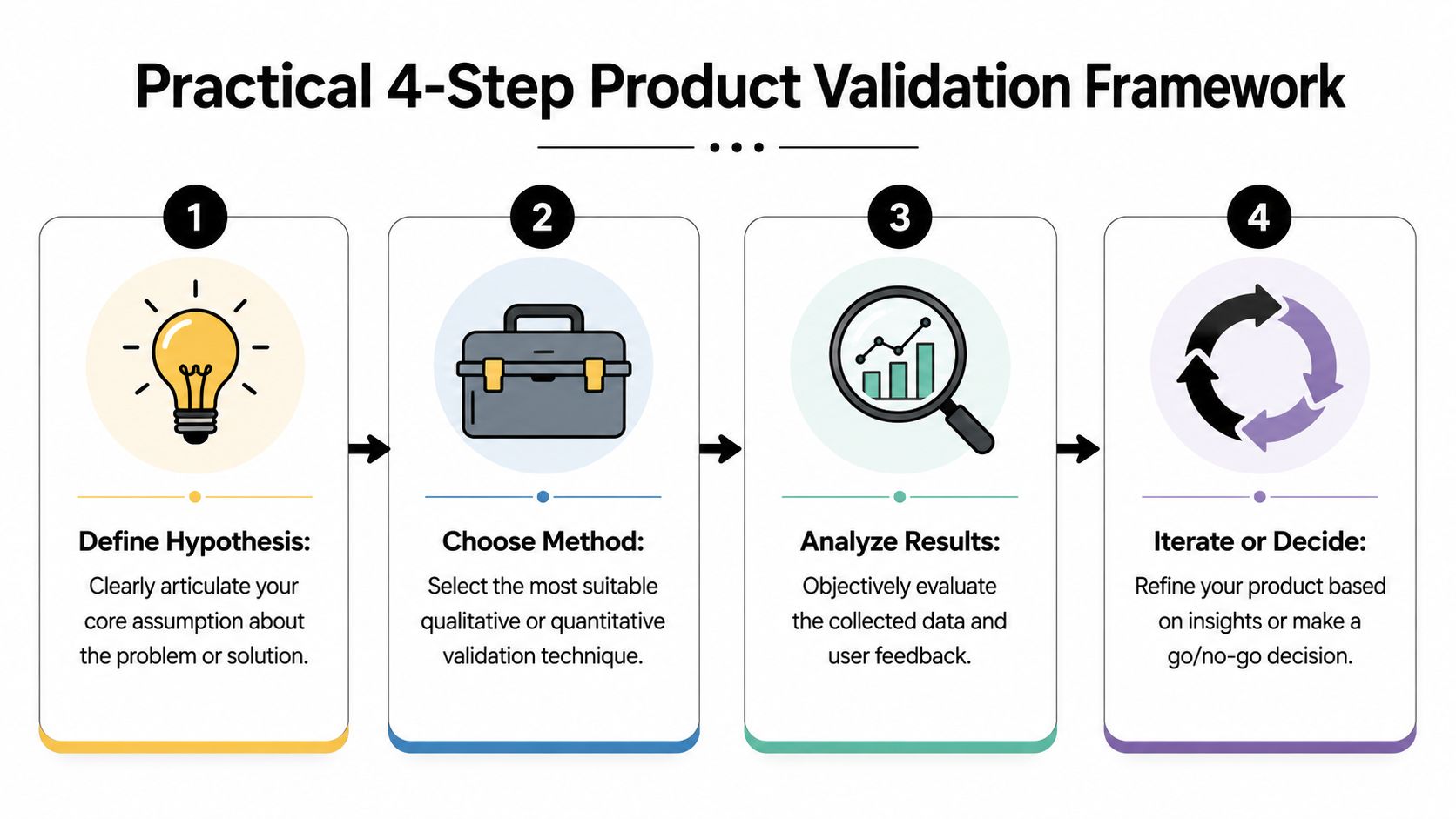
Here's the framework I've used most often with teams building new features, platform bets, and AI workflows. It's deliberately simple because speed matters. If your validation process is too heavy, the org will skip it.
Step one isolate the riskiest assumption
Every idea contains multiple assumptions. Don't test all of them at once. Find the one that can kill the idea.
For an AI scheduling assistant, the riskiest assumption usually isn't “can the model generate times?” Engineering can often make that work. The main risk is something like this: users will trust the assistant to coordinate scheduling on their behalf without manual review.
That's a serious assumption. If it fails, the whole concept weakens.
Step two write a falsifiable hypothesis
Weak PM language sounds like this: “Users will love smart scheduling.”
That's useless. A strong hypothesis has an if-then shape and can fail.
Example:
- If meeting-heavy users delegate scheduling suggestions to an assistant,
- then they'll complete scheduling tasks with less manual effort and continue using the workflow.
Many PMs often jump too quickly into MVPs. Don't. First make the claim crisp enough that the test can disprove it.
Step three design the leanest credible experiment
You want the fastest test that produces trustworthy evidence.
For the AI scheduling example, a good first experiment might be:
- Recruit target users who already handle scheduling frequently.
- Run a Wizard of Oz workflow through email, chat, or a lightweight interface.
- Have humans produce AI-like scheduling outputs behind the scenes.
- Track user behavior such as whether they delegate, whether they accept suggestions, and whether they repeat the behavior.
A more detailed walkthrough on testing business ideas can help if you want templates for this stage.
A short explainer often helps teams align on the flow before they test it:
Step four analyze and decide
At this point, many teams get timid. They collect data, see mixed evidence, and choose to build anyway because momentum has already formed.
Don't do that. Validation should drive a decision.
Your options are usually:
- Persevere: Evidence is strong enough to invest more.
- Pivot: The problem is real, but the current approach isn't.
- Kill: The core assumption failed. Stop spending.
Decision test: If you wouldn't fund this idea from scratch after seeing the evidence, don't continue funding it just because work has started.
A PM who can run this loop quickly becomes dangerous in the best way. Senior leaders trust them because they don't bring opinions. They bring structured judgment.
Validating in the Age of AI A Modern PMs Challenge
AI breaks a lot of old validation habits.
Traditional feature validation often assumes a stable workflow, clear user intent, and deterministic product behavior. AI products challenge all three. Output quality varies. User expectations move quickly. The thing users say they want can change the moment they interact with a capable system.
That's why standard “would you use this?” interviews perform poorly for AI bets.
Modern validation now includes methods such as A/B, multivariate, and canary testing, but the main issue in the AI era is harder. AI workflows can change user expectations faster than surveys can capture, so teams need to validate trust and friction reduction through behavioral telemetry, not opinions alone, as described in Optimizely's product validation overview.
What makes AI validation different
At a company building an AI writing assistant, for example, users may initially say they care about output quality. In reality, they may abandon the tool because reviewing and correcting drafts takes too much effort. The product “works,” but the workflow loses.
That means AI PMs need to validate at least four things:
- Trust: Will users rely on the output in a meaningful task?
- Correction cost: How much cleanup does the user still have to do?
- Explainability: Can the user tell when the system is safe to use?
- Behavior change: Does the product reduce steps, time, or cognitive load?
Practical AI experiments that work
For AI products, I'd start with experiments like these:
- Wizard of Oz service simulation: Great for agent workflows, copilots, and automation assistants.
- Human-in-the-loop pilot: Useful when quality assurance is critical and you need to monitor failure modes.
- Canary release: Expose a small slice of real traffic to the new workflow before broader rollout.
- Side-by-side workflow testing: Compare AI-assisted and non-AI paths on task completion, trust, and repeat use.
If you work in AI PM or want to move there, this primer on artificial intelligence product management is worth reviewing.
Prompts PMs can use with ChatGPT
You don't need AI to replace judgment. You can use it to sharpen experiments.
Try prompts like:
- For risky assumptions: “Act as a skeptical PM. List the top assumptions behind an AI meeting assistant for sales teams. Rank them by user risk, trust risk, and operational risk.”
- For experiment design: “Given this hypothesis, propose three low-cost validation experiments. Include one qualitative method, one behavioral method, and one launch-gated method.”
- For failure analysis: “What are the likely reasons users would praise this AI feature in interviews but avoid it in real workflows?”
The best AI PMs don't validate whether the model can generate output. They validate whether the system earns a place in the user's job.
Real World Validation Examples From Top Tech Companies
Good validation stories look simple in hindsight. That's because the teams focused on the core uncertainty instead of overbuilding.
Dropbox validated demand before product scale
Dropbox is the classic PM lesson. Before scaling the full experience, the team validated whether people cared enough about the file-syncing promise to engage with it. That's smart product work because the key risk wasn't just technical execution. It was whether users found the concept compelling enough to change behavior.
This mirrors a formal validation pattern used in regulated environments. Start with the design intent. Run a qualification step that produces evidence. Then scale and keep verifying in actual use.
Zappos validated behavior before infrastructure
Zappos followed the same logic in a different market. The early test didn't require building a full logistics machine first. The team tested whether people would buy shoes online, then fulfilled demand manually.
That's the essence of lean validation. Don't automate what you haven't proven matters.
The fastest route to truth is usually manual, narrow, and slightly unscalable.
Why these examples still matter for AI PMs
The validated pattern behind both examples aligns with the FDA's evidence-based lifecycle logic: establish design intent, prove reproducibility with a lean test, then continue verifying after launch, as outlined in the FDA process validation guidance.
That same pattern works for a modern AI agent.
A team building an AI research assistant, for instance, shouldn't start by building the full orchestration layer, model routing, feedback system, and permissions stack. A better first move is to manually deliver the research workflow for a small cohort, observe what users ask for, and track where trust breaks.
Here's the common structure across the strongest examples:
- Design: State the core user outcome you believe matters.
- Qualification: Run the smallest experiment that can prove repeatable demand or behavior.
- Continued verification: Monitor post-launch use so drift, confusion, or degraded quality doesn't hide behind launch excitement.
That's not just startup craft. It's disciplined product management.
How Mastering Validation Impacts Your PM Career
A PM at Google proposes a new onboarding flow. Another PM tests the same problem with a narrow experiment, finds that activation barely changes, and redirects the team to a higher-impact retention issue. One of those PMs shipped more. The other showed stronger judgment. Promotions usually follow the second pattern.
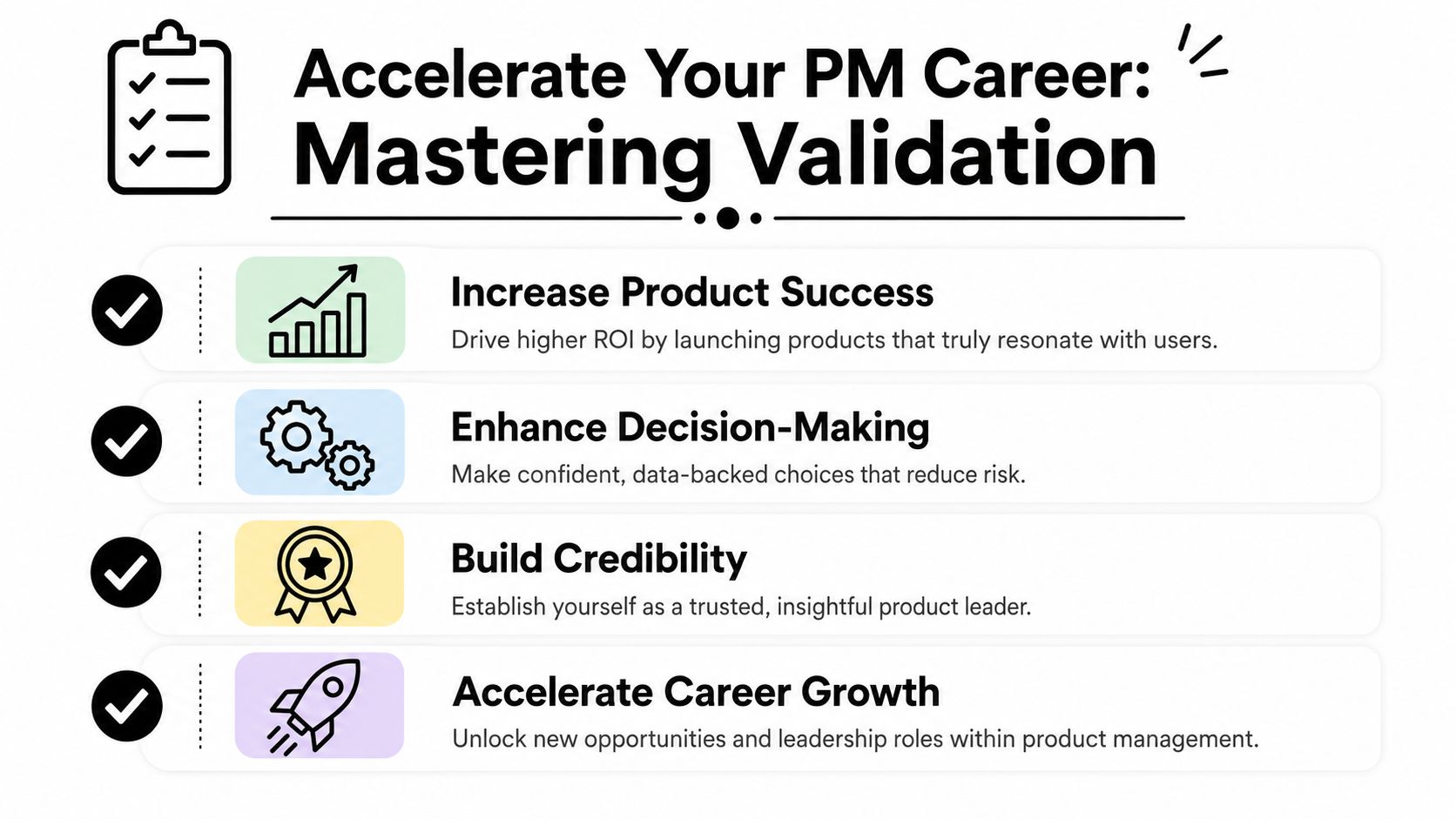
Validation changes how leaders assess you. Teams remember the PM who prevented a bad investment, clarified the underlying risk, and found evidence before asking for engineering time. At Meta, Google, and similar product organizations, that skill maps directly to scope. Once leaders trust your judgment on uncertain bets, they give you harder problems, more cross-functional influence, and larger business responsibility.
The career impact shows up differently at each level.
- Aspiring PMs: Validation gives you proof of product thinking. A side project with a clear hypothesis, a fast test, and a decision based on user behavior carries more weight than polished screens with no evidence behind them.
- Mid-level PMs: This is where promotion speed often changes. Senior PMs are expected to reduce uncertainty, choose the right problem, and avoid waste before execution starts.
- Group PMs and leaders: Validation becomes capital allocation. You are deciding which initiatives deserve headcount, model spend, design time, and executive attention across a portfolio.
For AI PMs, this matters even more. Shipping an AI feature that demos well but fails on trust, accuracy, or repeat usage can burn political capital fast. A PM who knows how to validate model behavior, human-in-the-loop fallback, and willingness to pay becomes much more valuable than a PM who only knows how to launch.
This is one reason experienced PMs study practitioners who are strong on hypothesis framing, discovery, and lightweight testing. Aakash Gupta is one example. His work often focuses on testing ideas, running smoke tests, and improving PM judgment.
Use a simple career-grade checklist:
- Name the risk: What must be true for this product or feature to matter?
- Define the evidence: What result would support the bet, and what result would kill it?
- Run the leanest credible test: What can you learn before committing full engineering effort?
- Prioritize behavior: What users did matters more than what they said in a survey.
- Make a clear decision: Continue, change direction, or stop.
PM careers rise on decision quality. Master validation, and you become the person leadership trusts with ambiguous, high-value bets. That is how PMs get promoted faster.
