Most advice about team culture is wrong for product leaders.
It tells you to care about values, trust, and morale, then leaves the actual execution to HR, founders, or good intentions. That's why so many teams say culture matters while still shipping slowly, re-litigating decisions, and burning out strong PMs.
A product team's culture isn't the vibe in the room. It's the system that determines how work gets done. It shapes who gets heard, how decisions get made, what gets documented, how conflict gets resolved, and whether learning compounds or disappears after each launch.
If you're a PM, culture as a product is one of the most effective ways to improve your team's output and your own career trajectory. Senior leaders don't just ship features. They build operating systems. The PM who can create clarity, raise decision quality, and make teams work better across engineering, design, data, and go-to-market functions becomes far more valuable than the PM who only manages a roadmap.
Your Team's Culture Is Not an HR Problem
Perks are not culture. Free lunch, swag, offsites, and a friendly Slack channel can make work nicer. They don't make a team effective.
Culture is what your team does when priorities collide. It shows up when engineering wants to reduce scope, design wants more polish, sales wants a commitment, and leadership wants a date. If your team handles those moments with clarity and consistency, you have a strong culture. If every hard call turns into politics, escalation, or confusion, you don't.

The mistake I see most often is treating culture as a people program instead of product infrastructure. PMs wouldn't describe authentication, observability, or analytics as “nice to have soft layers” because they know those systems affect every release. Team culture works the same way. It's infrastructure for execution.
What culture controls in practice
A weak culture usually creates the same operational problems:
- Slow decisions because nobody knows who owns the call.
- Repeated conflict because principles aren't explicit.
- Poor onboarding because tribal knowledge lives in people's heads.
- Fragile delivery because teams hide risk until it becomes a deadline problem.
- Low PM impact because the PM spends all day translating and deconflicting.
A strong culture does the opposite. It reduces coordination drag. It makes behavior more predictable. It helps new hires ramp without guessing the rules.
Practical rule: If a recurring team problem affects speed, quality, trust, or alignment, it's not “just a people issue.” It's a product problem with a system design gap.
This is why PMs who want to move into group PM, director, and VP roles need to care. At senior levels, nobody promotes you because you wrote sharper tickets. They promote you because you can scale judgment across teams. That's what culture does.
If you manage managers, the requirement gets even stricter. You're no longer shaping only backlog quality or stakeholder alignment. You're shaping how multiple teams interpret priorities and make trade-offs, which is exactly why strong leaders learn to build repeatable systems, not just heroic execution. That's the core shift in becoming a manager of managers.
The Culture Product Canvas A 1-Page Template
Many organizations describe their culture through adjectives like collaborative, high-performance, and customer-centric. Those words are too vague to be useful.
Use a one-page canvas instead. If a PM can turn an idea into a PRD, a PM can turn culture into a design artifact with owners, users, behaviors, and metrics.
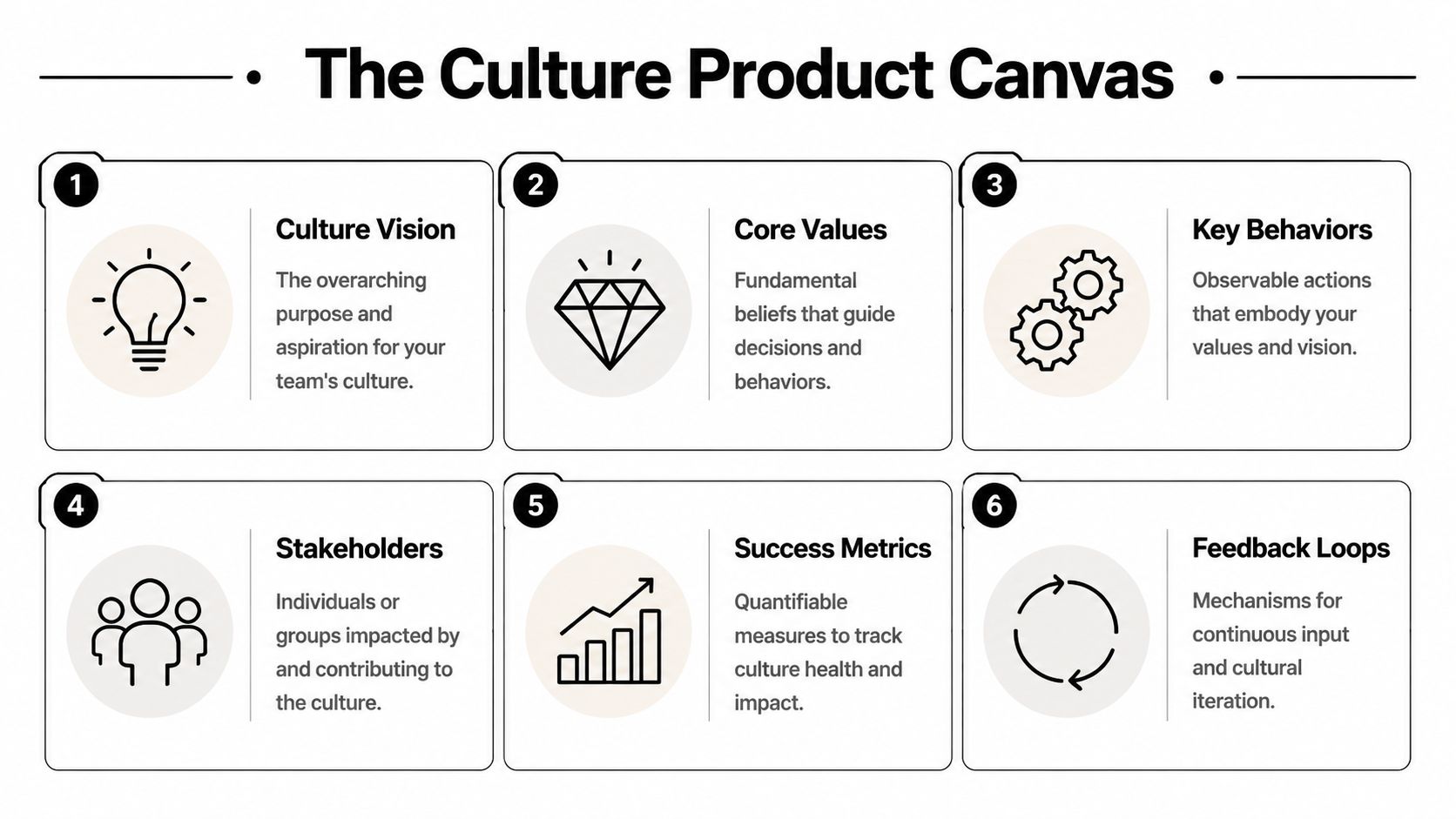
The six blocks
Culture vision
Write the team's operating aspiration in one sentence. Not a slogan. A usable design target.
Example: “We make fast, evidence-based decisions without creating hidden work for partner teams.”Core values Limit this to the few principles that should break ties. Too many values create theater.
Good examples are specific enough to guide behavior, such as “write before meeting” or “bring evidence, not certainty.”Key behaviors
This is the most important block. Translate values into actions people can observe.
If you value ownership, define what ownership means when a launch slips, when a dependency breaks, or when a customer escalates.Stakeholders
Your culture has users. Start with your immediate product trio or squad, then include engineering leadership, design, data, support, sales, and new hires.
A culture that feels efficient to one team but creates confusion for everyone else is poorly designed.Success metrics
These aren't vanity engagement measures. They should tell you whether the system is helping the team move faster and make better calls.
Think decision lead time, onboarding ramp clarity, documentation coverage, and quality of retros.Feedback loops
Every product needs telemetry. Every culture does too. Decide where you'll gather signal.
Use onboarding feedback, retro themes, manager one-on-ones, RFC comments, and escalation reviews.
A working canvas should fit on one page. Constraint matters. If it needs a slide deck, it's probably too abstract.
For PMs who want a simple planning format, adapt a lightweight product management template and treat culture like any internal product you're responsible for shaping.
Prompts that force clarity
Use prompts that make hand-wavy answers impossible:
Vision prompt
“When this team is working at its best, what becomes consistently easy?”Values prompt
“Which principles should overrule convenience when deadlines are tight?”Behavior prompt
“What would a new engineer see in their first two weeks if our culture were real?”Stakeholder prompt
“Which partner teams pay the cost when our team is disorganized?”Metrics prompt
“What evidence would convince a skeptical VP that this culture is helping execution?”
A short explainer can help your team see the model before you workshop it live:
One reason this matters is that leaders often underbuild the measurement side. A UNESCO analysis notes that many practitioners still struggle to quantify the ROI of cultural assets, which is why culture gets treated like a side feature instead of a core product line in planning and monetization in UNESCO's analysis of culture and future work. The same failure shows up inside product orgs.
A culture canvas is useful only if it changes default behavior. If nothing in your meetings, docs, or decision rights changes, you made a poster, not a product.
Defining Your Culture's MVP and Core Features
Cultural engineers often overdesign their systems. They attempt to define values, rewrite onboarding, fix meetings, upgrade feedback, improve planning, and launch a leadership charter all at once. That fails for the same reason bloated product launches fail. Too many moving parts, weak adoption, and no clear learning.
Your culture MVP is the smallest set of behaviors that would materially improve how the team works.
Start with pain, not aspiration
The cleanest way to define an MVP is to ask where execution is currently leaking.
If your team debates every decision for too long, the MVP might be a decision protocol. If launches surprise support and GTM partners, the MVP might be a written handoff ritual. If new hires take too long to understand how work really gets done, the MVP might be an onboarding system with examples, not generic company decks.
I've seen teams get more value from one well-enforced operating rule than from a polished values workshop. A rule like “major product decisions require a written recommendation with trade-offs before the meeting” changes behavior immediately. It also reveals whether people can think clearly, synthesize input, and separate opinion from evidence.

What a cultural feature spec looks like
Treat each cultural feature like a product feature. It needs a user problem, a clear behavior, a trigger, and an owner.
Here are three examples:
Disagree and commit
This isn't a value until you define the sequence. Who documents options? Who makes the decision? How long can dissent continue after the call? Where is the final record stored?Written-first decisions
The feature is not “we like docs.” The feature is that roadmap changes, launches, and strategic bets start with a short written brief in Notion, Google Docs, or Coda before a meeting happens.Blameless post-mortems
The feature is a standard template, a review cadence, and explicit rules about separating accountability from shame.
Real examples PMs should study
Amazon's Working Backwards process is a cultural feature because it forces teams to define customer value before solutioning. Stripe's written communication norms function like an internal API because they make asynchronous collaboration possible at scale. Figma's emphasis on open collaboration and shared context works because the ritual is embedded in how design reviews and product conversations happen, not because someone wrote “be collaborative” on a wall.
If you're operationalizing these habits across a growing org, it helps to connect cultural behaviors to capability-building. Teams usually need repeatable coaching, manager reinforcement, and skill development to make the habits stick. That's where the essential components of an L&D strategy become useful. They give you a way to support the behavior change instead of assuming people will absorb it by osmosis.
The best cultural features remove ambiguity. If your team can interpret a norm five different ways, it won't survive pressure.
Shipping and Iterating Your Culture
Culture doesn't change when you announce it. It changes when you install mechanisms that run every week.
That's why the most effective PM-led cultures rely on rituals, artifacts, and feedback loops. Think of these as your deployment pipeline. They're how behavior gets released into the team, observed, and improved.
Ship through rituals, not speeches
A team absorbs culture through repeated experiences. If you want sharper decisions, redesign decision-making. If you want accountability, redesign status reviews. If you want faster onboarding, redesign the first two weeks.
A practical system usually includes a few core rituals:
Onboarding package Build a short culture deck that explains how the team works. Include example PRDs, roadmap docs, decision memos, retro notes, and launch checklists. New hires don't need aspirational prose. They need working examples.
RFC process
Use a lightweight request-for-comments template for material product changes. Keep it short. Problem, options, recommendation, trade-offs, open questions, owner, decision deadline.Continuous feedback loop
Don't wait for formal review cycles. Use Slack, Google Docs comments, and one-on-ones to create fast micro-feedback. The habit matters more than the tool.Post-mortems
Make them blameless, but not consequence-free. The point is to learn how the system failed, then update the system. If every retro ends with “communicate better,” the ritual is broken.
Make remote execution explicit
Remote and hybrid teams expose weak culture fast. In-office teams can survive on hallway repair work for a while. Distributed teams can't.
That's why written-first norms, clean documentation, and explicit ownership matter much more now. AI adds another layer. As teams use copilots, meeting summarizers, and internal knowledge assistants, low-quality documentation gets amplified. If your docs are messy, AI will scale the mess.
A useful benchmark is whether your team could answer these without a meeting:
| Question | Healthy signal |
|---|---|
| Why are we doing this work now? | A current written rationale exists |
| Who decides? | Decision owner is explicit |
| What changed? | Changes are logged in one place |
| What did we learn? | Retro outcomes are searchable |
For leaders trying to make this practical, good innovation guidance often starts with operating norms instead of brainstorming theater. The ideas in this piece on fostering an innovative culture are helpful because they connect experimentation to team behavior rather than slogans.
Iterate like a PM
Culture should be versioned.
Launch one or two mechanisms. Watch adoption. Ask where the workflow creates friction. Tighten the spec. Remove rituals nobody uses. Keep the ones that produce clearer judgment and fewer avoidable mistakes.
If you need a simple framing, use the same mental model you already apply to product delivery: iteration in product work means shipping a smaller version, collecting signal, and improving the system instead of waiting for a perfect launch. Culture responds to the same discipline.
A ritual earns its place only if it improves execution. If it consumes time without changing behavior, cut it.
The Culture Dashboard KPIs for Product Teams
If culture stays qualitative, it loses every budget conversation.
PMs need a dashboard. Not because everything important can be reduced to a metric, but because leadership only funds what it can inspect. A culture dashboard turns “the team feels better” into “our system is making better decisions, faster.”
Measure leading indicators first
The strongest culture metrics are often process indicators. They tell you whether the operating system is improving before the business outcomes fully show up.
That matters because organizational change usually fails in the gap between action and visible payoff. Teams introduce better habits, don't measure early movement, then abandon the work too soon.
Executive surveys show that nearly 92% of leaders see cultural issues as the main barrier to becoming data-driven, and the same research notes that embedding data literacy into roles and training can improve decision quality within 6 to 12 months in Tier1 Performance's discussion of data-driven culture. For PM teams, data literacy isn't a nice credential. It's a cultural competency. If people can't interpret evidence well, they can't make better product calls.
Sample Culture KPI Dashboard
| KPI | Type | How to Measure | Target Outcome |
|---|---|---|---|
| Decision velocity | Leading | Track time from problem statement to documented decision | Faster, clearer decisions |
| Documentation rate | Leading | Review whether active projects have current specs, owners, and trade-offs recorded | Less tribal knowledge |
| Onboarding clarity | Leading | Ask new hires which docs, examples, and rituals helped them understand the team | Faster ramp and fewer repeated questions |
| Retro completion quality | Leading | Check whether post-mortems include cause, lesson, owner, and follow-up action | Better learning loops |
| Stakeholder predictability | Leading | Ask partner teams whether roadmap, launch timing, and ownership are easy to understand | Lower coordination friction |
| New-hire time to productivity | Lagging | Assess when new hires can independently drive scoped work | Quicker contribution |
| Team retention health | Lagging | Review avoidable attrition patterns qualitatively with managers | Greater stability |
| Product delivery reliability | Lagging | Compare planned work with completed work and note repeated failure modes | Stronger execution |
| Escalation volume | Lagging | Count how often unresolved ambiguity requires leadership intervention | More local ownership |
Don't over-instrument
You don't need a surveillance system. You need enough signal to see whether the culture product is improving.
Use a small dashboard. Review it monthly. Pair the numbers with examples from actual decisions, launches, and cross-functional interactions. For PMs building career advantages, this matters because you can show that your operating model is not abstract. It improves execution in ways leadership can inspect.
For a broader view of what strong product measurement looks like, it helps to anchor your thinking in practical metrics for product managers. The key move is applying the same rigor inward, not just outward to customers.
Case Studies Culture as a Product in Action
The most convincing argument for culture as a product is simple. Strong companies don't leave it to chance.
They encode beliefs into mechanisms, then they enforce those mechanisms until they become normal behavior. That's product thinking applied internally.
Netflix treats culture like a spec
Netflix's culture materials became famous because they're unusually explicit. What matters isn't the deck itself. What matters is the design choice behind it. The company translated expectations into observable standards around judgment, talent density, candor, and responsibility.
That's what PMs should copy. Not the surface language, but the clarity. The best internal culture artifacts work like a PRD for team behavior.
Google operationalized learning loops
Google is often cited for data-driven management, and the useful lesson for PMs isn't “be analytical.” It's “test your management system like a product.”
High-performing product orgs do this constantly. They examine manager quality, team norms, communication patterns, and decision structures the same way they examine funnel drop-off or activation friction. The principle holds even if your company is much smaller. Good teams don't assume their operating model is working. They inspect it.
Stripe scaled through written systems
Stripe's written-first style is powerful because it allows people to collaborate across time zones, functions, and layers of context without requiring endless meetings. In practice, that means docs become a coordination layer. Decisions become reviewable. New hires can trace reasoning. PMs can challenge assumptions based on written logic, not room dynamics.
That's a serious career advantage for product leaders. Written systems reward clarity, synthesis, and principled decision-making. Those are the exact skills senior PMs need.
Teams scale when good judgment becomes repeatable. Culture is the mechanism that makes repeatability possible.
There's also a business case for doing this well. According to Forrester research cited by Alation, insights-driven organizations are nearly three times more likely to achieve double-digit growth in Alation's overview of data culture. The mechanism is familiar to any PM. Better data discovery, stronger literacy, and better governance reduce friction and improve decision speed.
That's the point. Culture isn't separate from performance. It's one of the main ways performance compounds.
Common Pitfalls and Your 90-Day Roadmap
Most culture work fails for boring reasons.
Leaders cargo-cult another company's model. They copy Spotify squads, Amazon documents, or Netflix candor without understanding the underlying constraints. Or they treat culture like an HR initiative and never connect it to how product decisions, reviews, and launches happen.
Another common failure is culture debt. Small unresolved issues pile up. Ownership gets fuzzy. Meetings stop producing decisions. Docs become stale. New hires learn workarounds instead of learning the system.
A practical 90-day start
For PMs, the fix is to start narrow and operate visibly.
Days 1 to 30
Diagnose the current system. Interview your team and closest partners. Build the first version of your culture canvas. Identify the one or two behaviors causing the most execution pain.Days 31 to 60
Launch one cultural feature. Pick something concrete, such as a written decision template or a blameless post-mortem format. Train the team on when to use it, then use it consistently.Days 61 to 90
Add a lightweight dashboard and run your first review. Look for adoption, friction, and visible changes in team behavior. Then revise the mechanism.
If you want examples of what operational change looks like in practice, browsing successful Querio implementations can be useful for seeing how teams adopt structured workflows and turn them into repeatable operating habits.
For PMs stepping into broader leadership, this kind of system-building belongs in your first-quarter plan. The same discipline that helps a new PM leader gain context and establish credibility in their first 90 days as a product manager also applies to culture. Diagnose before redesign. Ship before polishing. Measure before declaring victory.
If you want more sharp, practical product thinking like this, follow Aakash Gupta. His work is built for PMs who want to get better at execution, leadership, and career growth without the usual fluff.
