You're probably dealing with this already.
Sales asks for a “must-have feature” because a competitor demoed it. Engineering pushes back and says the product's core functionality is still fragile. Design says the workflow is too messy to layer anything else on top. Everyone uses feature and functionality like they mean the same thing, and the roadmap gets muddy fast.
For a PM, this isn't word choice. It's judgment. If you can separate the user outcome that matters from the thing you might build, you write better PRDs, prioritize with more credibility, and sound like a product leader instead of a ticket manager. In AI products especially, this distinction matters more because shiny capabilities are cheap to pitch and expensive to operationalize.
The Debate That Derails Roadmaps
In a Q3 planning meeting, this usually shows up in a predictable way.
The VP of Sales says, “We need the competitor's analytics feature.” Engineering says, “Our reporting functionality is unreliable, so another surface area just adds support pain.” Both people are pointing at a real issue. They're just talking at different levels.

The PM who gets trapped here starts debating UI elements, parity requests, and roadmap slots. The PM who leads the room reframes the conversation around the user job and the business outcome. That's what good roadmap prioritization looks like in practice.
What confusion sounds like
You can hear the problem in the language teams use:
- “We shipped collaboration.” No, you probably shipped comments, mentions, and permissions.
- “Customers need AI.” No, they need faster writing, better recommendations, cleaner search, or lower effort.
- “We already have that functionality.” Maybe. Or maybe you have one narrow feature that technically exists but fails in the actual workflow.
Roadmaps become distorted. Teams compare checklists when they should compare outcomes. They count shipped items when they should ask whether the user can complete a task with less friction.
Practical rule: If people in the room can't clearly say what user goal is being improved, you're probably debating features too early.
Why this matters to your career
Senior PMs aren't promoted because they add more things to the backlog. They're trusted because they reduce ambiguity. They can tell the difference between a customer request, a product capability, a UI expression, and a technical dependency.
That skill shows up everywhere:
- In prioritization: You can defend why reliability beats parity.
- In stakeholder management: You can translate between Sales, Engineering, and Design.
- In executive communication: You can explain what the company is really buying when it funds a roadmap item.
Meta, Google, and every strong product organization care about this, even if they use different vocabulary. The teams that win don't just add options. They make the product better at doing the job customers hired it to do.
A Simple Framework The Best PMs Use
Strong PMs separate the user's job from the product expression.
That sounds simple. In practice, it changes how you prioritize, how you write a PRD, and how senior leaders judge your product sense. Teams that miss this distinction argue about shipping AI summaries, extra filters, or a new dashboard tab. Teams that get it right ask a harder question first: what capability are we improving for the user, and what is the best expression of that capability right now?
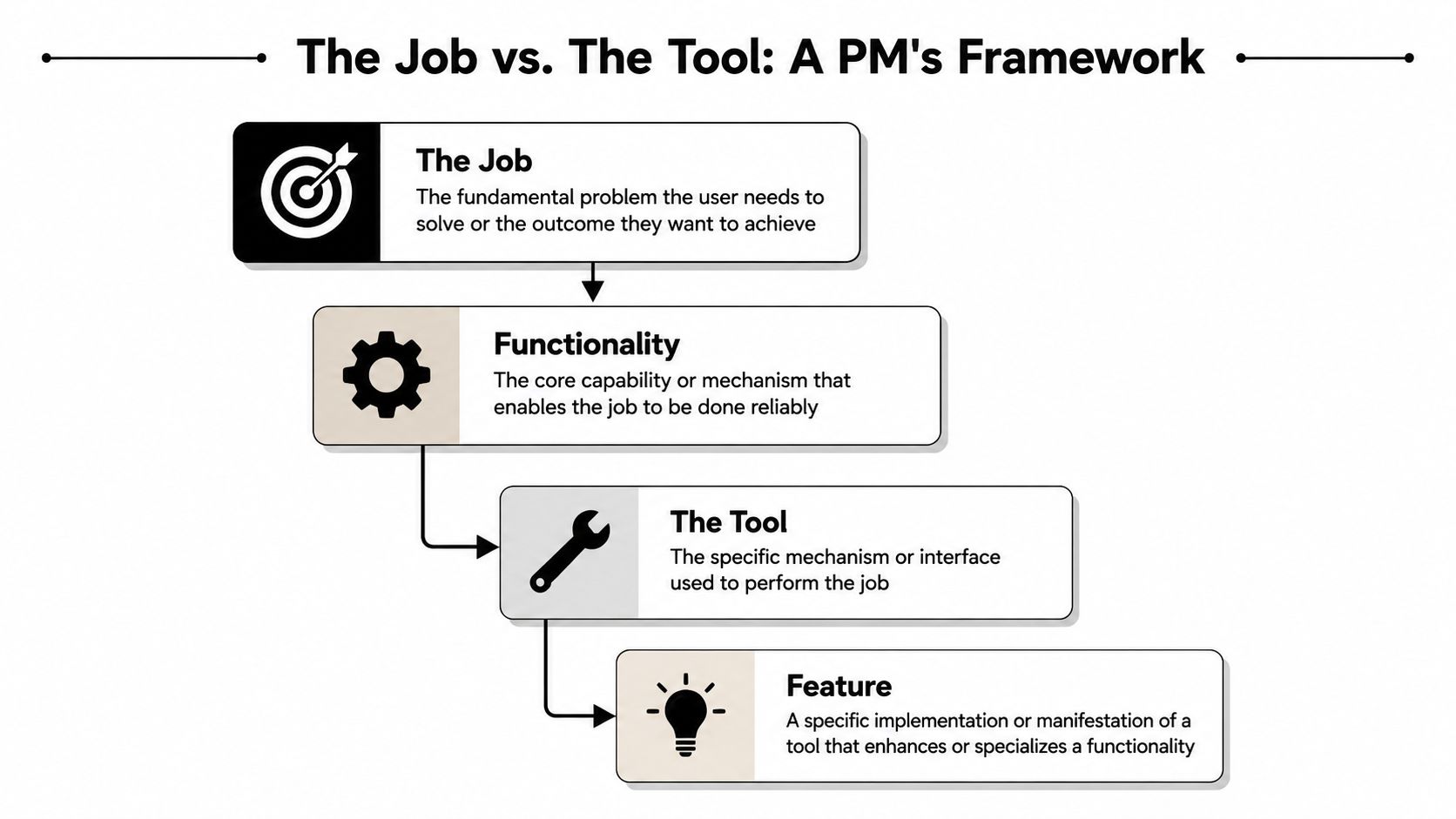
The Job
Start with the user goal.
Users do not wake up wanting “AI,” “advanced permissions,” or “saved views.” They want to finish a task faster, make a better decision, reduce errors, coordinate with a team, or remove tedious work. That is the level where good PM judgment starts.
A few concrete examples:
- In Google Maps, the job is reaching a destination with less time and stress.
- In Gmail, the job is handling communication without losing context or missing what matters.
- In an AI coding assistant, the job is producing correct code faster and with less mental overhead.
If the team cannot state the job in one clear sentence, the roadmap is already getting fuzzy.
Functionality
Functionality is the product capability that helps the user complete that job consistently.
It sits above any single UI element or workflow step. Search is functionality. Collaboration is functionality. Fraud detection is functionality. In AI products, summarization quality, retrieval accuracy, and response traceability are functionality too, because they determine whether the user can trust the system in a real workflow.
This is the level where experienced PMs spend more time than junior PMs. A feature can look polished in a demo and still fail to improve the underlying capability. I have seen teams celebrate shipping an AI assistant because the interface worked, while users still had to verify every answer manually. The feature shipped. The functionality was weak.
Useful questions here are simple:
- Can the user complete the end-to-end task?
- Does the product work reliably under normal conditions?
- Does it reduce time, effort, or mistakes in a meaningful way?
Feature
A feature is the specific implementation users can see, click, configure, or trigger.
Turn-by-turn navigation. Suggested replies. Public link sharing. Semantic search. A comments panel. A model picker. These are features. They are how functionality shows up in the product.
Good PMs stay flexible at this layer. The feature is a choice, not the mission. If the functionality is “help teams find company knowledge quickly,” the right feature might be semantic search today, an AI answer box next quarter, and workflow-specific recommendations later. The capability should stay stable longer than the expression.
That distinction matters a lot in AI. Feature teams often race to add copilots because competitors did. Product leaders ask whether the user can complete the job faster, with enough quality and trust to change behavior.
Why this framework holds up
A commonly cited stat claims many shipped features are rarely or never used. The exact number gets repeated more confidently than it should, and the original basis was narrower than many PMs realize, as noted by Simplicable's discussion of function versus feature. The larger lesson still holds: counting features is a poor way to measure product value.
Meta, Google, and other strong product organizations do not reward PMs for producing longer release notes. They reward PMs who can explain why a proposed feature improves a capability customers care about, and why that capability matters to the business.
That is also how promotion cases get stronger. A PM who says, “we shipped AI summaries” sounds tactical. A PM who says, “we improved knowledge retrieval for support agents, cut resolution time, and used summaries as one expression of that capability” sounds like someone ready for larger scope.
A roadmap gets sharper when every proposed feature has to earn its place by improving a clear functionality.
If you want to apply this in planning, use one of these product prioritization frameworks for PMs and force each roadmap item to map to a user outcome before it gets resources.
The shortcut test
Use these two questions in order:
- What job is the user trying to complete?
- Which feature is the best way to support that functionality right now?
If a team has a polished answer to question two and a vague answer to question one, they are designing too early. That is how roadmaps fill up with visible work and weak outcomes.
The Deep-Dive Comparison for Product Leaders
A roadmap review goes sideways fast when one PM is arguing for “AI summaries” and another is arguing for “faster decision-making for managers.” They sound like they are debating priorities. They are debating at different levels.
That distinction matters more as products get more AI-heavy. In AI teams, features multiply quickly. A prompt box, a summary card, a recommendation panel, an agent workflow, a confidence indicator. Promotions do not come from shipping more of those surfaces. They come from showing that you improved a user capability the business cares about and chose the right feature to do it.
Functionality vs. Feature the PM's Cheat Sheet
| Dimension | Functionality | Feature |
|---|---|---|
| User intent | The user goal being accomplished | The specific way the product supports that goal |
| Scope and granularity | Broader capability across a workflow | Narrower component, tool, or interaction |
| Value lens | Outcome for the user | Mechanism that may contribute to that outcome |
| Implementation focus | End-to-end behavior and system reliability | UI element, workflow step, model output, or control |
| Success measurement | Task completion, friction reduction, workflow quality | Availability, quality, adoption, and feedback |
| Strategic lifespan | Usually durable over time | More likely to change, evolve, or get replaced |
Where PMs get tripped up
Features are easier to sell internally because they are visible. You can demo them in 30 seconds. You can put them in release notes. You can compare them to a competitor screenshot.
Functionality is harder because it forces a broader question. Did the product help the user complete the job better?
That is where weaker product conversations drift into checklist thinking. A team says, “Customers asked for bulk edit,” or “Google has this,” or “AI competitors all added copilots.” None of those statements answers the question a strong PM needs to answer: what capability improves, for which user, and what business result should follow?
This is also where PM judgment starts to separate from project management. Product judgment means deciding whether a proposed feature improves the core function enough to deserve design, engineering, go-to-market time, and long-term maintenance. If that trade-off is still fuzzy, it usually helps to evaluate the idea through a feasibility versus viability framework for product decisions. A feature can be easy to build and still be the wrong call.
A practical example
Take a team chat product.
- Functionality: help teammates communicate clearly and keep context intact
- Features: send message, edit message, react with emoji, attach file, thread reply
A weak PM says, “We need reactions because Slack has reactions.”
A stronger PM asks sharper questions:
- Does this improve communication clarity or just add social polish?
- Does it reduce channel noise, or create more of it?
- Is this more valuable than improving message delivery reliability, search relevance, or notification controls?
- If usage goes up, will the underlying user outcome improve too?
That last question matters a lot in AI products. Teams often celebrate feature adoption when they should be checking whether the user got to a better answer, finished faster, or made a better decision. A highly used AI feature can still be weak product work if it creates extra review burden, trust issues, or messy handoffs.
If a feature ships and the user's job does not get easier, faster, safer, or clearer, the team added complexity, not value.
How leaders talk about this
Strong product leaders keep three layers separate.
- Strategy level: “We want users to collaborate asynchronously without losing context.”
- Capability level: “The product needs strong sharing, feedback, and traceability functionality.”
- Delivery level: “We'll ship public links first, then comments, then role-based permissions.”
Google, Meta, and other mature product orgs expect PMs to operate cleanly across all three. If strategy language is full of features, the team locks into solutions too early. If delivery plans stay at the functionality level, engineering cannot execute. If a PM can move between those layers with precision, PRDs get clearer, prioritization gets faster, and stakeholder debates get shorter.
That is not academic vocabulary. It is operating skill.
How Google, Notion, and Spotify Get It Right
You can spot mature product thinking by looking at whether a company builds isolated tricks or a coherent capability stack.
Google products often win because they focus on the user job before the interface layer.
Take Gmail's current AI direction. The user job isn't “use AI.” It's handle inbox complexity with less effort. Features like summaries, drafting help, reply suggestions, and inbox organization are useful because they support a broader capability: managing information and communication efficiently.
That's the right lens for AI PMs. The model output is rarely the product. The product is the improved functionality around the user's workflow.
Notion
Notion is another good example because people often describe it by listing components: databases, pages, templates, docs, wikis, AI writing help.
But the functionality users are really buying is something like organize work and knowledge in one flexible system. The individual features change. The core value stays stable.
That's why Notion can add or refine surfaces without losing its center of gravity. The PM work is less about “what else can we add?” and more about “does this make the system more usable, more connected, or more powerful for the organizing job?”
Spotify
Spotify's enduring functionality is not “play audio.” Lots of products do that.
Its stronger value is help me discover and enjoy the right music with low effort. Features such as personalized playlists, radio, and recommendation surfaces matter because they all push on discovery and listening confidence.
In AI products, this same distinction shows up in data terms too. In machine learning, a feature is a measurable input variable, while the functionality is the predictive capability enabled by those inputs. Statistics.com explains that feature engineering involves substantial transformation and filtering before data becomes useful, which is a useful reminder that valuable functionality depends on more than the raw presence of inputs, as described in Statistics.com's feature versus variable discussion.
The PM lesson
When you evaluate your own product, don't start by listing everything on the surface. Start by naming the durable user capability.
Ask yourself:
- If we removed three features, would the product still do its core job well?
- Which features are essential versus ornamental?
- In AI, are we building a workflow improvement or just dropping a model into the UI?
Google, Notion, and Spotify don't get everything right. No company does. But their strongest bets usually ladder up to a capability users care about, not just a launchable item.
From Concept to Code How This Shapes Your PRD
A lot of weak PRDs collapse because they jump straight into screens, edge cases, and acceptance criteria without defining the capability the team is trying to create.
That's where functionality vs feature becomes practical.
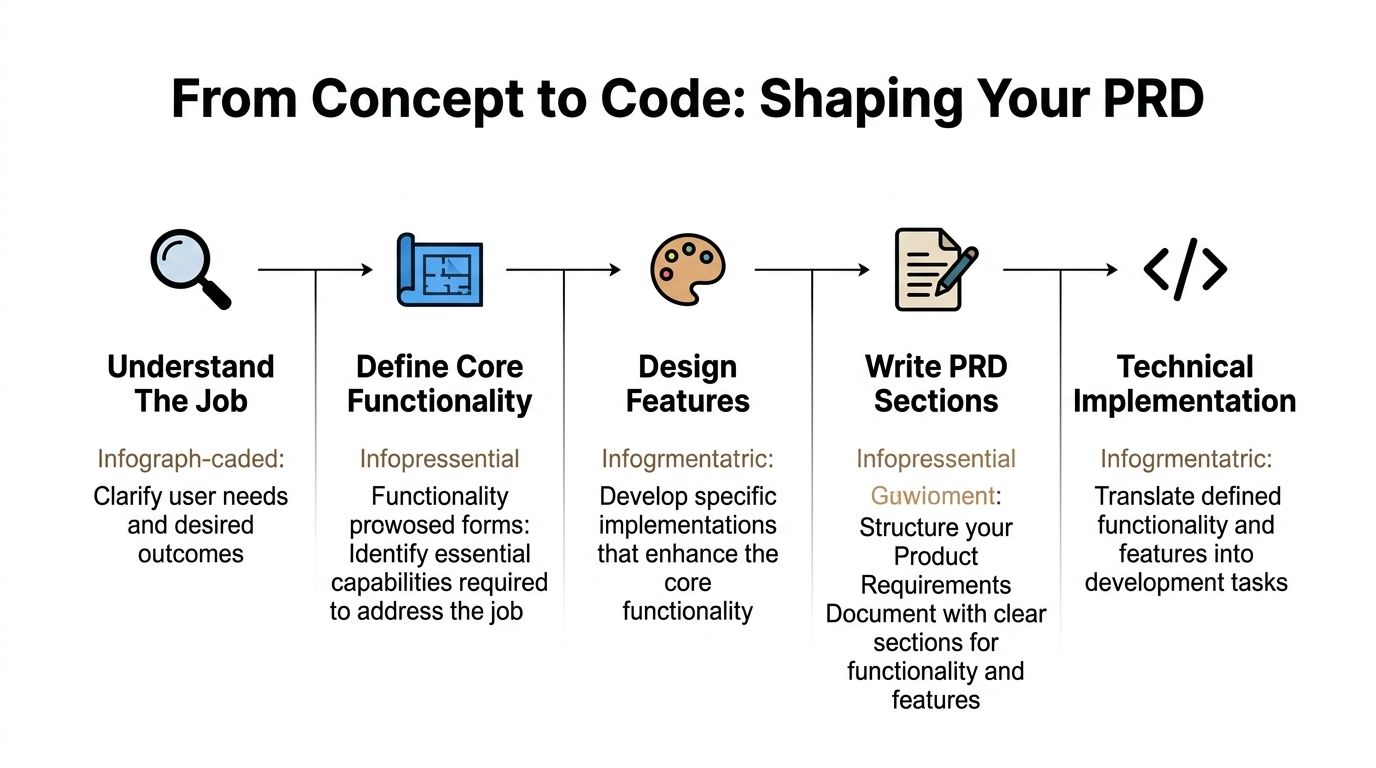
Structure the PRD in layers
Use this order:
- User job
- Core functionality
- Features that deliver it
- Dependencies and constraints
- Success criteria
That sequence keeps the document honest. It stops teams from treating a feature idea as if it's the whole solution.
A simple PRD template
Define the functionality first
Write a short statement like:
- Users need to share work with internal and external stakeholders without losing control over access.
- The product must support reliable sharing and collaboration across different permission levels.
Then define what success looks like in qualitative terms such as fewer workflow blockers, less manual coordination, and smoother handoff behavior.
Nest the features underneath
Under that functionality, list the proposed features:
- Public link sharing
- Email invitation flow
- Role-based access controls
- Commenting on shared assets
Now the team can discuss whether each feature is necessary, sequenced correctly, and supported by the system.
Hiring-manager lens: A strong PRD says why this capability matters before it says what buttons will exist.
Why backlog quality improves
Product terminology research distinguishes a feature as a visible, value-delivering part of the solution and a function as the underlying operation that enables it. The same research highlights a common reality in product work: one user requirement can map to multiple features, and one feature can depend on multiple functions, which is a major reason backlogs become messy and teams lose alignment, as discussed in this product terminology research reference.
That's exactly why many PMs struggle with epic breakdowns. They write one oversized requirement and then create stories that mix user-facing behavior, backend operations, and release scaffolding in the same level of abstraction.
Use a cleaner hierarchy.
A backlog hierarchy that works
- Epic: Enable users to share work securely with others
- Feature story: Generate public shareable link
- Feature story: Invite collaborator by email
- Functional enabler: Permission service validates access role
- Functional enabler: Audit log records share events
This doesn't make the backlog smaller. It makes it legible.
If you want a stronger operating model for this, borrow from good product requirement writing practices and make every feature traceable to a user-facing capability.
Prioritizing Value Over Volume
The most dangerous PM habit is treating shipped volume as proof of impact.
Feature factories look productive from the outside. They launch constantly, publish release notes, and keep every stakeholder temporarily happy. Then the product gets heavier, less coherent, and harder to maintain.
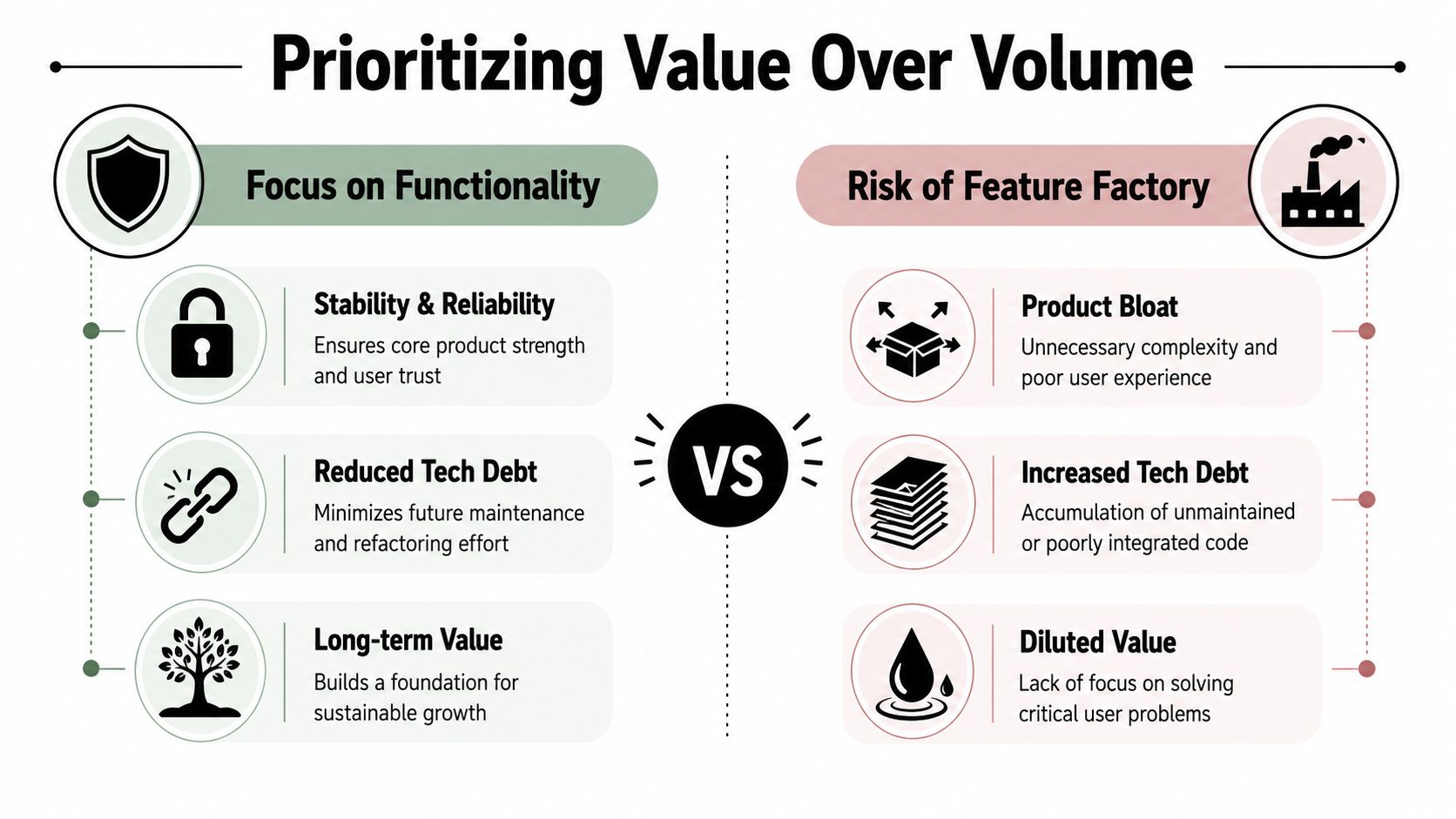
The decision question that matters
Don't ask only, “Should we build this feature?”
Ask, “Is a new feature the best way to improve the user's job, or would improving existing functionality create more value?”
That's a harder question because it forces tradeoffs.
Sometimes the best answer is a new surface. Sometimes it's reliability work, workflow simplification, model tuning, or better defaults. In commercial product planning, high-level feature ideas often break down once teams confront effort, dependencies, and delivery constraints, and guidance from InfoWorks recommends checking whether foundational work, manual workarounds, or deferral is the smarter choice, as outlined in InfoWorks' discussion of feature ideas versus product development reality.
A prioritization checklist
Use this in planning reviews.
- User pain first: Does this solve a painful job that users repeatedly struggle to complete?
- Functional lift: Will this materially improve reliability, speed, usability, or clarity in the core workflow?
- Alternative path: Could better defaults, operational fixes, or process changes solve the problem without a net-new feature?
- Product coherence: Does this make the product easier to understand, or does it create another branch users must learn?
- Delivery reality: What hidden dependencies, support costs, data needs, or model-evaluation work come with this?
- AI quality bar: If this is an AI feature, can the experience be trusted enough in an actual workflow, not just a demo?
When to improve existing functionality instead
Choose depth over breadth when:
- Your core workflow still feels fragile.
- Users can technically complete the task, but the path is slow or error-prone.
- Sales wants parity, but customers mainly care that the main job works better.
- The proposed feature adds another choice without reducing effort.
Google and Meta both know this dynamic. They may launch visible features, but the teams that endure usually invest heavily in ranking quality, latency, reliability, moderation, permissions, and workflow integrity. Users don't always praise those in release notes. They feel them in the product.
The PM who wins trust isn't the one with the longest roadmap. It's the one who can say no to attractive clutter.
A career signal
Executives notice when you protect the product from bloat.
That's not just taste. It's business judgment. If you can connect roadmap choices to clear business value, you become the PM people trust with larger surfaces, riskier bets, and eventually org-level strategy.
Winning Your Next PM Interview
This concept shows up constantly in interviews, even when nobody says “functionality vs feature” out loud.
When an interviewer asks, “How would you improve this product?” they're testing whether you begin with user problems or jump straight to a list of ideas. Strong candidates start with the functionality that needs improvement, then propose features in service of that goal.
Better ways to answer
For a product sense question, say something like:
“I'd start by identifying the core user job. If we're looking at Gmail, the functionality I'd focus on is helping users manage high-volume communication with less effort. From there, I'd evaluate which features most improve that workflow, such as better summarization, prioritization, or drafting support, instead of adding AI just because it's trendy.”
For a project walkthrough, use this flow:
- State the user problem
- Define the functionality you improved
- Explain the features you shipped
- Describe the tradeoffs you made
- Close with what you learned
That structure signals strategy, execution, and judgment.
What interviewers want to hear
They want evidence that you can:
- Distinguish the customer need from the implementation
- Avoid feature dumping
- Think clearly about tradeoffs
- Scope work at the right level
- Prioritize in a way that protects product quality
If you're interviewing for AI PM roles, this becomes even more important. Anyone can suggest “add a copilot.” Better candidates explain what core workflow improves, what quality bar matters, and why the feature belongs in the experience at all.
That's what separates a PM who manages delivery from a PM who shapes products.
Aakash Gupta publishes some of the most useful product management writing on the internet for PMs who want sharper judgment, better execution, and faster career growth. If this topic matters to your day job, explore Aakash Gupta for practical frameworks, hiring insights, and PM training that reflects how strong product teams operate.
