A product ships on time. The demo is clean. The team solved hard technical problems. Sales gets trained, marketing launches the page, and then nothing meaningful happens. A few polite customer calls. Some trial signups. A lot of internal explanations about why the market “doesn't get it yet.”
Most of the time, the market got it just fine. The team never gave buyers a clear reason to care.
That's what product positioning fixes. Not as a branding exercise. Not as a launch deliverable. As the discipline that connects the product you built to the buyer who should want it, the problem they feel, and the alternatives they're already using.
If you're a PM, this is your job. If you can't explain why your product wins, against whom, for which customer, and with what proof, you're not leading a product. You're managing output.
Introduction Why Great Products Fail
A launch can look healthy from inside the company and still fail the moment it hits the market. Engineering shipped. The UI looks polished. Sales got the deck. Early demos sound promising. Then buyers hesitate because they cannot tell, in plain terms, why this product exists, who it is for, or why they should switch from the tools and habits they already trust.
That failure usually starts before launch.
I've seen teams build capable products with flexible workflows, strong permissions, and thoughtful automation, then position them so broadly that buyers lump them in with spreadsheets, Notion, Airtable, Jira, or an internal process held together with Slack and grit. Often, the competitor is an existing process, not a vendor. If the team cannot define the specific customer, problem, and switching trigger, the product shows up as another interchangeable option.
This is one reason strong PMs outperform average ones. They do more than ship features. They shape how the market interprets the product. That judgment affects adoption, pricing power, sales efficiency, and credibility with executives. It matters even more with AI products, where buyers are still trying to separate novelty from business value.
Product discovery and positioning solve different problems. Discovery helps teams decide what to build. Positioning decides how customers should understand it, compare it, and justify buying it. If your team is still working through discovery, Aakash Gupta's article on what product discovery looks like in practice is a useful companion.
Great products fail when buyers can't place them quickly, compare them confidently, or justify switching.
When PMs ask, “What is product positioning?” the useful answer is not a marketing textbook definition. Product positioning is the discipline of deciding what your product means in the market for a specific customer, against specific alternatives, with evidence that makes the choice credible.
Get that wrong and quality does not save you. It just gives you a well-built product that buyers struggle to value.
Positioning Is a PM Superpower Not a Marketing Task
A team ships on time, the demo lands well, and early users say the product is polished. Then the pipeline stalls. Sales calls drift into long explanations. Prospects ask whether it replaces an existing tool, sits beside it, or solves a lower-priority problem. Engineering thinks the issue is awareness. Marketing thinks the issue is messaging. A strong PM recognizes the actual issue faster. The market does not know how to place the product.
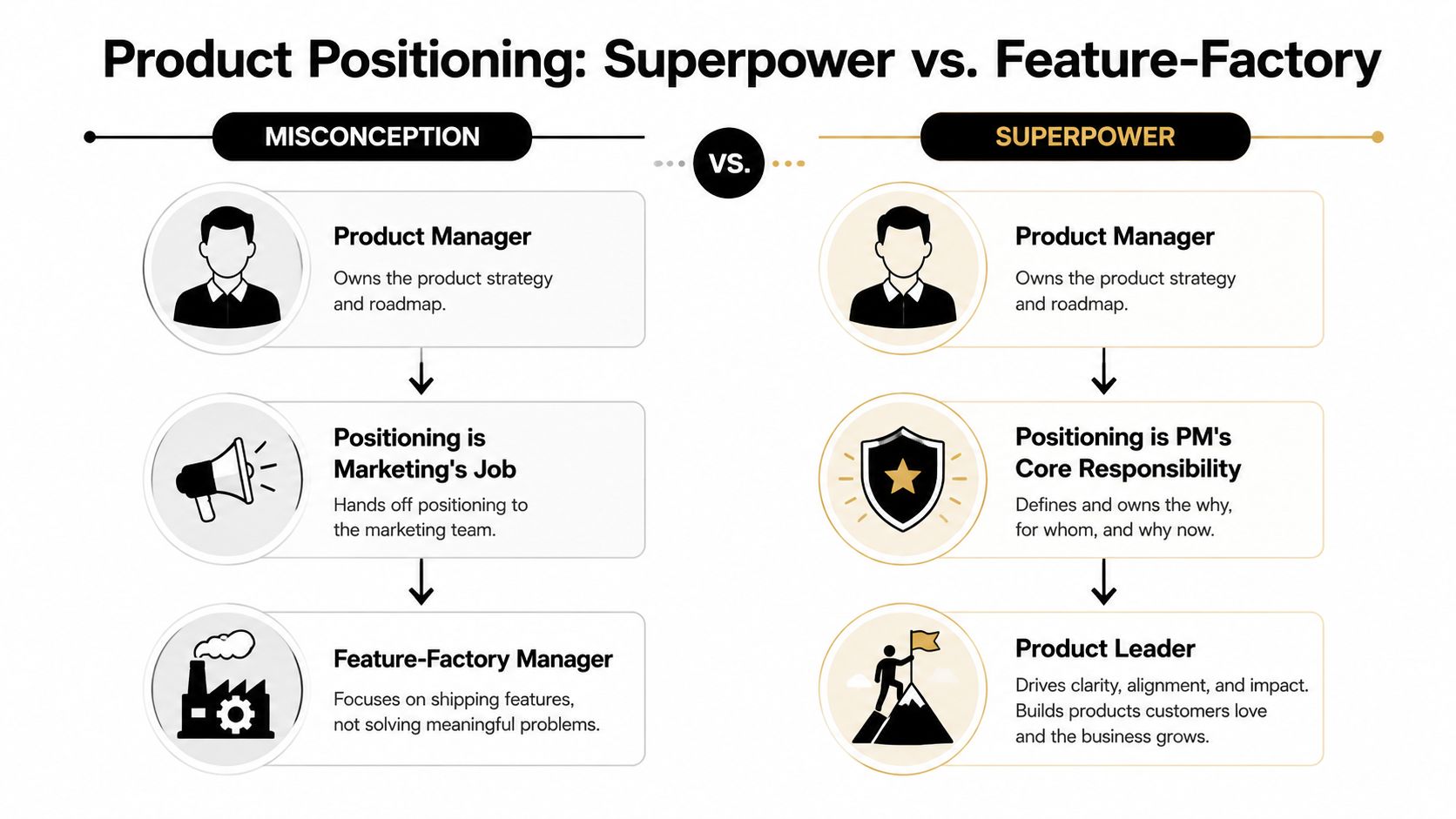
Many PMs hurt their careers by treating that problem as someone else's job. They assume product builds, marketing writes the message, and sales carries it into the field.
That handoff breaks down fast.
Positioning drives product decisions
Positioning changes the product long before it changes the homepage copy.
If the product is for finance leaders who need audit-ready reporting fast, the roadmap should favor permissions, approvals, traceability, and implementation support. If the product is for startup operators who need flexibility, the same team should probably invest in customization, integrations, and speed of setup. Both directions can be rational. Trying to do both at once usually produces a muddy product and a weak story.
That is why PMs need to own positioning. It sets the bar for what earns engineering time, what gets cut, and what quality means for the customer you want.
A simple framework helps because it forces explicit choices: who the product is for, what category it belongs in, what value it delivers, what proof makes that value credible, and which alternatives it must beat. PMs shape every one of those choices through customer research, packaging, pricing, and prioritization. Marketing helps express the position. Product leadership has to define it first.
What weak PMs do and what strong PMs do
This is the pattern I look for when I coach PMs.
| Behavior | Feature-factory PM | Product leader |
|---|---|---|
| Audience | Describes “users” broadly | Names the specific buyer and high-fit segment |
| Competition | Lists direct competitors only | Includes status quo and adjacent alternatives |
| Roadmap logic | Prioritizes loud requests | Prioritizes what strengthens the market position |
| Launch readiness | Ships when features are done | Ships when the value story is clear and testable |
| Stakeholder alignment | Reacts to opinions | Uses positioning to anchor decisions |
The strongest PMs use positioning to make hard trade-offs visible. They do not reject a request only because capacity is limited. They reject it because it weakens the product's claim in the market, confuses the buyer, or pulls the team toward a segment they cannot serve well.
Practical rule: If a feature helps many customers a little but does not help your best-fit segment a lot, it usually weakens positioning.
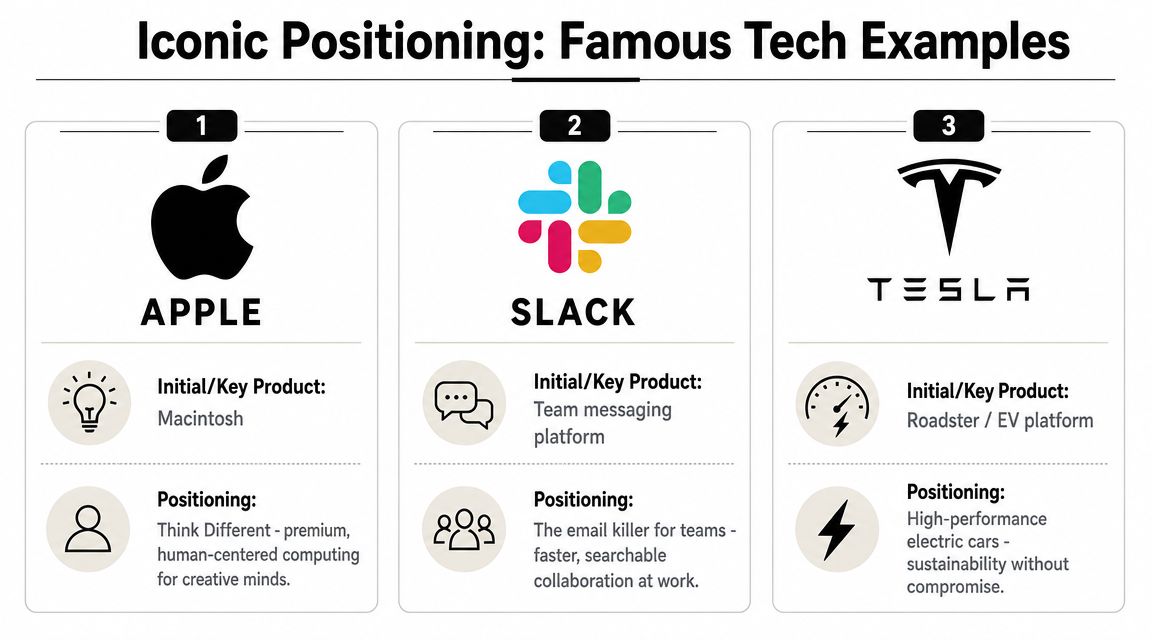
You can see this in top tech companies. Slack did not win by pitching itself as generic business software. It was positioned around faster, more transparent team communication than email. Zoom did not lead with a long collaboration suite story. It earned adoption with reliable video meetings that worked. Stripe focused on developers who wanted to start accepting payments without a painful enterprise integration cycle. In each case, the position narrowed the roadmap before it expanded the market.
AI products make this harder. Teams can demo a capability in minutes, but buyers still need a reason to trust it, budget for it, and change behavior around it. A PM who cannot position an AI product ends up shipping novelty. A PM who can position it ties the model to a business outcome, a workflow, and a buyer who can defend the purchase internally.
Positioning makes cross-functional leadership visible
This is one of the clearest career separators in product management.
Senior PMs can run execution well. Product leaders create alignment across engineering, design, sales, and marketing around a market thesis that holds up under pressure. That is what executives notice. It is also what turns roadmap discussions from feature debates into business decisions.
When a PM owns positioning well, the benefits show up across the company:
- Roadmap debates get sharper: Teams discuss strategic fit instead of personal preference.
- Sales enablement improves: Reps know which deals match the product and which ones waste time.
- Pricing gets more coherent: Packaging reflects perceived value and buyer intent.
- Team confidence improves: People understand what the product is trying to win and why.
The boundary between product management and product marketing is real, but it is not a clean handoff. This breakdown of product marketing and product management responsibilities explains the overlap well. PMs do not need to own every launch asset. They do need to own the core decision about how the product should be understood.
Positioning is one of the few PM skills that affects adoption, sales efficiency, pricing power, and executive trust at the same time. That is why it shapes product outcomes, and why it shapes careers.
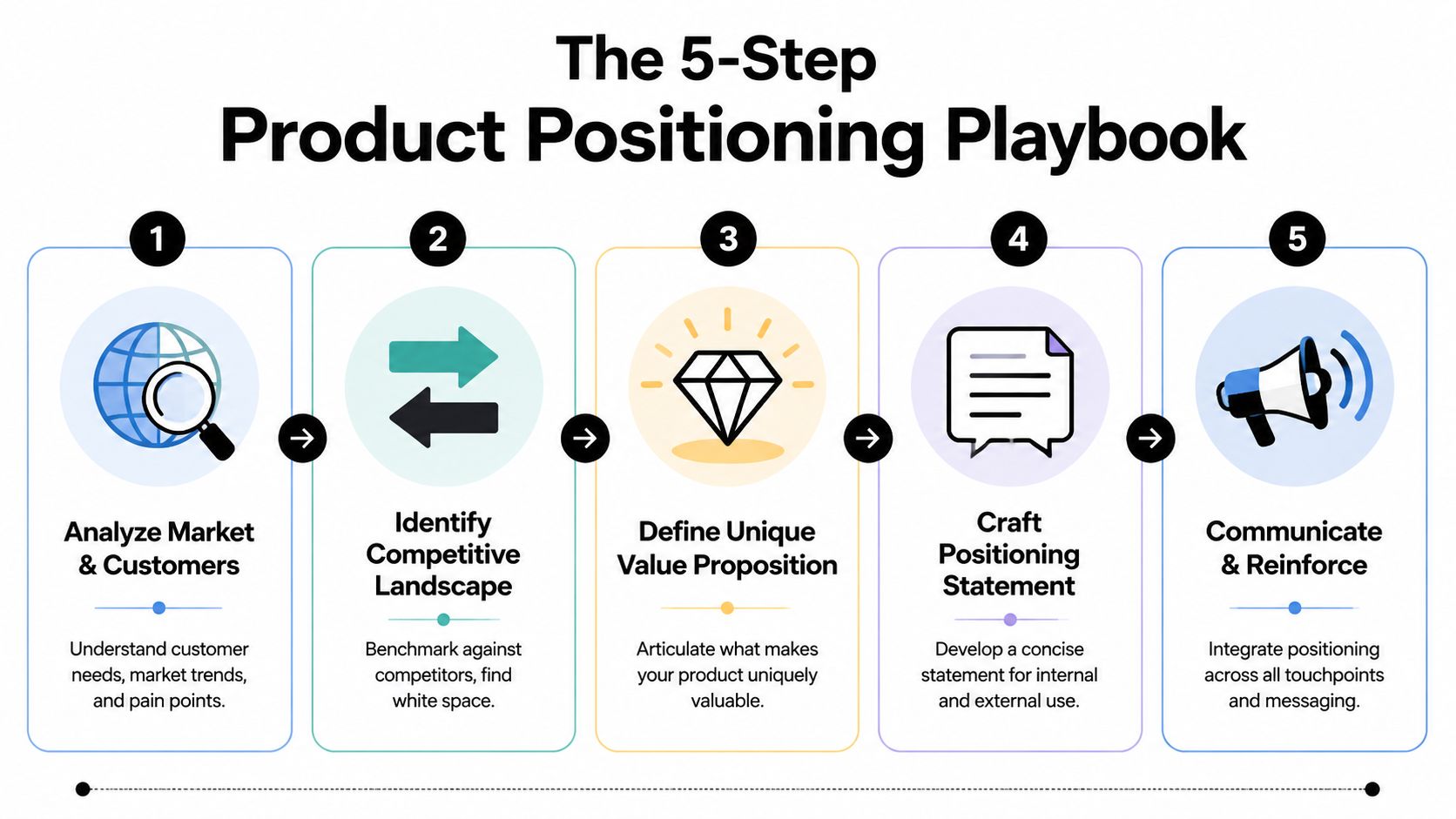
The 5 Step Positioning Playbook for Product Managers
A team ships on time, the demo looks strong, and early users say the product is impressive. Then the pipeline stalls because prospects do not understand who it is for, what problem it solves first, or why it deserves budget over the current workaround. I have seen this happen with good products far more often than with bad ones.
That is why positioning belongs in a PM playbook. It is not copy polish. It is a leadership discipline that forces hard decisions about customer focus, competitive choice, product trade-offs, and proof. With AI products, that bar gets higher because buyers are skeptical of generic claims and sensitive to risk.
A useful way to run positioning is as a decision process. Delighted's explanation of product positioning frames it as choosing where a product should sit in the market, which alternative it should replace, and which audience will care enough to act.
Step 1 Know the customer with enough precision to exclude people
Broad labels create weak strategy. “SMBs” is a market slice, not a decision-ready customer definition. “Product teams” is still too vague if one segment cares about speed, another cares about governance, and a third will never buy because the workflow is too light.
Start with concrete segmentation inputs you can use in prioritization:
- Who buys: Title, function, company size, industry
- Who uses: Daily user, occasional user, admin
- What problem is active: The pain they already feel
- Why now: Trigger event, deadline, cost, risk, or growth pressure
- Who is not a fit: Segments you will ignore on purpose
In B2B, company size, industry, and operating model often predict buyer behavior better than polished personas. An AI writing assistant for regulated healthcare teams needs a very different position than one for startup marketing teams, even if the core model is similar. The first buyer may care about review controls and auditability. The second may care about speed and output volume.
Good positioning gets sharper when you say no.
Step 2 Map the real competition
Teams regularly narrow the competitor set to products with similar screens and features. Buyers rarely do that. They compare your product against whatever gets the job done with acceptable risk.
The competitive set usually includes:
Direct competitors
Products in the same category solving the same job.Indirect alternatives
Agencies, spreadsheets, internal tools, adjacent platforms, consultants.Status quo
The current process. In many enterprise products, this is the strongest competitor because change itself carries cost.
Run a simple matrix with five columns: alternative, buyer reason to choose it, weakness, switching friction, and your advantage. If you want a practical format, use this competitive analysis framework template for product teams.
This step changes roadmap conversations. Once the team sees that the true alternative is often “keep using Salesforce plus spreadsheets” rather than a flashy startup, the product choices get more disciplined.
Buyers compare your product to the fallback option they trust, not the competitor slide your team put in the deck.
Step 3 Find your differentiated value
Useful is not enough. Buyers pay attention to differences that affect a decision.
A differentiator has to clear three tests:
| Test | Question |
|---|---|
| Important | Does the target customer care enough to switch, expand, or pay more? |
| Distinct | Is it meaningfully different from the available alternatives? |
| Credible | Can the company prove it through product behavior, customer evidence, or implementation reality? |
Many AI products encounter difficulties differentiating themselves. “AI-powered analytics” is not a differentiator. It is category wallpaper. Every vendor says some version of it.
A stronger claim names the workflow change and the buyer outcome. For example: “Compliance teams can review generated outputs inside the approval flow they already use, without exporting work into email and spreadsheets.” That statement gives the buyer something concrete to picture. It also forces the product team to ask whether the product really supports that claim end to end.
Step 4 Translate features into value and proof
Many launches fail this translation step. Teams describe what shipped, but they do not connect it to a business result the buyer cares about or to evidence that makes the claim believable.
Use a simple ladder:
- Feature: What exists in the product
- Capability: What the feature lets the user do
- Value: What outcome improves
- Proof: Why the buyer should believe the claim
For example:
| Layer | Example |
|---|---|
| Feature | Role-based workflow approvals |
| Capability | Multiple stakeholders can review outputs before release |
| Value | Teams reduce operational risk in high-stakes workflows |
| Proof | Customer usage patterns, process fit, product behavior, and implementation examples |
Proof matters more in AI than in many traditional SaaS products. Buyers want to know where a model is reliable, where a human stays in the loop, what data the system uses, and how the output fits existing controls. If the proof is weak, the positioning will sound inflated no matter how polished the words are.
This short explainer is worth watching if you want a quick visual on how teams simplify positioning work before a launch:
Step 5 Write the statement and test it in the field
Write the positioning statement after the hard choices are made, not before.
Use this structure:
For [target customer], [product] is a [market category] that [delivers specific value], unlike [main alternative], because [proof].
A good statement does four things well:
- Uses buyer language: Terms sales hears on actual calls
- Sets the category frame: Familiar enough that the market knows where to place you
- Makes one primary value claim: Strong enough to lead the story
- Includes a reason to believe: Evidence that survives scrutiny
Then test it where confusion appears fast:
- Sales calls
- Landing page headlines
- Demo openers
- Pricing page structure
- Outbound email copy
- Executive reviews
If buyers misunderstand the product in three different places, the issue is not messaging hygiene. The issue is positioning.
A 48 hour positioning sprint
Teams do not always have a quarter to get this right. A focused sprint can produce a useful first version.
Day 1 morning
- Gather PM, product marketing, sales, customer success, and one exec sponsor
- Review recent wins, losses, and no-decisions
- Agree on the buyer and the active problem
Day 1 afternoon
- Map alternatives, including the status quo
- List three to five product strengths
- Rank them by buyer relevance and credibility
Day 2 morning
- Draft value claims and proof points
- Write two positioning statements
- Rewrite the homepage headline and demo opener to match
Day 2 afternoon
- Test with customer-facing teams
- Cut vague claims
- Choose one primary statement and a short list of supporting messages
This process works because it forces PMs to make trade-offs in public. Which buyer matters most. Which problem comes first. Which claims the product can support. That is leadership work, and it is one of the clearest ways a PM shapes product success instead of just shipping features.
Positioning in Action Famous Tech Examples
The best tech companies didn't just build strong products. They framed those products so the market could understand them quickly.
That's the part many PMs miss. A category can exist for years, and the winner still comes from someone who explains the job differently.
Notion positioned against tool sprawl
Notion didn't win by saying it was “a better document editor.” That would've put it in a narrow fight with note apps.
Its practical positioning landed closer to this idea: one flexible workspace for notes, docs, tasks, wikis, and internal knowledge. That matters because the alternative wasn't a single competitor. It was a messy stack of Google Docs, spreadsheets, scattered wikis, and half-maintained project trackers.
That framing did two smart things:
- It expanded the problem space: Buyers weren't shopping for a note tool. They were trying to reduce operational mess.
- It gave flexibility a purpose: Blocks, templates, and databases weren't features to admire. They were the mechanism for consolidating work.
The lesson for PMs is simple. Sometimes your best position comes from replacing a fragmented workflow, not beating a direct rival feature for feature.
Figma positioned collaboration as the product
Figma's move was even sharper. The product mattered, but the market story mattered more. Instead of acting like another design tool, Figma framed browser-based collaboration as core value.
That repositioned the category around who participates in design work.
| Company | Positioning move | Why it worked |
|---|---|---|
| Notion | Replaced a stack of tools | Solved fragmentation, not just note-taking |
| Figma | Made collaboration central | Expanded value beyond designers |
| Slack | Framed messaging as team coordination | Replaced scattered internal communication habits |
The smart part of Figma's strategy wasn't only technical delivery in the browser. It was turning shared visibility into the reason to choose the product. Designers, PMs, engineers, and stakeholders could all work in one place. That created organizational pull, not just individual preference.
If you want more examples of how products build separation in crowded markets, this collection of product differentiation examples is useful.
The strongest positioning often changes the comparison set before the buyer even starts evaluating features.
What PMs should copy from these examples
Top tech companies usually do three things well:
- They position around the job, not the UI: Buyers care about replacing friction.
- They widen the frame selectively: They don't broaden the audience. They broaden the problem.
- They make the differentiator easy to repeat: Great positioning travels through product demos, sales decks, pricing pages, and word of mouth.
That's why these examples matter. They show that what is product positioning in practice isn't a slogan. It's a deliberate choice about what game your product is playing.
The New Frontier Positioning AI Products
AI products are harder to position because the category itself is still moving. In normal software markets, buyers already know the broad shape of the category. They know what CRM, analytics, or project management means. With AI, the buyer is often evaluating the product and the risk model at the same time.
That changes the PM's job.
Atlassian's product positioning discussion points out that for AI products, the category is still being defined. It also notes that enterprise AI adoption is accelerating, with McKinsey's 2024 global survey finding 65% of organizations were using gen AI regularly and 71% were using gen AI in at least one function. That means PMs can't rely on static feature comparisons. Buyers are reassessing expectations quickly, especially around trust and risk.
What buyers actually evaluate in AI products
In AI PM work, feature lists are weak positioning tools. Buyers usually care about a wider set of concerns:
- Trust: Can they rely on the output enough to use it in real work?
- Workflow fit: Does it plug into how the team already operates?
- Control: Can humans review, approve, or constrain the system?
- Risk posture: What happens when the model is wrong?
- Category clarity: Is this a foundational capability, a workflow application, or a thin wrapper?
A lot of AI products fail here. They position themselves as magic. Enterprise buyers buy systems, not magic.
The right frame depends on the AI product type
A foundation model company and an AI workflow application should not position themselves the same way.
| Product type | Better positioning angle |
|---|---|
| Foundation model | Capability, reliability, ecosystem, customization surface |
| Vertical AI application | Workflow improvement, domain fit, reviewability, operational trust |
| AI feature inside SaaS | Faster completion of a known job inside an existing workflow |
The fastest way to lose credibility is to overclaim autonomy when the buyer really needs oversight.
Position AI products against uncertainty less. Position them against a painful existing workflow more.
That's also why implementation matters to positioning more than many teams admit. If you're building in this space and need outside technical help, a practical way to find expert blockchain and AI developers is to look at firms with delivery experience across emerging technologies, especially when workflow integration and production quality matter more than flashy demos.
For PMs building toward AI roles, Aakash Gupta's guide to artificial intelligence product management is a useful resource because it treats AI as a product discipline, not just a model discussion.
The core shift is this. Traditional positioning asks, “Why us instead of the competitor?” AI positioning often starts one layer earlier. “Why this approach is safe, useful, and worth changing behavior for.”
Leverage Positioning to Advance Your PM Career
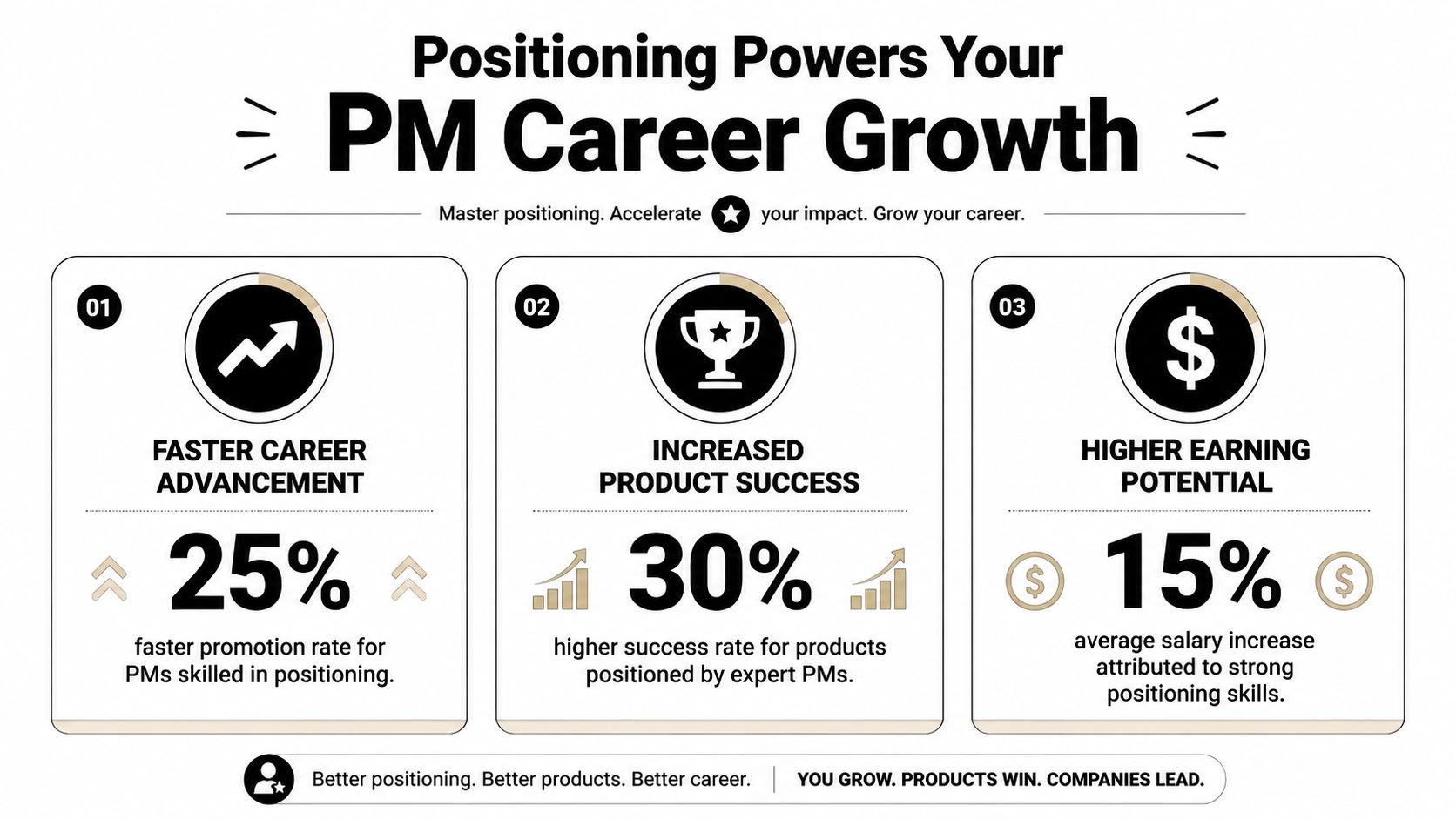
You're in a promotion review. The feature shipped on time, adoption is decent, and leadership asks a simple question: why did this product win with this customer segment, and why will it keep winning? PMs who can answer that clearly get trusted with bigger scope.
Positioning is career capital because it shows judgment. Writing requirements proves execution. Defining the buyer, the problem worth paying to solve, the alternatives in the market, and the value the product can defend proves strategic range. That is the difference between being seen as a delivery PM and being seen as someone who can shape a business.
Use positioning to answer interview questions better
A common PM interview prompt is, “How would you position this product?” Hiring panels ask it because it exposes how you think. Weak candidates jump straight to features or slogans. Strong candidates show a sequence.
A solid response usually covers six points:
- Define the buyer segment
- Name the urgent problem
- Identify the actual alternatives
- State the differentiated value
- Explain proof and pricing logic
- Clarify what you would not position it as
The fifth step is where many candidates lose altitude. Pricing is part of the position. If you claim premium value, the packaging, onboarding model, and proof points need to support that claim. If the product only wins in one narrow workflow, say that. Senior interviewers trust specificity more than broad ambition.
Here's a concise answer shape:
“I'd start with the buyer segment that feels the pain most acutely, usually defined by company size, industry, and current workflow. Then I'd map the status quo and competitive alternatives, identify the value we can prove today, and make sure packaging and price reinforce that value. I'd also be explicit about where I would not compete, so the message stays credible.”
That last point matters even more for AI products. Teams that position an AI feature as a general-purpose assistant often sound inflated. Teams that position it around one expensive, repetitive workflow sound credible.
Turn positioning into portfolio evidence
If you're job hunting, shipped features are not enough. Hiring managers want evidence that you can make hard choices under uncertainty.
Show artifacts such as:
- A one-page positioning memo
- A competitor comparison table
- A target segment definition
- A value proposition rewrite
- A launch brief showing trade-offs
Those materials signal seniority because they reveal how you think, not just what you shipped. They also help in interviews. Instead of saying, “I led the launch,” you can show how you narrowed the target market, rejected weaker messaging angles, and aligned pricing with the customer value story.
If you're packaging that work for interviews, reviewing examples of ATS-optimized product manager resumes can help you present positioning projects clearly in bullet form.
What changes as you become more senior
Positioning responsibility expands with scope.
| Level | Typical scope |
|---|---|
| PM | Delivers product increments |
| Senior PM | Owns a problem area and execution quality |
| Principal or Group PM | Sets strategic direction across products and teams |
At PM level, you usually inherit part of the frame. At senior and principal levels, you are expected to define it. That means choosing which customer to serve first, which market category helps or hurts you, which claims sales can defend, and which opportunities to ignore. Those choices affect roadmap quality, go-to-market efficiency, and team focus. They also affect your reputation inside the company.
I've seen this separate strong PMs from future product leaders many times. The people who rise faster are rarely the ones with the most polished specs. They are the ones who can walk into a messy debate about audience, value, pricing, and competition, then leave the room with a clear position the company can execute against.
Aakash Gupta is a useful follow if you want more exposure to how experienced product leaders talk about growth, strategy, and product judgment. His work is widely read by PMs who want to sharpen their market thinking.
If you want a skill that makes roadmap decisions sharper, stakeholder debates shorter, and interviews stronger, learn to position products well. It pays off before the title catches up.
Common Positioning Mistakes and How to Measure Success
Most positioning problems are self-inflicted. Teams try to sound broad, exciting, and flexible. Buyers hear vague.
Here's the short checklist I use.
Mistakes that weaken positioning
- Trying to serve everyone: Pick the segment that gets the most value now.
- Describing features instead of outcomes: Buyers purchase a better situation, not a longer spec sheet.
- Ignoring the status quo: Your real competitor may be an existing process, not a vendor.
- Making claims without proof: If sales can't support it, remove it.
- Freezing the position too long: Markets change. Revisit positioning when buyer behavior, product maturity, or competitive framing shifts.
Weak positioning creates noisy pipelines. Strong positioning attracts customers who already understand why they should care.
What to measure instead of vanity metrics
Don't evaluate positioning by whether your team likes the new headline. Measure whether the market understands and acts on it.
Track signals like these:
- Lead quality by segment: Are the right customers entering the funnel?
- Win loss themes: Do buyers repeat your intended value in their own words?
- Sales call clarity: Are reps explaining the product consistently?
- Conversion by use case: Which positioning angle produces stronger downstream movement?
- Pricing resistance: Are deals stalling because value and price feel misaligned?
Good positioning should narrow focus, improve message consistency, and make the right deals easier to recognize. If you're using positioning work in your own job search, those same principles apply to how you present yourself. Sharp narratives beat generic competence every time.
If you want more practical PM frameworks like this, Aakash Gupta publishes resources on product strategy, growth, leadership, and career development that are useful for both aspiring and experienced product managers.
